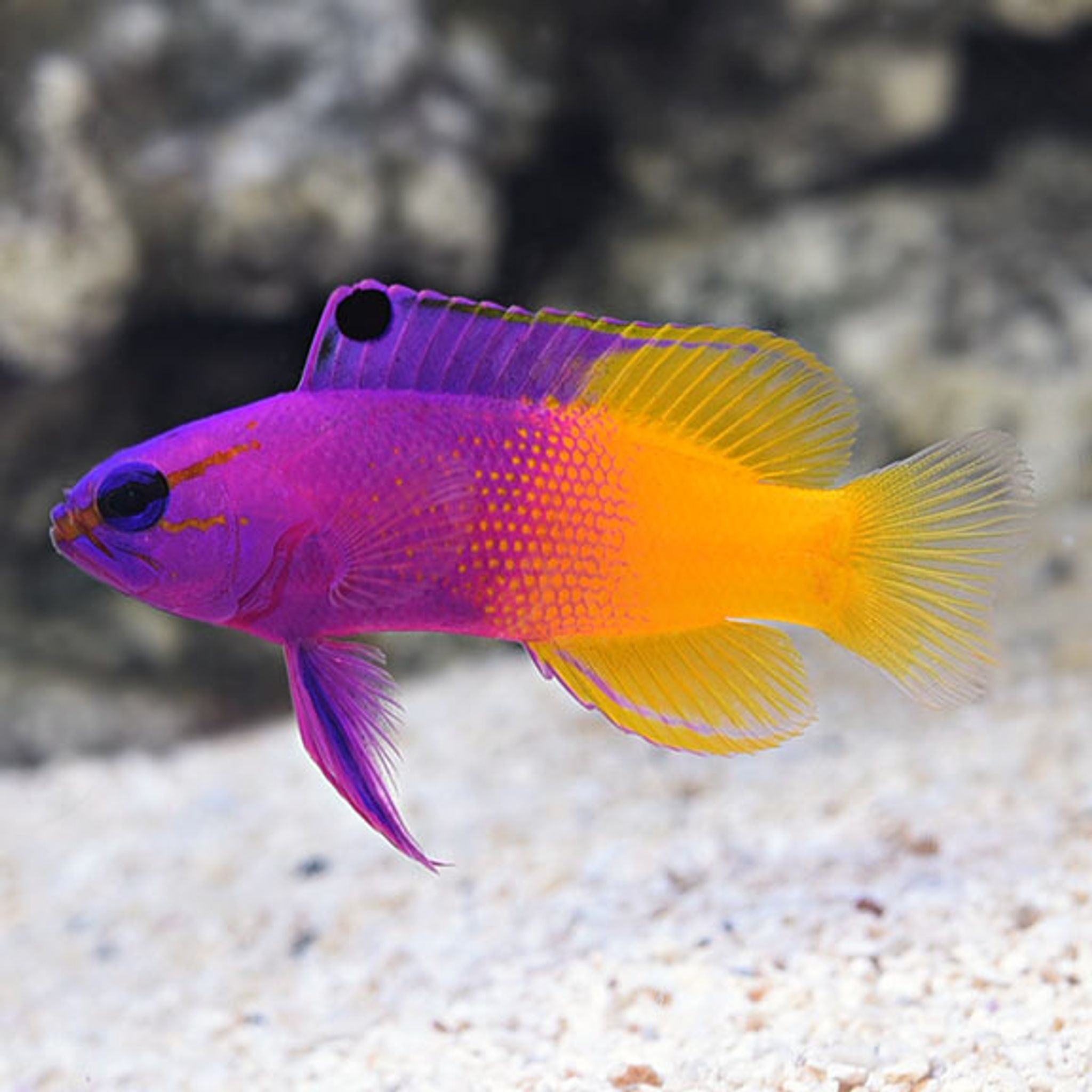
Best Tank Mates for Royal Gramma: Peaceful, Risky and Incompatible Choices
The royal gramma (Gramma loreto) is peaceful toward almost every fish in the tank except one very specific threat: anything that looks like it or wants its cave. This guide sorts tank mates into three practical tiers — peaceful, risky, and incompatible — and explains the setup habits that make the difference.
Royal Gramma at a Glance
The royal gramma, also called the fairy basslet, is a Caribbean basslet known for its two-tone body — purple up front fading to yellow toward the tail. It's a staple beginner marine fish because it's hardy, colorful, and 100% reef safe.
| Trait | Detail |
|---|---|
| Adult size | About 3 in (7.6 cm), occasionally to 4 in (10 cm) |
| Lifespan | 5–6+ years with good care |
| Care level | Easy / beginner-friendly |
| Temperament | Peaceful toward other species, territorial over its cave |
| Diet | Omnivorous planktivore |
| Reef safety | 100% reef safe |
Its defining trait isn't aggression — it's territorialism. A royal gramma claims one cave or ledge as home base and will defend that specific spot fiercely, even while ignoring fish swimming everywhere else in the tank. Understanding that distinction is the key to picking tank mates that work.
Tank Size Requirements
Tank size and rockwork determine how many caves exist, which directly determines how many territorial fish the aquarium can support without conflict.
- 30 gallons (114 L) minimum for a single royal gramma.
- 55–75 gallons (208–284 L) for a confirmed male/female pair, each with a separate cave and a visual barrier of rock between them.
- 100+ gallons (379+ L) for any attempt at a small group or harem, with abundant, well-separated rockwork.
Sources differ on the exact pair-tank minimum, with figures ranging from 50 to 75 gallons. Treat 55–75 gallons as the safe working band, and remember that more rockwork and more physical separation between caves always helps, regardless of the exact gallon count.
Understanding Its Temperament
A royal gramma is shy and spends most of its time hovering near or under its chosen ledge, often swimming upside-down or belly-toward-the-surface underneath overhangs. This posture is completely normal — it mimics the fish's natural deep-reef habitat and is not a sign of a swim bladder problem or illness.
When another fish approaches its cave too closely, the gramma may perform a gape: opening its jaws wide in a shark-like display. This is a warning, not a symptom of disease, and it's a healthy, expected part of establishing territory.
The real diagnostic line to watch is this:
- Normal: chasing an intruder away from the immediate cave area, then returning home.
- A problem: chasing a tank mate across the entire tank, repeatedly, with no return to base.
Tank-wide pursuit means the compatibility mix is wrong — either the intruder looks too similar to the gramma, or the tank doesn't have enough separate territory to go around.
Peaceful Tank Mates (Safe Bets)
These species pair reliably with a royal gramma because they occupy different water-column zones, hold their own separate territory, or are simply too docile to trigger a turf dispute.
- Clownfish – host an anemone or a coral corner and rarely interact with the gramma's cave.
- Gobies and blennies – bottom-dwellers that stay out of the gramma's mid-water territory.
- Firefish and dartfish – peaceful, similarly shy, and occupy open water near the substrate.
- Cardinalfish (Banggai, Pajama) – slow-moving and docile, low conflict potential.
- Peaceful, reef-safe wrasses – generally compatible if introduced with their own hiding spots.
- Hawkfish – perch on rock rather than compete for caves.
- Filefish, jawfish, rabbitfish, squirrelfish, boxfish – each fills a different niche and rarely challenges a gramma directly.
- Most reef-safe angelfish – compatible in a reasonably sized reef community.
- Blue-green chromis – open-water schoolers that ignore cave-dwelling fish entirely.
Shoppers building a mixed reef community around a royal gramma can browse marine fish or start with a proven pairing like clownfish for the first addition.
Reef Invertebrates
Royal grammas leave corals, shrimp, crabs, snails, and other sessile or mobile invertebrates alone. This makes them an easy addition to a mixed reef tank that already houses marine invertebrates such as cleanup crews or ornamental shrimp.
Risky Tank Mates (Context-Dependent)
These pairings can work, but success depends heavily on tank size, introduction order, and how much rockwork is already established — not on the species alone.
- Other peaceful basslets, or fish of similar shape and purple coloring – can trigger mistaken-identity aggression even when the other species isn't naturally aggressive.
- A second royal gramma – only safe as a true confirmed male/female pair in a large tank with abundant, separated rockwork; two unrelated grammas in a small tank will fight.
- Boisterous but not outright aggressive fish (some tangs, some angelfish) – these can out-compete a gramma for food or territory, but only if added before the gramma has settled in.
- Adding the gramma into a tank with no established caves – without a claimed territory, even mild-mannered tank mates can leave it perpetually stressed and hidden.
Rather than labeling an entire species as "safe" or "risky," it's more accurate to say compatibility hinges on introduction order and cave availability. A moderately assertive tang added after the gramma has claimed a cave for weeks behaves very differently than the same fish dropped in on day one.
Incompatible Tank Mates (Don't Even Try)
- Royal dottyback – the near-universal verdict across reef keepers is never mix these two. The dottyback looks similar in color but is significantly more aggressive and will harass or kill a royal gramma.
- Large or aggressive species – big wrasses, puffers, triggerfish, aggressive angelfish, and groupers will bully or injure a fish this small and passive.
- Predatory fish large enough to eat it – lionfish, eels, snappers, and larger groupers pose an outright predation risk, not just a compatibility problem.
If you're shopping and see dottybacks listed alongside basslets, keep them in separate tanks — the resemblance is exactly what makes this pairing dangerous.
Four Compatibility Rules of Thumb
- Never pair with anything visually similar. Bright purple, similarly-shaped fish read as rivals, not neighbors.
- Match temperament, not just size. A small but pushy fish can stress a gramma more than a larger, calmer one.
- Give the gramma first claim on a cave before adding more boisterous fish to the tank.
- Stock different water-column zones — bottom, mid-water, and open water — to reduce turf overlap between species.
The Introduction Order Decision Tree
Most compatibility guides treat this as a flat species list, but introduction order is often the deciding factor:
- Add the royal gramma first, once rockwork with multiple caves is already in place. It claims a territory early and settles in with less competition for food.
- Add boisterous fish (tangs, some angelfish) after the gramma has established itself for at least a few weeks. Adding them first lets them dominate the best real estate before the gramma even has a chance to claim a cave.
- Add a second basslet-type fish only if it's a confirmed mate and the tank has a completely separate cave system on the far side of the rockwork.
If you're upgrading an established solo royal gramma from a smaller tank into a new, larger reef build, move the fish only after the new tank has cycled and its rockwork is in place — not into a bare tank. Acclimate slowly via drip, and offer at least one immediately available cave on arrival so it doesn't spend its first days exposed and stressed.
Setting Up a Reef Tank for a Royal Gramma
Territory has to exist before the fish that wants it arrives. Build the habitat first:
- Stack live rock into multiple caves, ledges, and overhangs at varied heights, leaving low-to-moderate, indirect flow around them.
- Mix saltwater to roughly 1.025 specific gravity and rinse live rock before placing it.
- Stabilize temperature and lighting, then test water parameters weekly for several weeks.
- Let the tank run at least two extra weeks after adding live rock and coral before introducing any fish, so biological and chemical parameters settle and real, ready-to-claim territory is waiting.
Dimmer, indirect lighting suits a royal gramma well since it mimics the deeper reef ledges it inhabits in the wild.
Saltwater Aquarium Setup Basics
For anyone building the tank from scratch rather than adding a gramma to an existing system:
- Plan your full stocking list before buying equipment, so tank size and filtration match the eventual fish load.
- Use RO/DI water with a quality salt mix rather than tap water.
- Cycle the tank for 6–8 weeks until ammonia and nitrite both read 0 ppm before adding any fish.
- Add substrate and rinse decor before filling the display.
- Verify temperature consistency by placing the heater on one side of the tank and a thermometer on the opposite side.
- Introduce fish gradually, using proper drip acclimation rather than a quick temperature-only adjustment.
Water Parameters and Diet
| Parameter | Target range |
|---|---|
| Temperature | 72–80°F (22–27°C) |
| pH | 8.1–8.4 |
| Specific gravity | 1.020–1.025 |
| dKH | 8–12 |
| Ammonia / nitrite | 0 ppm |
| Nitrate | Low and stable |
Royal grammas are omnivorous planktivores. Offer frozen mysis or brine shrimp, chopped marine shrimp, quality pellets or flakes, and the occasional plankton or bloodworm. Feed once or twice daily, in an amount the fish consumes within 2–3 minutes — more frequent small feedings are fine too, but once or twice daily is a reliable baseline.
A useful long-term health cue: diet variety affects the vibrancy of the purple-to-yellow gradient. A gramma on a monotonous diet often fades in color over months, while varied feeding — rotating shrimp, pellets, and occasional live or frozen plankton — tends to keep the color saturated. Fading color alongside normal behavior is worth a diet review before assuming illness.
Using a Refractometer to Check Salinity
Salinity accuracy matters for every fish in the tank, gramma included, since stable specific gravity keeps both fish and invertebrates from being chronically stressed.
- A refractometer measures salinity through light refraction, reading specific gravity directly.
- Always fully dissolve the salt mix before testing — an undissolved clump gives a falsely low reading in the moment and can spike salinity later as it dissolves.
- Clean the prism after every use to avoid residue affecting the next reading.
- Calibrate the refractometer every few months using RO/DI water, which should read exactly 1.000 — recalibrate if it doesn't.
Common Mistakes to Avoid
- Adding a second royal gramma or a royal dottyback "because they look similar." This is the single most common cause of fatal fights.
- Introducing a new fish without adding hiding spots for it. The newcomer needs its own retreat, or the resident gramma will chase it constantly.
- Misreading normal behavior as illness. Cave-guarding and the jaw-gape display are normal; tank-wide chasing is the actual red flag.
- Mistaking upside-down swimming under ledges for a swim bladder issue. It's natural resting posture for this species.
- Skipping a secure lid. Royal grammas are notorious jumpers, especially when startled or under-stocked with too little cover.
- Testing salinity with undissolved salt or an uncalibrated refractometer. This leads to chronic under- or over-salting that stresses fish and invertebrates alike.
- Adding assertive feeders, tangs, or angelfish before the gramma claims a cave. This traps the gramma in permanent hiding and prevents it from settling.
A Note on Quarantine
Because royal grammas are shy by nature, a bare quarantine tank can be more stressful than the disease it's meant to screen for. Give the QT tank its own mini-cave — a short piece of PVC or a small rock overhang works — so the fish has somewhere to retreat and keeps eating during the isolation period.
Breeding Notes
Royal grammas breed readily in stable captive systems. Males build a nest from algae and rubble, and females lay 5–40 eggs that hatch in 5–7 days. Fry require copepods or rotifers as a first food, graduating to baby brine shrimp as they grow.
Frequently Asked Questions
Can I keep two royal grammas together?
Only as a confirmed male/female pair in a large tank (55–75+ gallons) with separate caves and a visual barrier between them. Two unrelated grammas in a smaller tank will fight.
Are royal grammas reef safe?
Yes. They're safe around corals, shrimp, crabs, snails, and other invertebrates, making them a solid choice for mixed reef community tanks.
Why is my royal gramma hiding all the time?
This is normal, shy behavior, especially in a newly stocked tank. Give it time and adequate rockwork, and check that tank mates aren't crowding the cave it's trying to claim.
Can royal grammas live with clownfish?
Yes — this is one of the most reliable pairings, since clownfish hold their own territory around a host anemone or coral corner and rarely compete with the gramma's cave.
What's the difference between a royal gramma and a royal dottyback, and why does it matter?
The two species have similar purple coloring, but the dottyback is far more aggressive. They should never be housed together, since the dottyback will typically harass or kill the gramma.
What size tank does a royal gramma need?
A single royal gramma needs a minimum of 30 gallons (114 L). Pairs and groups need considerably more space and rockwork.
Do royal grammas jump out of tanks?
Yes, they're known jumpers, particularly when startled or stressed. A tight-fitting or mesh lid is essential.
Will my royal gramma bother my shrimp or snails?
No. It's a planktivore that leaves invertebrates completely alone, making it compatible with cleanup crews and ornamental shrimp.
Ready to plan a royal-gramma-ready community? Browse compatible options in marine fish on FishyHub to round out a reef tank built around peaceful, well-matched tank mates.

