
Best Tank Mates for Queen Angelfish: Peaceful, Risky and Incompatible Choices
A Queen Angelfish (Holacanthus ciliaris) is one of the most striking large marine fish available, but it is also a big, territorial adult waiting to happen. This guide sorts tank mates into three clear tiers — peaceful, risky, and incompatible — so you can build a stocking list before you buy, not after a fight breaks out.
Species Snapshot
Before picking tank mates, it helps to know what you're actually working with.
- Native range: Tropical Western Atlantic and Caribbean reefs
- Max size: Up to 15–18 inches (38–46 cm) in adulthood
- Lifespan: Commonly 15+ years in captivity with good care
- Care level: Advanced
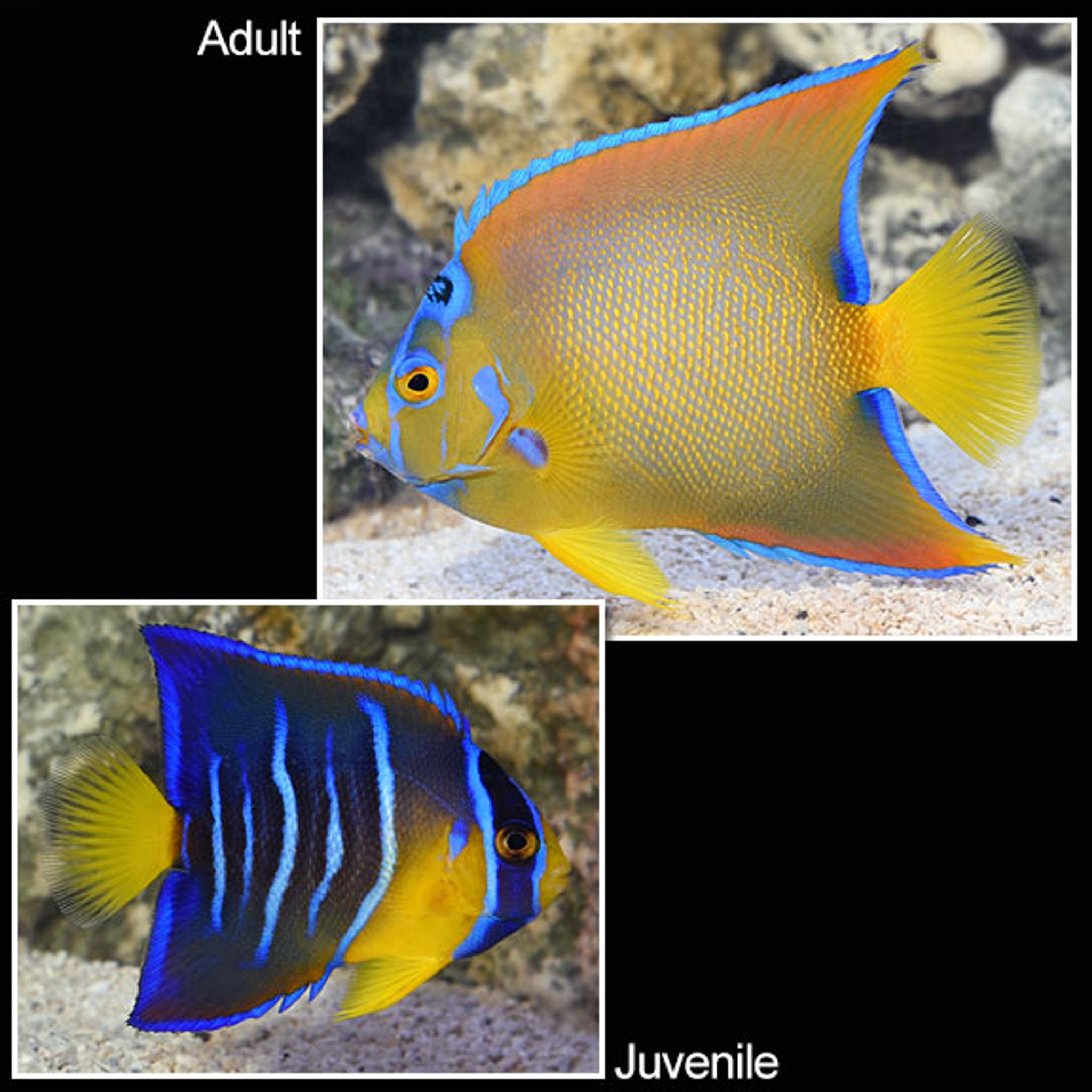
- Appearance: Blue-and-yellow body, a dark "crown" spot ringed in blue on the forehead, and a spade-shaped tail
Juveniles look completely different from adults — dark blue bodies with vertical yellow-white stripes — and are also noticeably more tolerant and less territorial than mature fish. That makes early introduction easier while the angel is still young, since it hasn't yet decided the tank belongs to it.
Tank Size and Setup Requirements
This is not a fish to squeeze into a modest reef tank. Full-grown Queen Angelfish need serious swimming room, and undersized housing is the single biggest driver of the aggression problems people blame on the species.
- Minimum tank size: 180 gallons (680 L) is the absolute floor for a single adult
- Realistic minimum for a mixed community: 220–300+ gallons (830–1,135+ L)
- Footprint matters as much as volume: aim for an 8-foot-plus length and roughly 2 feet of width rather than a tall, narrow tank — length gives tank mates room to retreat and breaks up sightlines
- Water parameters: 72–78°F (22–26°C), specific gravity 1.020–1.025, pH 8.1–8.4
- Filtration: Heavy live rock for grazing and hiding, plus strong filtration and protein skimming — Queen Angelfish are large, messy eaters with a correspondingly heavy bioload
- Layout: Multiple rockwork breaks and open swimming lanes reduce territorial disputes by giving subordinate fish places to disappear from view
A common mistake is buying a tank sized for the angel alone and then adding several other large fish on top of it. Size the system for the full adult community you intend to keep, not just the angelfish.
Is a Queen Angelfish Reef Safe?
No. Queen Angelfish carry real risk for large-polyp stony corals, soft corals, zoanthids, clam mantles, and most other sessile invertebrates. Their natural diet includes sponges and algae, and that grazing instinct doesn't switch off in captivity — it drives nipping at coral tissue and clam mantles.
The best-suited setup is a Fish-Only-With-Live-Rock (FOWLR) system, or a very large mixed reef where the keeper accepts some coral loss as a cost of keeping the fish. Nipping behavior does not reliably fade with age; in many cases it persists or worsens as the fish matures, so don't count on "growing out of it."
The Three-Tier Tank Mate Framework
Instead of a flat list of "compatible species," it's more useful to sort candidates by confidence level, since outcomes depend heavily on tank size, order of introduction, and individual temperament.
Peaceful / Compatible Tank Mates
These are large, boisterous, non-timid fish that can hold their own against a territorial angel:
- Tangs and surgeonfish
- Large wrasses (hogfish-type species, larger Halichoeres and Coris species)
- Groupers
- Non-aggressive to medium triggerfish
- Other large angelfish species that look distinct from the Queen — Emperor, French, Blue, and Gray angelfish
- Damselfish
- Moray eels
- Larger hawkfish
- Clownfish and chromis, used as filler schoolers in a large enough tank
You can browse tangs and surgeonfish and large wrasses as a starting point for building this peaceful tier.
Risky / Case-by-Case Tank Mates
These can work, but outcomes are inconsistent enough that you should treat them as a gamble rather than a plan:
- Other Holacanthus or large angelfish species: some keepers report long-term success, others see persistent fighting. Outcome hinges on tank size, whether fish are introduced simultaneously, and individual temperament.
- Small or medium peaceful community fish, timid gobies, and long-finned fish: these can get picked on once the angel matures, even if they were fine as juveniles.
- Cleaner shrimp: larger, well-established cleaner shrimp are sometimes tolerated, but there's no consistent verdict. Small ornamental shrimp species (peppermint shrimp and similar) are frequently eaten.
If you want to try shrimp, established larger cleaner shrimp are a better bet than smaller ornamental species — but go in expecting it could go either way.
Incompatible / Avoid
Skip these outright rather than hoping for the best:
- A second Queen Angelfish, or a very similar-looking large angelfish in the same tank — near-certain aggression, especially between two similarly sized individuals
- Highly aggressive triggerfish — queen, clown, gray, and blue-lined triggers can outcompete or injure the angel
- Small, slow, or timid fish — small gobies, small blennies, pipefish, seahorses
- Any coral, clam, or sessile invertebrate you want to keep long-term
- Small ornamental shrimp
Compatibility at a Glance
| Tier | Examples | Why |
|---|---|---|
| Peaceful | Tangs, large wrasses, groupers, medium triggers, Emperor/French/Blue/Gray angelfish, damselfish, moray eels, hawkfish, clownfish/chromis | Large or bold enough to hold territory without becoming targets |
| Risky | Other large angelfish, timid gobies, long-finned fish, established cleaner shrimp | Outcome depends on tank size, timing, and individual temperament |
| Incompatible | A second Queen Angelfish, aggressive triggers (queen/clown/gray/blue-lined), small/slow/timid fish, sessile corals and clams, small ornamental shrimp | Near-guaranteed aggression, injury, or predation |
Can You Keep Two Queen Angelfish Together?
Only as a calculated gamble. It's possible in very large systems (300+ gallons) when similarly sized juveniles are introduced at the same time, but even then it's a risk best avoided by less experienced keepers. One Queen Angelfish per tank is the safe default, and mixing two adults or two fish of noticeably different sizes is asking for a serious fight.
Introduction and Acclimation Strategy
Stocking order matters as much as species selection with this fish.
- Quarantine every new arrival. Queen Angelfish are prone to health issues from poor water quality and diet, so introducing disease into an otherwise stable large-fish community is a real risk.
- Add the Queen Angelfish last, after other tank mates are established. Adding it first — or early — lets it claim the tank as its own territory before anyone else gets a chance to settle in, which is one of the most common mistakes keepers make.
- Rearrange the rockwork before adding any new fish, angel included. A reshuffled layout resets everyone's territorial map instead of letting an established resident defend a familiar space against a newcomer.
- Introduce similarly sized, similarly assertive species together where possible, or after the angel if sequencing allows. Avoid dropping a small juvenile into a tank with an already-established adult Queen Angel.
- Watch the first 48–72 hours closely for sustained chasing rather than brief posturing. Persistent, one-sided chasing is your signal to intervene — separate the fish or add more visual breaks in the rockwork.
Feeding to Reduce Nipping
Diet quality is one of the more overlooked tools for keeping a Queen Angelfish from nipping at tank mates and corals. Feed 2–3 or more small meals daily rather than one large feeding, using a varied omnivore diet:
- Marine algae and spirulina
- Nori
- Mysis and other frozen meaty foods
- Quality prepared angelfish foods
- Occasional fresh vegetables
A fish that's underfed — or fed a diet too light on marine algae and sponge-based foods — is more likely to forage on tank mates' slime coats or graze at coral tissue to compensate. Feeding heavily and consistently is a direct, actionable way to reduce that behavior, not just a general health tip.
A Note on Hybrids: The Townsend Angelfish
Where their ranges overlap — the Gulf of Mexico, Florida, the Bahamas, and Bermuda — Queen Angelfish naturally interbreed with the Blue Angelfish (Holacanthus bermudensis), producing a fertile hybrid known as the Townsend Angelfish. This is a species-ID issue worth knowing before you buy: a fish sold as a "Queen" that shows intermediate markings may actually be a Townsend hybrid, which can affect the size, temperament, and compatibility planning you were counting on.
Common Mistakes to Avoid
- Undersizing the tank, then blaming the species for aggression that's really a space problem
- Adding the Queen Angelfish first, letting it claim territory before other fish establish
- Assuming coral nipping fades with age — it can persist or worsen as the fish matures
- Mixing two large, similarly sized angelfish without a backup plan — extra rockwork or the ability to separate them if fighting starts
- Underfeeding, or skimping on marine algae and sponge-based foods, which increases nipping as the fish forages to compensate
- Skipping quarantine, risking disease in an otherwise stable large-fish community
Frequently Asked Questions
Can Queen Angelfish live with other angelfish?
It's usually risky rather than reliably safe. Success is more likely with a different-looking, differently sized large angelfish species — Emperor, French, Blue, or Gray angelfish — in a very large tank. Avoid pairing two Queens, or two similar Holacanthus species, in the same system.
Are Queen Angelfish reef safe?
No. They pose a high risk to coral, clam mantles, and other sessile invertebrates, and this risk doesn't reliably decrease as the fish ages. A Fish-Only-With-Live-Rock setup is the best-suited environment.
What is the minimum tank size for a Queen Angelfish?
Roughly 180 gallons (680 L) is the absolute minimum for a single adult, but 220–300+ gallons (830–1,135+ L) is more realistic for a mixed community. Prioritize a long, wide footprint — 8 feet or more — over pure volume.
Can Queen Angelfish live with clownfish?
Generally yes in a large enough tank, since clownfish are hardy and can hold their own as filler schoolers alongside chromis. They aren't completely immune to occasional bullying, but they tend to tolerate a Queen Angel well overall.
Will a Queen Angelfish eat cleaner shrimp?
Sometimes. Larger, well-established cleaner shrimp have better odds of being left alone, while smaller ornamental shrimp species are commonly eaten. Treat shrimp as a case-by-case risk, not a guaranteed-safe or guaranteed-unsafe choice.
Can two Queen Angelfish be kept together?
Only as a gamble in very large systems (300+ gallons), and only with simultaneous introduction of similarly sized juveniles. It's not recommended for most home aquariums — one Queen Angelfish per tank is the safer default.
What fish should never be housed with a Queen Angelfish?
Small, slow, or timid fish — small gobies, small blennies, pipefish, and seahorses — along with highly aggressive triggerfish species like queen, clown, gray, and blue-lined triggers. Both groups face a high risk of injury or predation.
Do Queen Angelfish hybridize with other angelfish?
Yes. Where their ranges overlap in the Gulf of Mexico, Florida, the Bahamas, and Bermuda, Queen Angelfish naturally interbreed with Blue Angelfish to produce the fertile Townsend Angelfish. It's worth confirming ID before buying, since a hybrid can differ from a pure Queen in size and temperament.
Ready to plan your stocking list? You can browse large marine angelfish and other marine fish on FishyHub to find compatible tank mates for your setup.


