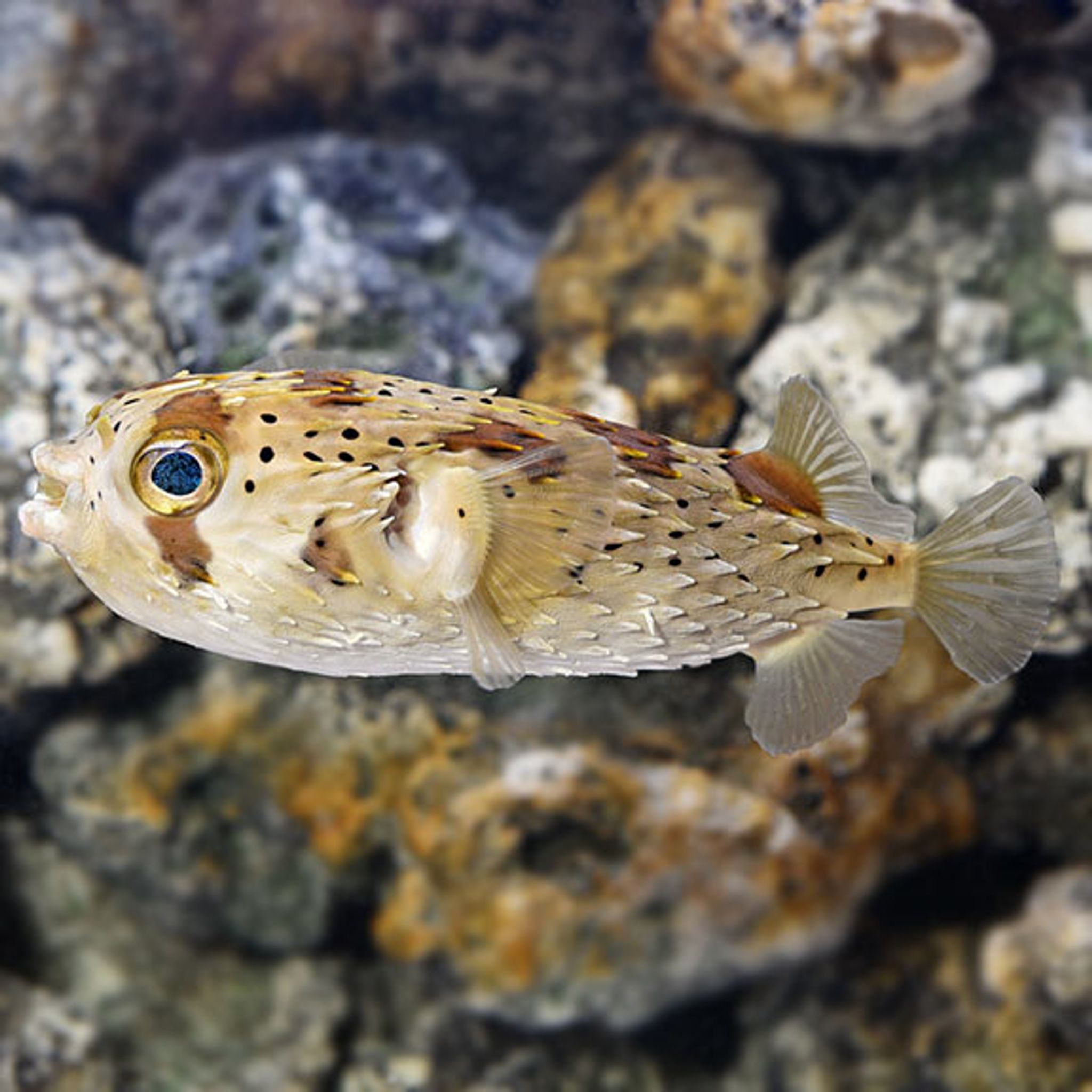

Best Tank Mates for Porcupine Puffer: Peaceful, Risky and Incompatible Choices
Porcupine puffers are large, slow-moving, opportunistic eaters, so the real question for stocking a tank isn't "is this fish aggressive" - it's "can this fish fit in the puffer's mouth." This guide sorts realistic tank mates into three tiers - peaceful, risky, and incompatible - based on the puffer's size, bite force, and non-reef-safe diet, so you can stock a fish-only or FOWLR system with fewer surprises.
Know Your Puffer First
The common name "porcupine puffer" covers two different fish that get sold interchangeably:
- Diodon hystrix (long-spine porcupinefish) - the larger of the two, with wild specimens exceeding 24 inches (61 cm) and captive adults commonly reaching 18-24 inches (46-61 cm).
- Diodon holocanthus (balloon or spiny puffer) - slightly smaller and stockier, typically topping out around 12-18 inches (30-46 cm) in home aquariums.
Both are sold as juveniles under the same generic name, and both will outgrow a "starter" tank fast. That size difference matters for stocking: a tank built around an 18-inch D. holocanthus has a bit more flexibility than one housing a 24-inch D. hystrix, but both need to be planned for their adult size, not their juvenile size at purchase.
Tank Requirements Before You Add Anyone Else
A porcupine puffer is a heavy bioload producer with a big appetite for meaty, shell-heavy food, and that combination shapes everything about compatibility.
- Minimum tank size: 180 gallons (680 L) is the realistic baseline for one adult. Some keepers raise juveniles in 120-150 gallon (450-570 L) systems, but plan to upgrade - don't treat that as a permanent home. Add meaningful extra volume for every additional large tank mate, and prioritize length and open swimming room over raw gallons.
- Water parameters: 74-78°F (23-26°C), pH 8.1-8.4, specific gravity 1.020-1.025 - standard reef-range marine parameters, even though the tank itself won't be reef-safe.
- Filtration and skimming: Oversize your filtration relative to a typical fish-only tank of the same volume. Porcupine puffers are messy eaters that leave shell fragments and uneaten scraps, so strong mechanical filtration and a properly sized protein skimmer matter more here than turnover rate alone.
- Aquascape: Keep decor relatively open with minimal sharp edges. The rockwork doesn't need to protect the puffer - its spines and toughened skin handle that - but open sightlines and a few visual breaks reduce territorial standoffs once tank mates are added, and softer decor reduces stress-related fin or spine snags for other fish darting around a large tank.
Peaceful and Good Tank Mates
These pairings show up consistently across experienced keepers because the other fish is either too large to be viewed as food, too armored to bother, or occupies a different part of the tank.
- Large tangs and surgeonfish - yellow tang, blue hippo tang, sailfin tang, naso tang. Fast swimmers, mostly herbivorous, and large enough by adulthood to be ignored.
- Large or adult wrasses - harlequin, dragon, and Hoeven's wrasse are commonly cited as workable once sized appropriately.
- Foxface rabbitfish - slow but well-defended by venomous dorsal spines, which discourages nipping or predation attempts.
- Large angelfish - species that aren't themselves highly aggressive tend to coexist well once both fish are adult-sized.
- Appropriately sized groupers - similar logic to angelfish: size parity removes the puffer's motivation to test them.
- Snowflake and chain-link moray eels - a genuinely strong pairing. Eels occupy a different feeding niche and tank zone, share a similar crustacean-based diet, and their thick, tough skin discourages the puffer from any exploratory nipping.
Quick Compatibility Table
| Tank Mate | Tier | Why |
|---|---|---|
| Large tangs (yellow, hippo, sailfin, naso) | Peaceful | Fast, herbivorous, too large to target |
| Adult wrasses (harlequin, dragon, Hoeven's) | Peaceful | Size parity, active swimmers |
| Foxface rabbitfish | Peaceful | Venomous spines deter predation |
| Snowflake/chain moray eels | Peaceful | Different niche, similar diet, armored skin |
| Lionfish | Risky | Fine if sizes match and puffer isn't a fin-nipper |
| Mellow triggerfish (Niger, bluethroat) | Risky | Species- and individual-dependent |
| Second puffer or boxfish | Risky | Needs a very large tank; territorial risk |
| Damsels/clownfish | Risky | Often ignored, but not guaranteed |
| Small gobies, blennies, chromis | Incompatible | Small enough to be swallowed |
| Cleaner shrimp, hermit crabs, snails | Incompatible | Eaten almost every time |
| Seahorses, pipefish | Incompatible | Too slow, easily caught or stressed |
| Aggressive triggers (Picasso, undulate) | Incompatible | Can shred puffer fins and skin |
Risky and Situational Tank Mates
These pairings can work, but they depend on individual temperament, careful size matching, and close monitoring rather than being a safe default.
- Lionfish - Generally compatible when sizes match, since a puffer isn't built to hunt a lionfish and lionfish rarely provoke a puffer directly. The variable is the individual puffer: some are prone to nipping fins out of curiosity. Watch lionfish spines and fin margins closely during the first few weeks after introduction.
- A second puffer or a boxfish - Can work in very large systems, but same-species or similarly shaped pairings raise the odds of territorial fighting, especially in anything under roughly 250-300 gallons (950-1,135 L).
- Triggerfish - The most polarizing pairing on this list. Milder species such as Niger or bluethroat triggers have better odds of coexisting peacefully, while more assertive species like Picasso or undulate triggers are a common source of torn puffer fins. Treat any trigger pairing as species- and individual-dependent, never a guaranteed-safe pick, and lean toward it only if you're comfortable managing a conflict if one develops.
- Damsels and clownfish - Their speed and small size mean a puffer often ignores them entirely, but "often" isn't "always." Their nipping behavior can also stress a puffer into inflating defensively or going off food, so treat this as a situational choice rather than a safe one.
Incompatible Tank Mates to Avoid
The unifying rule here isn't temperament - it's size and vulnerability. A porcupine puffer views anything small enough to swallow as food, regardless of how peaceful or feisty that species normally behaves.
- Small reef fish - gobies, small blennies, chromis, and small clownfish are all easy targets.
- Ornamental invertebrates - cleaner shrimp, hermit crabs, and snails are eaten almost without exception. This is the single most common mistake new keepers make, expecting cleanup crew animals to survive alongside a molluscivore that's specifically built to crush shells.
- Slow, delicate fish - seahorses and pipefish get eaten or stressed to the point of decline; they simply can't out-swim or out-maneuver a determined puffer.
- Aggressive fin-nippers - certain damsels and the more assertive triggerfish species can shred a puffer's fins, leading to secondary infection and a stressed fish that stops eating.
- Other puffers or boxy, spiny species in small tanks - territorial fights are common below roughly 250-300 gallons.
Temperament and Natural Behavior
Porcupine puffers are semi-aggressive and territorial once settled, but they're not fast predators - they're opportunistic ones. They're slow, deliberate swimmers with a curious, investigative streak that leads them to nose around tank mates rather than chase them down. Many are nocturnal or crepuscular, becoming more active around dawn and dusk. Their signature inflation response is a defense mechanism, not a display of aggression, and repeated stress-inflation should be read as a warning sign, not routine behavior.
Their beak - a fused, ever-growing dental plate - needs regular wear from hard-shelled foods. Without that wear, beak overgrowth can impair feeding, which indirectly increases a puffer's interest in tank mates as alternative food sources.
Diet and Reef Compatibility
Porcupine puffers are strict carnivores and molluscivores. A proper diet includes shellfish, crustaceans, chopped seafood, and mysis, with hard-shelled foods - clams, crab legs, mussels - offered multiple times a week specifically to wear down the beak. This diet is exactly why ornamental shrimp, crabs, and snails are at risk in a mixed tank.
For the same reason, porcupine puffers are not reef safe. They will eat or crush most invertebrates and can nip coral polyps purely out of curiosity, even when they're not actively hunting. A few generalist puffer-care sources hedge that certain puffers can be kept in reef systems with very careful stocking, but for porcupine puffers specifically, the stronger and more common consensus is to keep them in FOWLR or fish-only systems. If you're building your stock list, browse marine fish suited to a fish-only setup rather than planning around live coral.
Stocking Order and Feeding Management
How you introduce tank mates matters almost as much as which species you choose.
- Add the puffer last, or alongside similarly sized new arrivals. Introducing a puffer to an already-established tank of large fish reduces its tendency to claim the entire tank as its own territory.
- Use a divider or acclimation box for a cautious, gradual introduction rather than releasing everyone together on day one.
- Feed the puffer separately, or feed generously enough that it isn't motivated to hunt tank mates for extra calories. Underfed puffers are more likely to sample their neighbors.
- Watch for early warning signs during the first few weeks with any risky-tier pairing: nipped fin edges, a tank mate hiding constantly, or a puffer that repeatedly inflates near a specific fish. Torn fins on a puffer or a tank mate usually heal over one to two weeks in clean water, but repeated damage or any sign of secondary infection (white fuzzy patches, reddened tissue) is a cue to separate the fish rather than wait it out.
Quarantine and Health Considerations
Quarantine new puffers and new tank mates for 2-4 weeks before introduction. Porcupine puffers are prone to marine ich and flukes, and - because they lack scales - they're notably sensitive to copper-based medications, which limits your treatment options once they're in a mixed display. This makes quarantine more valuable here than in a typical marine tank: treating parasites in a puffer-plus-tankmates system without copper is far easier to manage in a separate quarantine tank than in the display itself.
Sexing and breeding aren't practical considerations for most keepers - porcupine puffers aren't reliably sexed or bred in home aquariums, so this has little bearing on tank mate selection.
Common Mistakes to Avoid
- Buying a juvenile for a small tank without planning for its 12-24 inch (30-61 cm) adult size and 180-gallon endpoint, which often leads to forced rehoming.
- Assuming "semi-aggressive" means the puffer will bully everything, when in practice it's more predatory toward small fish than combative toward same-sized ones.
- Adding cleanup-crew shrimp, crabs, or snails expecting them to survive.
- Housing a puffer with fast, established fin-nippers before it has settled in.
- Skipping hard, shelled foods, which leads to beak overgrowth and indirectly raises predation risk toward tank mates.
- Using copper medication in a mixed tank with the puffer present.
Frequently Asked Questions
Can porcupine puffers live with other puffers?
Only in very large tanks - generally 250-300 gallons or more - with careful monitoring. In smaller setups, territorial aggression between two puffers is common, so pairing is discouraged for most home aquariums.
Will a porcupine puffer eat cleaner shrimp?
Yes, almost always. Avoid ornamental shrimp, hermit crabs, and snails entirely, since a puffer's shell-crushing diet makes these animals an easy target rather than a functional cleanup crew.
Is a porcupine puffer reef safe?
No. It will eat or damage most invertebrates and can nip coral polyps out of curiosity, so it belongs in a FOWLR or fish-only system rather than a reef tank.
What is the minimum tank size for tankmates with a porcupine puffer?
180 gallons (680 L) is the baseline for the puffer alone. Add proportional extra volume for each additional large tank mate, and prioritize swimming length and open sightlines over the raw gallon number.
Can porcupine puffers live with clownfish or damsels?
Sometimes - their speed and small size mean a puffer often ignores them, but it's not guaranteed. Choosing fish that are clearly above bite-size removes the risk entirely rather than relying on speed alone.
Do porcupine puffers get along with eels?
Generally, yes. Snowflake and chain moray eels share a similar crustacean-based diet, occupy a different part of the tank, and have tough skin that discourages nipping, making this one of the more reliable pairings available.
If you're planning a FOWLR system around a porcupine puffer, browse marine livestock on FishyHub to compare size, temperament, and stock availability before you finalize your tank mate list.


