
Best Tank Mates for Pom-Pom Crab in a Reef Aquarium
The pom-pom crab is one of the few reef inhabitants where the compatibility question runs backward — it isn't a threat to anything in your tank, but plenty of things are a threat to it. This guide covers exactly which fish, invertebrates, and corals make safe roommates, which ones will eat or bully it, and how to protect the tiny anemones it depends on for both defense and food.
What Is a Pom-Pom Crab?
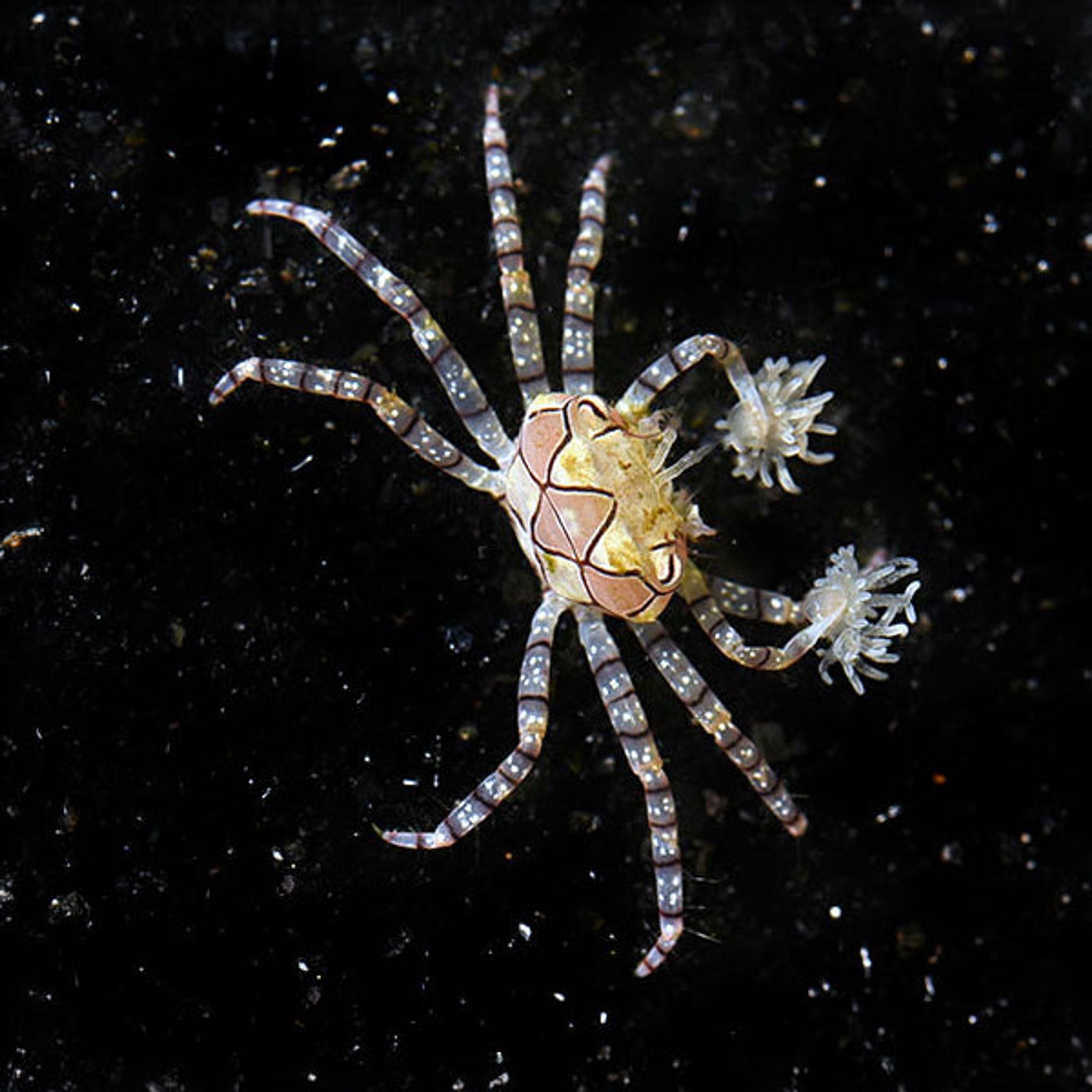
The pom-pom crab (Lybia tessellata), also called the boxer crab, is a tiny reef crustacean with a carapace roughly 0.5–1 inch (1.3–2.5 cm) across. Its signature trait — and the source of both its common names — is that it holds a small anemone (usually Triactis producta, occasionally other species) in each claw, waving them like pom-poms when threatened. This isn't aggression toward tank mates; it's a defensive bluff, and the same waving motion helps sweep food particles toward the anemones' stinging tentacles.
Is a Pom-Pom Crab Reef Safe?
Yes. A pom-pom crab does not eat corals, clams, or fish — it's a scavenger and detritivore that grazes biofilm and algae film off rock and sand, and picks up whatever fine particles its paired anemones catch. It's opportunistic rather than predatory: it eats what comes its way rather than actively hunting, which is exactly why it poses zero risk to the rest of a reef aquarium's inhabitants. Its behavior is genuinely peaceful, not just tolerable.
Ideal Reef Tank Setup for a Pom-Pom Crab
Getting the base setup right matters just as much as picking tank mates, since a stressed or exposed crab is far more vulnerable regardless of who else is in the tank.
- Tank size: Comfortable as the sole notable invertebrate in a nano reef as small as 5–10 gallons, and scales fine into larger established systems.
- Rockwork: Needs plenty of tight crevices and rubble-style rockscape to retreat into. A pile of small, irregular rock with narrow gaps is a better compatibility tool than any stocking choice — it physically limits which predators can reach the crab, regardless of what else lives in the tank.
- Water parameters: Standard reef range — temperature 74–78°F (23–26°C), specific gravity 1.023–1.025, pH 8.1–8.4, alkalinity 8–12 dKH, calcium 380–450 ppm. Sources vary slightly on the exact temperature window, but stability matters far more than hitting one precise number, especially for a crustacean that molts periodically.
- Behavior to expect: Mostly nocturnal and secretive, spending daylight hours tucked in rockwork and emerging to forage when it feels safe.
Best Tank Mates (Fish)
Small, peaceful fish that ignore tiny crustaceans make ideal companions. Good options browsed through FishyHub's marine fish selection include:
- Clownfish — peaceful, reef-safe, and generally indifferent to crabs on the rockwork
- Gobies — small, bottom-oriented, and non-predatory toward crustaceans
- Blennies — algae grazers with no interest in hunting inverts
- Firefish — peaceful water-column fish that stay out of the crab's business
- Non-predatory small wrasses — species that feed on plankton or algae rather than crustaceans (see the avoid list below for the ones to skip)
Best Tank Mates (Inverts & Corals)
Most peaceful reef invertebrates and sessile corals coexist without issue, since none of them compete with or prey on the crab.
- Snails — algae and detritus grazers with no interaction risk
- Peaceful ornamental shrimp — most cleaner and peppermint shrimp are fine in a reasonably sized tank; see the note below on nano-tank crowding
- Small, similarly peaceful hermit crabs — species that don't compete aggressively for shells or territory
- Soft corals, LPS, and zoanthids — anything that doesn't sting or harass a small crustacean crawling across the rock
Tank Mates to Avoid (Predators & Bullies)
This is the list that actually matters for a pom-pom crab's survival. Avoid:
- Crustacean-hunting wrasses, dottybacks, and hawkfish — species built to pick small crabs and shrimp off the rock
- Triggerfish and puffers — powerful jaws that crush small crustaceans without hesitation
- Lionfish, groupers, and other large predatory fish — will simply swallow a crab this size
- Mantis shrimp — a serious threat that can kill a pom-pom crab outright
- Arrow crabs and large, aggressive hermit crabs — these don't necessarily eat the pom-pom crab directly, but they will steal or damage its anemones and outcompete it for food and shelter
- Anemone-nipping fish — some butterflyfish species pick at small anemones and polyps; nipping the pom-pom's anemones removes both its defense mechanism and part of its food-gathering tool, stressing the crab even if it's never touched directly
| Tank mate category | Verdict | Why |
|---|---|---|
| Clownfish, gobies, blennies, firefish | Safe | Peaceful, ignore small crustaceans |
| Cleaner/peppermint shrimp | Generally safe | Monitor in very small nano tanks for space/food competition |
| Snails, peaceful hermits | Safe | No predatory or competitive interest |
| Soft corals, LPS, zoanthids | Safe | No interaction with a crawling crustacean |
| Crustacean-hunting wrasses, dottybacks, hawkfish | Avoid | Actively hunt small crabs |
| Arrow crabs, large hermits | Avoid | Steal or destroy the anemones |
| Triggerfish, puffers, lionfish, groupers | Avoid | Will eat the crab outright |
| Mantis shrimp | Avoid | Can kill the crab |
| Anemone-nipping butterflyfish | Avoid | Damages the crab's defense tool |
A Note on Cleaner and Peppermint Shrimp
This pairing rarely comes up in general compatibility guides, but it's worth a plain answer: cleaner shrimp and peppermint shrimp are generally fine tank mates for a pom-pom crab. In a reasonably sized reef tank they occupy different niches and don't compete directly. In a very small nano tank, though, tighter competition for hiding spots and food particles can lead to occasional squabbling — worth watching rather than avoiding outright.
Feeding the Pom-Pom Crab
In an established reef tank, a pom-pom crab needs no target feeding. It grazes biofilm and algae film off rock and sand, and its paired anemones sting and capture fine food particles that the crab then eats — a passive, ongoing food source that doesn't require any intervention.
That said, sources differ slightly on whether supplemental feeding is ever needed. In a very clean, low-nutrient, or newly established system where biofilm hasn't built up yet, a pinch of finely crushed meaty food (mysis or pellet crumbs) once a week is a reasonable insurance policy — not a requirement, just a buffer. Avoid overfeeding a nano tank in an attempt to specifically target-feed the crab; the water-fouling risk in a small volume outweighs any benefit, since the crab doesn't need it in a healthy system.
Molting Behavior: What's Normal vs. Concerning
Like all crustaceans, a pom-pom crab periodically sheds its exoskeleton to grow. During and immediately after a molt, it typically disappears into rockwork for a day or two while its new shell hardens — this is completely normal, not a sign of illness or death. Resist the urge to search it out or disturb the rockwork; leave water parameters stable and let the process finish undisturbed.
The compatibility angle here is easy to miss: a freshly molted crab with a still-soft shell is far more vulnerable to opportunistic tank mates than usual. If you know a molt is likely due (the crab has looked "full" or sluggish beforehand), it's a poor time to introduce a new predatory or borderline-aggressive fish — wait until the shell has hardened and the crab is back to normal activity.
Keeping Multiple Pom-Pom Crabs Together
Pom-pom crabs can be kept in pairs or small groups given adequate space, multiple hiding spots, and sufficient food. The main friction point is the anemones themselves — crabs can squabble over them, so give each individual its own defined hiding territory rather than clustering the rockwork into one shared crevice.
Their anemone biology is unusual among reef invertebrates: if a crab loses one anemone, it can bisect the remaining one, giving each claw half, which then regrows to full size — a form of clonal propagation. If it loses both anemones, it may fight another pom-pom crab in an attempt to steal one, which is another reason to give each crab its own space when housing more than one.
Buying and Acclimating a Pom-Pom Crab
Pom-pom crabs are wild-collected from Indo-Pacific reef rubble and sold in the marine ornamental trade as a nano-tank novelty invertebrate. They're considered hardy and beginner-friendly once water quality is stable, but because they arrive wild-caught, a few practical steps at purchase go a long way:
- Drip-acclimate slowly rather than a quick float-and-dump, since wild-collected inverts are more sensitive to sudden parameter shifts.
- Inspect the anemones before buying — they should be well-attached to the claws, open, and plump rather than shriveled or loose. A crab with damaged or missing anemones can still recover over time, but it's worth knowing what you're starting with.
Browse available specimens and anemone options among FishyHub's marine invertebrates listings before adding one to your tank.
Common Mistakes to Avoid
- Assuming the claw-waving is aggression. It's a defensive bluff aimed at deterring threats, not an attack on tank mates.
- Panicking during a molt. Days of hiding after a molt is expected recovery time, not death or predation.
- Adding crustacean-eating fish without knowing the risk. Certain wrasses, hawkfish, and dottybacks can pick off a pom-pom crab before you notice anything wrong.
- Introducing aggressive hermits or arrow crabs. These steal or destroy the anemones, leaving the crab defenseless even if it survives.
- Overfeeding a nano tank to "feed" the crab directly. It doesn't need it, and the water-quality cost isn't worth it.
- Mistaking anemone loss for illness. A damaged or reduced anemone is often normal wear that the crab can regenerate, not a health crisis.
- Skimping on hiding crevices. An open aquascape leaves the crab exposed and stressed regardless of which tank mates you choose.
Frequently Asked Questions
Is a pom-pom crab reef safe?
Yes. It doesn't eat corals or fish and feeds entirely on detritus, biofilm, and fine particles caught by its anemones, making it fully compatible with a reef aquascape.
Will a pom-pom crab hurt my fish?
No, it's harmless to fish and every other tank inhabitant. The compatibility concern runs the other direction — protecting the crab from fish and invertebrates that might eat or bully it.
What do pom-pom crabs eat?
Biofilm, algae film, and detritus grazed off rock and sand, plus food particles trapped by its paired anemones. Occasional fine meaty food is optional, not required, in an established tank.
Can I keep more than one pom-pom crab together?
Yes, in a tank with enough space, hiding spots, and food for each individual. They can compete over anemones, so give each crab its own territory to reduce squabbling.
What fish will eat a pom-pom crab?
Crustacean-hunting wrasses, dottybacks, hawkfish, triggerfish, puffers, and other generally predatory fish like lionfish or groupers all pose a real risk to a crab this size.
Why did my pom-pom crab lose its anemones?
Usually either aggression from tank mates like arrow crabs or large hermits stealing them, or the anemone declining from poor water quality or starvation. The crab can regenerate a lost anemone by splitting its remaining one in half.
How big of a tank does a pom-pom crab need?
As small as 5–10 gallons as the sole notable inhabitant, though it does just as well in any larger, established reef system.
Is it normal for my pom-pom crab to disappear for a few days?
Yes — this is almost always a molt in progress. Leave it undisturbed, keep water parameters stable, and it should reappear once its new shell has hardened.
Ready to build out a peaceful nano reef around your pom-pom crab? Explore FishyHub's full range of marine livestock to find compatible fish, corals, and invertebrates suited to a small, crevice-rich reef setup.


