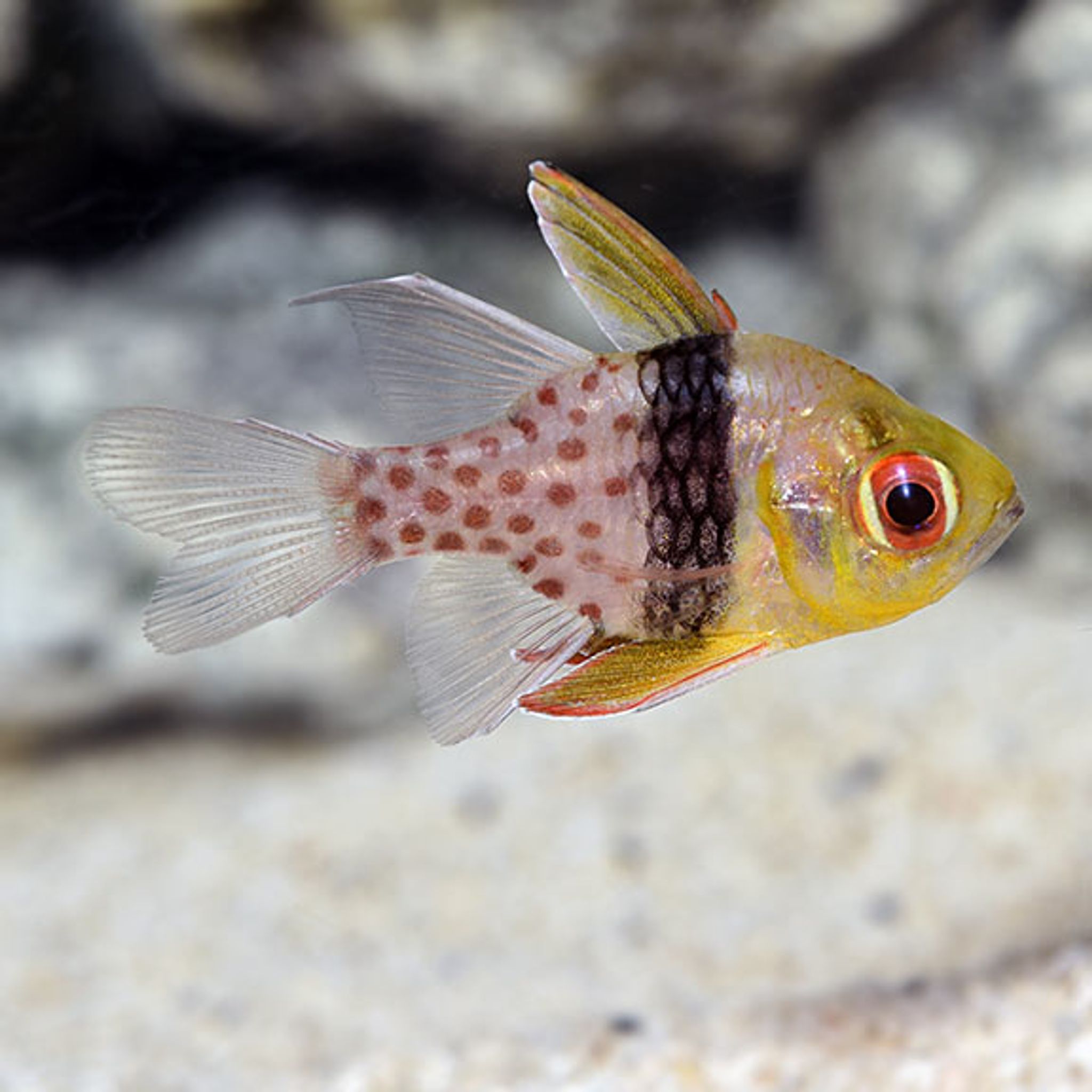
Best Tank Mates for Pajama Cardinalfish: Peaceful, Risky and Incompatible Choices
Pajama cardinalfish are slow, shy hoverers that lose out fast when paired with the wrong roommates. This guide sorts potential tank mates into three tiers — peaceful, risky, and incompatible — so you can build a stocking list that keeps your shoal confident, well-fed, and visible instead of hiding all day.
Species Snapshot
| Trait | Detail |
|---|---|
| Scientific name | Sphaeramia nematoptera |
| Size | About 3 in (7.5 cm) |
| Lifespan | 3-5 years typical in captivity |
| Origin | Indo-Pacific |
| Care level | Easy |
| Reef-safe rating | Yes, with a caveat on very small crustaceans |
| Swimming style | Slow, hovering "floating" gait rather than active swimming |
In the wild, pajama cardinalfish shoal loosely among branching coral heads and long-spined urchins, using the structure as a retreat rather than actively patrolling territory. That background matters for stocking: they are built for cover-hopping, not for racing across open water to compete for food.
Temperament and Grouping
Pajama cardinalfish are peaceful and shy toward every other species in the tank, and they are not bullies even when kept in numbers among their own kind. A loose pecking order forms within a group, but reports differ on how visible it is — some describe it as minimal, others as barely-there dominance behavior. In practice, expect mild posturing at most; it rarely causes injury and is not a sign something is wrong.
Grouping guidance:
- Best practice: 5-6+ individuals for natural shoaling behavior and confident, visible daytime activity.
- Workable alternative: a single fish or a pair does fine if space is limited, though individuals tend to be shyer and spend more time in cover.
- Bigger shoals consistently show more natural behavior and less hiding than singles or pairs.
Tank Size and Setup
Sources disagree slightly on minimum tank size, so here's the sensible range:
- Single fish: 20-30 gallons (75-115 L) minimum.
- Shoal of 5-6: 30-40+ gallons (115-150+ L), sized more by footprint (length) than height, since these fish hover in the mid-to-low water column rather than swimming vertically.
Ideal Setup Details
- Rockwork: branching, coral-like structure that mimics their wild habitat and gives multiple shaded pockets.
- Shaded hiding spots: pajama cardinalfish lean crepuscular to nocturnal in feeding activity, hovering near cover during bright daylight hours. Without shade, they stress and stay hidden.
- Layout priority: favor horizontal swimming space over vertical height — a long, low-traffic tank suits their hovering style better than a tall column tank.
Water Parameters
Standard reef parameters work fine; no special requirements.
| Parameter | Range |
|---|---|
| Temperature | 72-79°F (22-26°C) |
| pH | 8.1-8.4 |
| Specific gravity | 1.020-1.025 |
| dKH | 8-12 |
Diet and Feeding Technique
Pajama cardinalfish are carnivorous micro-predators that need meaty foods: mysis shrimp, enriched brine shrimp, bloodworms, chopped clam or other marine flesh, and small feeder shrimp. Most will accept pellets or flakes once fully acclimated, but meaty foods should stay the base of the diet.
Because they're slow, deliberate feeders, technique matters as much as menu:
- Feed small amounts multiple times a day rather than one large feeding.
- Use target feeding (dropping food near the group with a feeding tube or turkey baster) so faster tank mates don't clean out the water column before the cardinals move in.
- Watch the group during feeding for a few cycles after adding any new tank mate — a fish that hangs back while others eat is an early warning sign.
The Three Compatibility Tiers
Predation risk in a pajama cardinalfish tank runs in two directions: fast or aggressive tank mates that outcompete or bully them, and predators large enough to eat a 3-inch fish outright. The cardinals themselves pose only a mild risk to very small crustaceans, never to other fish.
Tier 1: Peaceful (Recommended)
These species match the cardinal's slow pace and non-aggressive temperament:
- Dartfish — similarly slow-moving and shy, occupies open water without competing for cover.
- Gobies — bottom-dwelling and peaceful, minimal feeding overlap.
- Mandarin dragonets — peaceful and occupies a different niche, though a mandarin still needs its own established pod population regardless of what else is in the tank.
- Filefish — generally calm, non-competitive feeders.
- Dwarf or pygmy angelfish — peaceful temperament at a similar activity level.
- Clownfish — a classic pairing; both are slow-to-moderate swimmers with non-aggressive habits.
- Other peaceful cardinalfish species (e.g., Banggai cardinalfish) — compatible temperament and similar care needs.
- Firefish — shy and peaceful, rarely competes aggressively for food.
The general rule across this tier: match temperament and swimming speed first, then worry about size.
Tier 2: Risky (Proceed with Caution)
These aren't flatly incompatible, but they need careful monitoring and usually work better added after the cardinals are established:
- Moderately active wrasses — many are peaceful enough on paper, but their faster, more energetic feeding style can leave slow cardinals losing out at mealtime unless you target-feed.
- Larger gobies — size and territoriality vary a lot by species; a boisterous individual can crowd out a shy cardinal from favored shelter.
- Semi-aggressive dottybacks — some individuals stay peaceful, others turn territorial as they mature, especially in a smaller footprint tank. Monitor closely after introduction and have a backup plan if bullying starts.
The common thread in this tier is variability — outcome depends heavily on individual temperament, tank size, and the order fish are added, not just the species label.
Tier 3: Incompatible (Avoid)
- Large damsels — aggressive, fast feeders that will outcompete cardinals for food and can harass them directly.
- Some tangs — size and territorial behavior make them a poor match, particularly in anything under 40 gallons.
- Aggressive dottybacks — reliably territorial individuals will bully a slow, shy species.
- Triggerfish — large enough to view a 3-inch cardinalfish as a snack, and temperament mismatch compounds the risk.
- Larger predatory fish generally — any species with a mouth big enough for a 3-inch fish is a predation risk, not just a competition risk.
Compatibility Quick Reference
| Tier | Examples | Main Risk |
|---|---|---|
| Peaceful | Dartfish, gobies, mandarin dragonets, filefish, dwarf angelfish, clownfish, firefish, other cardinalfish | Minimal |
| Risky | Active wrasses, larger gobies, semi-aggressive dottybacks | Individual variability, feeding competition |
| Incompatible | Large damsels, some tangs, aggressive dottybacks, triggerfish | Bullying, starvation, predation |
Reef and Cleanup Crew Compatibility
Pajama cardinalfish are reef-safe with corals and larger invertebrates, but "reef-safe" doesn't mean safe with every invertebrate. The consistent caveat: they will eat very small crustaceans — tiny ornamental shrimp and copepod or amphipod populations if they build up heavily.
- Adult cleaner or peppermint shrimp: generally safe once fully grown.
- Juvenile or very small shrimp: at risk, especially in a tank without abundant alternative food.
- Snails, hermit crabs, brittle stars: generally safe — these aren't on the menu the way small shrimp and pods are.
- Pod populations: a heavy amphipod or copepod bloom will get picked at, but this rarely threatens an established population the way it would a target mandarin tank.
Breeding in a Community or Reef Tank
Pajama cardinalfish are paternal mouthbrooders and are considered one of the easier marine species to breed at home. The male incubates fertilized eggs in his mouth for roughly three weeks and does not eat during that period. Fry can free-swim and immediately take copepods or baby brine shrimp — no dedicated rearing tank is strictly required to get started.
That said, fry survival odds are low in a general community or reef tank without a grow-out plan. Anything from wrasses to peaceful gobies will happily eat free-swimming fry, so if breeding is a goal rather than a bonus, plan a separate grow-out container or an isolated section of the display.
Stocking Order: Where Pajama Cardinalfish Fit
Because they're slow feeders that get outcompeted easily, pajama cardinalfish generally do better added early to mid in a tank's stocking sequence, before faster or more established fish have claimed the best feeding rhythm and territory. Adding them last into a tank full of confident, fast-swimming fish makes it harder for them to settle in and compete for food.
During quarantine, the same shy, slow-feeding nature creates a specific risk: if a pajama cardinal is quarantined alongside bolder fish, it can be overlooked at feeding time and slowly lose condition even without any direct aggression. Where possible, quarantine cardinals alone or with equally slow, peaceful tank mates, and confirm they're eating well before moving them to the display.
Common Mistakes to Avoid
- Pairing with fast, aggressive feeders (large damsels, some tangs, aggressive dottybacks) that out-compete pajama cardinals at feeding time, causing slow starvation even without any direct attacks.
- Housing singly or in pairs by default when a proper shoal of 5-6 would reduce stress and shyness — a lone or paired fish that hides constantly and feeds poorly is a common result.
- Assuming "reef safe" covers all invertebrates — small ornamental shrimp and heavy pod populations can still get picked off.
- Overstocking a small tank with a full shoal — bioload adds up even though each fish is small, so a 40-gallon shoal in a 20-gallon tank is a mistake.
- Ignoring swim-speed mismatch — fast tank mates create constant low-grade stress even without any aggression or nipping.
- Skipping hiding places and branching decor — without shaded retreats, the shoal won't settle into a visible daytime routine.
Frequently Asked Questions
Can pajama cardinalfish live with clownfish?
Yes. This is generally considered a classic peaceful pairing since both species are slow-to-moderate swimmers with non-aggressive temperaments.
Can pajama cardinalfish live with a mandarin dragonet?
Yes, they're compatible — both are peaceful and occupy different niches in the tank. Keep in mind the mandarin still needs its own established copepod population to thrive, regardless of what else shares the tank.
Will pajama cardinalfish eat cleaner shrimp or small ornamental shrimp?
Adult cleaner or peppermint shrimp are generally safe. Very small or juvenile shrimp, along with excess amphipods and copepods, can become an easy meal.
How many pajama cardinalfish should I keep together?
Ideally 5 or more for natural shoaling behavior and confidence. A single fish or a pair is workable if space is limited, but individuals tend to be shyer.
Are pajama cardinalfish aggressive toward each other?
Not seriously. A mild pecking order forms within the group but doesn't typically cause injury — this is normal shoaling behavior, not a red flag.
Can pajama cardinalfish be kept with aggressive fish like triggers or larger tangs?
No. The size and temperament mismatch makes this a poor and risky pairing — pajama cardinalfish can be bullied, outcompeted for food, or in the case of triggerfish, eaten outright.
What is the minimum tank size for a shoal of pajama cardinalfish?
Around 30-40 gallons (115-150 L) for a group of 5-6, with more room needed if you're combining them with other community fish.
Do pajama cardinalfish need a species-only tank?
No. They integrate well into general peaceful reef communities as long as tank mates are chosen carefully from the peaceful tier.
Ready to build out your shoal? Browse a current selection of cardinalfish on FishyHub and plan your stocking order around the compatibility tiers above.

