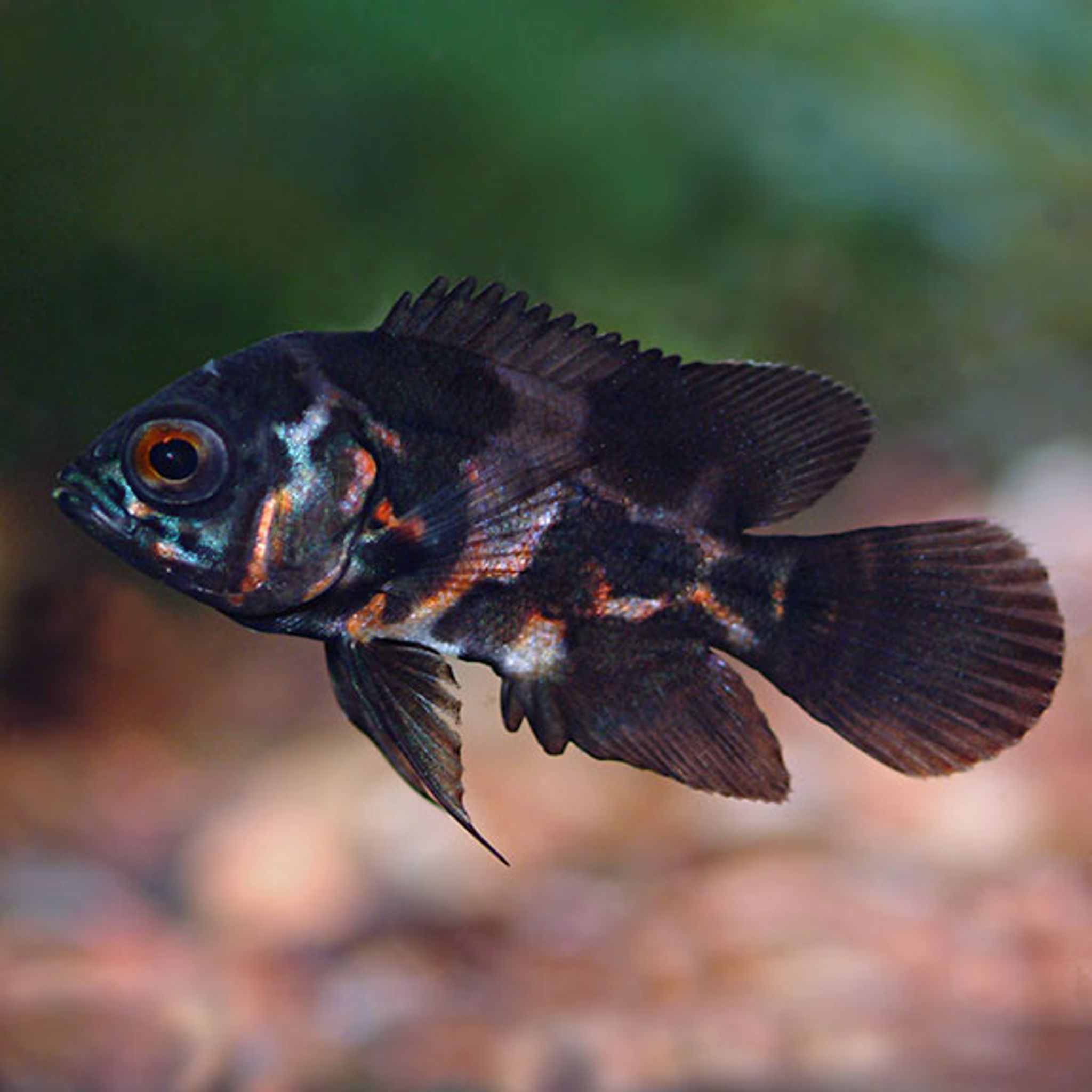

Best Tank Mates for Oscar: Compatible Fish and Species to Avoid
The best tank mates for an oscar are large, sturdy, calm fish: another oscar raised alongside it, a school of silver dollars, a severum, a full-size common pleco, or a giant gourami in a very big tank. Anything small enough to fit in an adult oscar's mouth will eventually be eaten. For many keepers the safest setup is an oscar living alone, and that's a perfectly good choice.
The Rule Behind Every Oscar Pairing
If it fits in the mouth, it's food. An adult oscar (Astronotus ocellatus) has a huge mouth, and a fish that looks too big at 3 inches can be swallowed six months later. Tank mates should reach about 6 inches (15 cm) or more, or be so armored or deep-bodied that swallowing them isn't possible.
Plan around the adult fish, not the one in the store bag:
- Growth: oscars reach 10–12 inches (25–30 cm) within 1–2 years, and some hit 14 inches (36 cm).
- Lifespan: 10–15 years or longer, so your stocking choices have to hold up for a decade.
- Waste: oscars are messy eaters and heavy producers of waste, which matters every time you add another big fish.
Temperament is the other half. Oscars are predatory and territorial, but they're not the meanest cichlids in the hobby. A good companion is calm enough not to start fights and tough enough to stand its ground when the oscar pushes back.
Tank, Water and Filtration Come First
You can't pick tank mates until the system can support them. Published minimums for one oscar range from 25 to 125 gallons, but the 25–55 gallon figures are outdated or just wrong.
- One oscar: 75 gallons (284 L) minimum, 125 gallons (473 L) preferred.
- Oscar plus tank mates: 125 gallons (473 L) or more.
- Two oscars: about 100–125 gallons (379–473 L) in practice.
Water parameters to match:
- Temperature: 74–81°F (23–27°C); the full range cited is 71–84°F (22–29°C)
- pH: 6.0–7.8. Upper limits quoted vary from 7.6 to 8.5, but a stable 6.5–7.5 suits both oscars and most South American companions
- Ammonia and nitrite: 0 ppm
- Nitrate: under 40 ppm, ideally under 20 ppm
Choose mates that like the same warm, soft-to-neutral water. Filtration should be a canister or sump rated for at least twice the tank volume, with 30–50% water changes every week. Weak filtration is one of the most common reasons an oscar community fails: nitrate climbs, fish get stressed and cranky, and problems like hole-in-the-head show up. Browse external canister filters sized for large tanks before adding a second big fish.
Oscar Tank Mates Ranked by Risk
Most lists lump safe and risky fish together. This table sorts them by risk and gives the tank size each pick needs.
| Tank mate | Adult size | Risk tier | Tank needed (with oscar) | Key caveat |
|---|---|---|---|---|
| Another oscar | 10–14 in (25–36 cm) | Low | 100–125+ gal (379–473+ L) | Raise them together; pairs may spawn and turn territorial |
| Silver dollars (5+) | ~6 in (15 cm) | Low | 125+ gal (473+ L) | Fast schooling dither fish; keep a group |
| Severum | ~8 in (20 cm) | Low | 125+ gal (473+ L) | Mellow New World cichlid |
| Common or large pleco | 12–20 in (30–51 cm) | Low | 125+ gal (473+ L) | Buy one over 5 in (13 cm) |
| Giant gourami | 16–18 in (41–46 cm) | Low (temperament) | 200–300+ gal (757–1,136+ L) | Docile but enormous |
| Jack Dempsey | 8–10 in (20–25 cm) | Moderate | 125+ gal (473+ L) | Size-match at introduction |
| Electric blue acara | ~6 in (15 cm) | Moderate | 125+ gal (473+ L) | Peaceful, borderline size |
| Blood parrot | varies | Moderate | 125+ gal (473+ L) | Watch for bullying |
| Bala shark (group) | 12–14 in (30–36 cm) | Moderate | 150+ gal (568+ L) | Jumper; needs a tight lid and a group |
| Clown loach (5–6+) | slow-growing | Moderate | 150+ gal (568+ L) | Small ones are at risk |
| Large bichir species | varies | Moderate | 125+ gal (473+ L) | Large species only |
| Green terror, jaguar cichlid | large | High | 150+ gal (568+ L) | Experienced keepers only |
| Convict, firemouth, jewel | small | High | 125+ gal (473+ L) | Only if grown up with the oscar |
| Arowana, fire eel | very large | High (space) | 200–300+ gal (757–1,136+ L) | May be legally restricted in some states |
Top-tier picks
- Another oscar. Two juveniles grown up together is the classic pairing. Expect some sparring, and if they pair off and spawn, they may claim the whole tank.
- Silver dollars. Keep five or more. They're fast, stay in the upper water, and act as dither fish, which helps a nervous oscar feel secure.
- Severum. At around 8 inches, it's one of the most laid-back cichlids that can hold its own.
- Common or large plecos. Armored, 12–20 inches, and helpful with leftovers. Browse plecos and pick a large-growing species that's already past 5 inches.
- Giant gourami. Gentle and slow, but at 16–18 inches it needs a very large tank.
Workable with caveats
Jack Dempseys, electric blue acaras and blood parrots can work in a 125-gallon tank if they're close in size to the oscar at introduction. Bala sharks and clown loaches get along fine, but both outgrow most home tanks. Balas reach 12–14 inches and jump, and clown loaches grow slowly, so they spend years at a size an oscar can eat. Bichirs work only as large species.
Monster fish and legal limits
Arowana, fire eels, giant gourami and freshwater stingrays sometimes show up as "compatible," but they need 200–300+ gallons (757–1,136+ L). Stingrays and arowana are also legally restricted in some US states, so check your state's rules before buying one.
Oscars and Other Cichlids
Medium-to-large New World cichlids with similar water needs are the most natural companions: severum, Jack Dempsey, acara and, for experienced keepers, green terror. Size-match them and give them room. Browse American cichlids to compare species.
Where sources disagree:
- Convicts, firemouths and jewels: some call them compatible, others say they end up eaten or fighting nonstop. Treat them as risky. Only try them as juveniles raised with the oscar in 125+ gallons.
- Jaguar cichlids and green terrors: opinions run from "fine" to "never." They're for experienced keepers with 150+ gallons (568+ L).
- Red devils and flowerhorns: skip them. They're aggressive enough to cause serious, sometimes fatal, fights.
- Temporary pairings: some suggest keeping convicts with a young oscar and separating them later. Avoid that plan. Keeping a tank stable beats rehoming fish down the line.
African rift-lake cichlids need harder, more alkaline water and behave differently, so they're a poor match.
Fish to Avoid With Oscars
- Tetras, guppies, danios and other small community fish. They're food.
- Angelfish, bettas and other long-finned or slow fish. Fins get nipped, and slow fish get bullied or eaten.
- Discus. Different care needs, and too timid.
- Small spined catfish, such as small Synodontis or Corydoras. Their locking fin spines can lodge in an oscar's throat, which can kill the oscar and the catfish.
- Red devils and flowerhorns. Too aggressive.
- Shrimp and snails. An expensive snack.
- Goldfish. They get eaten, and they need cooler water anyway.
Why angelfish are a special case
Most keepers say no to angelfish. A few report full-grown angels living peacefully with a mellow oscar in 125+ gallons, but it's still a gamble. Angels are slow, their long fins invite nipping, small angels are prey, and the constant stress wears them down. Choose a sturdier fish instead.
How to Introduce Tank Mates Safely
- Quarantine every newcomer for 2–4 weeks in a separate tank. Watch for disease, get it eating, and treat it if needed before it meets your oscar.
- Get the order right. Add juveniles together at similar sizes, or add the mates before the oscar settles in. Adding fish to a tank an oscar has owned for months invites territory fights.
- Rearrange the decor right before the newcomer goes in, so the oscar loses its claimed territory.
- Build sight breaks with heavy caves and large driftwood the oscar can't easily move.
- Feed well on a schedule. A hungry oscar hunts. Offer quality pellets, frozen foods, earthworms and some greens.
- Watch closely for 1–2 weeks, and keep a tank divider or spare tank ready.
Skip feeder goldfish. They can carry disease and contain thiaminase, an enzyme that breaks down vitamin B1. Feeding live fish also teaches the oscar that fish are food.
Oscar Intelligence and Why It Matters
Oscars are often called "water dogs." They recognize their keepers, beg at the glass, can be hand-fed or trained to come to the surface, and sulk or rearrange the tank when upset. (Other fish often named as smart include flowerhorns, goldfish, archerfish and elephantnose fish.) That intelligence has a downside: a bored oscar is more likely to turn aggressive. Space, rearranged decor, hand-feeding and varied food all help keep the peace.
Personality varies a lot. Some oscars accept companions and others won't tolerate anything. Always have a plan B: a divider, a second tank, or a trade-in or rehoming arrangement with a local fish store.
Common Mistakes and Troubleshooting
- Buying a 3-inch oscar for a community tank. The tetras disappear within months.
- Adding fish to an established oscar's tank without rearranging. Fix it with new decor, a divider, or several fish added at once so no single fish takes all the attention.
- Undersized filtration, which leads to nitrate spikes and stressed fish.
- Adding small or delicate catfish, which creates a choking risk.
Signs a pairing is failing: torn fins, a tank mate that hides constantly or stops eating, an oscar guarding the entire tank, or a companion losing color. Separate them quickly.
Oscar lying on its side or turning dark? That's often sulking or stress after a change. Test your water parameters first before assuming illness or bullying.
Frequently Asked Questions
Can an oscar live alone?
Yes. A solo oscar is often the happiest and safest setup, and it tends to bond strongly with its keeper. A single oscar in a 75–125 gallon tank lives a full life without companions.
Can two oscars live together?
Yes, if they're raised together in 100–125+ gallons. Pairs can still fight, or spawn and turn territorial, so keep a divider on hand.
Can oscars live with goldfish or tetras?
No. Both become food, and goldfish also need cooler water than oscars do.
What's the best first tank mate for an oscar?
A school of large silver dollars or a sizable common pleco. Both are low risk, and silver dollars help calm a nervous oscar.
Will an oscar eat plecos?
Adult common plecos are safe thanks to their size and armor. Small or fancy plecos under 5 inches (13 cm) are at risk.
Can oscars live with African cichlids?
Generally no. Rift-lake Africans want harder, more alkaline water, and their aggression doesn't mix well with an oscar's.
Build Your Oscar Setup
Start with the tank and filter, choose one or two low-risk companions, and introduce them carefully. When you're ready, browse oscars on FishyHub along with suitable large companions for a community built for the adult fish.


