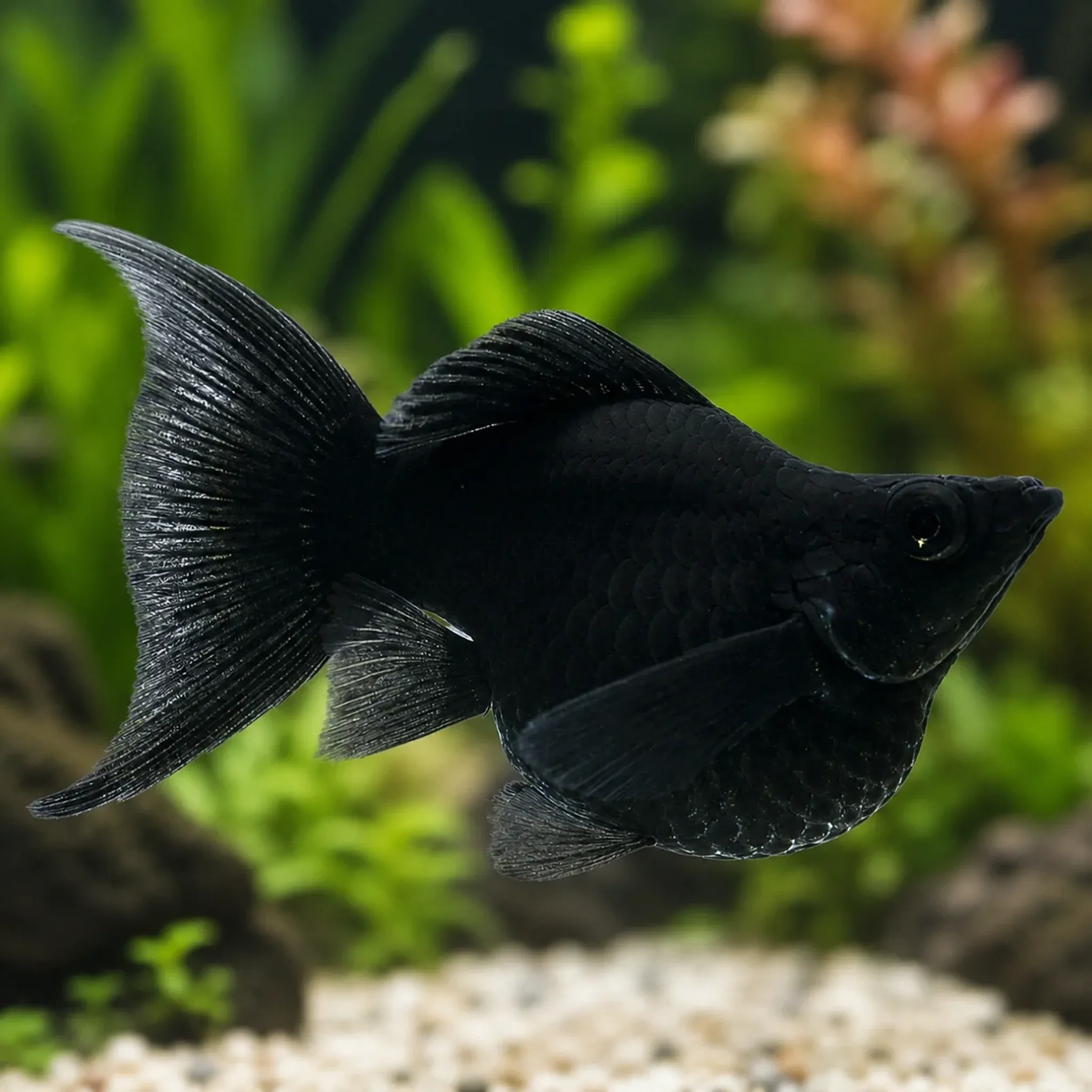

Best Tank Mates for Molly: Compatible Fish and Species to Avoid
The best tank mates for mollies are other hardy, peaceful fish that like the same hard, alkaline water: platies, swordtails, sturdy guppies, corydoras, a bristlenose pleco, danios, rasboras and snails. Skip bettas, goldfish, fin nippers, large cichlids and dwarf shrimp. Below you'll find a compatibility table, three stocking plans for common US tank sizes, and the reasons behind each pairing.
Start With What Mollies Need
Compatibility starts with water and space. Temperament matters less. A fish that is peaceful but wants soft, acidic water will do poorly next to mollies however well they behave.
- Temperature: 72–80°F (22–27°C). Fancy strains do best around 76–78°F (24–26°C).
- pH: 7.5–8.5.
- Hardness: roughly 15–30 dGH/KH. This is the main filter for choosing tank mates, and it's why discus and rams are out.
- Adult size: 3–5 inches (8–13 cm). Sailfins reach 4–5 inches (10–13 cm).
- Tank size: 20 gallons (76 L) minimum for short-fins, 30 gallons (114 L) or more for sailfins, and 40 gallons (150 L) or more for the largest sailfin and Yucatan types. A long footprint beats a tall one.
- Group: 3 or more, at 1 male per 2–3 females.
Raising and holding hardness
If your tap water is soft, crushed coral in the filter or mixed into the substrate will buffer pH and hardness upward. Test GH and KH with a liquid kit before and after, and make changes gradually so the numbers don't swing.
How molly strains differ
| Strain | Typical adult size | Fin vulnerability | Minimum tank |
|---|---|---|---|
| Short-fin (common, black, dalmatian) | About 3–4 in (8–10 cm) | Low | 20 gal (76 L) |
| Balloon | Compact, deep-bodied | Moderate; slower swimmer | 20 gal (76 L) |
| Sailfin | 4–5 in (10–13 cm) | High; tall dorsal fin attracts nippers | 30 gal (114 L) |
| Large sailfin / Yucatan types | Up to about 5 in (13 cm) | High | 40 gal (150 L) |
Sailfin and balloon mollies are the strains most likely to get torn fins and fin rot when kept with nippers, so choose their tank mates carefully.
Molly Tank Mate Compatibility Table
| Species | Temp range fit | Hard, alkaline water | Adult size | Verdict |
|---|---|---|---|---|
| Platy | Good | Excellent | ~2–3 in | Best match |
| Swordtail | Good | Excellent | Larger than platies | Best match (lidded, 15–20 gal+) |
| Guppy (sturdy strains) | Good | Good | ~1–2 in | Good |
| Endler's livebearer | Good | Good | Tiny | Good; may get pestered |
| Corydoras (6+) | Keep ≤78°F | Tolerant | Small | Good on sand |
| Bristlenose pleco (one) | Good | Tolerant | Small pleco | Good |
| Otocinclus | Good | Tolerant | Tiny | Mature planted tanks only |
| Zebra / leopard danio | Good | Tolerant | Small | Good |
| Harlequin / scissortail rasbora | Good | Tolerant | Small | Good |
| White cloud minnow | Cool side | Tolerant | Tiny | Workable at the cool end |
| Rosy / gold barb | Good | Tolerant | Medium | Good |
| Rainbowfish | Good | Good | Medium | Good in 30 gal+ |
| Black skirt / lemon tetra | Good | Tolerant | Small | Good |
| Neon / cardinal tetra | Prefer cooler | Prefer softer | Small | Conditional |
| Dwarf / pearl gourami | Good | Moderate | Small–medium | Conditional |
| Angelfish | Good | Moderate | Tall | Conditional (30 gal+, tall tank) |
| Tiger barb | Narrow overlap (75–78°F) | Tolerant | Medium | Conditional (short-fins only) |
| Betta | Overlaps | Moderate | Small | Avoid |
| Goldfish | Coldwater | — | Large | Avoid |
| Oscar, convict, Jack Dempsey | — | — | Large/aggressive | Avoid |
| Dwarf shrimp | — | — | Tiny | Avoid (eaten) |
The Best Tank Mates for Mollies
Livebearer cousins
- Platies: the hardiest of the group and the classic molly companion.
- Swordtails: need 15–20 gallons (57–76 L) or more and a tight lid because they jump.
- Guppies: compatible, but choose sturdier strains (more on this below).
- Endlers: very small, so pushy molly males may pester them.
Bottom and algae crew
- Corydoras: keep 6 or more on sand, and don't run the tank warmer than about 78°F (26°C).
- Bristlenose pleco: one per tank is plenty.
- Otocinclus: only in a mature, planted tank with steady algae growth.
- Snails: nerite, mystery, ramshorn and rabbit snails. Snails are the safest invertebrate to keep with mollies.
Midwater schoolers
- Zebra and leopard danios, harlequin and scissortail rasboras.
- White cloud minnows: a compromise at the cool end of the molly range.
- Rosy and gold barbs.
- Rainbowfish: in 30 gallons (114 L) or more.
- Hard-water-tolerant tetras like black skirt and lemon tetras.
Conditional picks
- Neon and cardinal tetras: they prefer softer, cooler water. Only try them if your hardness sits at the low end of the molly range.
- Dwarf or pearl gourami: usually fine in a roomy tank.
- Angelfish: 30 gallons (114 L) or more in a tall tank. They will eat molly fry.
- Kuhli loaches: workable with fine substrate and places to hide.
- Siamese algae eaters: keep them in a group.
Fish and Species to Avoid
- Bettas: mollies and bettas tend to chase each other, and fins get damaged on both sides.
- Goldfish: coldwater fish with a different temperature range and a heavy waste load.
- Fin nippers around long-finned mollies: sailfins and balloons suffer most.
- Large or aggressive cichlids: oscars, convicts and Jack Dempseys.
- Anything big enough to swallow a molly.
- Dwarf shrimp: covered below.
Specific Pairings People Ask About
Mollies and cherry shrimp
Mollies hunt shrimp and steal their food, and shrimplets almost never survive. You'll see shrimp listed as compatible in some places, but treat them as incompatible. Keep shrimp in their own tank, or use snails for your cleanup crew.
Mollies and tiger barbs
Tiger barbs go after flowing fins, which is why they show up on both "avoid" and "workable" lists. It can work only with short-fin mollies, a barb group of 6–10, and a tank of 30 gallons (114 L) or more. The comfortable temperature overlap is narrow, about 75–78°F (24–26°C).
Mollies and guppies
The two get along well. They can rarely hybridize, and the offspring are usually sterile. Male guppies court with an S-shaped display and also sneak matings, and females store sperm for several broods, so expect guppy fry even after removing males. Fancy long-tailed guppies get nipped and outcompeted at feeding time, so pick sturdier strains. You can browse guppies on FishyHub to compare varieties.
Platies and mollies (molly, platy or guppies?)
Platies and mollies are the classic mix. They belong to different genera and won't crossbreed. If you're choosing between the three livebearers:
- Guppies suit a 10-gallon (38 L) tank.
- Platies are the hardiest.
- Mollies need the most space and the cleanest water.
Platies are the easiest first companion for a new molly tank.
Marbled crayfish (the "clones")
Adult marbled crayfish get along with livebearers, but they reproduce without mates and multiply endlessly. They may also grab sleeping fish, and they are restricted in several US states. Not recommended.
Sample Stocking Plans
These assume a cycled tank, a filter rated for the volume, and weekly water changes.
| Tank | Mollies | Tank mates |
|---|---|---|
| 20 gal (76 L), long | 3–5 short-fin (1 male, 2–4 females) | 6 corydoras (sand, ≤78°F) + a few nerite snails |
| 29/30 gal (110–114 L) | 4–5 mollies, sailfins OK (1–2 males) | 5–6 platies + 6 zebra danios + 1 bristlenose pleco + snails |
| 40 gal (150 L) breeder | 5–6 mollies incl. large sailfins | 6 rosy barbs or a small rainbowfish group + 6 corydoras + 1 bristlenose pleco |
Add fish in small batches rather than all at once, and stop early if your water tests start drifting.
Care That Keeps a Mixed Tank Healthy
Bioload and water changes
Mollies produce a lot of waste. Change 25–33% of the water weekly and keep ammonia and nitrite at 0. Even trace ammonia can cause clamped fins and shimmying.
Diet
Mollies are omnivores that need plant matter such as spirulina and blanched zucchini or spinach, plus protein. They eat fast, so drop sinking food after the mollies are busy to make sure the bottom feeders get their share.
Fry and population control
Expect a batch every 4–6 weeks (gestation is about 21–30 days). Tank mates eat most of the fry, which works as natural population control. To raise some, add dense plants or use a breeder box. Plan ahead for surplus: rehome fry through a local store or aquarium club, or keep a single sex.
Introductions
Quarantine new fish for 2–4 weeks and add them in small batches.
Fancy Mollies and the Salt Debate
Opinions differ here. Some keepers say sailfin and Yucatan types need about 1 tablespoon of salt per 5 gallons (19 L). Others call salt a myth for fancy hybrids, and point out that it harms plants, corydoras and plecos.
Pet-store mollies are hybrids of inland and coastal species, so salt is optional. Big water changes, good aeration, plants and room to swim matter much more. Our recommendation is no salt in a community tank. Rely on hard, clean water, and save salt for a molly-only setup or for treatment. When bringing fancy mollies home, acclimate them around 80°F (27°C), then let the tank settle to about 78°F (26°C).
Are mollies schooling fish?
No. Mollies shoal loosely and prefer company, but they don't school tightly the way danios or rasboras do. Keep at least 3.
Common Mistakes and Troubleshooting
- A 10-gallon tank or soft-water tank mates. Start at 20 gallons with hard water.
- Too many males. Harassed females hide and get stressed. Rebalance to 1 male per 2–3 females.
- Sailfins or balloons with nippers, which leads to torn fins and fin rot.
- Salting a tank that holds corys or live plants.
- A population boom. Have a rehoming plan before it happens.
- Shimmying. Usually ammonia, low hardness or temperature swings. Test and change water.
Why is my guppy (or molly) not moving?
Test ammonia, nitrite, nitrate, pH and temperature first. Then look for bullying from tank mates, a heavily pregnant female about to give birth, white spots and fading color. Fix the water before reaching for medication.
Frequently Asked Questions
Can mollies live with bettas?
Generally no. Mollies and bettas tend to chase each other, and both can end up with fin damage. Give a betta its own tank or a carefully chosen peaceful setup without mollies.
Can mollies live with goldfish?
No. Goldfish are coldwater fish, while mollies need tropical temperatures, and goldfish add a heavy waste load on top of the mollies' own. Neither species will thrive in a compromise.
How many mollies can go in a 20-gallon tank?
About 3–5 short-fin mollies plus a small bottom crew, such as 6 corydoras and a few snails. Sailfins need 30 gallons or more.
Will mollies eat fry?
Yes, including their own. So will most tank mates. Dense plants or a breeder box let a few survive if you want to raise them.
Do mollies need salt when kept with tank mates?
No. Keep the water hard and alkaline instead, since salt can harm plants, corydoras and plecos. Reserve salt for molly-only tanks or short-term treatment.
Are mollies aggressive?
Mostly peaceful. Males get pushy with females and may nip small or slow fish, and crowding makes it worse. The right sex ratio and enough space keep things calm.
Build Your Molly Community
Get the water hard, the tank long enough, and the male-to-female ratio right, and mollies make easygoing centerpieces for a lively community. Browse mollies on FishyHub to find short-fin, balloon and sailfin strains for your setup.


