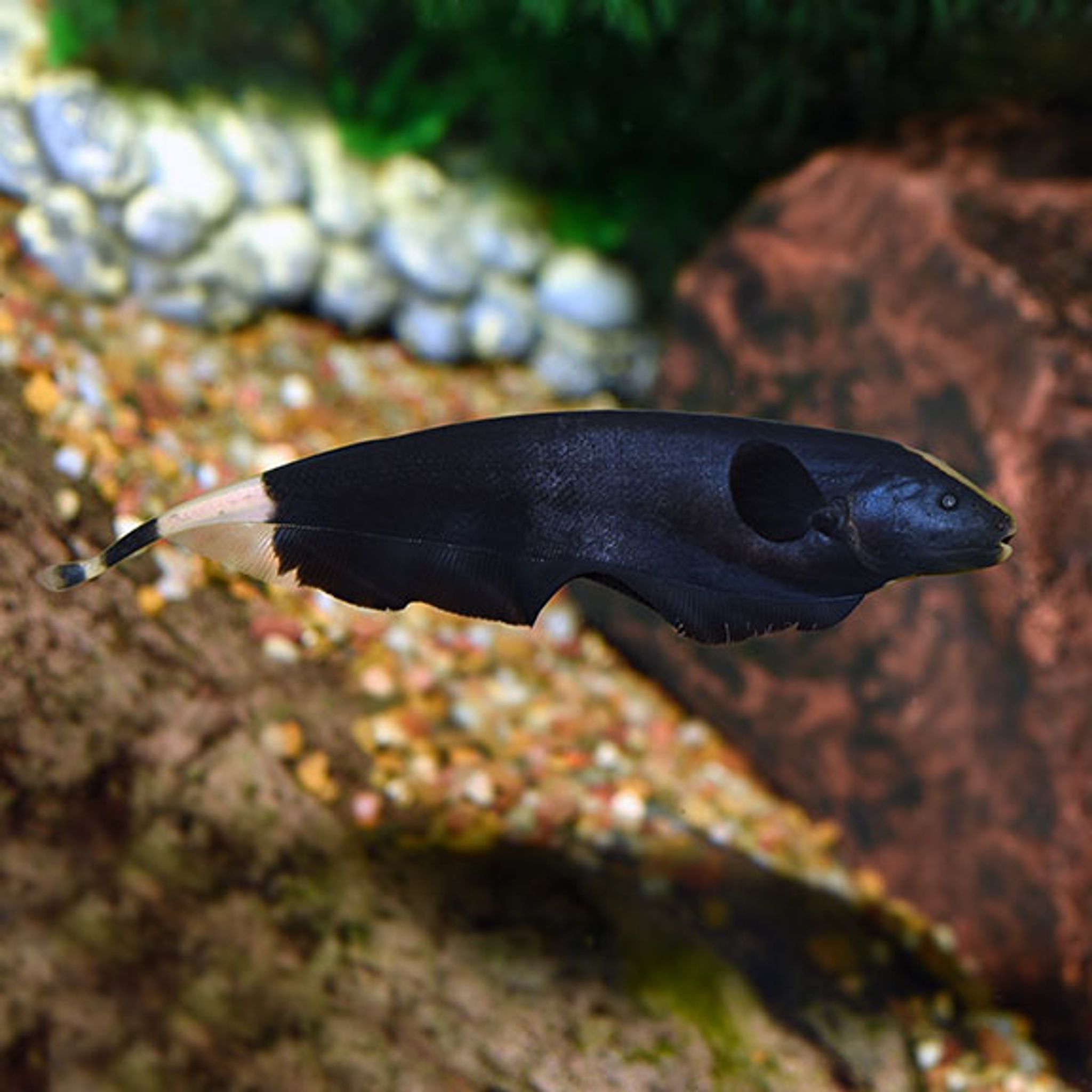

Best Tank Mates for Knifefish: Compatible Fish and Species to Avoid
The best tank mates for knifefish are calm, medium-to-large fish (roughly 6 inches and up) that won't nip, chase or crowd the knife out at feeding time: think clown loaches, eartheaters, angelfish, silver dollars, peaceful plecos and bichirs. Anything small enough to fit in a knifefish's mouth will eventually disappear at night. The right list also depends on which knifefish you own, because a 10-inch African brown knife and a 3-foot clown knife need completely different companions.
Two Rules That Decide Every Pairing
Before looking at species lists, it helps to understand how knifefish live.
- They hunt at night by electricity and smell. Knifefish are timid, nocturnal and have poor eyesight. They find food with a weak electric field and a strong sense of smell, so after lights-out, any fish that fits in the mouth counts as prey. Aim for tank mates around 6 in (15 cm) or larger as adults.
- They are slow and cannot flee. A knifefish glides forward and backward with its long bottom fin; it can't outrun a bully. That means fin nippers and hyperactive chasers are off the table even if they're big enough not to be eaten.
A useful way to think about temperament: knifefish are peaceful toward fish that aren't food, and aggressive toward their own kind and other electric fish. Labels calling them "semi-aggressive" usually refer to that second behavior.
"Knifefish" Is Several Different Fish
Most tank mate advice only covers the black ghost. Here's how the common groups compare.
| Species | Adult size | Long-term tank | Social with own kind? | Good tank mates |
|---|---|---|---|---|
| Black ghost (Apteronotus albifrons) | 18–20 in (46–51 cm) | 125 gal+ (475 L) | No, one per tank | Clown loaches, Geophagus, angelfish, severums, electric blue acaras, silver dollars, large gouramis, peaceful plecos, bichirs, rope fish |
| Brown ghost (Apteronotus relatives) | Similar to black ghost | 125 gal+ | No | Same as black ghost |
| Clown knife (Chitala ornata/chitala) | 2–3+ ft (60–90+ cm) | 250–300+ gal (950–1,135+ L) | No, aggressive to its own kind | Arowanas, large plecos, oscars, big calm cichlids, large bichirs, adult tinfoil barbs, adult silver dollars |
| African brown knife (Xenomystus nigri) | 8–12 in (20–30 cm) | 55 gal+ (208 L) | Usually kept singly | Congo tetras and other large tetras, gouramis, peaceful catfish, similar-size bichirs |
| Glass knife (Eigenmannia) | 8–12 in (20–30 cm) | Size for a group | Yes, prefers groups | Peaceful mid-size fish; no nano species |
| Banded knife (Gymnotus carapo) | About 2 ft (60 cm) | Very large | No, one per tank | Only large, non-aggressive fish |
Black Ghost Knifefish
The black ghost is the one most people buy, often as a 4–5 in juvenile. It grows fast (around 8 in in the first year) and reaches 18–20 in. Solid companions include:
- Clown loaches: they often share caves with black ghosts peacefully. Browse loaches on FishyHub if you're planning a group.
- Calm South American cichlids: Geophagus and other eartheaters, angelfish, severums and electric blue acaras. You can find many of these in the angelfish, discus and cichlids section.
- Silver dollars, larger gouramis, giant danios and the bigger, calmer rainbowfish.
- Bottom and mid-level oddballs: peaceful plecos, bichirs, rope fish and the horse-face loach.
- Discus, but only if you can reconcile temperatures (see below).
- Larger Corydoras, with a caveat covered in the disagreements section.
Clown Knife
A clown knife sold at 4 inches is a genuine monster fish in the making: predatory, 2–3+ ft, and aggressive toward other clown knives. Realistic long-term housing is 250–300+ gal. Tank mates must be large and sturdy: arowanas, large plecos, oscars and other big, calm cichlids, large bichirs, and tinfoil barbs or silver dollars once they're adult-sized. Keep one clown knife per tank.
African Brown Knife
This is the most "community-friendly" knifefish. At 8–12 in and shy, it does well in a 55 gal+ mid-size community with larger tetras such as congo tetras, gouramis, peaceful catfish and bichirs of similar size.
Glass Knifefish
Glass knives are the exception to the one-per-tank rule. They are more comfortable in groups of their own kind and should only share space with peaceful fish. Skip nano species, since adults at 8–12 in will eat them.
Banded Knife
At about 2 ft and noticeably more predatory, the banded knife is a one-per-tank fish that should only live with large, non-aggressive species.
Water Parameters and Temperature Overlap
Black ghosts want stable, well-filtered water with low nitrate. Published ranges vary:
- Temperature: some sources list 73–80°F (23–27°C), others 75–82°F (24–28°C). A target of 76–80°F (24–27°C) overlaps most tropical mates.
- pH: about 6.5–7.8
- Hardness: moderate, around 5° GH or more
Check each companion against that window:
| Tank mate | Typical comfort zone | Fit with 76–80°F target |
|---|---|---|
| Clown loach | Warm tropical | Good overlap |
| Angelfish, Geophagus, severum, acara | Tropical | Good overlap |
| Silver dollar, giant danio | Tropical | Good overlap |
| Discus | 82–86°F (28–30°C) | Marginal: only the top of the knife's range meets the bottom of theirs |
| Oscar | Tropical | Workable in very large tanks with calm individuals |
Tank Size Planning for a Community
Sources disagree on the minimum tank for one black ghost: 55 gal, 100 gal, or 120–180 gal. The practical answer is to plan for 125 gal+ (475 L+) for the fish's lifetime and treat a 55 gal only as a temporary grow-out tank. Then add capacity for every large companion.
Juvenile-to-Adult Stocking Timeline
The most common mistake is stocking for the fish you bought rather than the fish you'll have.
- Month 0 (4–5 in juvenile): The knife ignores most fish. Neons and small tetras seem safe. This is misleading.
- Around month 6–12 (approaching 8 in): Small tetras, rasboras and shrimp start vanishing overnight. Upgrade tank size and move any small fish out.
- Adult (18–20 in): Only fish around 6 in+ and sturdy bottom dwellers remain safe. Your final stocking should be built around this stage from day one.
Keeping Two Black Ghosts
Black ghosts are territorial. One per tank is the safe default. Some keepers manage two in 180+ gal tanks with separate caves (budgeting roughly 80–100 gal extra per fish), while others say never. For most hobbyists, one is the right number, and three or more is not recommended in any home tank.
Fish to Never Pair with a Knifefish
These apply to every knifefish type:
- Small fish: tetras, rasboras, guppies, small danios. They are food once the knife grows.
- Shrimp, snails and other small invertebrates: also prey.
- Fin nippers: tiger barbs, serpae barbs and nippy tetras will shred the long anal fin.
- Boisterous or territorial cichlids: Central American cichlids, Mbuna and flowerhorns bully slow knifefish.
- Puffers: nippy and unpredictable.
- Other knife or electric species in typical home tanks. Their electric fields interfere with each other, which drives constant fighting over territory and caves. This, more than size, is the real reason not to mix knife species.
Where Opinions Split
- Rainbowfish: Some keepers list them as ideal; others say they're too fast and steal all the food. Choose only calm, larger species and feed the knife after dark.
- Corydoras and small tetras: Cories are often called safe, but adult knives can eat small fish. They're reasonable while the knife is juvenile or with the largest cory species. Expect possible losses.
- Oscars and discus: Oscars can work if calm and housed in very large tanks. Discus overlap only marginally on temperature.
Setup That Makes Pairings Work
A knifefish that feels secure is far less likely to be stressed or to harass others.
- Dim lighting and floating plants to cut glare
- Sand or soft substrate to protect the belly and fin
- One tube or cave per knifefish, sized for the adult: PVC pipe, hollow driftwood or dense plant cover
- A tight-fitting lid, since knives can jump
- Strong, stable filtration for the heavy bioload of large fish
Feeding in a Mixed Tank
Fast, day-active fish can eat everything before the knife leaves its cave. Work around that:
- Feed the day fish their normal meal with the lights on.
- After lights-out, target-feed the knife near its tube with frozen or live bloodworms, blackworms, brine shrimp, chopped seafood or a sinking carnivore pellet.
- Watch for a few minutes with a dim light to confirm the knife is actually eating.
How to Introduce Tank Mates
- Quarantine every newcomer. Ich is a common killer of knifefish, so a separate quarantine tank is worth it.
- Let the knife claim a cave first. Either add it before other bottom-dwellers or rearrange the decor when adding it so no one already "owns" the best tube.
- Add fish in small batches so filtration keeps up.
- Watch the first few nights for chasing or fin damage.
Troubleshooting Common Problems
- Knife always hiding or not eating: The tank is too bright, there's no suitable tube, or fast feeders are winning. Add caves, dim the lights and target-feed at night.
- Torn fins or bite marks: Remove nippers and check whether a cichlid is defending territory.
- Knife harassing tank mates: Usually the tank is cramped or short on shelter.
- White spots: Treat ich carefully. Knifefish are sensitive to many medications, so use half doses or cautious heat-and-salt approaches, and avoid copper where possible.
- Clown knife outgrowing its tank: Plan rehoming early. Public aquariums rarely accept them.
Frequently Asked Questions
Can a black ghost knifefish live with tetras?
Only short-term while the knife is a juvenile. Once it approaches adult size, it will eat tetras and other small fish at night. If you want tetras, choose large species like congo tetras and pair them with an African brown knife instead.
Can I keep two knifefish together?
Generally no. One per tank is the safe rule, with two black ghosts possible only in 180+ gal tanks with separate caves. Glass knifefish are the exception and prefer groups of their own kind.
Are knifefish good with cichlids?
Yes, with calm species such as angelfish, Geophagus, acaras and severums. Avoid aggressive Central American cichlids, Mbuna and flowerhorns, which will bully a slow-moving knife.
Will a knifefish eat shrimp or snails?
Yes. Shrimp, snails and other small invertebrates are prey for knifefish, so don't plan on keeping them together.
Can a clown knife live with an arowana or oscar?
Often, yes, in 300 gal-class tanks where all the fish are of similar size. Undersized companions become food, and a cramped tank increases aggression.
Does a knifefish's electricity hurt tank mates?
No. The electric field is weak and used for navigation and communication, not stunning prey. It only matters when two electric fish share a tank and interfere with each other.
Build Your Knifefish Community
A successful knifefish tank starts with the adult size in mind: a big tank, one cave per knife, and companions too large to eat and too calm to nip. Once you've matched species and temperatures, browse FishyHub's monster fishes and larger freshwater species to plan a community that will still work years from now.


