
Best Tank Mates for Hermit Crab in a Reef Aquarium
Saltwater hermit crabs are popular clean-up crew members, but their compatibility with fish, snails, and corals depends less on species and more on shell supply and feeding. This guide covers which tank mates genuinely pair well with hermit crabs, which ones to avoid, and how to manage shells and food so crabs never turn opportunistic toward their neighbors.
Common Reef Hermit Crab Species
Most hermit crabs sold for reef tanks are dwarf species that stay small and reef-friendly when kept fed and supplied with shells:
- Scarlet reef hermit crab — bright red legs, one of the most commonly stocked dwarf species, typically under 1 inch (2.5 cm).
- Blue-leg hermit crab — a workhorse algae grazer, usually 1 inch or smaller.
- Red-leg (dwarf zebra) hermit crab — similar size and habits to blue-legs.
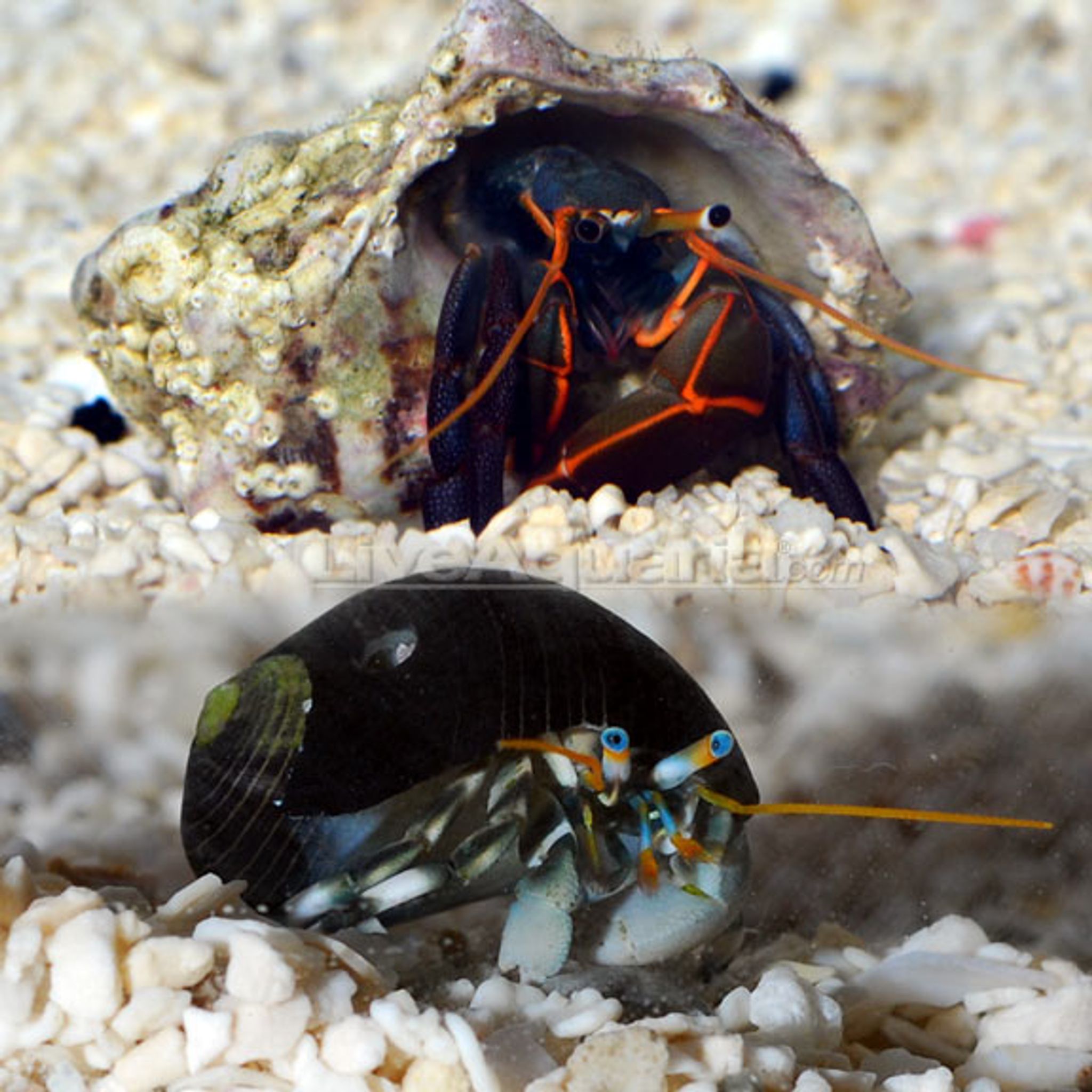
- Electric blue hermit crab — striking blue coloration, but grows larger and more active than the dwarf species above.
- Halloween hermit crab — orange-and-black coloring, moderate size.
Dwarf species (scarlet reef, blue-leg, red-leg) mostly stay under 1–2 inches and are the safest default for mixed reef tanks. Electric blue and other larger hermits need more room and closer observation, since they are bolder and more likely to disturb tank mates.
Best Fish Tank Mates
Small, peaceful reef fish that spend their time in the water column or picking at rock generally ignore hermit crabs entirely:
- Clownfish
- Gobies
- Blennies
- Dartfish
- Cardinalfish
- Firefish
These species share the same reef environment without competing for the same food or territory, making them a safe first choice when stocking around a clean-up crew. FishyHub's clownfish and gobies selections are a good starting point for a hermit-friendly community.
Fish to Avoid or Watch
Predatory or aggressive species can eat, injure, or constantly stress hermit crabs:
- Wrasses — many species actively hunt small crustaceans.
- Triggerfish — strong jaws capable of cracking shells.
- Puffers — opportunistic crab predators.
- Groupers and lionfish — large ambush predators that will eat anything crab-sized.
Beyond outright predators, any large or highly territorial fish can also keep hermit crabs hiding constantly, which limits their usefulness as scavengers and stresses them over time.
Best Invertebrate and Coral Tank Mates
Cleaner shrimp, peppermint shrimp, and most other ornamental shrimp generally coexist well with hermit crabs. Both groups are largely nocturnal foragers, so there is some territorial overlap after lights-out, but conflicts are uncommon when food and hiding spots are adequate. New shrimp and crabs should still be watched during the first few days in a shared tank.
Snails — nassarius, cerith, trochus, and astrea — are the highest-risk tank mates. Hermit crabs may kill a snail specifically to take over its shell rather than for food, and this risk climbs sharply when spare shells are scarce or the crab has outgrown its current one.
Clams, including Tridacna species, are usually fine tank mates since they attach to the substrate or rockwork and stay put, giving crabs little reason to bother them.
For coral compatibility:
- Small, peaceful hermit species rarely bother sessile corals.
- Larger or more active hermits can knock over unsecured frags while foraging.
- Soft corals like mushrooms and zoanthids are generally tolerated, since crabs simply walk over them without much disturbance.
- LPS corals can get irritated if a crab repeatedly climbs on them, so give them room away from rockwork paths crabs travel.
Gluing or anchoring frags, and planning coral placement away from well-worn crab pathways, prevents most physical contact incidents.
| Tank Mate Group | Compatibility | Notes |
|---|---|---|
| Clownfish, gobies, blennies, firefish | High | Ignore crabs, minimal overlap |
| Wrasses, triggerfish, puffers | Low | Can eat or injure crabs |
| Cleaner/peppermint shrimp | High | Some nighttime overlap, usually fine |
| Snails (nassarius, cerith, trochus, astrea) | Highest risk | Targeted for shells, not food |
| Clams (Tridacna spp.) | High | Stationary, little interaction |
| Soft corals (mushrooms, zoas) | High | Tolerate foot traffic |
| LPS corals | Moderate | Keep clear of crab paths |
| Large/electric blue hermits with small shrimp or snails | Low | Needs more space, more monitoring |
Shell Management: The Real Compatibility Factor
Shell supply — not species selection — is the single biggest driver of hermit crab aggression. Crabs that cannot find a properly sized shell will take one from a tank mate, usually a snail, by force.
- Keep 3–5 empty spare shells per crab in the tank at all times.
- Spares should be slightly larger than each crab's current shell, since crabs upgrade as they grow.
- Keep a range of graduated sizes on hand rather than a single size, since a mixed clean-up crew includes crabs at different growth stages.
- Shells can come from pet-supply sources or cleaned natural shells; either way, rinse and inspect them for residue before adding them to the tank so nothing decaying gets introduced.
- Watch for one hermit consistently harassing others or targeting snails — it's often an individual behavior rather than a species trait, and a persistently aggressive crab may need to be rehomed to a separate tank rather than removing the whole species from your stocking plan.
Feeding and Diet
Hermit crabs are omnivorous scavengers and algae grazers, but they should not be left to rely on leftover scraps and biofilm alone in an established reef tank. A consistent supplemental diet sharply reduces attacks on snails and grazing damage to coral polyps.
- Offer sinking algae or spirulina pellets and dried seaweed as a base diet.
- Add occasional meaty foods — mysis shrimp, chopped shrimp, or chopped fish — a few times a week.
- Feeding frequency is debated: some recommend small portions twice daily, others 2–3 times per week. A practical middle path is small, near-daily supplemental feedings, scaled down if the tank already has strong natural algae growth and adjusted upward if the clean-up crew looks undersized relative to food availability.
- Underfeeding is one of the most common causes of hermit crabs turning predatory toward snails, coral polyps, or slow-moving fish.
Calcium and Iodine for Molting
Healthy exoskeleton and shell development depends on stable calcium and iodine levels:
- Crushed coral substrate and cuttlebone provide grazable calcium sources.
- Reef calcium and iodine dosing supports both molting crabs and the wider reef system.
Molting Care
Molting is a normal but vulnerable part of a hermit crab's life cycle:
- Juveniles molt roughly monthly.
- Mature adults molt far less often — up to around 18 months between molts in some specimens.
- A freshly molted crab looks pale, soft, and often hides for a period afterward.
- Never remove a molting crab. A motionless, pale crab is very often mid-molt, not dead — disturbing or discarding it can kill an otherwise healthy animal.
- Leave the shed exoskeleton in the tank. The crab (or its tank mates) will consume it to recover calcium.
Stocking Density and Tank Size
As a rule of thumb for a mixed clean-up crew, stock roughly 1 small hermit crab per 3–5 gallons of tank volume. This ratio should factor into your overall clean-up crew planning, not just hermit crab numbers in isolation — snails, shrimp, and other scavengers all draw from the same food supply.
- Reserve larger or electric blue hermits for tanks of 75+ gallons, with regular observation, since their bolder behavior and larger size raise the risk to fish and corals in smaller systems.
- Stick to dwarf species in nano and mixed reef tanks under that size.
- Overstocking a clean-up crew relative to tank size and food supply increases competition for shells and territory, which is one of the most common causes of aggression that isn't tied to any particular species.
- Avoid adding hermit crabs to an immature or uncycled tank with little biofilm or algae present; starvation-driven aggression is common when crabs are introduced before there's enough natural food to support them.
Water Parameters and Acclimation
Hermit crabs are sensitive to abrupt swings in salinity and temperature, so slow acclimation matters as much as stable long-term parameters.
- Temperature: 74–78°F (23–26°C)
- Specific gravity: 1.023–1.025
- pH: 8.1–8.4
- Stable calcium and alkalinity, supporting both shell integrity and exoskeleton health
Drip acclimate new hermit crabs over 30–60+ minutes rather than a quick temperature-matched dump. It's also worth a brief visual inspection of new crabs and their shells for hitchhikers or signs of parasites before adding them to an established reef, since crabs are commonly shipped alongside live rock and macroalgae.
Common Mistakes to Avoid
- Skipping spare shells — leads directly to crabs killing snails or fighting each other over housing.
- Underfeeding — pushes otherwise peaceful crabs toward predatory behavior.
- Mistaking a molting crab for dead — wait it out in a safe spot instead of removing it.
- Throwing away a shed exoskeleton — leave it for the crab to eat.
- Adding crabs too early — an uncycled tank with little algae or biofilm invites starvation-driven aggression.
- Overstocking the clean-up crew — creates shell and territory conflicts even with well-fed crabs.
- Pairing large hermit species with small shrimp or snails in tight quarters without enough hiding spots.
- Skipping drip acclimation — sudden parameter swings are a common and preventable cause of stress or death.
Frequently Asked Questions
Are hermit crabs reef safe?
Generally yes for small, dwarf species when they're fed properly and given an ample supply of spare shells. Risk rises significantly with hunger, shell shortages, or when keeping larger hermit species in smaller tanks.
Will hermit crabs eat my snails?
They can, but it's usually to take over the snail's shell rather than for food. Supplying several spare shells of the right size and feeding consistently largely prevents this behavior.
Can hermit crabs live with shrimp?
Yes, most peaceful ornamental shrimp — including cleaner and peppermint shrimp — coexist fine with hermit crabs. It's still worth monitoring new introductions for the first few days.
What fish should I avoid with hermit crabs?
Avoid predatory or large species such as triggerfish, puffers, groupers, and many wrasses, which may eat or injure small crabs. Stick to peaceful reef fish like clownfish, gobies, and blennies instead.
How many hermit crabs can I put in my tank?
A common guideline is roughly one small hermit crab per 3–5 gallons, counted as part of your overall clean-up crew rather than in isolation. Avoid overcrowding, since it increases competition for shells and food.
Do hermit crabs harm coral?
Small, peaceful species rarely bother sessile corals. Larger or more active hermits can occasionally knock over unsecured frags or irritate LPS corals by climbing on them, so keep coral placement away from well-traveled rockwork paths.
Why is my hermit crab not moving or looks dead?
It's most likely mid-molt rather than dead. Leave it undisturbed in a safe area of the tank and avoid removing it — molting crabs are vulnerable and shouldn't be handled.
What size shell does my hermit crab need?
A shell slightly larger than its current one, so it has room to grow into. Keep several backup shells in graduated sizes available at all times rather than a single spare.
Browse FishyHub's marine invertebrates selection to round out a hermit crab-friendly clean-up crew with compatible shrimp, snails, and crabs.


