
Best Tank Mates for Harlequin Rasbora: Compatible Fish and Species to Avoid
The best harlequin rasbora tank mates are small, peaceful fish that like the same soft, slightly acidic tropical water: pygmy corydoras, otocinclus, neon and ember tetras, chili rasboras, cherry barbs, and a centerpiece honey gourami. Avoid fin nippers, fast bullies, and anything with a mouth big enough to swallow a 1.5-inch fish. Below you'll find a compatibility table, stocking plans for 10-, 20-long, and 29–40-gallon tanks, and straight answers on the borderline picks.
Harlequin Rasbora Basics
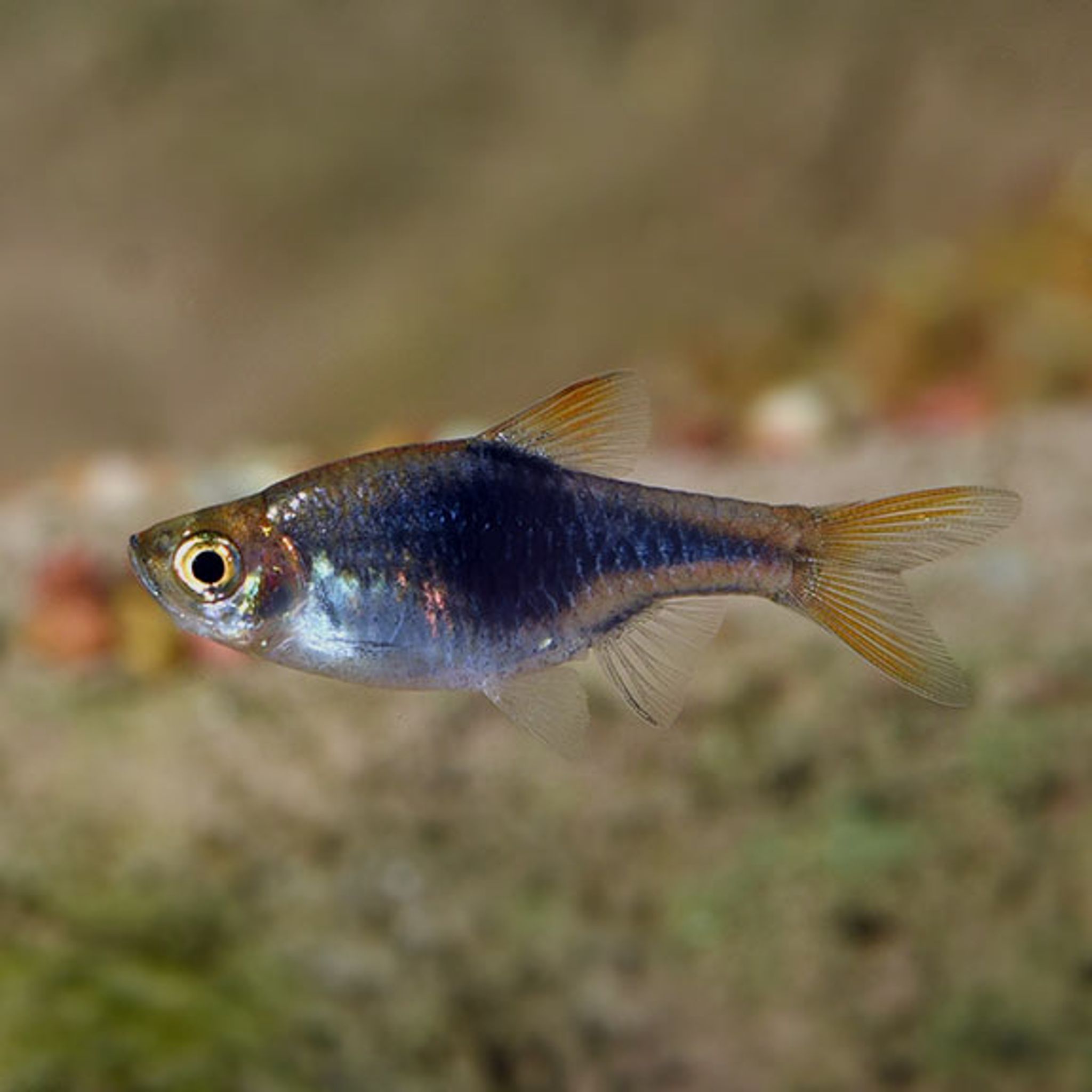
The harlequin rasbora (Trigonostigma heteromorpha) comes from Southeast Asia: the Malay Peninsula, southern Thailand, Sumatra, and Borneo. Adults reach about 1.5–2 inches (4–5 cm) and live 5–8 years with good care. You can spot one by its copper-orange body and the black triangular "wedge" near the tail.
They're peaceful fish that stay in the top and middle of the water column, so they leave the bottom and the surface zone open for other species.
Water parameters your tank mates must share
- Temperature: 72–80°F (22–27°C); 76–78°F (24–26°C) is the sweet spot
- pH: 6.0–7.5; they prefer slightly acidic water but can handle up to about 7.8 once acclimated
- Hardness: soft to moderate, around 2–12 dGH
Any tank mate needs to be comfortable in that range. That rules out hard-water specialists like African rift lake cichlids and makes mollies a poor fit.
Group size and tank size
- Group size: 6 is the absolute minimum, but 8 or more is the better starting point. Groups of 3–4 turn pale and skittish and spend their time hiding. A school of 15–20 looks far more impressive.
- Tank size: a 10-gallon (38 L) tank works for a small species-only group. Once you add companions, a 20-gallon long (76 L) is the realistic minimum. Horizontal length matters more than height, because these fish swim back and forth.
The Compatibility Rule of Thumb
Before you buy any fish to go with harlequins, check four things:
- Temperament: peaceful, with no history of fin nipping
- Size: under about 3–4 inches (7.5–10 cm) as an adult
- Water: overlapping temperature and pH ranges
- Mouth size: the mouth-size rule. If an adult of that species can fit a 1.5-inch fish in its mouth, it will eventually try, even if the store labels it "peaceful." This happens most often at night.
Best Tank Mates by Water Layer
The easiest way to build a balanced community is to stack the layers: one bottom-dwelling group, one midwater school (the harlequins can be this), and an optional centerpiece. The tank stays busy without species fighting over the same space.
Bottom dwellers
- Corydoras: pygmy, panda, or sterbai cories in groups of 6+. Pygmies suit smaller tanks. Browse corydoras on FishyHub.
- Otocinclus: small algae grazers that do best in groups in a mature tank.
- Kuhli loaches: shy, eel-like, and more active after lights-out. Give them a soft substrate.
- Bristlenose pleco: a good algae eater for larger tanks.
Midwater schools
- Tetras: neon, cardinal, ember, rummy-nose, and glowlight tetras are all good choices. See the tetra selection for options.
- Other small rasboras: chili rasboras and lambchop (espei) rasboras.
- Cherry barbs: the peaceful exception among barbs.
- Zebra or pearl danios: active and fast, so give them a bigger tank.
Top dwellers
- Hatchetfish: they jump, so you'll need a tight lid.
- Endlers, guppies, and platies: these lean toward harder water but do fine near neutral pH.
Centerpiece fish
- Honey, sparkling, or pearl gourami: calm and a good size for a community tank.
- Dwarf gourami: colorful, but see the health warning below.
- Bolivian ram: the safest dwarf cichlid for this setup.
- One betta: possible with conditions (see below).
Invertebrates
- Nerite and mystery snails: completely safe.
- Amano shrimp: too big to be bothered.
- Cherry shrimp: adults are safe, but babies get eaten.
Temperature and Compatibility Chart
| Tank mate | Adult size | Temp overlap with harlequins | Verdict |
|---|---|---|---|
| Neon tetra | ~1.5 in (4 cm) | Good (neons like 72–76°F / 22–24°C) | Excellent |
| Pygmy corydoras | ~1 in (2.5 cm) | Good | Excellent |
| Kuhli loach | 3–4 in (7.5–10 cm) | Good | Excellent |
| Chili rasbora | under 1 in (2.5 cm) | Good | Excellent |
| Cherry barb | ~2 in (5 cm) | Good | Excellent |
| Honey gourami | ~2 in (5 cm) | Good | Great centerpiece |
| Guppy / Endler / platy | 1–2.5 in (2.5–6 cm) | Good at neutral pH | Good |
| Betta | ~2.5 in (6 cm) | Good | Conditional |
| Bolivian ram | ~3 in (7.5 cm) | Good | Good in 29+ gal |
| White cloud minnow | ~1.5 in (4 cm) | Poor, prefers cooler water | Skip |
| Molly | 3–4 in (7.5–10 cm) | Temp fine, water too soft | Skip in soft water |
| Adult angelfish | 6 in (15 cm) tall | Good | Risky, predator |
| Tiger barb / serpae tetra | 1.5–3 in (4–7.5 cm) | Good | Avoid, nippers |
| Goldfish | 6+ in (15+ cm) | Poor, coldwater | Avoid |
The Borderline Picks: Where Opinions Split
Bettas
Some keepers call harlequins the ideal betta companion; others won't mix them at all. What works: a 15–20+ gallon (57–76 L) tank, a calm betta, and a large rasbora school so no single fish gets singled out. Have a backup tank ready in case the betta chases, or in case the rasboras start picking at long fins.
Dwarf cichlids
A Bolivian ram is the safest choice. Kribensis and Apistogramma can work only in 30+ gallon (114 L) tanks with caves. Watch them closely when they spawn, because guarding parents become territorial.
Barbs
Cherry barbs (and gold barbs, according to some keepers) are fine. Tiger barbs and other nippy barbs are not.
Livebearers
Platies, guppies, and Endlers are fine near neutral pH. Skip mollies in soft water, since they prefer hard or brackish conditions.
Dwarf gouramis
Dwarf gouramis are compatible in temperament, but the species has a known disease problem (iridovirus), and fresh imports can carry it. Buy healthy-looking stock and quarantine it.
Species to Avoid
- Large or predatory cichlids: oscars, Jack Dempseys, and most Africans. Adult angelfish are a gray area.
- Fin nippers: tiger barbs and serpae tetras.
- Pushy "sharks": red-tail and rainbow sharks, and bala sharks (which also grow too big).
- Goldfish: they're coldwater fish with completely different needs.
- Large catfish, arowana, and big gouramis: all have mouths that can swallow a harlequin.
Sample Stocking Plans
| Tank | Harlequins | Companions | Notes |
|---|---|---|---|
| 10 gal (38 L) | 8 | Nerite snails, cherry or Amano shrimp | Species-only; don't add a fish community |
| 20 gal long (76 L) | 8–10 | 6 pygmy cories + a few otos or one honey gourami | Pick one centerpiece option |
| 29–40 gal (110–151 L) | 10–12 | 8–10 tetras or chili rasboras, 6 cories, a pair of honey gouramis or a Bolivian ram | Room for full layers |
These counts assume regular water changes and decent filtration. Stock gradually so the biological filter can keep up with the added bioload.
Shoaling Tips for a Tighter Group
Shoaling means a loose social group; schooling means tight, synchronized swimming. Harlequins do both, and you can encourage schooling:
- Keep odd-numbered groups of 7–11, which tend to split into smaller cliques less often.
- Leave the center of the tank open and put decor along the back and sides.
- A dark substrate and some floating plants make them feel more secure.
- High nitrate and small numbers both break up the school.
- Match energy levels: very fast species like danios can make harlequins nervous in a small tank.
Building a Southeast Asia Biotope
To build a biotope, pick a region or river system first, then choose fish, plants, and invertebrates found there. For harlequins, use soft, slightly acidic water (pH 5.5–7, 77–82°F / 25–28°C), driftwood or root wood, leaf litter (catappa or oak), and gentle flow.
Species that fit the region include chili rasboras, sparkling and licorice gouramis, kuhli loaches, and pygmy or glass catfish. Cherry barbs come from Sri Lanka, so they're close but not an exact match.
Lookalikes: lambchop rasboras and the false harlequin look very similar. You can keep them together without worrying about hybrids, but each species will school with its own kind, so buy a full group of each.
Harlequins in Planted Aquariums
Harlequins are a classic planted-tank fish. They never uproot or eat plants, and their copper color stands out against green leaves. Good plant choices include Cryptocoryne, Java fern, Java moss, Bucephalandra, and Rotala.
They lay eggs on the undersides of broad leaves like Crypts and Anubias. In a community tank, other fish will almost always eat the eggs. If you want fry, set up a separate breeding tank.
Feeding a Mixed Community
Harlequins are small-mouthed omnivores. Feed crushed flake, micro pellets, and frozen daphnia, brine shrimp, or baby brine shrimp. Spread the food across the surface, or feed in two spots, so faster eaters don't take it all. Drop sinking wafers for cories and loaches.
Introducing New Fish
- Quarantine every new fish for about 2–4 weeks.
- Add the harlequins and other peaceful schooling fish first.
- Add the centerpiece fish last so it doesn't claim the whole tank as its territory.
- Watch closely during the first week for nipping or chasing.
Common Mistakes and Troubleshooting
- Buying only 3–4 fish: they hide and lose their color. Build the group up to 8+.
- Adding fin nippers or fast bullies: you'll see torn fins and fish pinned in corners. Rehome the aggressor.
- Trusting "peaceful" big-mouthed fish: adult angelfish and large gouramis can eat rasboras overnight.
- Mismatched water: hard-water livebearers or coldwater goldfish won't do well in the same conditions.
- Overstocking a 10-gallon: a full community in a small tank leads to ammonia and nitrate spikes.
- Rasboras missing meals: fast eaters get to the food first. Feed at two spots.
Troubleshooting: faded color, clamped fins, or panicked scattering usually point to stress from poor water quality, a bully, or a group that's too small. Test ammonia, nitrite, and nitrate first. If the water is fine, watch the tank at feeding time to find the troublemaker.
Frequently Asked Questions
Can harlequin rasboras live with bettas?
Often, yes. It works best in a 15+ gallon (57 L) tank with a mellow betta and a large rasbora school. Watch for chasing and fin nipping, and keep a backup plan.
Will harlequin rasboras eat shrimp?
Adult cherry and Amano shrimp are safe. Newborn shrimplets may get picked off, and dense Java moss gives them places to hide.
How many harlequin rasboras can go in a 10 or 20 gallon tank?
About 8 in a 10-gallon (38 L) species-only tank. In a 20-gallon long (76 L), keep 8–12 along with a few small companions.
Can harlequin rasboras live with neon tetras?
Yes, it's close to an ideal match. Neons like it a little cooler (72–76°F / 22–24°C), so set the heater around 76°F (24°C) and both species will be comfortable.
Are angelfish safe with harlequin rasboras?
They're risky. Adult angelfish can eat grown harlequins. The combination only has a chance if the fish grow up together in a large tank.
Do harlequin rasboras need a planted tank?
Not strictly, but plants and shaded areas noticeably improve their color and confidence. Easy plants like Java fern and Cryptocoryne are enough.
Build Your Harlequin Community
A good harlequin community comes down to a group of 8+ rasboras, one bottom-dwelling group, and at most one calm centerpiece, all in water that suits everyone. When you're ready to stock, browse harlequin and other rasboras or the full range of small community fishes on FishyHub.


