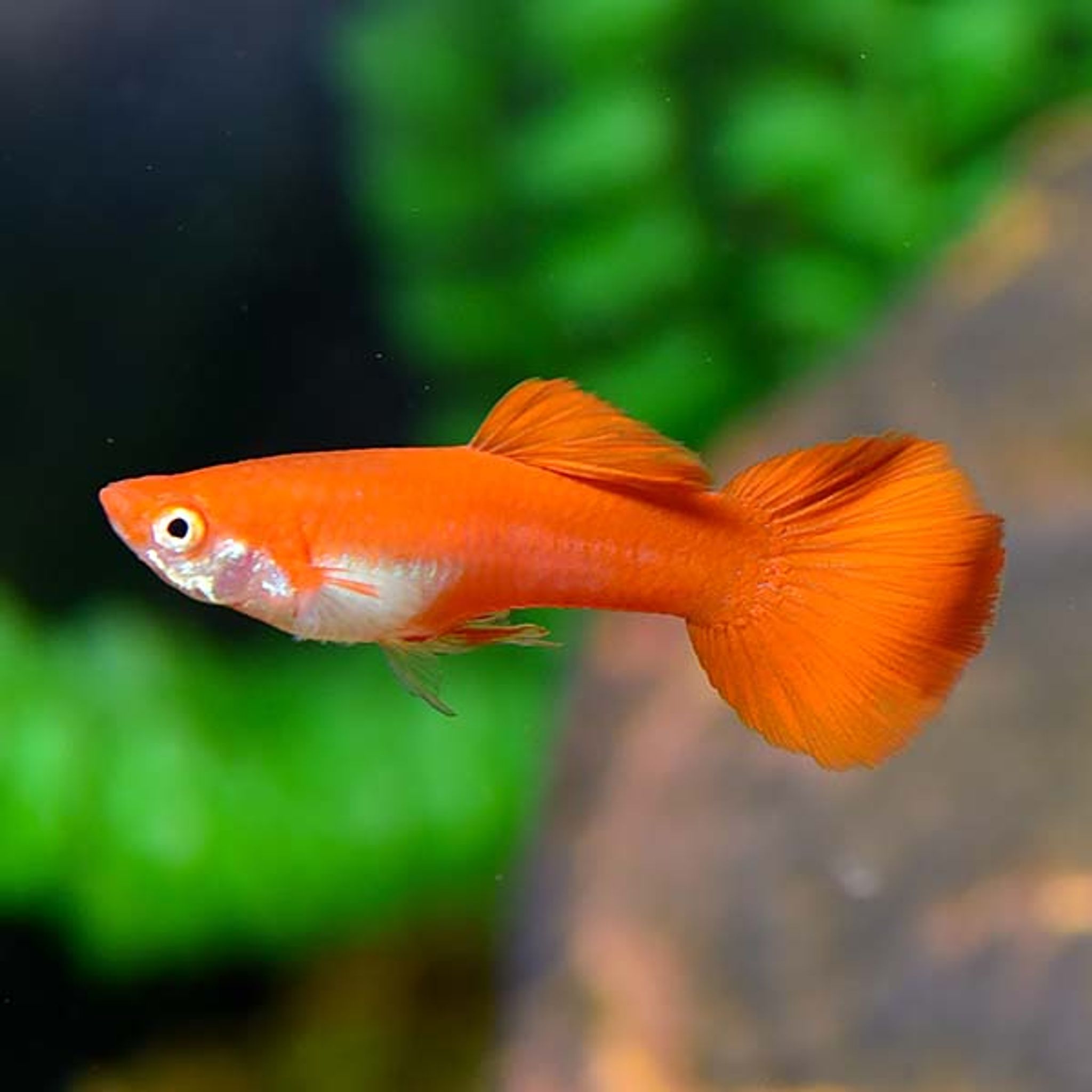

Best Tank Mates for Guppy: Compatible Fish and Species to Avoid
The best tank mates for guppies are small, calm fish that like the same warm, fairly hard water: platies, corydoras, harlequin rasboras, small tetras, otocinclus, honey gouramis, and invertebrates like nerite snails and Amano shrimp. Skip fin nippers such as tiger barbs, male bettas, and any fish with a mouth big enough to swallow a guppy. Below you'll find a three-question test for any candidate, picks sorted by tank level and tank size, and notes on pairings where hobbyists disagree.
The Three-Question Compatibility Test
"Peaceful" alone doesn't tell you much. Before buying any companion, ask:
- Will it leave long male tails alone? Fancy male guppies are slow swimmers with big, flowing fins, so they attract nippers. Short-finned wild-type or Endler-like guppies are tougher.
- Is its mouth too small to swallow an adult guppy? A good rule of thumb: if a fish's mouth can fit a guppy, it will eventually eat one.
- Does it like hard, alkaline water? Guppies do best at 72–82°F (22–28°C) and tolerate roughly 64–84°F (18–29°C). They want pH 7.0–8.5 and fairly hard water, about 8–12 dGH (140–215 ppm). A companion's range should overlap this one.
That third question matters a lot in the US. Many municipal water supplies are moderately hard, which suits guppies. Test your GH and KH before choosing soft-water species like cardinal tetras. Don't assume your tap water matches what a fish profile says.
Guppy Basics That Shape Your Choices
- Tank size: 10 gallons (38 L) is the minimum for a guppy trio on its own. A mixed community needs 20 gallons (76 L, a "20 long" is ideal) or more. Bristlenose plecos and schools of cardinal-size tetras do better in 29–30 gallons (110–114 L).
- Group size: Keep 3 or more guppies. One male to two or three females spreads out the male's constant chasing. All-male groups work in planted tanks if you keep enough males that no single fish gets all the attention.
- Can guppies live alone? No. They're social, and a lone guppy is stressed. Avoid pairs too, since one female takes all of the male's pursuit.
Best Tank Mates for Guppies by Tank Level
Top and Midwater
- Platies: Hardy livebearer cousins with the same water needs. They're probably the easiest match.
- Harlequin rasboras: Calm, colorful, and they school in the middle of the tank.
- Small tetras: Neon, ember, and black neon tetras. Keep them in schools (see the neon notes below).
- Chili and galaxy rasboras: Tiny and gentle, good for smaller planted tanks.
- Cherry barbs: One of the few barbs that leaves fins alone.
- White cloud minnows: Tolerate cool water and do best at the lower end of the guppy range.
- Honey gourami: A mellow, small gourami that works as a centerpiece fish.
- Swordtails and mollies: Compatible, but they need 20–30 gallons (76–114 L), and mollies like harder water.
You can browse many of these on FishyHub in small community fishes.
Bottom Dwellers and Cleanup Crew
- Corydoras: A top pairing. Keep 6 or more on soft sand.
- Kuhli loaches: Shy, eel-like diggers that come out at dusk.
- Otocinclus: Algae grazers for mature tanks, kept in groups.
- Bristlenose pleco: Stays small for a pleco but still belongs in 29–30 gallons.
- Nerite snails: Graze algae and won't breed in freshwater.
- Amano shrimp: Big enough to be safe, and hard-working algae eaters.
- Cherry shrimp: Adults are fine. Guppies eat the babies, though, so you'll need heavy moss cover if you want a colony.
Temperature and Water Overlap Chart
| Tank mate | Temp range °F (°C) | Water preference | Fit with guppies |
|---|---|---|---|
| Guppy (baseline) | 72–82 (22–28) | pH 7.0–8.5, hard | — |
| Platy | Overlaps guppy range | Hard, alkaline | Excellent |
| Molly | Overlaps guppy range | Harder water | Good in 20–30 gal |
| Corydoras | Overlaps guppy range | Neutral to moderate | Excellent |
| Neon tetra | Overlaps guppy range | Softer; OK near pH 7.0–7.6 if captive-bred | Good in schools of 8+ |
| Zebra danio | Best at 72–76 (22–24) | Adaptable | Good with short fins |
| White cloud minnow | Cool end of range | Adaptable | Good at lower temps |
| African dwarf frog | 72–82 (22–28) | Adaptable | Good, 10 gal minimum |
| Discus | 82–86 (28–30) | Soft, acidic | Poor, skip |
| German blue ram | Warm end or above | Warm, soft | Poor |
| Goldfish | Cold water | Heavy waste load | Avoid |
Sample Stocking Plans by Tank Size
Stock slowly over several weeks and add each school in one batch, not a few fish at a time.
| Tank | Guppies | Companions |
|---|---|---|
| 10 gal (38 L) | A trio up to about 5 | A few nerite snails or Amano shrimp; optionally a small group of pygmy corys |
| 20 gal long (76 L) | 8–10 | A small school (harlequins or ember tetras) plus 6 corydoras, nerites |
| 29–30 gal (110–114 L) | 10 or so | School of 8+ neons or rasboras, 6+ corys, a honey gourami, a bristlenose pleco, snails/shrimp |
Keep stocking light if you care about perfect fins. Crowding increases stress and nipping.
Pairings Hobbyists Disagree On
Guppies and Neon Tetras
Most lists call neons ideal, but they prefer softer water than guppies do, and cardinals also want warmer water. Choose captive-bred neons, keep the pH near neutral (about 7.0–7.6) with moderate hardness, and add a school of 8 or more at once. Neons are sensitive in new tanks, so add them after the tank has matured.
Guppies and Zebra Danios
A hardy pair that does well at the cooler end, 72–76°F (22–24°C). Danios are fast, though, and some will nip long tails. Keep 6 or more danios in a larger tank, and pair them with short-finned guppies instead of show-tail males.
Guppies and Endler's Livebearers
They get along, but Endlers hybridize with guppies. Only mix them if the group is all one sex or you don't care about pure lines.
Guppies and Bettas
Avoid male bettas entirely. Their fins and attitude clash with male guppies, and shredded tails usually follow. A female betta might work in a 20+ gallon (76+ L) planted tank, but have a backup tank ready.
Ram Cichlids and Guppies
Possible, but not ideal. German blue rams need warmer, softer water and guard territory when spawning. Bolivian rams match guppy conditions better if you want a dwarf cichlid. Skip discus: they want soft water at 82–86°F (28–30°C).
Dwarf Gourami vs. Honey Gourami
Male dwarf gouramis can be territorial, and the species is prone to an iridovirus. The honey gourami is the safer choice.
Guppies and African Dwarf Frogs
A peaceful match at the same 72–82°F (22–28°C). Recommended minimums range from 2.5 to 10 gallons, so go with 10 gallons (38 L). Frogs are slow, nearly blind eaters, so target-feed sinking food near them. They may eat fry, and they need a tight lid.
More Pairing Notes
Guppies and Corydoras
One of the best combinations. Keep groups of 6 or more on sand and feed sinking food. Pygmy and panda corys suit smaller tanks.
Otocinclus with Guppies
Otos are gentle grazers but need a mature, algae-rich tank, plus algae wafers or blanched vegetables as a supplement. Keep them in groups of 4 or more.
Are All Livebearers Compatible?
Their behavior matches well, but cross-breeding is a concern. Guppies can cross with mollies and Endlers, and platies and swordtails cross with each other. Hybrids are often weak, so use single-sex groups if you mix livebearers.
Show-Tank Mates for Fancy Guppies
For a display where the tails stay perfect, choose small, mellow fish in contrasting colors: ember tetras, harlequin rasboras, corys, nerites, Amanos, and otos. Keep stocking light and plant the background densely.
Species to Avoid
| Avoid | Why |
|---|---|
| Tiger barbs, serpae tetras, black skirt tetras | Well-known fin nippers |
| Male bettas | Attack flowing guppy fins |
| Large or territorial cichlids, oscars | Aggressive, and big enough to eat guppies |
| Angelfish (once grown) | Adults can swallow guppies |
| Large gouramis | Too big and can be pushy |
| Puffers, including dwarf (pea) puffers | Nip fins and harass slow fish |
| Arowanas | Predators |
| Goldfish | Cold-water fish with a heavy waste load |
Fry: What Really Happens
Guppies of both sexes together breed nonstop, and almost every tank mate eats fry, including the guppies themselves. To let a few survive, add dense plants and floating cover, or move pregnant females to a separate grow-out tank. If you don't want a population boom, stock all males. For extra fry, local stores will sometimes take them; ask ahead of time.
Feeding, Cover and Quarantine
- Feeding: Guppies grab food fast at the surface and midwater. Drop sinking wafers or pellets for corys and plecos after lights out so bottom dwellers get their share.
- Plants and cover: Java fern, anubias, hornwort, and floating plants lower stress and give harassed females and fry places to hide.
- Quarantine: Keep new fish separate for 2–4 weeks. Guppies are prone to parasites and columnaris, and buying from several sources raises the risk. A simple routine: a bare quarantine tank with a sponge filter, daily observation, and treatment only if symptoms show up.
Common Mistakes and Troubleshooting
- Buying a betta "because both are pretty." Shredded tails usually follow.
- Adding a semi-aggressive fish to a small tank. Aggression gets worse with crowding.
- Ignoring water mismatch, like soft-water species in hard tap water or the reverse.
- Too many males, not enough females. Females end up harassed and stressed.
- Expecting fry to survive in a community tank without cover.
- Skipping quarantine.
Signs a pairing is failing: clamped or shredded fins, guppies hiding at the surface, fish going missing, or one species hogging food. If you see fin damage, watch at feeding time to find the nipper, then rehome it or add cover. If the tank is overpopulated, rehome extras or switch to all males.
Guppy with a Droopy Tail
Causes include fin nipping, fin rot, ammonia or nitrate spikes, overcrowding, old age, and tails bred too large to carry. Fix the water first and remove bullies, then consider aquarium salt or medication if you suspect infection. Recovery can take days to weeks.
Is My Guppy Sleeping or Dying?
A sleeping guppy hovers still, often low or near plants, with faded colors, and wakes up when the lights come on. A dying fish gasps, lists to one side, lies on the bottom, clamps its fins, or ignores food.
Guppy Lifespan
Guppies usually live 1.5–3 years, and fancy lines tend toward the short end. Warmer water speeds up metabolism and can shorten their lives, which is another reason to keep tank mates that are comfortable in the middle of the range, not at the top.
Frequently Asked Questions
How many guppies can go in a 10 or 20 gallon tank?
A 10 gallon (38 L) holds a trio up to about 5 guppies. A 20 gallon (76 L) can hold 8–10 guppies plus a small school and a group of corydoras. Stock gradually and watch water quality.
Can guppies live with bettas or goldfish?
Generally no. Male bettas go after guppy fins, and a female betta is risky even in a 20+ gallon planted tank. Goldfish need cooler water and produce heavy waste, so they don't suit a tropical guppy tank.
Will shrimp breed with guppies in the tank?
Adult cherry and Amano shrimp are safe with guppies. Cherry shrimp will breed, but guppies eat the shrimplets unless you give them dense moss cover. You can find options in FishyHub's shrimp selection.
Can guppies live with mollies?
Yes. They get along and like similar hard water, but mollies need 20–30 gallons (76–114 L). Guppies and mollies can hybridize, so consider single-sex groups.
What cleanup crew is best for a guppy tank?
Nerite snails, otocinclus, and corydoras work in most community tanks, and a bristlenose pleco fits tanks around 30 gallons (114 L). Amano shrimp are another good algae eater.
Do guppies eat other fish?
Only fry and very small shrimp, including their own babies. They're too small and gentle to bother adult tank mates.
Build Your Guppy Community
Start with the guppies, confirm your water hardness, then add companions that pass all three tests: fin-safe, too small to eat a guppy, and comfortable in hard water. When you're ready, browse the guppies collection on FishyHub to pick the fish at the center of your tank.


