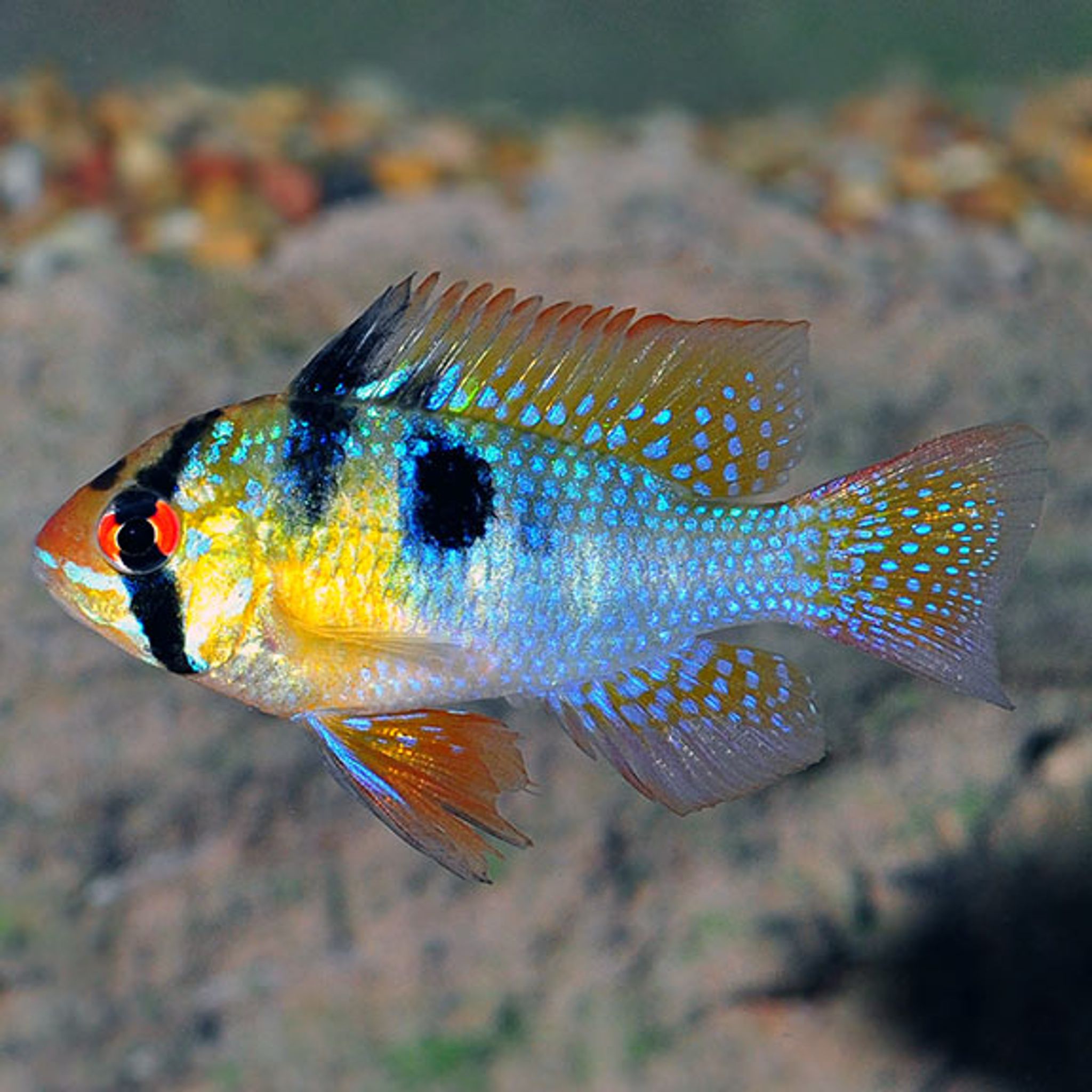

Best Tank Mates for German Blue Ram: Compatible Fish and Species to Avoid
The best tank mates for German blue rams are calm, heat-loving fish that live above them: cardinal tetras, rummynose tetras, rasboras, hatchetfish, a honey gourami, and warm-tolerant bottom fish like sterbai corydoras. Skip fin-nippers, big or pushy cichlids, and anything that prefers cool water. This guide covers why temperature matters first, which species pass that test, and how to stock 20-, 29- and 40-gallon tanks.
Know the Ram Before You Pick Its Neighbors
The German blue ram (Mikrogeophagus ramirezi), along with its electric blue and gold morphs, is a small South American dwarf cichlid.
- Adult size: about 2–3 inches (5–7.5 cm)
- Temperament: peaceful for a cichlid, but a pair will defend a small patch of floor when spawning
- Swimming level: bottom to lower middle
- Social: forms pairs
- Hardiness: delicate; needs a mature, stable tank
Water Parameters
| Parameter | Target for rams |
|---|---|
| Temperature | 78–85 °F (26–29 °C); aim for 80–84 °F (27–29 °C) |
| pH | 5.5–7.0 |
| Hardness | Soft, roughly 1–10 dGH |
| Ammonia / nitrite | 0 ppm |
| Nitrate | Under 20 ppm |
| Current | Slow |
Tank Size
A 20-gallon long (76 L) holds one pair plus a small community. Go to 30 gallons (114 L) or more if you want another dwarf cichlid or a larger dither school.
Why Temperature Is the First Filter
Most "peaceful community fish" lists ignore the fact that rams live in the low-to-mid 80s °F. A fish can be perfectly gentle and still be a poor match if it wants mid-70s water. Keeping rams down at 76 °F (24 °C) to suit cooler companions weakens their immune system, and splitting the difference stresses everyone.
So sort candidates in this order:
- Heat tolerance — comfortable at 80 °F (27 °C) and up, in soft, acidic water
- Temperament — calm, no fin-nipping
- Swimming level — ideally mid-water or surface, leaving the floor to the rams
- Size — similar or smaller, but not small enough to become a snack
- Feeding speed — not so fast that rams go hungry
Compatibility at a Glance
| Candidate | Tank level | Handles ram temperatures? | Verdict |
|---|---|---|---|
| Cardinal tetra | Middle | Yes, better than neons | Top pick |
| Rummynose tetra | Middle | Yes | Top pick |
| Harlequin and other rasboras | Middle | Yes | Good |
| Ember or lemon tetra | Middle | Yes | Good |
| Marbled hatchetfish | Surface | Yes | Good |
| Peaceful killifish, lampeyes | Upper | Yes | Good |
| Honey gourami | Upper | Yes | Good single fish |
| Betta (single) | Upper | Yes | Usually fine in 20+ gal |
| Sterbai corydoras | Bottom | Yes, unlike most cories | Good, leave floor space |
| Otocinclus, kuhli loach, bristlenose pleco | Bottom | Yes | Good with caution |
| Discus | Middle | Ideal match | 50+ gal only |
| Angelfish | Middle | Yes | Conditional, 40+ gal tall |
| Neon tetra | Middle | Struggles at 82 °F (28 °C) and above | Choose cardinals |
| Most corydoras, zebra danios | Bottom / top | Prefer cooler water | Mismatch |
| Guppies, platies, mollies, swordtails | Upper | Prefer cooler, harder water | Not ideal |
| Goldfish, white cloud minnows | Various | Cool-water fish | Avoid |
Best Tank Mates for German Blue Rams
Mid-Water Dither Fish
Dither fish are small schooling fish whose calm, open swimming tells rams the coast is clear. With a school overhead, rams usually come out more, color up and act bolder. Keep 6 or more of each species.
- Cardinal tetras — the standard choice. They handle heat far better than neons.
- Rummynose tetras — tight schoolers that do well in warm, soft water.
- Harlequin rasboras and other rasboras — peaceful and easygoing.
- Ember and lemon tetras — small, gentle options for smaller tanks.
You can browse schooling options in FishyHub's tetra selection.
Surface Dwellers
- Marbled hatchetfish stay right at the top and never compete for floor space. Keep a tight lid on the tank, because hatchetfish jump.
- Peaceful killifish and lampeyes add color in the upper layer.
- A single betta or a honey gourami works in a large enough tank. Both like warm water.
Bottom Dwellers (With Caution)
The bottom belongs to the rams, so pick floor fish carefully and leave open sand for the pair to claim.
- Sterbai corydoras tolerate warm water, unlike most corydoras. Name the species when you shop instead of buying "cories" generically.
- Kuhli loaches stay tucked in cover and rarely bother anyone.
- Otocinclus graze algae on glass and plants.
- Bristlenose pleco is a manageable algae eater for ram-sized tanks.
FishyHub's plecos, corys and bottom dwellers category is the place to look for these.
Larger Peaceful Companions
- Discus share the ram's taste for very warm, soft water, which makes them a classic pairing. They need 50 gallons (190 L) or more.
- Angelfish are possible in a big tank with tall decor, but they carry some risk (see below).
Where Keepers Disagree
- Livebearers (guppies, platies, mollies, swordtails): They prefer harder, more alkaline, cooler water; mollies especially. Not ideal. Guppies are acceptable if your water sits in a moderate middle ground.
- Neon tetras: Recommended everywhere, but neons like the mid-70s °F and suffer at 82 °F and above. Buy cardinals instead.
- Dwarf gourami: Some keepers call it ideal; others find it semi-aggressive, dominant and prone to disease. The honey gourami is the safer choice.
- Angelfish: They can eat small ram fry and may bully adult rams. Only try them in a 40+ gallon (150+ L) tall tank with fully grown rams.
- Clown loaches, silver dollars, black ghost knifefish: Sometimes suggested, but they need 75–125+ gallons (285–475+ L) and are very active. Leave them out of a typical ram tank.
- Apistogramma, Bolivian rams, kribensis: Some pair them with rams; others stick to one cichlid species per tank. Only attempt it in 30+ gallons with separate caves and territories. Kribs are the most assertive of the three.
- Zebra danios and most corydoras: Peaceful, but they prefer cooler water, so the temperature doesn't suit either side.
Fish to Avoid With German Blue Rams
- Fin-nippers: tiger barbs, serpae tetras and similar fish
- Large or aggressive cichlids: convicts, Jack Dempseys, oscars and most African rift lake cichlids
- Cool-water fish: goldfish and white cloud minnows
- Very boisterous fish that stir up the tank and grab all the food
- Big predators that can swallow a 2–3 inch fish
- Dwarf shrimp, if you want the colony to last. Adult rams hunt shrimplets.
Other Dwarf Cichlids: Alternatives and Companions
A good rule of thumb is one dwarf cichlid species per average-sized tank. Community-friendly dwarf cichlids include rams, cockatoo and agassizi apistos, Bolivian rams and keyhole cichlids. Rams can even raise fry in a community, though few babies survive.
Bolivian Ram
The Bolivian ram (M. altispinosus) is the hardier cousin. It tolerates cooler water, 72–79 °F (22–26 °C), and harder water, which makes it a better fit for beginners and easier to match with standard community fish.
Keyhole Cichlid
The keyhole cichlid is shy and peaceful and suits the same small community fish that rams do.
Nanochromis
Nanochromis species such as N. splendens are small dwarf cichlids from the Congo River, about 2 inches (5 cm). They like slightly acidic, soft water around 78 °F (26 °C). New pairs can be rough with each other at first, and they get along with small non-predatory fish like lampeyes. Keeping them with rams only makes sense in a large, well-structured tank. Treat this one as a niche alternative.
Checkerboard Cichlid
The checkerboard cichlid (Dicrossus filamentosus) reaches 2.25–3.5 inches (6–9 cm) and is a peaceful bottom schooler. It wants very soft, acidic water: pH 4–6.5, under 5 dGH, 79–82 °F (26–28 °C). It prefers a long tank, ideally 48 inches (122 cm), and pairs well with apistos and small tetras. It could share a blackwater tank with rams, but it's a demanding fish for experienced keepers.
Sample Stocking Plans
| Tank | Rams | Mid/upper fish | Bottom crew |
|---|---|---|---|
| 20 gal long (76 L) | 1 pair | 8–10 cardinals, embers or harlequins | 4–6 otocinclus or sterbai cories |
| 29 gal (110 L) | 1 pair | 10–12 rummynose or cardinals, plus a honey gourami or small group of hatchetfish | 5–6 sterbai cories or a few kuhli loaches |
| 40 gal (150 L) | 1–2 pairs, or 1 pair plus another dwarf cichlid species | Two schools of 8+ dithers | Sterbai cories plus a bristlenose pleco |
In the 40-gallon plan, the second pair or dwarf cichlid only works with broken sightlines and separate territories.
Setting Up the Tank to Reduce Conflict
- Plants, driftwood and leaf litter give cover and help keep water soft.
- Rocks and flat stones give rams spawning sites and natural territory markers.
- Break sightlines so a spawning pair can't see every other fish all the time.
- One pair per tank under about 30 gallons (114 L). A second pair or another dwarf cichlid needs more floor space and visual barriers.
Using Distilled or RO Water
Distilled or RO water helps you reach soft, acidic ram conditions, but pure water has no minerals. Never use it raw. Remineralize it or blend it with tap water, and mix each water-change batch the same way so pH and GH stay steady. For regular changes, a home RO unit is more practical than buying jugs.
Stocking Order and Quarantine
- Cycle the tank fully and let it mature.
- Add the dither school and cleanup crew first and let them settle.
- Add the rams last, once the tank is stable.
- Quarantine every newcomer for 2–4 weeks before it joins the display tank.
Picking Healthy Rams
Many imported rams are fragile, and some color morphs are weaker than wild-type fish. When shopping, look for fish that are actively swimming, eating, and showing full color with fins held open. Skip fish that are pale, clamped, hiding in a corner, or sharing a tank with dead or sick fish.
Feeding Rams in a Community
Rams are slow, deliberate eaters that pick at the bottom. Fast tetras and livebearers can clear the food before rams get much.
- Feed the dithers at the surface first to keep them busy.
- Target-feed sinking pellets or granules near the rams.
- Offer frozen bloodworms and brine shrimp for conditioning.
- Watch the rams' bellies; a hollow belly means they're being outcompeted.
Common Mistakes and Troubleshooting
- Adding rams to a new, uncycled tank. They are often the first fish to die when water is unstable.
- Running the tank at 76 °F (24 °C) to suit cool-water fish. This weakens their immunity.
- Mixing too many cichlid species in a small tank.
- Rams hiding and not eating: add a dither school, add more cover, target-feed, and watch for a bully.
- Rams pale or with clamped fins: check nitrate and temperature, and look for nippers.
- Aggression during spawning: rearrange the decor, add sight breaks, or remove the fish being targeted.
Frequently Asked Questions
Can German blue rams live with bettas?
Often, yes. Both like warm water, so a single betta in a planted tank of 20 gallons (76 L) or more usually works. Individual temperaments vary, so watch both fish closely for the first few weeks.
Can German blue rams live with shrimp?
Adult rams eat shrimplets, so a cherry shrimp colony will usually shrink over time. Larger Amano shrimp are generally fine because they're too big to be prey.
Should I choose neon tetras or cardinal tetras for rams?
Choose cardinals. Neons prefer the mid-70s °F and suffer at 82 °F (28 °C) and above, while cardinals handle ram temperatures much better.
Can I keep more than one pair of rams?
Yes, in 30 gallons (114 L) or more with plenty of sight breaks and floor space. In a 20-gallon tank, stick to one pair.
How many tank mates can go in a 20-gallon ram tank?
A typical plan is one ram pair, 8–10 small tetras or rasboras, and 4–6 otocinclus or sterbai cories. Add slowly and keep nitrate under 20 ppm.
Are electric blue and gold rams different from German blue rams?
They have the same care needs and tank mate rules. Some morphs are weaker, so buying healthy, active stock matters even more. If you want something more forgiving for a community tank, the Bolivian ram is the easier choice.
Build Your Ram Community
Plan around heat first, then temperament, level and feeding speed, and your rams will have calm neighbors that make them more confident. When you're ready to choose your pair, browse FishyHub's angelfish, discus, rams and cichlids collection.


