
Best Tank Mates for Dogface Puffer: Peaceful, Risky and Incompatible Choices
A dogface puffer's mild, curious personality makes it easy to assume it will get along with almost anything — but its beak and its appetite tell a different story. This guide sorts realistic tank mate options into peaceful, risky, and incompatible tiers, and explains the tank size, water quality, and feeding routine that determine whether any combination actually works.
Meet the Dogface Puffer: One Fish, Several Names
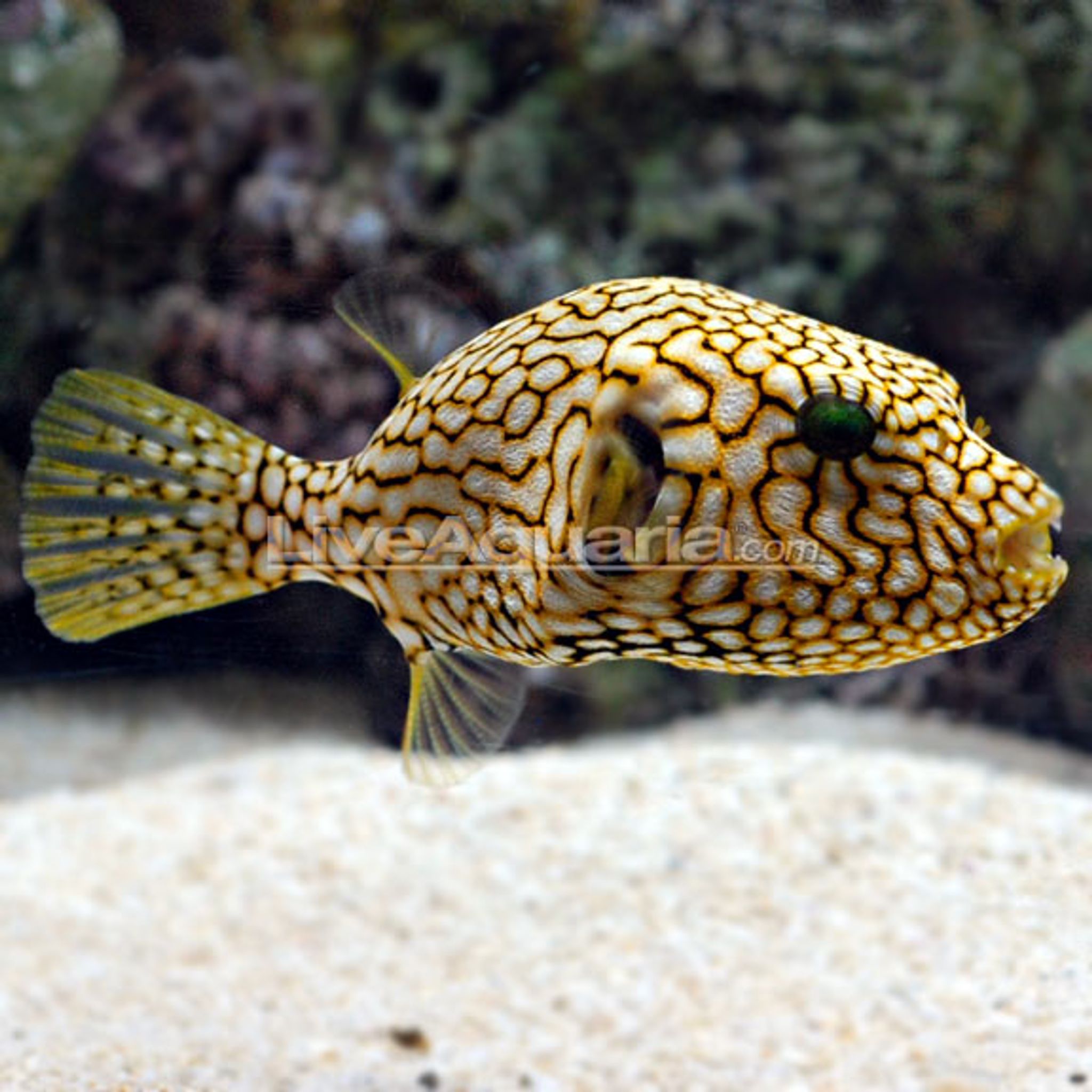
The dogface puffer sold in the trade is a single species, Arothron nigropunctatus. It shows up under several common names depending on its color phase: gray dogface, black dogface, yellow-belly (or half-yellow) dogface, and freckled dogface. These are not different species or different temperaments — just color and pattern variations of the same fish. Buyers can shop by whichever morph appeals to them without worrying that a "black" specimen will behave differently from a "yellow-belly" one; care requirements, adult size (roughly 8–13 inches / 20–33 cm), and compatibility rules are identical across morphs.
It's worth distinguishing this species from other Arothron puffers sometimes marketed with similar-sounding names, such as the stars-and-stripes puffer or reticulated puffer. Those grow larger, have different temperaments, and are not interchangeable with a dogface puffer when planning a stocking list.
Tank Size and Water Parameters That Set the Stage
Compatibility starts with the tank itself. A dogface puffer kept alone can be housed in a 100-gallon (380 L) tank as an absolute floor, though some keepers cite 90 gallons and others recommend 120–125 gallons for a single adult. Once any tank mates enter the picture, footprint matters more than raw volume: aim for 125+ gallons in a long, wide tank (ideally 5–6 feet long) rather than a tall, narrow one, so multiple mid-to-large fish have room to establish separate territories.
Target water parameters:
| Parameter | Target Range |
|---|---|
| Temperature | 74–78°F (23–26°C) |
| pH | 8.1–8.4 |
| Specific gravity | 1.020–1.025 |
| dKH | 8–12 |
Dogface puffers are messy, heavy-bioload fish. Strong mechanical and biological filtration, an appropriately sized protein skimmer, and frequent water changes aren't optional extras — they're what keeps ammonia and nitrate low enough for a mixed community to thrive. Undersized filtration is one of the fastest ways to turn a docile puffer irritable, since poor water quality raises stress and territorial behavior in every fish in the tank, not just the puffer.
One puffer per tank is the rule: dogface puffers are territorial toward their own species and toward similarly shaped puffers and tobies. Doubling up almost always ends in fin damage or a fight.
Peaceful Tank Mates: Fish That Can Hold Their Own
The dogface puffer is genuinely one of the more docile, slow-moving puffer species — but "docile" only protects tank mates that are large enough, fast enough, or tough-skinned enough not to look like food or a target. Good matches share one or more of these traits: robust body, thick scales or leathery skin, comparable adult size, and enough speed or attitude to avoid becoming a punching bag at feeding time.
- Tangs and surgeonfish — hippo tang, regal tang, yellow tang, and similar species are fast, thick-skinned, and generally ignore puffer antics.
- Larger angelfish — emperor angelfish and other large angel species are sturdy enough to coexist without being bullied.
- Rabbitfish and foxface — their spines and calm-but-alert demeanor make them a solid match.
- Robust wrasses — bluehead wrasse and similar hardy wrasses hold their own reasonably well.
- Groupers — large, unbothered, and rarely intimidated by a puffer's curiosity.
- Larger, even-tempered triggerfish species — only those known to tolerate tankmates well (see the risky tier below for the caveats).
- Lionfish — similar slow pace and temperament can make this workable in the right setup, though it's a niche, advanced pairing rather than a beginner default (see below).
You can browse compatible options directly, including tangs and surgeonfish and foxface and rabbitfish, when planning a stocking list around an established dogface puffer.
A Note on Lionfish
Lionfish are sometimes recommended as compatible tank mates because both fish are slow-moving and unhurried, which reduces the odds of chasing or fin-nipping. This is a real option, but it's an advanced combination, not a starter pairing — most beginner-focused guides skip it. The bigger consideration with lionfish isn't puffer compatibility at all; it's the venomous spines, which pose a handling risk to the keeper during tank maintenance, water changes, or aquascaping, not a risk to the puffer itself.
Risky and Case-by-Case Tank Mates
These combinations can work, but success depends heavily on individual fish temperament, tank size, and how well-fed the puffer is. Treat every entry here as "maybe," not "yes."
- Other triggerfish species — this is genuinely split territory. Some triggers coexist fine with a dogface puffer in a large enough system; others are aggressive enough to shred a puffer's fins. Because trigger temperament varies wildly by species and even by individual specimen, classify triggerfish as case-by-case rather than a blanket safe pick. Buyers exploring this route should research the specific triggerfish species carefully before committing.
- Other puffer species — territorial disputes and competition over food and space are common, even between different puffer species. This overlaps with the "one puffer per tank" rule above.
- Small or juvenile fast fish — anything that might get outcompeted for food or intimidated during feeding time is a gamble, even if the species is normally hardy as an adult.
- Boxfish — both fish are slow and low-aggression, which sounds compatible on paper. The real risk is boxfish toxin: a stressed boxfish can release toxins into the water in a closed system, which is dangerous to every other tank occupant, puffer included.
- Clownfish and other small peaceful fish — can work in a large, heavily rock-worked tank where a well-fed puffer has plenty of alternative activity and the clownfish has places to retreat. This is not guaranteed safe, and success tends to correlate directly with tank size and feeding consistency. Anyone considering this pairing should start with a fully mature tank and observe closely after introduction; clownfish are available to browse for those weighing the option.
Incompatible Tank Mates
Some combinations aren't a matter of luck — they're a mismatch that predictably ends badly.
- Eels — despite the puffer not being inherently aggressive, its nipping behavior at feeding time or out of curiosity can seriously damage an eel's exposed, scaleless skin and soft tissue. This pairing is not recommended.
- Ornamental shrimp, crabs, snails, and other motile invertebrates — a dogface puffer views these as food, not tank mates, full stop.
- Stony and soft corals — covered in detail below; this puffer is not reef safe.
- Very small or timid fish — anything easily outcompeted for food or physically overpowered will be bullied, stressed, or eaten.
- Delicate long-finned fish — lace-fin and veiltail-type fish practically invite fin-nipping and shouldn't be paired with any puffer.
Reef Compatibility: Why This Puffer Doesn't Belong With Corals
Dogface puffers have fused, beak-like teeth built to crack hard-shelled prey — and that includes coral skeletons, clam shells, and snail shells. This is not a fish that occasionally samples a coral out of curiosity; crunching hard structures is exactly what its mouth evolved to do. That makes the dogface puffer fundamentally incompatible with reef tanks. It belongs strictly in a FOWLR (fish-only-with-live-rock) setup, never in a system stocked with stony corals, soft corals, clams, or ornamental snails and crustaceans. Anyone drawn to this puffer for a reef display should reconsider the tank concept rather than the fish.
Diet and Dental Health: The Compatibility Factor Most People Skip
A dogface puffer's beak and teeth grow continuously, the same way a rodent's incisors do. Feeding hard-shelled foods 3–4 times a week — clams still in the shell, crab, shell-on shrimp, mussels, and snails — grinds those teeth down naturally. Skip this, and the beak overgrows, which does two things: it makes normal feeding harder for the puffer, and it appears to increase nipping and "testing" behavior directed at tank mates, glass, and decor, likely as the fish searches for something hard enough to gnaw on. A well-fed puffer with properly worn teeth is measurably less likely to harass tank mates than one running short on hard food or dental wear opportunities.
Introduction Order: Setting Up New Tank Mates for Success
How and when tank mates are added matters as much as which species are chosen.
- Establish the puffer first, in a mature tank with ample hiding spots and rockwork, before introducing any other fish.
- Feed heavily and consistently before and during the introduction period — a well-fed puffer is a calmer, less predatory puffer.
- Add new tank mates that are equal in size or larger than the puffer rather than small juveniles, since size parity discourages predatory and territorial responses.
- Quarantine every new arrival before adding it to the main tank. Skipping quarantine risks introducing disease that stresses the whole system and can spike aggressive behavior tank-wide.
- Avoid adding the puffer last to an already-established, potentially aggressive community — it's generally easier to introduce robust tank mates to a settled, well-fed puffer than the reverse.
Signs of a Stocking Mismatch
Watch for these red flags after introducing tank mates, and be ready to separate fish if you see them:
- Torn or ragged fins on tank mates, especially slower species
- Missing invertebrates — snails, shrimp, or crabs disappearing is a clear sign the puffer is treating them as food
- A tank mate hiding constantly or refusing food, which signals chronic stress or bullying
- The puffer refusing food or glass-surfing, both classic stress indicators that something in the current stocking mix isn't working
Any of these warrant reassessing the combination rather than waiting for things to resolve on their own.
Common Mistakes to Avoid
- Undersized tanks. Cramming a dogface puffer into anything under roughly 75–90 gallons leads to stunted growth, poor water quality, and elevated aggression driven by stress.
- Trusting the "docile" reputation too much. Delicate or slow fish like mandarins, small gobies, and ornamental shrimp are still at risk regardless of the puffer's generally calm temperament — size and shape of the prey matter more than overall disposition.
- Skipping hard-shell foods. This leads directly to overgrown teeth, feeding difficulty, and more nipping toward tank mates.
- Assuming reef safety from appearance. A puffer that looks slow and unbothered can still strip a reef tank of corals, clams, and snails within days of introduction.
- Mixing multiple puffers or puffer-shaped fish (other Arothron species, tobies) expecting harmony — territorial fights are the norm, not the exception.
- Skipping acclimation and quarantine for new tank mates, which introduces disease risk and raises aggression tank-wide.
Quick Decision Checklist
Before adding any specific tank mate, run through this list:
- Is the tank at least 100 gallons for the puffer alone, and 125+ gallons with a long footprint if tank mates are involved?
- Is the puffer already established and eating well, with hard-shelled foods offered 3–4 times a week?
- Is the candidate tank mate equal in size or larger than the puffer, robust-bodied, and reasonably fast or thick-skinned?
- Has the new fish been quarantined and properly acclimated?
- Is the tank FOWLR only, with no corals, clams, or ornamental inverts the puffer could destroy?
If any answer is no, address that gap before introducing the fish.
Frequently Asked Questions
Can dogface puffers live with clownfish?
It's generally risky in smaller tanks, but can work in large, well-fed setups with plenty of rockwork for the clownfish to retreat into. It's not a guaranteed-safe pairing, so monitor closely after introduction.
Can dogface puffers live with other puffers?
This isn't recommended. Dogface puffers are territorial toward their own species and similarly shaped puffers, and fights over territory are common even in large tanks.
Are dogface puffers reef safe?
No. Their fused, beak-like teeth are built to crack coral skeletons, clam shells, and snail shells, so they belong in FOWLR tanks only, never with corals or ornamental invertebrates.
What is the best tank size for a dogface puffer with tank mates?
Once other fish are added, aim for 125+ gallons with a long, wide footprint rather than a tall tank, so multiple fish have room to establish their own space.
Do dogface puffers eat shrimp and snails?
Yes. Ornamental crustaceans and snails are treated as food, not tank mates, and shouldn't be kept in the same system.
Can dogface puffers live with eels?
No. Even though the puffer isn't aggressive by nature, its nipping can seriously damage an eel's exposed, scaleless skin and soft tissue.
What fish are most compatible with a dogface puffer?
Robust, similarly sized fish that can hold their own — tangs, larger angelfish, and rabbitfish or foxface — tend to be the safest matches, since they're neither easily intimidated nor an easy target.
Will a dogface puffer attack bigger fish?
Rarely. The puffer seldom initiates against larger or equal-sized fish; the real risk is toward smaller, slower, or defenseless tank mates, particularly during feeding-time territorial flare-ups.
If you're planning a FOWLR system around a dogface puffer, you can browse compatible marine puffers on FishyHub to compare available color morphs and start building out a stocking plan that fits your tank size and current community.


