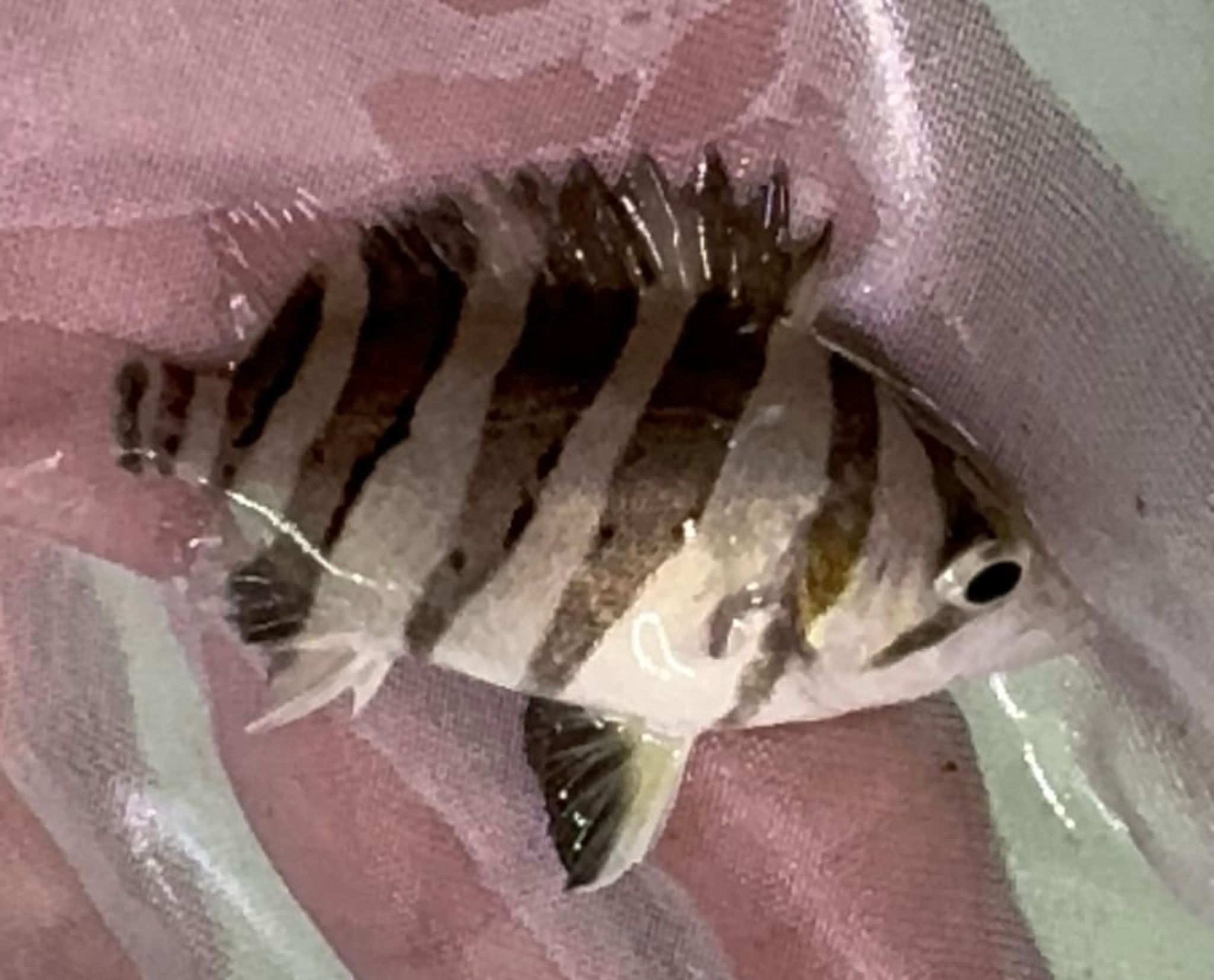

Best Tank Mates for Datnoid: Compatible Fish and Species to Avoid
The best datnoid tank mates are large, calm fish that live in a different part of the water column: arowanas at the surface, bichirs, big catfish and plecos on the bottom, and schools of tinfoil barbs or silver dollars in open water. Skip anything small enough to swallow and any rough cichlid that will bully a shy ambush predator. Below you'll find three simple filters, a compatibility table and stocking examples by tank size.
Datnoid Quick Profile
Datnoids, also called tiger perches or tigerfish, belong to the family Datnioididae. They come from Southeast Asia and New Guinea and are known for bold vertical dark bars over a gold or silver body.
- Adult size: usually 12–16 in. (30–40 cm) in aquariums; wild fish can reach 18–24 in. (45–60 cm)
- Lifespan: 10–15+ years
- Growth: slow, so a small juvenile can take years to reach full size
- Behavior: a stalking, ambush predator that swallows anything that fits in its mouth
Which datnoid do you have?
Common names get mixed up in the trade, which matters because adult sizes differ.
| Common name | Scientific name | Notes |
|---|---|---|
| Indonesian / Sumatran tiger | Datnioides microlepis | Most common in the US trade |
| Siamese tiger | D. pulcher | Rare and protected; look for captive-bred fish or choose another species |
| Thinbar / Mekong tiger | D. undecimradiatus | Smallest, about 12 in. (30 cm) max |
| Silver / four-bar tiger | D. polota | Estuarine origins |
| New Guinea tiger | D. campbelli | Estuarine origins |
Tank Size and Water Conditions
Sources give minimums anywhere from 100 gallons "to start" up to 180 gallons. A sensible plan:
- 150 gal (570 L) minimum for one adult. A 125 gal (475 L) can hold a juvenile for a while.
- 180–250+ gal (680–950+ L) once you add large companions, and up to 300 gal (1,135 L) for bigger communities.
- Footprint beats height. Length and front-to-back width give big fish room to turn and claim territory.
Water targets:
- Temperature: 75–82°F (24–28°C)
- pH: 6.5–7.5 (some fish accept 6.0)
- Hardness: soft to moderately hard, up to about 15 dGH
- Ammonia and nitrite: 0 ppm
- Nitrate: under 20 ppm
Datnoids react badly to nitrate buildup, so plan on large weekly water changes and filtration rated well beyond your tank volume. Every companion you add raises the bioload.
Do datnoids need brackish water?
Opinions differ. Most trade fish (Indonesian and Siamese types) do fine in fresh water. The New Guinea and silver/four-bar tigers come from estuaries and may benefit from a light salt addition. If you go that route, remember that many catfish and plecos tolerate salt poorly, so your tank-mate list shrinks.
The Three Rules for Choosing Datnoid Tank Mates
Rule 1: Size against the adult, not the juvenile
Every tank mate should be at least half the datnoid's adult length and too deep-bodied to swallow. A 3 in. (7.5 cm) silver dollar next to a 4 in. (10 cm) datnoid looks fine at the store; three years later it's a snack for a 14 in. (35 cm) predator.
Rule 2: Match temperament
Datnoids are generally calm and even timid, especially as juveniles. They can be testy with newcomers and with fish their own size, but that usually settles down. Choose peaceful to semi-aggressive fish. Hyper-aggressive species will harass a slow, shy predator until it stops eating.
Rule 3: Split the water column
Datnoids hover in the middle and lower-middle zone near cover. The best companions use other space:
- Surface: arowana
- Bottom: bichirs, catfish, plecos, stingrays
- Open water: fast-moving schoolers like tinfoil barbs and silver dollars
Best Tank Mates for Datnoid
These picks show up on most compatibility lists.
- Arowana: the classic pairing. The silver arowana is the most practical choice. It owns the surface and ignores a datnoid holding near the middle.
- Bichirs: Senegal, ornate, Delhezi and endlicheri bichirs stay on the bottom and are too long for a datnoid to swallow once grown. Browse bichirs on FishyHub if you're planning a bottom layer.
- Tinfoil barbs: big, fast and active. They also work as dither fish.
- Silver dollars: keep them in groups of 5 or more and add them at a decent size.
- Giant gourami: large, slow and peaceful.
- Large catfish: eclipse (Asian upside-down) catfish, and large pims or shark catfish in very big tanks.
- Large plecos: common plecos and other large species handle the bottom and algae. See the pleco selection for options.
- Other datnoids: same-species or mixed-species groups work well when sized and grouped correctly (see below).
Conditional picks
- Oscars and severums: some keepers rate them solid, others borderline. Try them only in 200+ gal (760+ L) with same-size fish, and watch for chasing. Oscars can also outcompete a datnoid at feeding time.
- Blood parrots: clumsy and small-mouthed, and their deep body only protects them once they're adult. Add them large or not at all.
- Peacock bass: only in very large tanks.
- Freshwater stingrays: possible in 180+ gal (680+ L), but rays are more sensitive to water quality than datnoids and need careful feeding.
- Pacu: realistically needs 500+ gal (1,890+ L). Treat it as public-aquarium scale, not a home option.
Datnoid Compatibility Table
| Species | Typical adult size | Zone | Min. tank with datnoid | Rating |
|---|---|---|---|---|
| Silver arowana | Very large | Surface | 250 gal (950 L) | Good |
| Senegal / ornate / Delhezi / endlicheri bichir | Varies by species; long-bodied | Bottom | 150–180 gal (570–680 L) | Good |
| Tinfoil barb | Large | Open water | 180 gal (680 L) | Good |
| Silver dollar (5+) | Medium, deep-bodied | Open water | 150–180 gal (570–680 L) | Good |
| Giant gourami | Very large | Middle | 250 gal (950 L) | Good |
| Eclipse catfish | Medium-large | Bottom | 150–180 gal (570–680 L) | Good |
| Common pleco | Large | Bottom | 150–180 gal (570–680 L) | Good |
| Other datnoids (group of 3–6+) | 12–16 in. (30–40 cm) | Middle | 250+ gal (950+ L) | Good |
| Oscar / severum | Large | Middle | 200+ gal (760+ L) | Conditional |
| Blood parrot | Medium, deep-bodied | Middle | 200 gal (760 L) | Conditional |
| Freshwater stingray | Large disc | Bottom | 180+ gal (680+ L) | Conditional |
| Peacock bass | Very large | Middle | Very large systems | Conditional |
| Pacu | Huge | All | 500+ gal (1,890+ L) | Impractical |
| Tetras, danios, rasboras, livebearers | Small | Various | — | Avoid |
| Midas, red devil, jaguar, flowerhorn | Large, aggressive | Middle | — | Avoid |
Fish to Avoid With Datnoids
Anything that fits in the mouth:
- Tetras, danios, rasboras and livebearers
- Small barbs and gouramis under about 6 in. (15 cm)
- Dwarf cichlids
- Shrimp and small snails
Rough Central American cichlids: Midas, red devil, red terror, jaguar, flowerhorn and blue umbee. They push datnoids into hiding, and a stressed datnoid turns pale or dark, stops eating and fades.
Fin-nippers: large groups of tiger barbs will pick at a slow datnoid's fins.
Can Datnoids Live Together?
Yes, and they're some of the best tank mates for each other. A single datnoid is perfectly fine. A group of 3–6 or more spreads out aggression so no one fish takes all the pressure. A pair is the risky setup: one often bullies the other relentlessly. Buy same-size fish and add them at the same time.
Datnoid and Arowana Setups
This is the go-to monster-fish community. Plan for 250+ gal (950+ L), add both fish at similar sizes, and fit a tight, weighted lid because arowanas jump. Give the datnoids driftwood or rock cover in the middle zone, leave the surface open for the arowana, and round it out with a bichir or large catfish on the bottom.
Stocking Examples by Tank Size
- 150 gal (570 L): one datnoid, a group of 5–6 silver dollars and one bichir or one large pleco.
- 250 gal (950 L): a group of 3 datnoids, one silver arowana, a school of tinfoil barbs and a bichir or eclipse catfish, each bottom dweller with its own cave.
- 400+ gal (1,515+ L): a larger datnoid group, arowana, giant gourami, tinfoils, several bottom dwellers, or a carefully managed stingray setup with strict water quality.
Introducing Tank Mates Safely
- Quarantine every newcomer for 3–4 weeks. Big fish are expensive, and one sick addition can wipe out years of growth.
- Add juveniles together when you can, sized so no one will later swallow another.
- Add the datnoid last, or rearrange the decor before adding fish, to reset territories.
- Feed well on introduction day to take the edge off hunting and squabbles.
Aquascaping for a Shy Predator
- Driftwood, rockwork or tall hardy plants break up sight lines and give datnoids ambush cover.
- Hardy plants such as anubias, java fern and crypts work best attached to wood or rock.
- Moderate lighting keeps datnoids out and showing their bars.
- A secure lid for arowanas and other jumpers.
Feeding a Mixed Datnoid Tank
Offer meaty staples: pellets, shrimp, fish fillet and earthworms. In a busy tank:
- Dither fish like tinfoil barbs or giant danios encourage shy or fasting datnoids to eat.
- Bottom dwellers need sinking food, ideally after lights-out, so they aren't outcompeted.
- Avoid feeder goldfish. They can carry parasites and disease, and they contain thiaminase, an enzyme that breaks down vitamin B1. To wean a datnoid onto prepared foods, start with fresh shrimp or earthworms, then mix in pellets.
Common Mistakes and Troubleshooting
- Buying for today's size. Juvenile companions become prey, or a juvenile datnoid ends up bullied by fish that outgrow it.
- Stocking a 125 like a 300. Expect aggression, nitrate spikes and stunted fish.
- Pairing with rough Central American cichlids. The datnoid hides, fades and refuses food.
- Crowding bottom dwellers. Several bichirs, catfish and plecos will fight over caves. Give each its own hide.
- Skipping quarantine on big, costly fish.
- Misreading color. Datnoids darken and sulk when unsettled. That dark stress coloring is not the same as disease.
If your datnoid goes on a hunger strike: test nitrate first, add more cover, try live or fresh foods, add a fast dither species and dim the lights.
Long-Term Planning
A datnoid is a 10–15+ year commitment that grows slowly toward a foot or more. Budget for the final tank, filtration and water-change routine from the start, and for the size of every companion at maturity. Captive-bred or Indonesian fish are the most practical choice in the US, since the Siamese tiger is rare and protected.
Frequently Asked Questions
Can datnoids live with arowanas?
Yes, it's a classic pairing in tanks of 250 gal (950 L) or more. Add both fish at similar sizes so neither dominates. Use a secure lid, since arowanas are strong jumpers.
Will a datnoid eat my other fish?
It will eat anything that fits in its mouth. Choose companions at least half the datnoid's adult length and deep-bodied enough that they can't be swallowed. Always size against the adult datnoid, not the juvenile you bought.
Can I keep two datnoids together?
A pair is risky because one usually bullies the other. A trio or larger group of same-size fish added together spreads out aggression. Otherwise, keep a single datnoid.
Are datnoids good with oscars?
Sometimes, in big tanks of 200+ gal (760+ L) with fish of equal size. Oscars are bold eaters and can outcompete a shy datnoid, so watch feeding time and any chasing.
Can datnoids live with stingrays?
Yes, in 180+ gal (680+ L) with pristine water and careful feeding. Rays are more sensitive than datnoids, so keep nitrate low and make sure food reaches the bottom.
What is the smallest tank for a datnoid community?
Realistically about 180–250 gal (680–950 L). One adult alone needs about 150 gal (570 L), and each large companion adds both bioload and territory demands.
Planning your tiger perch community? Browse monster fishes on FishyHub to find large, compatible companions for your datnoid tank.


