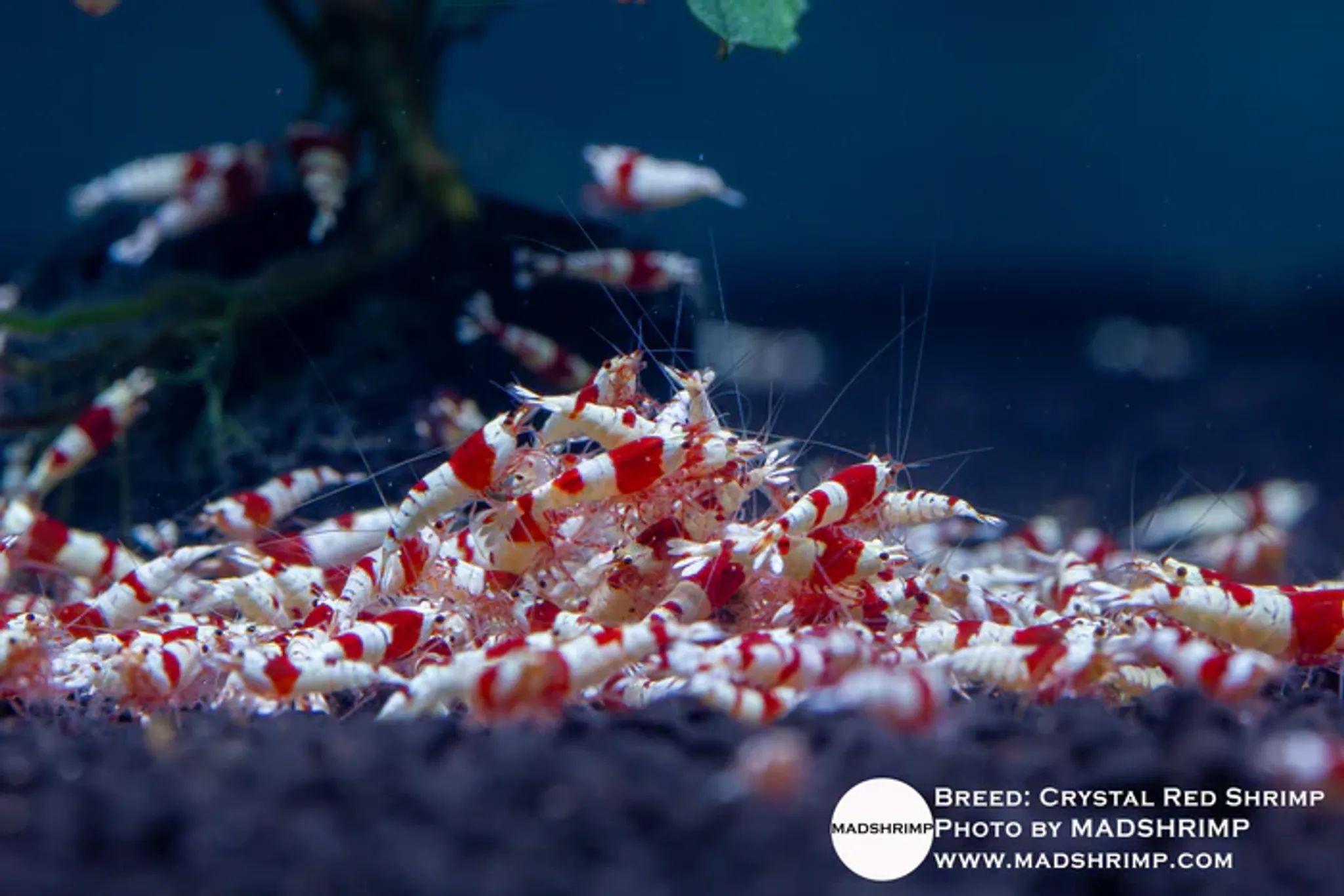

Best Tank Mates for Crystal Red Shrimp: Safe Fish and Invertebrate Companions
Crystal Red Shrimp (CRS) are pickier roommates than the average dwarf shrimp, and their shrimplets are vulnerable to almost anything with a mouth big enough to notice them. This guide breaks down which fish and invertebrates are genuinely safe, which ones to avoid, and how your goal — a mixed display tank versus a serious breeding colony — should shape the decision.
Why CRS Need Stricter Tank Mate Rules
CRS are a selectively bred, high-grade color morph within the Bee Shrimp lineage, not a hardy feeder species. That breeding history makes them noticeably more sensitive to water chemistry swings and predation stress than common Cherry Shrimp, so generic "shrimp tank mate" lists don't automatically apply.
Any companion you add also has to tolerate the same narrow water window CRS need:
| Parameter | Tolerated range | Breeding-optimal sweet spot |
|---|---|---|
| Temperature | 62–78°F (16.5–25.5°C) | Mid-60s to low 70s°F |
| pH | 5.8–7.4 | 6.2–6.8 |
| General hardness | Low (soft water) | Low (soft water) |
| KH | 0–4 | 0–2 |
| TDS | Stable, low-to-moderate | Stable |
This is the point most generic compatibility articles skip: a fish can be perfectly peaceful and still be a poor fit if it needs warmer, harder, or more alkaline water than a CRS colony can tolerate. Ruling out mismatched water chemistry first narrows the list considerably before you even get to temperament.
The Core Rule for Choosing Tank Mates
Two filters decide almost everything:
- Size: nothing large enough to fit an adult shrimp — let alone a shrimplet — in its mouth.
- Behavior: nothing that actively hunts along the substrate or picks through plant thickets and moss, since that's exactly where shrimp and shrimplets spend their time.
Species that fail either test should be considered a risk, regardless of how "peaceful" they're marketed as.
Safest Fish Options
Small, peaceful nano fish are the least risky fish additions for adult CRS. These are algae- or micro-food eaters rather than hunters, and they tend to occupy water columns shrimp don't spend much time in:
- Chili rasboras — tiny, slow-swimming, mostly mid-water.
- Ember tetras — peaceful schooling fish that ignore adult shrimp.
- Pygmy corydoras — small bottom dwellers that sift substrate rather than hunt.
- Otocinclus catfish — algae grazers with no interest in shrimp as prey.
You can browse small community fish and corydoras options that fit this profile before adding anything to an established colony.
Adults are usually safe; shrimplets are still at risk. This is the single most repeated caveat across shrimp-keeping circles, and it deserves to be said plainly: even fish widely labeled "shrimp-safe" will opportunistically snap up a shrimplet if given the chance. Nothing on the list above is a guaranteed babysitter.
Fish to Avoid Entirely
- Bettas — effective, targeted shrimp and shrimplet predators.
- Larger tetras — size and speed make them opportunistic hunters.
- Barbs — often nip and forage aggressively along plants and substrate.
- Gouramis — large mouths, patient hunting behavior.
- Cichlids — territorial and predatory, unsuitable at any size for a CRS colony.
- Any fish marketed as semi-aggressive or a fin-nipper.
If display variety matters more to you than maximizing shrimplet survival, a handful of tiny nano fish is a reasonable compromise. If your priority is a breeding colony, a species-only tank is the setup breeders consistently recommend — it's the only way to remove predation risk from the equation entirely.
Invertebrate Tank Mates
Other invertebrates are generally the safer route because most don't compete directly for food or view shrimplets as prey.
- Amano shrimp — generally compatible, and they cannot reproduce in freshwater, so they won't multiply and crowd out the colony. However, they're noticeably larger than CRS and can occasionally out-compete or even harass smaller shrimplets at feeding time. Best kept in larger tanks with food spread across multiple spots so shrimplets aren't muscled out.
- Bamboo/wood shrimp — filter feeders with very different feeding behavior and body size, so they don't directly compete with CRS for the same food sources.
- Vampire shrimp — same filter-feeding niche as bamboo shrimp; coexist well if water parameters overlap.
The Neocaridina Warning
Avoid mixing CRS with Neocaridina species like Cherry Shrimp, even though care requirements look similar on paper. This isn't a predation issue — it's a genetics one. CRS and Neocaridina shrimp will interbreed, producing muddy, low-grade hybrid offspring that dilute the CRS color line over generations. If you're maintaining a pure line, keep the two genera in separate tanks entirely.
That genetics concern matters more for CRS than it would for cheap feeder shrimp, because CRS are graded and priced specifically on pattern quality and color saturation. Hybridizing a colony doesn't just change its look — it erodes the value and predictability that selective breeding built into the line in the first place.
Snails: The Best Clean-Up Crew
Snails are widely considered the ideal CRS companion because they pose essentially zero predation risk and help process waste and biofilm rather than competing with shrimp for it.
- Nerite snails — excellent algae control, don't reproduce in freshwater.
- Mystery snails — larger cleanup workers, harmless to shrimp.
- Ramshorn snails — small, prolific biofilm grazers.
- Malaysian trumpet snails — burrow through substrate, aerating it as they go.
Exceptions to avoid:
- Assassin snails — despite the clean name, they will eat shrimplets and slow-moving or molting adult shrimp. Only add them if snail population control is genuinely your goal, not if you're running a breeding colony.
- Bladder/pond snails — harmless to shrimp but can boom in population; fine to leave alone unless the numbers become an aesthetic issue.
Bioload and Tank Size Matter Too
Most CRS setups run small — often in the 5–10 gallon (19–38 liter) range — and that changes the math on tank mates. Even fish that pose zero predation risk still add bioload. In a small, soft-water tank, a few extra fish can push the nitrogen cycle further than the same fish would in a 40-gallon community setup. Before adding any tank mate, factor in how much extra waste and feeding your filtration and water-change schedule can handle without needing more frequent maintenance than a CRS colony's sensitive parameters can tolerate.
Quarantine New Arrivals First
Any new fish or invertebrate — even one from the "safe" list — should spend time in a separate quarantine setup before joining an established CRS colony. Shrimp are highly sensitive to medications and to diseases or parasites that ride in on new stock, and a colony that took months to build can be wiped out by a single unquarantined addition. This step gets skipped often in general compatibility advice, but it's one of the cheapest ways to protect an investment in high-grade shrimp.
How to Increase Shrimplet Survival Rate
If shrimplets are the priority, several habits matter more than tank mate choice alone:
- Stabilize water parameters above all else. Avoid large or frequent water changes that swing temperature, pH, GH/KH, or TDS — sudden shifts stress shrimplets more than almost anything else.
- Don't over-clean. Leave biofilm and algae in place; shrimplets graze on it constantly as a primary food source.
- Build cover and grazing surfaces. Indian almond leaves, alder cones, driftwood, and moss all encourage biofilm growth and give shrimplets places to hide.
- Use a sponge or matten filter. Standard hang-on-back or canister intakes can pull in and kill shrimplets; a sponge pre-filter or matten filter provides gentle flow without that risk.
- Supplement with powdered fry food two to three times a week in small amounts.
- Keep predatory tank mates out entirely during active breeding periods.
How to Breed Crystal Red Shrimp
A basic breeding setup follows a fairly consistent pattern:
- Start with a mature, cycled tank that's densely planted or filled with moss, matching CRS's soft, slightly acidic water needs.
- Run a sponge filter for gentle flow and ongoing biofilm growth.
- Feed adults a varied diet — algae wafers, blanched vegetables, and biofilm-based foods — to condition females for breeding.
- Watch for a female "berried" — carrying eggs under her abdomen. Eggs are typically held for 3–5 weeks before hatching as fully formed miniature shrimp, unlike Amano shrimp, which pass through a larval stage.
- Keep the colony free of fish and aggressive invertebrates through the hatching period.
- Many breeders separate new breeding pairs into their own tank away from a general community setup, both to control genetics and to eliminate predation risk during the most vulnerable stage.
Common Mistakes to Avoid
- Adding "just one" small tetra or betta assuming it's harmless — a single active hunter can steadily wipe out shrimplets over weeks without an owner noticing until the population has already collapsed.
- Over-cleaning the tank, including stripping algae or deep-cleaning substrate, which removes the shrimplets' main food source.
- Doing large water changes for cleanliness, which causes parameter swings that stress or kill sensitive CRS, particularly juveniles.
- Mixing CRS with Neocaridina shrimp thinking it's just a color variety mix, then being surprised by hybrid, low-grade offspring diluting the line.
- Using standard filter intakes without a sponge pre-filter, which pulls in and kills shrimplets.
- Assuming Amano shrimp will breed and take over a freshwater tank — they need brackish, larval-stage conditions to reproduce, so they won't multiply, though their larger adult size can still crowd out shrimplets at feeding time.
Frequently Asked Questions
Can Crystal Red Shrimp live with bettas?
No. Bettas are effective shrimp predators, especially of shrimplets and molting adults, and should be avoided entirely in a CRS setup.
Will CRS breed if kept with fish?
Adults may still berry up and carry eggs normally, but survival of shrimplets to adulthood drops significantly with any fish present, since fish pick off the tiny newly hatched shrimp before they can grow.
Can I keep Cherry Shrimp and Crystal Red Shrimp together?
They share similar care needs, but they will interbreed and produce lower-grade hybrid offspring that lose the CRS pattern and color over generations. Keep them in separate tanks if you're maintaining a pure line.
Are snails good tank mates for CRS?
Yes. Most snails, including nerite, mystery, and ramshorn snails, are considered ideal companions since they don't prey on shrimp and help manage biofilm and waste. Avoid assassin snails if you're breeding shrimplets, since they will eat them.
What's the best filter for a CRS or shrimplet tank?
A sponge or matten filter is the standard choice — it provides gentle flow, poses no intake risk to babies, and its surface grows the beneficial biofilm shrimplets graze on.
How long do Crystal Red Shrimp eggs take to hatch?
Roughly 3–5 weeks depending on temperature. Babies emerge as fully formed miniature shrimp rather than passing through a free-swimming larval stage.
Can Amano shrimp live with Crystal Red Shrimp?
Generally yes for adults, and Amano shrimp can't reproduce in freshwater, so they won't overrun the tank. Their larger size means you should spread out feeding to make sure shrimplets get adequate access to food.
Whether you're rounding out a display tank or setting up a dedicated breeding colony, browse dwarf shrimp and other shrimp species on FishyHub to find compatible companions for your Crystal Red Shrimp setup.


