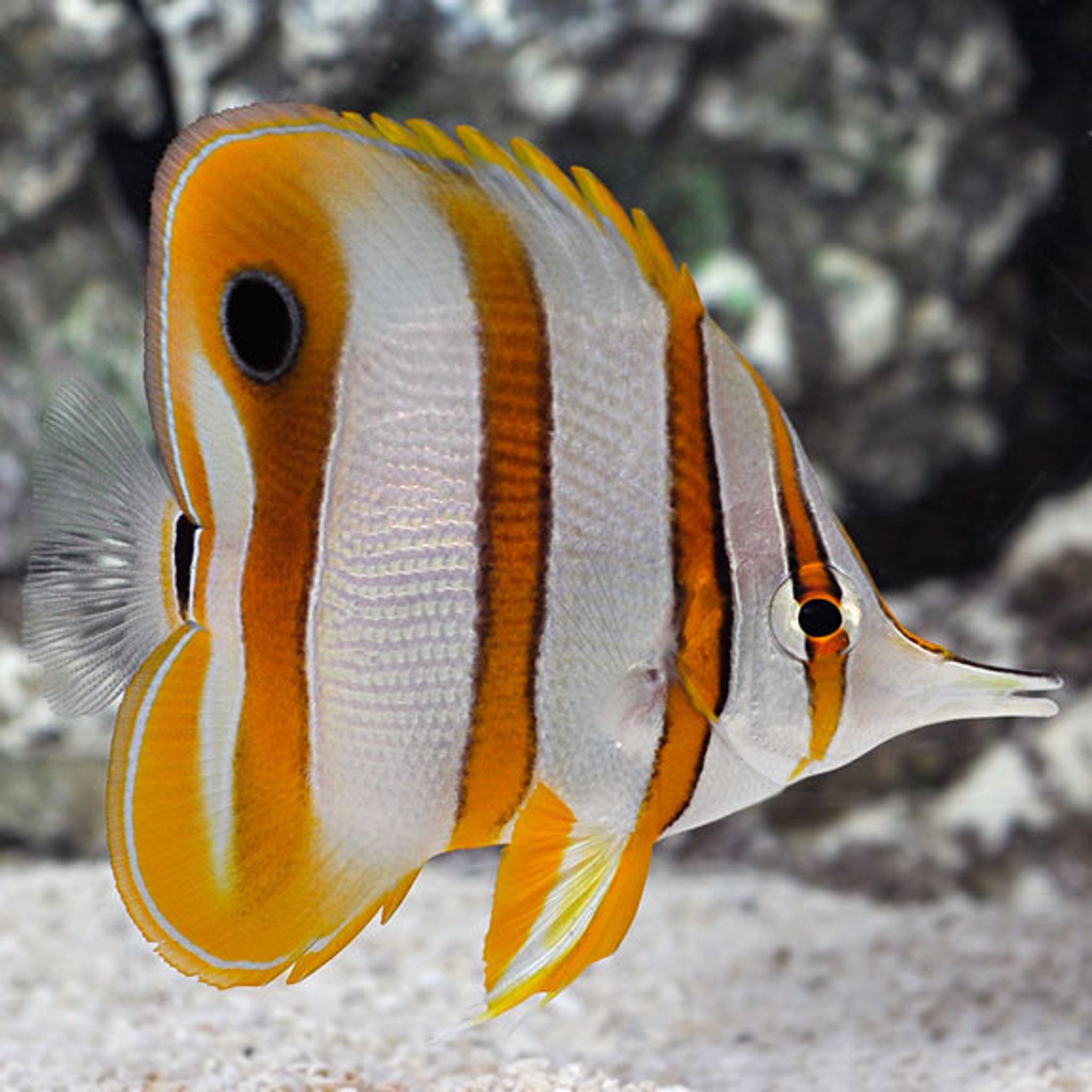

Best Tank Mates for Copperband Butterflyfish: Peaceful, Risky and Incompatible Choices
Copperband Butterflyfish (Chelmon rostratus) fail in community tanks less often from outright aggression and more from being outcompeted at feeding time or stressed into jumping. This guide sorts tank mates into peaceful, risky, and incompatible categories based on three real drivers of success: feeding competition, aggression, and invertebrate-eating risk.
Species Snapshot
The Copperband Butterflyfish is a semi-difficult to difficult species prized for its striking orange-and-white banding and long, narrow snout built for picking food out of rockwork crevices. Its temperament is generally peaceful toward other fish, but its deep, laterally flattened body and slow, deliberate feeding style make it vulnerable in the wrong stocking mix.
Tank size is the first compatibility decision:
- A single specimen needs a 75–130 gallon (284–492 L) tank, depending on the source. 100+ gallons (380+ L) is a sensible baseline for most US home setups.
- A bonded or mated pair needs 125+ gallons (473+ L).
- Tank height matters as much as footprint — avoid anything under roughly 18–20 inches (46–51 cm) tall, since shallow water gives a startled fish less room to avoid a chase and encourages jumping.
Stocking Order Matters More Than the Species List
Add the Copperband early, ideally before territorial fish like established tangs or angelfish have claimed the rockwork. A Copperband introduced last into a tank already run by boisterous fish is far more likely to get harassed away from food, even if none of the existing residents are outright aggressive by nature. This single decision often matters more than which species end up on the stocking list.
Peaceful Tank Mates
These species are generally low-competition, non-territorial toward butterflyfish, and unlikely to out-hustle a slow forager at feeding time.
| Tank Mate | Why It Works |
|---|---|
| Clownfish | Peaceful, mid-water feeders that rarely compete for crevice-picked food |
| Chromis (green or blue) | Schooling, non-territorial, feed mid-water away from the Copperband's foraging zone |
| Most gobies (including mandarin/dragonet types) | Bottom-oriented, non-competitive feeding niche |
| Dartfish (firefish) | Shy, peaceful, hover near burrows rather than compete at the surface |
| Cardinalfish (pajama cardinal) | Slow, calm feeders with a similar unhurried pace |
| Calm damselfish | Less territorial species tolerate a Copperband well |
| Dottybacks | Generally peaceful toward non-similar body shapes |
| Small-to-medium peaceful wrasses | Compatible temperament, distinct feeding style |
| Dwarf angelfish (case-by-case) | Workable only with calm individuals and enough food to prevent competition |
You can browse many of these calmer community options, including clownfish and gobies, when planning a Copperband-friendly stocking list.
A Note on Dwarf Angelfish
Sources disagree here. Some list dwarf angels as flatly compatible; others put them in a caution bucket alongside larger, more predatory fish. The realistic answer is case-by-case: a calm dwarf angelfish in a well-fed, spacious tank is usually fine, but a boisterous individual in a tighter system can bully a Copperband away from food. Watch behavior closely for the first few weeks rather than assuming compatibility from the species name alone.
Risky Tank Mates
Risky doesn't mean automatic failure — it means the pairing needs deliberate feeding management and close observation.
- Fast or aggressive eaters that clean up food before a slow forager gets a bite: large or boisterous tangs, active wrasses, and fast-swimming anthias.
- Large or aggressive angelfish (beyond calm dwarf species) that may bully a Copperband away from territory or food.
- Puffers and triggers — unpredictable temperaments that can nip fins even without hunting a Copperband specifically.
If you keep any of these, plan on target- or spot-feeding the Copperband separately, before general tank feeding, so it gets a guaranteed meal without racing faster fish.
Incompatible Tank Mates
- Other Copperbands (non-bonded) or any other butterflyfish species. This is near-universal advice: butterflyfish are highly territorial toward their own kind and toward similarly shaped fish, and unrelated individuals will chase, tear fins, and stress each other to the point of death. An already-bonded pair in a large enough tank is the only safe exception.
- Large, aggressive triggers or puffers in an undersized system, where there's no room to escape harassment.
- Any relentless harasser of a slow, shy eater — even a species that's generally "reef safe" on paper can be a poor match if its individual temperament is pushy.
Invertebrate Risk: The "Reef Safe With Caution" Reality
Some sources call Copperbands flatly "reef safe." That's an overstatement. The accurate framing is reef safe with caution: they leave most stony coral alone but are carnivorous foragers that will pick at ornamental invertebrates, including:
- Shrimp (including cleaner shrimp, which are not a guaranteed-safe pairing despite their reputation)
- Clams
- Feather duster worms
- Small mollusks
- Anemones, especially
Don't pair a Copperband with a prized clam, a display feather duster, or an anemone you want to keep intact. If you're stocking marine invertebrates alongside a Copperband, treat anything soft-bodied and stationary as at-risk.
Coral Compatibility
Stony coral is generally left alone. Some individual Copperbands nip at soft corals, polyps, and zoanthids while foraging through crevices — not a guaranteed reef hazard, but a real possibility, especially in a food-scarce system where the fish is hunting harder for supplemental protein.
The Aiptasia-Control Use Case
Copperbands are one of the more valued natural predators of aiptasia (glass anemone) pests, which is a major reason reefers put up with a genuinely difficult fish. This works best when:
- The tank is established, with an actual aiptasia population for the fish to hunt.
- You're adding the Copperband specifically for pest control, not just as a general community addition — the fish will supplement its diet with aiptasia rather than relying on it exclusively.
If your goal is aiptasia control rather than a general community fish, factor that into timing: introduce the Copperband once the pest population is established enough to give it something to forage.
Feeding Difficulty and Solutions
Copperbands are notoriously difficult initial feeders. Many individuals refuse flake or pellet food outright, and a fish that "isn't eating" is usually just refusing unsuitable food, not genuinely uninterested in eating.
Best foods, in weaning order:
- Live blackworms
- Live or frozen mysis or brine shrimp
- Thinly sliced clam meat or chowder clams
- Gradually introduce a gel food or frozen preparation once the fish is established
Feed multiple small meals per day while acclimating a new Copperband, rather than one or two large feedings. Red flags that a fish isn't eating include a visibly sunken belly, pinched appearance behind the head, and no interest in food placed near its favored crevices after several days.
A practical tip worth adopting: target- or spot-feed the Copperband in a specific spot before general tank feeding, especially in a community with faster eaters. This gives it a reliable meal independent of how competitive the rest of the tank is at feeding time.
Tank Maturity and Passive Feeding
An established tank with a healthy pod (copepod/amphipod) population gives a Copperband a passive food source between target feedings. This is an underrated factor in long-term feeding success — a chronically thin specimen in an otherwise well-fed tank is often living in a system too young or too "clean" to support supplemental grazing. Never add a Copperband to a tank younger than about 3 months for this reason.
Ideal Tank Setup
- Rockwork with crevices for the fish's natural foraging behavior.
- Established live rock with an active pod population.
- Secure, tight-fitting lid or canopy — non-negotiable regardless of tank mates (see below).
- Moderate flow. Copperbands are slow, deliberate foragers; a high-turbulence, fast-current system scatters food before they can pick it up. Moderate flow suits their feeding style far better than a reef tank tuned for maximum flow.
Buying and Selection Checklist
Before purchase, look for:
- Active foraging behavior in the display or holding tank.
- No lumps, discoloration, or raised scales — these often indicate shipping-related internal injury and are usually fatal, through no fault of the buyer.
- Confirmed eating. Ask to see the fish eat in-store before buying; this is the single best predictor of a successful transition home.
Once purchased, quarantine for 2–4 weeks before adding to the display, both to treat any disease and to give a stressed fish time to stabilize before facing a new community.
Stress and Jumping: The Defining Risk
Copperbands respond to harassment by fleeing toward the surface and pointing their dorsal spines at the aggressor, rather than fighting back. That instinct, combined with an open or poorly covered tank, is one of the most common causes of loss in this species — often unrelated to whether the tank mates were technically "compatible" on paper. A secure lid is a practical requirement with this species, independent of what else is in the tank.
Common Mistakes to Avoid
- Adding a Copperband last, into a tank already dominated by tangs or angelfish — leads to chronic harassment and starvation.
- Feeding only flake or pellet and assuming the fish isn't hungry, when it's actually refusing the food type.
- Skipping quarantine and losing the fish to disease or an untreated shipping injury within the first few weeks.
- Keeping two unbonded Copperbands, or any second butterflyfish species, in anything short of a very large tank.
- Running an open-top tank combined with any stressor — aggressive tank mate, sudden movement, or a tank transfer — a common recipe for a jumping death.
- Assuming "reef safe" means invert-safe and losing feather dusters, small clams, or ornamental shrimp to a hungry Copperband.
Once you've settled on a stocking plan, you can browse compatible Butterflyfish and peaceful reef fish on FishyHub to round out a Copperband-friendly community.
Frequently Asked Questions
Can I keep two Copperband Butterflyfish together?
Only as an established, already-bonded pair in a large tank (125+ gallons). Two unrelated individuals will fight, often resulting in torn fins and chronic stress.
Is a Copperband Butterflyfish reef safe?
Mostly yes for stony coral, but it's more accurately described as reef safe with caution. It poses a real risk to ornamental invertebrates like shrimp, clams, and feather dusters, and occasionally nips soft coral or polyps.
Will a Copperband eat my aiptasia?
Often, yes — it's one of the more reliable natural predators of aiptasia. Effectiveness varies by individual and by how much other food is available.
Why won't my Copperband eat?
It's usually refusing flake or pellet food, not genuinely disinterested. Switch to live blackworms, mysis, or thinly sliced clam meat, and offer several small meals a day while it acclimates.
Can Copperbands live with clownfish and other peaceful reef fish?
Yes. Clownfish, chromis, gobies, and similarly calm species are among the safest tank mate choices, since they don't compete aggressively for food or territory.
What tank mates should I avoid?
Avoid other butterflyfish, aggressive or fast-feeding tangs and wrasses, triggers, puffers, and any fish likely to outcompete the Copperband for food or bully it away from cover.
How big a tank does a Copperband need?
At least 75–100 gallons for a single fish, favoring the higher end, and 125+ gallons for a bonded pair. Prioritize tank height as well — shallow tanks make jumping more likely when the fish is startled.
Why do Copperbands jump out of tanks?
When stressed or harassed, Copperbands flee toward the surface rather than fight back. Combined with an unsecured lid, this instinct is a common cause of loss, especially alongside aggressive tank mates.


