Best Tank Mates for Clown Triggerfish: Peaceful, Risky and Incompatible Choices
For a clown triggerfish, "compatible" almost never means "gets along" — it means "coexists without being eaten, chased, or shredded." This guide sorts realistic tank mate options into three tiers, explains why the temperament shifts drastically as the fish grows, and lays out the practical playbook for introducing new fish without triggering an all-out territorial war.
Species Snapshot
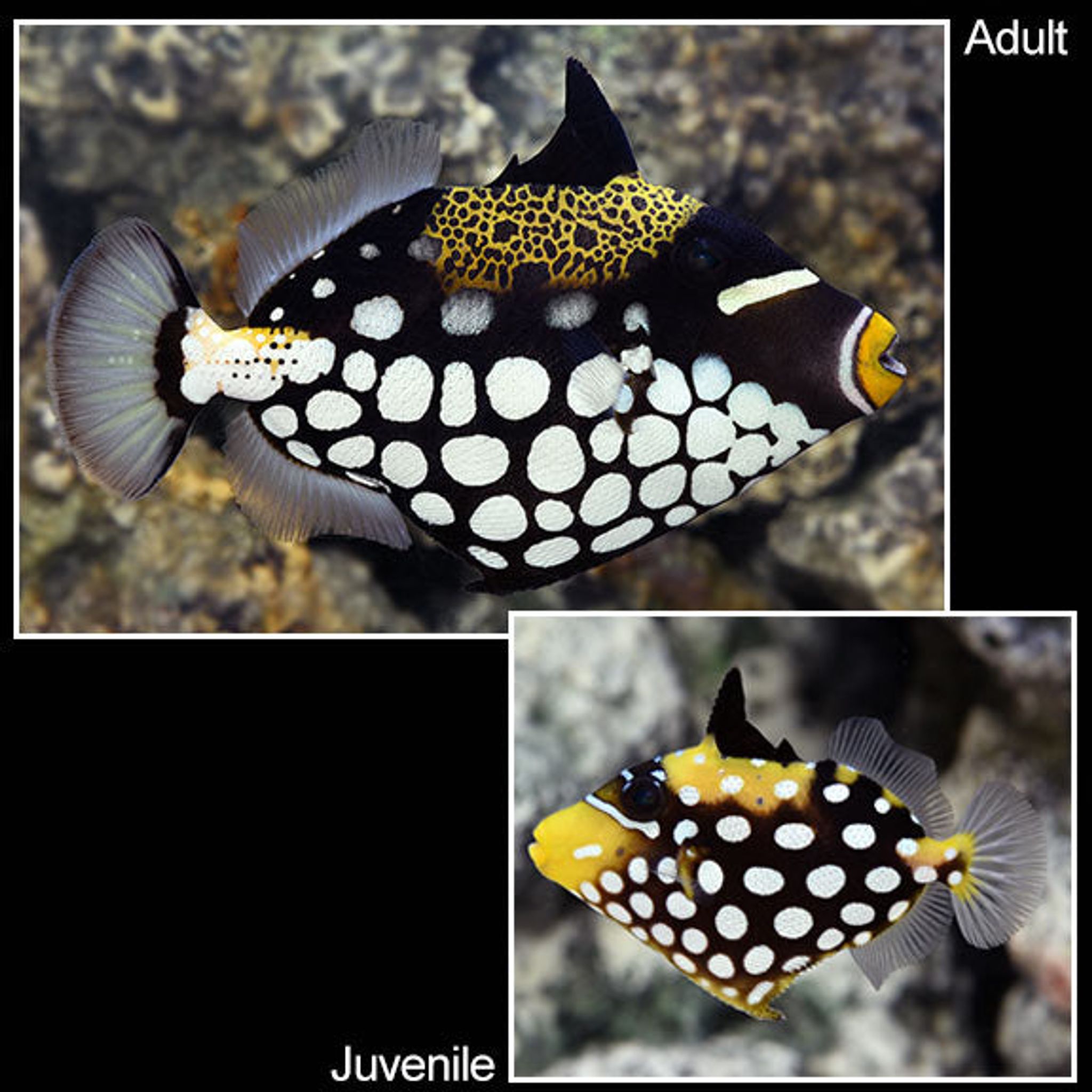
The clown triggerfish (Balistoides conspicillum) is one of the most recognizable fish in the marine hobby, prized for its bold white-spotted pattern and yellow-ringed mouth. It is also one of the most misunderstood in terms of stocking.
- Adult size: 16–20 inches (41–51 cm)
- Mouth: a strong, beak-like set of teeth built for crushing shells and coral skeletons
- Native range: Indo-Pacific coral reefs, typically found near steep drop-offs and rubble zones
- Diet in the wild: hard-shelled invertebrates, urchins, crustaceans, and mollusks
That crushing beak is the root cause of nearly every compatibility problem on this list. A fish built to break open shells does not need to be "mean" to seriously injure a tank mate — it just needs to test one.
Minimum Tank Size
Sources disagree on the minimum, ranging anywhere from 180 gallons (680 L) up to 300 gallons (1,135 L) for long-term keeping. The gap comes down to whether the tank is meant to house the trigger alone or alongside other fish.
| Setup Goal | Minimum Tank Size | Notes |
|---|---|---|
| Solo adult, no tank mates | 180 gallons (680 L) | Absolute floor; needs heavy filtration and large weekly water changes |
| Adult with select tank mates | 250+ gallons (945+ L) | Recommended for any community-adjacent stocking |
| Long-term display, multiple large fish | 300 gallons (1,135 L) | Gives tank mates room to retreat and establish separate territories |
Treat 180 gallons as a bare-minimum solo tank, not a stocking target. Undersizing the tank is one of the most common mistakes keepers make — it concentrates aggression in a small space and leaves tank mates nowhere to retreat.
Why Temperament Changes With Size
A 3–5 inch juvenile clown trigger can be surprisingly tolerable in a community setup. Many keepers report a genuinely calm window early on. That window is temporary and unpredictable, not a stocking strategy to build around.
- 3–5 inches: often calm enough for supervised community life
- 6–8 inches: aggression escalates sharply; this is the turning point most keepers underestimate
- Adult (16–20 in): aggression toward tank mates is essentially guaranteed
Buying a cute 3-inch juvenile and assuming it will stay peaceful is one of the most common mistakes in this hobby. Plan for a permanent species-only setup — or a heavily supervised large system with a backup plan — from the day you bring the fish home, not after the aggression shows up.
The Three-Tier Tank Mate List
Tier 1: Peaceful (Best Odds, Still Supervise)
These are fish large, fast, or thick-skinned enough to outswim or shrug off nips. None of them are guaranteed safe, but they have the best track record.
- Large angelfish — sturdy, similarly sized adults hold their own better than dwarf species
- Tangs and surgeonfish — fast swimmers that can outmaneuver a trigger
- Large wrasses — robust, active species with thick scales
- Rabbitfish — hardy body plan, generally not an easy target
- Large hawkfish — bold enough not to panic under a chase
You can browse candidates for this tier, including large marine angelfish and tangs and surgeons, on FishyHub.
Tier 2: Risky (Case-by-Case, Close Monitoring Required)
These fish can sometimes hold their own given a size or space advantage, but documented reports of clown triggers attacking them — including eels and even small sharks — are common enough that they should never be presented as a safe recommendation.
- Groupers — large and defensive, but not immune to bites
- Large puffers — can inflate as a deterrent, though fins remain vulnerable
- Other large or robust triggerfish species — size parity helps, but conspecific-style aggression can still occur
- Large lionfish — slow movers despite their spines
- Moray eels — often assumed compatible in general triggerfish guides, but species-specific reports describe clown triggers biting and harassing eels directly
Only attempt this tier in a very large system with close monitoring and a clear backup plan if a fight breaks out. If you're considering eels or groupers, go in expecting to intervene, not to set and forget.
Tier 3: Never Do This
- Small or slow-moving fish
- Long-finned fish (butterflyfish, fancy wrasses, small angels) — fins get shredded
- Gobies and blennies
- Cardinalfish
- Chromis and damsels
- Clownfish (anemonefish)
- Any fish notably smaller than the trigger
- Virtually all invertebrates: shrimp, crabs, snails, urchins, clams
Clown triggers are dedicated invert hunters regardless of how well-fed they are. Keeping cleanup-crew invertebrates and expecting them to survive is a recurring mistake — a full belly does not turn off the hunting instinct.
Is a Clown Triggerfish Reef Safe?
No. Clown triggers rearrange rockwork, topple frags, and eat mobile invertebrates as a matter of course. They are not comparable to more planktivorous trigger species sometimes labeled "reef-safe with caution" — clown triggers are benthic hunters and among the least reef-compatible triggerfish in the trade. Skip corals and a display reef entirely if this fish is on your stocking list.
Diet and Aggression: The Overlooked Link
A poorly fed clown trigger is more likely to test tank mates and invertebrates as food. This species needs meaty protein — clams, krill, shrimp, and silversides — both for nutrition and to wear down teeth that grow continuously. An under-fed or improperly fed trigger with overgrown teeth may become more prone to testing tank mates, a link that rarely gets connected explicitly in general stocking advice. Feeding heavily and consistently is a compatibility tool, not just a husbandry checkbox.
Introduction Order and Best Practices
How you introduce fish matters as much as which fish you choose.
- Add the trigger last, or introduce all semi-aggressive/large fish at the same time so no single fish gets an established territorial head start.
- Add new fish at night, after lights-out, so the resident trigger is less alert.
- Rearrange rockwork and decor first to reset existing territorial boundaries for every fish in the tank, not just the newcomer.
- Feed the tank heavily right before introduction to distract the resident fish.
- Favor tank mates larger than the trigger whenever possible — size parity discourages testing.
- Leave visual barriers and hiding spots in place so a new fish has somewhere to retreat during a chase; skipping this is a common and preventable mistake.
Managing Aggression Once It Starts
Watch for early warning behavior rather than waiting for a full-blown fight:
- Fin-nipping
- Chasing a tank mate into rock
- Glass-surfing or aggression toward its own reflection
- Refusing to let a tank mate feed (food guarding)
If these signs appear, several tactics can redirect or reset the aggression:
- Mirror or photo trick: placing a mirror or photo of a similar fish outside the tank can redirect the trigger's aggression toward the reflection instead of a live tank mate.
- Rearrange the rockscape again: erasing established territorial landmarks resets the pecking order for everyone, not just the aggressor.
- Temporary removal: move the aggressor to a quarantine tank or sump for at least 1–2 weeks. Shorter removals — a day or two — don't work, because fish memory of territory and hierarchy can last weeks to months.
- DIY traps: a bottle trap or critter-carrier trap baited with food can pull a problem fish out for a cool-down period without a full tank breakdown.
Separately from aggression, quarantine any new tank mate for disease before introduction — this is a distinct step from the aggression-management tactics above, and skipping it risks introducing illness on top of a territorial fish.
Building a Backup Plan
Nearly every experienced source agrees the trigger may eventually need to live alone. Have a plan in place before you need it:
- A spare tank or sump large enough for temporary isolation
- A local fish store or hobbyist network willing to take a rehomed adult trigger
- A clear size/age threshold (for example, once it exceeds 8 inches) at which you'll reassess the entire stocking plan
Compatibility that works at 4 inches can fail completely once the trigger passes 6–8 inches, so treat every tank mate decision as provisional and keep reassessing as the fish grows.
Frequently Asked Questions
Can clown triggerfish be kept with other clown triggerfish?
Generally no. Territorial aggression toward their own species is typically worse than aggression toward other species. It's only attempted in very large systems with simultaneous introduction, and even then it often fails.
Can clown triggerfish live with clownfish (anemonefish)?
No. Clownfish are far too small and slow relative to a clown trigger and will likely be bullied or eaten. If you want clownfish for a display, keep them in a separate system entirely.
Is a clown triggerfish reef safe?
No. It will eat mobile invertebrates and disturb rockwork and corals, making it unsuitable for a reef display of any kind.
What is the single best tank mate for a clown trigger?
There's no guaranteed "best," but large, robust, similarly sized fish — big angelfish, tangs, or groupers — have the best odds when paired with careful introduction and a large enough tank.
How big of a tank does a clown triggerfish need if I want tank mates?
Plan for 250 gallons (945 L) or more. Reserve 180 gallons (680 L) as an absolute floor for a solo specimen only.
Can I keep a clown triggerfish with an eel or lionfish?
It's possible but risky. There are documented cases of clown triggers attacking both eels and lionfish. Only attempt this in a very large tank with close monitoring and a backup plan ready.
How do I stop my clown trigger from attacking a new tank mate?
Rearrange the rockscape, add the newcomer at night after heavy feeding, try a mirror or photo to redirect aggression toward a reflection, or temporarily isolate the aggressor for at least 1–2 weeks.
Whether you're planning a species-only display or a carefully supervised large-tank community, browse marine fish on FishyHub to compare tank mate candidates by size and temperament before you buy.


