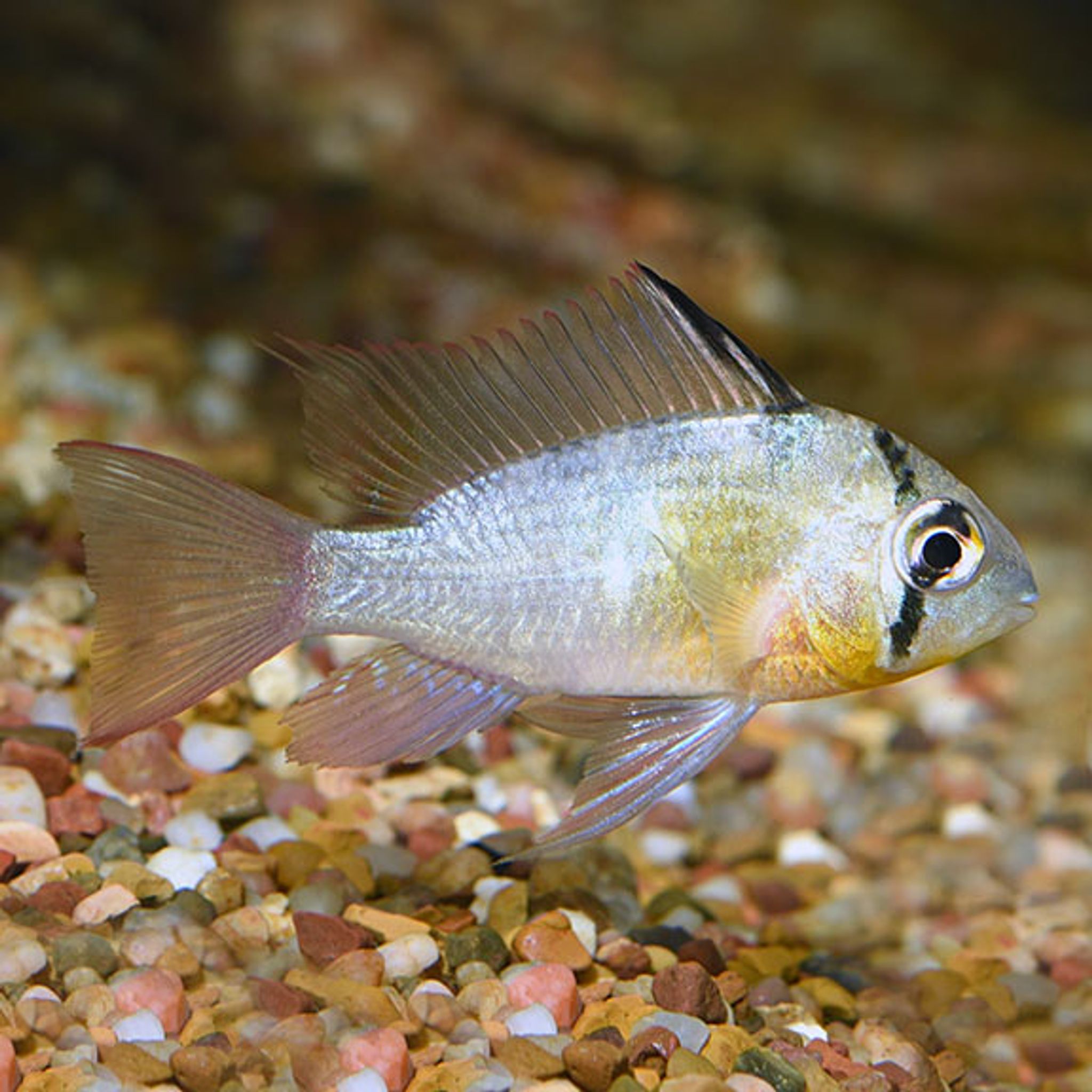

Best Tank Mates for Bolivian Ram: Compatible Fish and Species to Avoid
The best Bolivian ram tank mates are peaceful schooling fish that swim in the middle and upper water, like cardinal tetras, rummy-nose tetras and harlequin rasboras, plus a small bottom crew such as Corydoras or a bristlenose pleco. Avoid large or aggressive cichlids, fin-nippers, predators and cool-water fish. Below you'll find why each pick works, what to skip, and stocking plans sized for common US tanks.
Bolivian Ram at a Glance
The Bolivian ram (Mikrogeophagus altispinosus) is a peaceful South American dwarf cichlid from the Mamoré and Guaporé river basins of Bolivia and Brazil. Adults reach about 3–3.5 inches (7.5–9 cm) and usually live 4–6 years. It is much hardier and calmer than its cousin, the German blue ram.
| Parameter | Bolivian ram range | Notes |
|---|---|---|
| Temperature | 72–79°F (22–26°C) | Some keepers run up to 82°F (28°C) |
| pH | 6.0–7.5 | Tolerates up to about 8.0 |
| Hardness | About 2–15 dGH | Soft to moderately hard |
| Minimum tank | 20 gal long (76 L) | 30–40 gal (114–151 L) is more comfortable |
| Adult size | 3–3.5 in (7.5–9 cm) | Males show longer dorsal and tail extensions |
| Swimming zone | Lower third | Sifts sand for food |
That temperature range is the key to compatibility. German blue rams need 80–86°F (27–30°C), which pushes them out of reach of most community fish. Bolivians sit right in the middle of the standard tropical range, so the usual community tetras, rasboras and catfish fit without compromise.
Tank Size and Floor Space
Rams live near the bottom, so floor area matters more than height. A 20 gal long (76 L) is the practical floor for one ram or a single pair with a few small dithers. A 29 gal (110 L) or 40 breeder (151 L) gives room for a pair plus a full community. Sources range from 20 to 40 gallons as a minimum; treat 20 long as the lowest option and 30+ as comfortable.
One Ram, a Pair or a Group?
Keep one ram or a bonded pair. A single ram does fine without a mate. Pairs claim a patch of substrate and chase rivals, so groups of four or more need at least 40 gallons (151 L) with plenty of rock, wood and plants to break lines of sight. Some keepers insist on one pair only, others run several; tank size and sightline breaks are what decide it.
Sexing tip: males usually have longer extensions on the dorsal fin and tail.
How to Choose Tank Mates for a Bolivian Ram
Run every candidate through four checks:
- Water layer: favor fish that stay in the middle and top of the tank, out of the ram's zone.
- Temperature and pH: the species must be comfortable in the 72–79°F (22–26°C), pH 6.0–7.5 window.
- Size: similar size, too big to fit in a ram's mouth, but not large enough to bully it.
- Temperament: peaceful, not nippy, and not so boisterous that it takes all the food.
Aggression in rams rises mainly when a pair is spawning or guarding fry, and it is aimed mostly at other bottom fish and other rams. Plan your stocking around that window, not around the calm weeks in between.
Best Tank Mates for Bolivian Rams
Dither Fish (Schooling Mid- and Top-Water Species)
Dither fish are active schoolers that signal "no predators here." They make rams bolder, and a bold ram shows better color. Keep them in groups of 6–10 or more.
- Cardinal, rummy-nose, black phantom, glowlight, ember and lemon tetras
- Harlequin and other rasboras
- Pencilfish
- Hatchetfish (keep a tight lid; they jump)
- Cherry barbs, a peaceful barb that stays in the middle water
- Dwarf neon rainbowfish
You can browse schooling tetras for a ram community on FishyHub.
Bottom Dwellers and Cleanup Crew
Rams share the floor, so choose bottom fish that are peaceful and don't compete for the same caves.
- Corydoras, with sterbai cory a good choice because it handles warmer water well
- Kuhli loaches
- Otocinclus
- Bristlenose pleco and other small loricariids
Leave spare caves so the catfish and loaches aren't fighting the rams for shelter, and don't overload a small footprint. If you need a peaceful cleanup crew, see Corydoras on FishyHub.
Centerpiece Fish
- Pearl, honey or dwarf gourami: one male, which stays up top and adds color.
- Angelfish: in 40+ gallons (151+ L). Grow them up alongside the rams, and remember that big adults may eat tiny tetras.
- Keyhole cichlid: a shy, gentle dwarf cichlid that pairs well with rams.
- Cockatoo apistogramma: workable in larger tanks with separate territories.
Livebearers
Platies, swordtails and guppies are peaceful and stay in the upper water. They prefer harder water than rams, so if you mix them keep pH near 7.0–7.5 with moderate hardness.
Shrimp and Snails
- Adult amano shrimp and nerite snails are safe.
- Cherry shrimp are risky: rams will pick off the babies and sometimes the adults. Only try them with heavy moss cover.
Species to Avoid With Bolivian Rams
| Avoid | Why |
|---|---|
| Oscars, Jack Dempseys, convicts, most Central American cichlids | Too large or too aggressive |
| African rift-lake cichlids | Need hard, alkaline water and are far too aggressive |
| Tiger barbs, serpae tetras, black skirt tetras | Fin-nippers, especially around long fins |
| Dwarf pike cichlids (Crenicichla) | Ambush predators |
| Adult angelfish with nano fish | Will eat tiny tetras and shrimp |
| Goldfish and cool-water species | Temperature mismatch |
| Clown loaches in small tanks | Grow to about 12 in (30 cm) |
| Boisterous, fast-eating fish | Outcompete rams at feeding time |
Why Dwarf Pike Cichlids Don't Work
Dwarf Crenicichla reach roughly 4.75–5.5 inches (12–14 cm), hunt from ambush and get aggressive when breeding. They also want around 83°F (28°C) and pH 5.5–7. In a normal community tank, rams and small dithers become prey or targets.
Why Fairy Cichlids Show the Rift-Lake Problem
The fairy cichlid (Neolamprologus brichardi) from Lake Tanganyika needs pH 8.4+ and hard water. It lives in colonies that gang up on other fish. It's a clear example of why rift-lake cichlids are incompatible with rams on both water chemistry and behavior.
Borderline Combos Where Keepers Disagree
- Discus: they need 82–86°F (28–30°C), right at or above the ram's upper edge. Only consider this in a large, warm tank as an advanced combo.
- Clown loaches: they reach about 12 in (30 cm) and need 75+ gallons (284+ L). Fine only in big tanks.
- Mollies: they prefer hard, alkaline, even slightly brackish water, a poor match for rams. Platies are the better livebearer choice.
- White cloud minnows and zebra danios: white clouds want 64–72°F (18–22°C), and danios are hyperactive and crowd feeding. Both are marginal; tropical tetras and rasboras are better picks.
- Angelfish: some keepers report years of peace with rams in a 40, while others find maturing or breeding angels get pushy. Use 40+ gallons, tall decor and lots of cover.
Best Cichlids for a Community Tank
If you want more than one cichlid, the dwarf South Americans are the top picks: Bolivian ram, keyhole cichlid and cockatoo apisto. In 55+ gallons (208+ L), mid-size options include angelfish, festivum, electric blue acara and severum. Two rules apply:
- Don't mix cichlids from very different water types.
- Provide roughly 1.5 caves per cichlid, so every fish has a fallback.
Breeding Behavior and Why Rams Get Territorial
Rams, like most South American cichlids, are monogamous-leaning substrate spawners. Both parents clean a flat stone, guard the eggs, then move the fry into pits they dig in the sand. Tetras are natural egg and fry predators, which is why a spawning pair suddenly chases them. Plan extra cover, or set up a separate breeding tank if you want to raise fry.
Temperament can also differ between wild-type and farmed rams, so individual fish may be shyer or bolder than expected. Either way, give new rams cover and time to settle.
Setting Up the Tank to Reduce Conflict
- Fine sand so rams can sift naturally
- Dense plants, driftwood and rock to break sightlines
- Several caves or flat stones for spawning sites and retreats
- Gentle flow
Stocking Order
- Dithers first, once the tank is cycled.
- Bottom crew next.
- Rams last, so they don't claim the whole floor before others arrive. If you add rams to an established tank, rearrange the decor at the same time to reset territories.
Quarantine every new fish for 2–4 weeks before adding it.
Sample US Stocking Plans
| Tank | Rams | Dithers | Bottom crew | Extras |
|---|---|---|---|---|
| 20 gal long (76 L) | 1 ram or 1 pair | Small school of ember tetras or rasboras | A few otocinclus | Nerite snail |
| 29 gal (110 L) | 1 pair | 10 cardinal tetras | 6 sterbai cory | 1 bristlenose pleco |
| 40 breeder (151 L) | 1 pair | 12 rummy-nose tetras | 8 kuhli loaches | 2 angelfish, added young |
| 55 gal (208 L) | 1 pair | Large tetra or rasbora school | Corys and a bristlenose | Centerpiece such as a single male gourami |
In a 29, the choice is one pair, or one ram with a larger dither school.
Feeding Rams in a Community
Rams eat slowly from the bottom, and fast midwater fish can clear the food before it lands. Fix it by:
- Offering sinking pellets and frozen bloodworms or brine shrimp
- Feeding the dithers at the surface first, then dropping sinking food near the rams
- Target-feeding with a baster or tongs if a ram looks thin
Water Chemistry: Lowering pH and Softening Water
Rams do fine at neutral pH, so most US tap water works. In hard-water regions, tap often runs above pH 7.5 with high hardness; you can soften it gently:
- Driftwood, catappa leaves (about 1 leaf per 30 gallons / 114 L) and peat in a mesh bag lower pH gradually.
- Mix RO water with tap. Pure RO needs remineralizing before use.
- KH buffers pH, so reduce it slowly.
- Skip pH-down chemicals; they cause swings. Stable pH beats a perfect number.
- Test weekly.
Common Mistakes and Troubleshooting
- Running blue-ram temperatures: heat above the ram's range shortens its life.
- Crowding the floor: too many rams or bottom dwellers in a small footprint means constant chasing.
- Adding snack-sized tank mates: nano fish or shrimp that adult angels or rams will eat.
- Starved rams: fast feeders take everything; target-feed sinking foods.
- Pale, hiding ram: add a school of dithers and more cover, and test ammonia, nitrite and nitrate. Keep nitrate under 20 ppm.
- Suddenly hostile pair: they're probably spawning. Add sightline breaks or move the pair out for a while.
Frequently Asked Questions
Can Bolivian rams live with German blue rams?
It's possible in 40+ gallons, but it isn't recommended. Their temperature needs only overlap around 79–80°F (26–27°C), and both species compete for the same bottom territory.
Can Bolivian rams live with apistogrammas or bettas?
Apistogrammas work in 40+ gallons with separate caves, though you should expect some sparring. Bettas are often fine if the betta is calm and the tank sits around 78°F (26°C). Watch for fin-nipping in either direction.
Are Bolivian rams aggressive?
They are mostly peaceful. They become mildly territorial when breeding, and that aggression is aimed mostly at other bottom dwellers and other rams.
How many Bolivian rams can go in a 29 gallon tank?
One bonded pair, or a single ram with a larger dither school. More rams in that footprint usually leads to chasing.
Do Bolivian rams need a mate?
No. A single ram does well on its own and often shows more color when kept with a school of dither fish.
Can Bolivian rams live with shrimp and angelfish?
Adult amano shrimp are safe, but cherry shrimp only survive with heavy moss cover. Angelfish work in 40+ gallons when you add them young and give the tank tall decor and cover.
Build Your Ram Community
A calm pair of rams, a bright dither school and a small bottom crew make one of the most rewarding community setups in the hobby. When you're ready to choose your centerpiece, browse angelfish, discus, rams and cichlids on FishyHub.


