
Best Tank Mates for Boesemani Rainbowfish: Compatible Fish and Species to Avoid
The best tank mates for Boesemani rainbowfish are fish of similar size that swim fast or stay near the bottom and like the same hard, alkaline water: danios, larger tetras, peaceful barbs, corydoras, loaches, bristlenose plecos and hardy livebearers. Avoid anything small enough to swallow, slow long-finned fish, aggressive cichlids and soft-water specialists. Below you'll find the selection rules, a compatibility table, stocking plans for 55 and 75 gallon tanks, and the mistakes that cause most problems.
What Boesemani Rainbowfish Are Like as Tank Mates
Melanotaenia boesemani is best described as peaceful but boisterous. It doesn't pick fights with other species, but it's fast and restless and cruises the full length of the tank all day. That constant motion can stress slow or shy fish, and at feeding time rainbows get to the food first.
Males spar and flare at each other, mostly around spawning time. It looks dramatic but rarely causes real damage, as long as the group is large enough and has enough females.
Size, group and tank needs
- Adult size: males reach about 4–4.5 in (10–11.5 cm), females about 3 in (7.5 cm). The body is deep, so these are mid-size fish, not nano fish.
- Group size: at least 6, and 8–12 is better. Keep more females than males, roughly 2 males to 3 females, so displays spread out and colors peak.
- Tank: at least 4 ft (120 cm) long. Swimming length matters more than gallons. Plan on 55 gallons (208 L) for a starter group of rainbows alone and 75 gallons (284 L) or more once you add a community.
- Lid: rainbows jump, especially when startled or chasing. A tight-fitting lid is not optional.
Advice on tank size varies, with some figures as low as 30 gallons for six fish. Given their adult length and speed, a 4 ft tank is the realistic floor.
Water Chemistry: Why US Tap Water Decides Your Shortlist
Boesemanis want:
- Temperature: 75–82°F (24–28°C)
- pH: about 7.0–8.0 (they tolerate 6.5)
- Hardness: moderately hard, roughly 8–20 dGH
Much US tap water is already hard and alkaline, which suits Boesemanis well. It also takes strict soft-water species off the table: discus, rams and chocolate gouramis all want soft, acidic water that you'd have to fight your tap to provide. Choose tank mates that thrive in the water you already have.
Temperature is a compromise. Most guidance lands at 75–82°F, though at least one recommendation pushes 81–86°F. Holding 77–80°F (25–27°C) is the overlap that suits most of the companions below. Save the warmer end for when you want to trigger spawning.
The Four Rules for Choosing Tank Mates
- Size: pick fish of similar size, or at least 2 in (5 cm) long, so they don't fit in a Boesemani's mouth.
- Speed and toughness: choose active or robust swimmers that won't get pushed off food.
- Zone: fish that live in other parts of the tank work best. Bottom dwellers are the easiest pairing because they barely interact with mid-water rainbows.
- Water: the species must be comfortable in hard, alkaline water at 77–80°F.
Best Tank Mates for Boesemani Rainbowfish
Other Melanotaenia rainbows
Turquoise, praecox and red rainbows share the same water, speed and diet, and a mixed rainbow tank is a striking display. The catch is hybridization: Melanotaenia species can cross. If you want to avoid hybrids, keep a full group of Boesemanis and add only males of the second species.
Danios
Zebra, pearl and giant danios are fast, tough and happy in hard water. They're one of the few fish that can match rainbows for speed, so food competition isn't an issue. If you're shopping for this group, you can browse danios on FishyHub.
Larger or hardy tetras
Congo and black skirt tetras are big enough and bold enough. Serpae tetras work with caution because they can nip. Skip tiny tetras such as neons (see below).
Rasboras
Harlequin and scissortail rasboras are active schooling fish of workable size. Scissortails in particular are fast swimmers that fit well in a long tank.
Peaceful barbs
Gold, cherry and rosy barbs are good choices. Denison barbs work in big tanks. Tiger barbs are debated: they keep up with rainbows, but they nip fins. They're acceptable only in a group of 8+ in a large tank, and gold or cherry barbs are the safer pick.
Bottom dwellers
- Corydoras in a group
- Bristlenose pleco
- Hillstream loaches
- Kuhli and yoyo loaches
These fill the lower level and stay out of the rainbows' way. Feed them sinking foods so they aren't relying on scraps. You can see a range of options in plecos, corys and bottom dwellers.
Robust gouramis
Pearl and moonlight gouramis are sturdy enough. A single dwarf gourami can also work. Watch that they get enough food, since gouramis are slower at the surface.
Hardy livebearers
Mollies, platies and swordtails like the same hard water, and these sturdier livebearers handle the pace far better than fancy guppies.
Peaceful dwarf cichlids
Kribensis are a reasonable fit in hard, neutral-to-alkaline water. Rams are a poor match at pH 7.5 because they want soft, warm water.
Snails and shrimp
Nerite, mystery and assassin snails are safe, and Boesemanis leave adult snails alone. Amano shrimp and adult ghost shrimp usually survive, but juvenile ghost shrimp get eaten, so treat ghost shrimp as a maybe.
Quick Compatibility Table
| Tank mate | Speed | Adult size vs. Boesemani | Zone | Hard/alkaline water | Verdict |
|---|---|---|---|---|---|
| Other Melanotaenia rainbows | Fast | Similar | Mid/top | Yes | Good, watch hybrids |
| Zebra, pearl, giant danios | Fast | Smaller to similar | Top/mid | Yes | Good |
| Congo, black skirt tetras | Moderate | Large enough | Mid | Tolerates | Good |
| Serpae tetra | Moderate | Large enough | Mid | Tolerates | Caution (nips) |
| Harlequin, scissortail rasbora | Fast | Large enough | Mid/top | Tolerates | Good |
| Gold, cherry, rosy barbs | Moderate-fast | Large enough | Mid | Yes | Good |
| Tiger barb | Fast | Large enough | Mid | Yes | Only 8+ in large tank |
| Corydoras, loaches, bristlenose | Slow-moderate | Varies | Bottom | Yes | Good, feed sinking food |
| Pearl, moonlight gourami | Slow | Similar | Top/mid | Tolerates | Good, target-feed |
| Mollies, platies, swordtails | Moderate | Similar | Mid/top | Yes | Good |
| Kribensis | Moderate | Similar | Bottom | Tolerates | Good |
| Angelfish | Slow | Tall, long-finned | Mid | Tolerates | Risky, 75 gal+ tall tank only |
| Rams, discus | Slow | Varies | Mid/bottom | No | Avoid |
| Neon tetra, fancy guppy | Slow-moderate | Too small / long fins | Mid/top | Varies | Avoid |
Fish and Species to Avoid
- Anything small enough to eat: fry, cherry and other dwarf shrimp, and nano fish like chili rasboras and small ember tetras.
- Small neons and fancy guppies: some keepers recommend them, but adult Boesemanis may eat very small neons and bully fancy guppies. Choose larger tetras and hardier livebearers instead.
- Large or predatory cichlids: oscars and big Central American cichlids will treat rainbows as food or targets.
- Aggressive or territorial fish: red-tail and rainbow sharks in smaller tanks, and bettas.
- Slow long-finned fish: bettas, fancy guppies and long-fin angelfish get outcompeted and may be nipped in the chaos.
- Soft-water specialists: discus, rams and chocolate gouramis.
- Goldfish: they're coldwater fish and don't belong at tropical temperatures.
Angelfish deserve a special note. They're sometimes listed as compatible, but their long fins and slow pace make them risky. Consider them only in a tall tank of 75 gallons or more, and watch closely.
Stocking Examples for Common US Tank Sizes
These are starting points for a well-filtered tank with regular water changes. Adjust downward if your filtration or maintenance is light.
| Tank | Rainbows | Mid-water mates | Bottom crew | Cleanup |
|---|---|---|---|---|
| 55 gal (208 L), 4 ft | 6–8 Boesemanis (about 2:3 male:female) | 6–8 zebra or pearl danios | 6 corydoras | Nerite snails |
| 55 gal alternative | 6–8 Boesemanis | 6 cherry or gold barbs | 1 bristlenose pleco + 6 kuhli loaches | Mystery snails |
| 75 gal (284 L), 4 ft | 8–12 Boesemanis | 8 congo tetras or 8 harlequin rasboras | 6–8 corydoras + 1 bristlenose | Nerite snails |
| 75 gal hard-water mix | 8–10 Boesemanis | 5–6 platies or mollies + 1 pearl gourami | 1 bristlenose + hillstream loaches | Assassin snails |
| 75 gal+ mixed rainbows | 8 Boesemanis | 3–4 male turquoise or praecox rainbows | 6–8 corydoras | Amano shrimp |
Feeding a Mixed Boesemani Community
Boesemanis are omnivores that grab food fast, so the challenge is making sure everyone else eats.
- Offer a quality flake or pellet as the base.
- Add frozen bloodworms, brine shrimp and daphnia a few times a week.
- Include some vegetable matter, such as a spirulina-based food.
- Drop sinking pellets or wafers for bottom dwellers, ideally after the rainbows are busy at the surface or after lights-out.
- Target-feed slower fish like gouramis with a feeding tube or by feeding at the opposite end of the tank.
Introducing Tank Mates Safely
Stock the rainbows first, or add tank mates in small batches so the biological filter can keep up. Quarantine new fish for 2–4 weeks in a separate tank before adding them. Adding the rainbows early also lets them settle before faster competitors arrive.
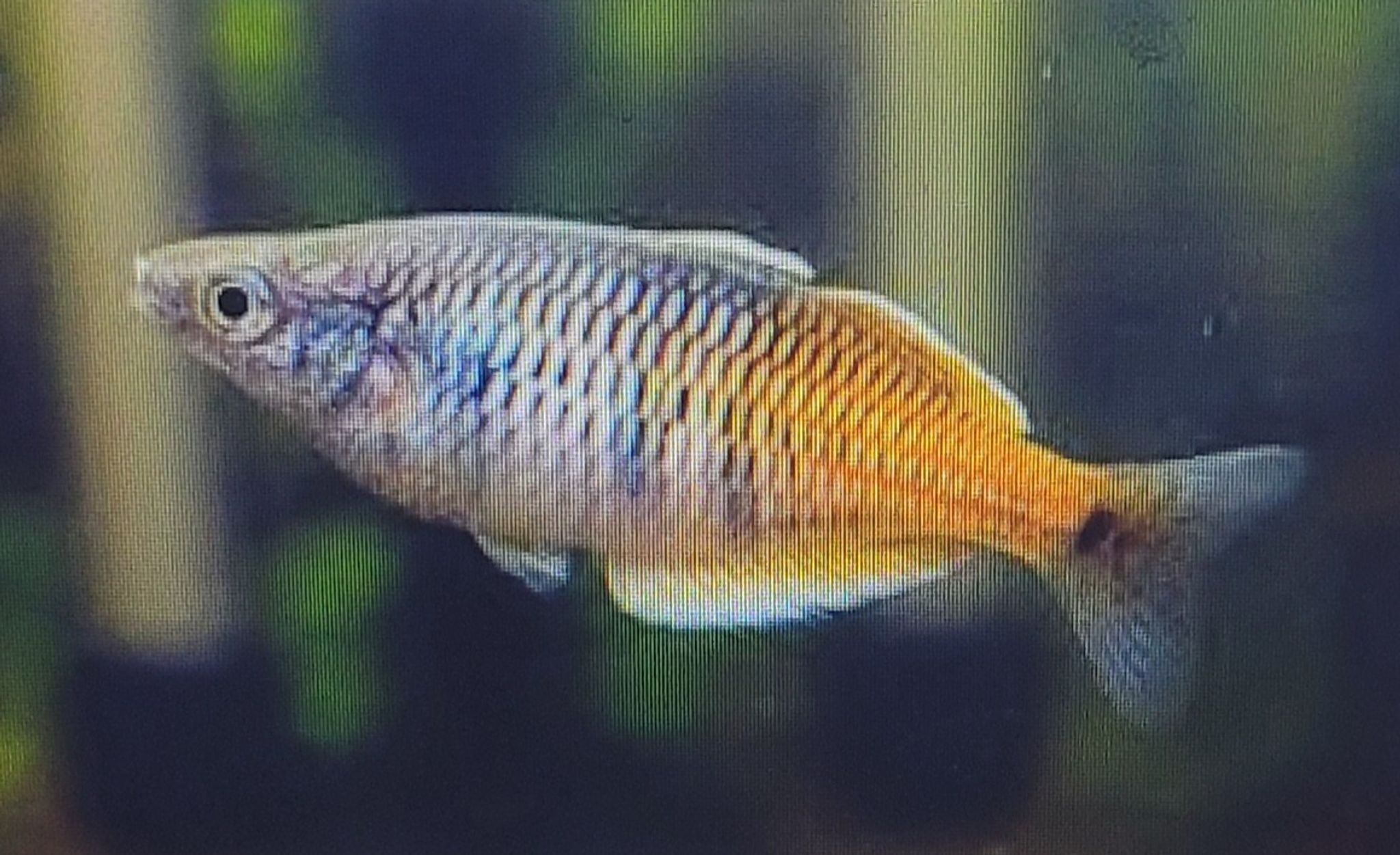
Expect juveniles to look dull. Shops usually sell young fish, and the full blue-front, orange-back adult color can take 6–12 months to develop. Diet, group dynamics and the presence of females all affect how intense it gets.
Line-bred strains, look-alikes and wild stock
Wild Boesemanis live only in the Ayamaru lakes region of West Papua, and the wild population is listed as threatened after past overcollection. Aquarium fish are captive-bred, so buying them is a responsible choice. You'll also see line-bred "Boesemani" strains and look-alike hybrids. They behave the same as tank mates, but if you want to breed true Boesemanis, don't mix in other Melanotaenia females.
Common Mistakes and How to Fix Them
- Keeping only 2–3 rainbows: they get stressed and colors fade. Keep 6 or more.
- An all-male group or the wrong ratio: leads to constant chasing. Aim for about 2:3 male:female.
- A 20–29 gallon tank: there's no swimming room for a 4 in fish that cruises all day.
- Mixing with soft-water species: discus, rams and chocolate gouramis won't thrive in the same water.
- Adding a dwarf shrimp colony: the shrimp become food.
- Shy fish going hungry: slow eaters can waste away. Target-feed them or use sinking pellets.
- Mixing Melanotaenia species carelessly: they can hybridize. Keep only males of the second species if you don't want hybrids.
If chasing gets out of hand: add females, add plants and décor to break line of sight, and consider moving the group to a longer tank.
Frequently Asked Questions
Can Boesemani rainbowfish live with cherry shrimp?
Usually not. Adult Boesemanis will hunt cherry and other dwarf shrimp, and a colony tends to disappear. Amano shrimp and larger adult ghost shrimp have a much better chance.
Can Boesemanis live with guppies or neon tetras?
It's risky. Adult Boesemanis may eat very small neons and bully fancy guppies with long fins. Larger tetras such as congos and hardier livebearers like platies and swordtails are better choices.
Can Boesemani rainbowfish live with angelfish?
Only in a large, tall tank of 75 gallons or more, with close monitoring. Angelfish are slow and long-finned, and the rainbows' constant activity can stress them or crowd them away from food.
Can Boesemanis share a tank with other rainbowfish?
Yes. Turquoise, praecox and red rainbows are natural companions. Because Melanotaenia species can hybridize, keep only males of the second species if you want pure offspring.
How many Boesemanis should I keep, and at what ratio?
Keep 6–12, with more females than males, around 2 males to 3 females. This spreads out male displays, reduces chasing and brings out the best color.
Can they live with a betta or African cichlids?
No to bettas: their long fins and slow swimming make them a target. African cichlids are generally not recommended either. It could only work in a peaceful hard-water setup with no mbuna. Boesemanis also leave most plants and adult snails alone, so a planted tank with snails is fine.
Build Your Boesemani Community
Start with a proper group of rainbows in a 4 ft tank, then add fast mid-water fish and a bottom crew that suit your hard tap water. When you're ready to pick your group, browse the rainbowfish on FishyHub and plan your tank mates around them.


