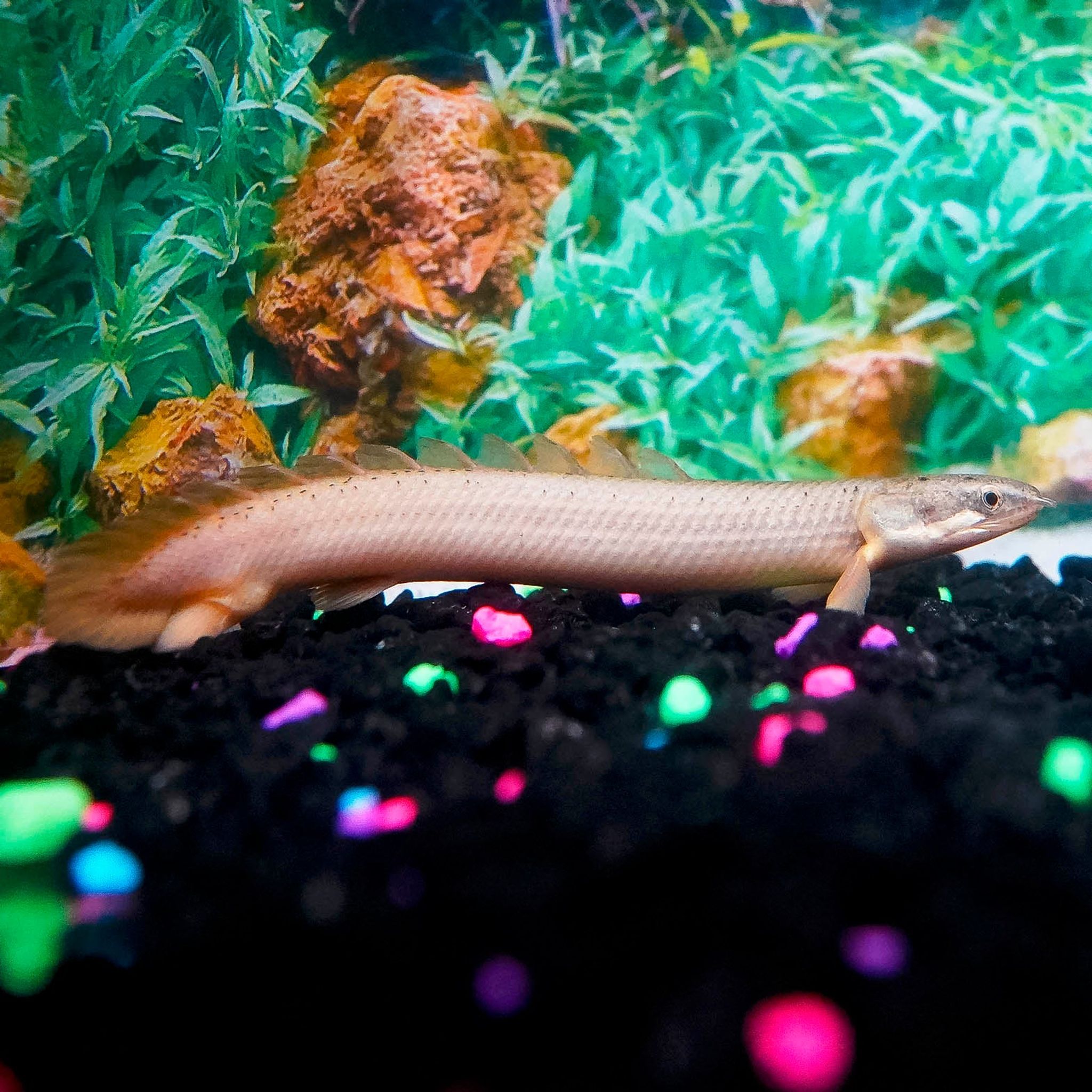
Best Tank Mates for Bichir: Compatible Fish and Species to Avoid
The best tank mates for bichir are fish that will stay too big to swallow for the bichir's whole life: silver dollars, hoplo catfish, severums, blue acaras, similar-size oscars, clown loaches, ropefish and other bichirs are the proven core. Anything small enough to fit in its mouth, including tetras, guppies, corydoras and shrimp, will eventually become dinner. Below you'll find one simple rule for choosing mates, stocking plans sorted by tank size, and a clear list of species to skip.
The One Rule: Mouth Size and Future Adult Size
Bichirs are predators, not bullies. They rarely chase or harass fish they can't eat, but anything that fits in their mouth is fair game. A practical rule of thumb: any tank mate under about half the bichir's length is at risk.
Two details make this rule easy to underestimate:
- They hunt at night. Bichirs are low-light hunters with poor eyesight that track prey by smell. A fish the bichir ignores all day can vanish overnight, so "they get along fine" during daylight hours proves nothing.
- They keep growing. Most bichirs are sold at 3–4 inches (8–10 cm). The fish you buy is not the fish you'll have in three years, so size every mate against the bichir's adult length.
Adult Size by Bichir Species
| Bichir type | Typical adult size | Realistic tank for a community | Mates that stay safe |
|---|---|---|---|
| Senegal / gray bichir, small palmas types | 10–14 in (25–36 cm) | 75 gal (284 L) minimum | Fish reaching 5–6 in (13–15 cm) or more |
| Delhezi | ~14 in (36 cm) | 75–125 gal (284–473 L) | Fish reaching 6–7 in (15–18 cm) or more |
| Ornate, endlicheri, lapradei and other "big" bichirs | 2–3 ft (61–91 cm) | 180+ gal (681+ L) | Only large fish: big cichlids, arowana, giant gourami |
If you don't know which species you have, plan as if it will reach the top of its range.
Tank Size, Water and Setup
How Big a Tank?
- 55 gal (208 L) is a bare minimum for one small bichir kept alone.
- 75 gal (284 L) with at least 18 in (46 cm) front-to-back depth is the realistic starting point for a community.
- 180+ gal (681+ L) is required for the large species.
Bichirs live on the bottom, so footprint matters more than height. A long, wide tank gives multiple bottom dwellers room to claim their own spots.
Water Parameters
Bichirs do well at roughly 74–82 °F (23–28 °C), pH 6.5–7.5 (they tolerate about 6.2–7.8), in soft to moderately hard water. Sources vary slightly on temperature (some suggest 78–82 °F); aiming for 77–80 °F (25–27 °C) suits the widest range of tropical companions. Most large tropical fish overlap easily with these numbers. Cold-water fish, like fancy goldfish, do not.
Air Breathing, Surface Access and Lids
Bichirs have lung-like organs and gulp air from the surface. Keep a clear path to the top; don't crowd the surface so heavily with floating plants or surface fish that the bichir can't reach it. The same trait makes them escape artists: they will push through gaps around filters, heaters and cords. Use a tight-fitting lid and seal cord gaps with foam or mesh.
Decor That Keeps the Peace
- Sand or smooth, fine substrate to protect the bichir's belly and barbels.
- One cave per bottom dweller — PVC pipe, driftwood or rock caves — so bichirs, catfish and ropefish don't fight over a single hide.
- Floating plants in patches to dim the light, which bichirs prefer.
- No sharp-edged rock or decor that can scrape a fish that moves along the floor.
What Makes a Good Bichir Tank Mate
Look for fish that are:
- Similar or larger adult size than half the bichir's length
- Mid- or top-water swimmers, so they don't compete for floor space
- Day-active, so they're resting when the bichir hunts
- Peaceful to semi-aggressive, not hyper-territorial
- Not fin-nippers, since bichir fins are slow-moving targets
Best Tank Mates for Bichir
Safe Core Picks
- Silver dollars — a school of 5 or more in 75+ gal (284+ L). Fast, deep-bodied and out of reach once grown.
- Hoplo catfish — armored, hardy and unbothered by a bichir sharing the bottom.
- Severum — a calm, deep-bodied South American cichlid.
- Blue acara — a manageable, mostly peaceful cichlid for 75 gal tanks.
- Oscar — only with a bichir of similar size; 75 gal minimum, 125 gal (473 L) ideal. Oscars are notorious food thieves.
- Black ghost knifefish — nocturnal like the bichir, so give each its own hide; needs 125+ gal (473+ L) long term.
- Clown loaches — keep as a group in 100+ gal (379+ L). Buy them large enough to be out of mouth range.
- Bala sharks and tinfoil barbs — both need large groups, 125+ gal and a 6-ft (183 cm) tank.
- Giant gourami and arowana — only for 200–250+ gal (757–946+ L) systems.
If you're shopping for cichlid companions, the American cichlids range includes several of the larger, calmer species that pair well with bottom-dwelling predators.
African Biotope Picks
- Elephantnose — keep one only, over sand. It is sensitive and needs stable water and targeted feeding.
- Leopard bush fish (ctenopoma) — an ambush predator itself; fine with an adult bichir but can threaten a small juvenile.
- African butterflyfish — a surface dweller that never meets the bichir, but it jumps, so a tight lid is essential.
- Congo tetras — only when fully grown and only with a small bichir species.
Other Bichirs and Ropefish
Bichirs and ropefish (a close, eel-like relative) are natural companions. They share the same habits, water and diet. Keep them at similar sizes when added, give plenty of floor space, and provide at least one hide per fish.
Where Advice Conflicts
Plecos. Some keepers list them as good mates; others warn they can rasp a bichir's slime coat at night. Skip common and sailfin plecos. If you want one, choose a peaceful mid-size species, add plenty of wood and caves, and watch the bichir for pale patches. The plecos and bottom dwellers section is where to compare adult sizes before buying.
Semi-aggressive cichlids (convict, firemouth, Jack Dempsey). Possible in 75+ gal with lots of cover, but a spawning pair will harass anything on the bottom. Not a first choice.
Smaller fish (tiger barbs, Boesemani rainbows, Congo tetras, Denison barbs). Only with small bichir species and fully grown mates. Tiger barbs are fin-nippers and a poor match either way.
Oscars and peacock bass. Tank recommendations range from 55 to 200 gal. A practical answer: oscar plus bichir in 125 gal (75 gal minimum); peacock bass only in 180–200+ gal (681–757+ L) and only with big bichir species.
Species to Avoid
- Nano fish and small schoolers — neons, most tetras, danios, rasboras
- Livebearers — guppies, platies, mollies, swordtails
- Corydoras — small bottom dwellers in the bichir's direct path
- Bettas
- Shrimp and snails — shrimp are food, and small snails likely are too
- Slow, long-finned fish — fancy goldfish also need cooler water
- Fin-nippers — tiger barbs and similar
- Very aggressive large cichlids that pin bottom dwellers in corners
- Any juvenile of a "safe" species that is still small enough to swallow
Compatibility Quick Reference
| Fish | Adult size | Swim zone | Min. tank | Risk with a small bichir |
|---|---|---|---|---|
| Silver dollar (5+) | 6 in+ (15 cm+) | Mid | 75 gal | Low |
| Hoplo catfish | 5–6 in (13–15 cm) | Bottom | 75 gal | Low |
| Severum / blue acara | 6–8 in (15–20 cm) | Mid | 75 gal | Low |
| Oscar | 12 in (30 cm) | Mid | 75–125 gal | Low–moderate (food theft) |
| Clown loach (group) | Large | Bottom/mid | 100 gal | Low if bought large |
| Black ghost knifefish | Large | Bottom/mid | 125 gal | Low–moderate (shared night hours) |
| Ropefish / other bichirs | Similar | Bottom | 75 gal+ | Low with enough hides |
| Common/sailfin pleco | Large | Bottom | — | Moderate (slime-coat rasping) |
| Convict / Jack Dempsey | Medium | Mid/bottom | 75 gal | Moderate (spawning aggression) |
| Tetras, guppies, corydoras | Small | Any | — | High (eaten) |
| Shrimp and snails | Small | Bottom | — | High (eaten) |
Adult sizes are approximate; check the specific species before buying.
Stocking Plans by Tank Size
These are starting points for a Senegal or similar small bichir unless noted.
75 Gallon (284 L)
- 1 Senegal bichir
- 5–6 silver dollars or 1 severum / blue acara
- 2–3 hoplo catfish
Keep cichlids to one; the floor fills up fast.
125 Gallon (473 L)
- 1–2 small bichirs (added at similar size) or 1 bichir plus 1 ropefish
- 1 oscar or a group of silver dollars
- A group of clown loaches, or a black ghost knifefish with its own hide
180+ Gallon (681+ L)
- 1 large bichir species (ornate, endlicheri, lapradei) or several small ones
- Large schools of tinfoil barbs or bala sharks in a 6-ft tank
- Big, calm cichlids; peacock bass or giant gourami only at 200+ gal, arowana at 250+ gal
Feeding a Slow Bichir Among Fast Mates
Bichirs are slow, nearly blind, scent-driven eaters. Oscars, silver dollars and other fast mid-water fish will grab food before the bichir finds it. To keep it fed:
- Offer sinking pellets and frozen foods placed near the bichir's cave.
- Feed a second portion after lights-out, when the bichir is active and the day fish are resting.
- Use feeding tongs to target-feed.
- Check body shape weekly. A thin bichir means mates are out-competing it; switch to targeted night feeding.
Common Mistakes and Troubleshooting
- Pairing a 3-in juvenile bichir with tetras "because they get along now." The tetras disappear within months.
- Adding a bichir to a tank of mature, territorial cichlids. It can end up with torn fins and stop eating. Add bichirs at equal or larger size and rearrange decor on introduction to reset territories.
- Fish missing overnight. Check the mouth-size math, not the bichir's temperament.
- Frayed fins or scrapes. Look for nippers, plecos working the bichir at night, or sharp decor.
- Bichir found on the floor. It escaped through a gap around a filter or heater; seal the lid.
- Skipping quarantine. Quarantine new mates for 2–4 weeks. Bichirs can live 15+ years and represent a significant investment.
Introduction Order and Long-Term Monitoring
Add the most peaceful mates first, and add the bichir either alongside or before territorial fish, at a size equal to or larger than its companions. Over the years, keep an eye on growth: a mate that was safe at 5 inches against a 6-inch bichir may not be safe against a 13-inch one. Re-check the half-length rule every few months as your bichir grows.
Frequently Asked Questions
Are bichirs aggressive?
Bichirs are predatory but mostly peaceful toward anything too large to eat. You may see some squabbling with other bottom dwellers over caves, which extra hides usually solve.
Can bichirs live with community fish like tetras or guppies?
No, not small species. Tetras, guppies and similar fish will be eaten, usually at night. Only large, robust schoolers that are already full-size, such as adult Congo tetras with a small bichir, are worth considering.
Can you keep multiple bichirs together?
Yes. Add them at similar sizes, give them plenty of floor space, and provide at least one hide per fish. Ropefish can join the group on the same terms.
Can bichirs live with oscars?
Yes, if the bichir is similar in size and the tank is 75–125 gal (284–473 L), with 125 gal being the better target. Watch for food theft and feed the bichir separately after lights-out.
Do bichirs get along with African cichlids?
Hard-water, rock-dwelling mbuna are a poor fit because of their aggression, rock stacks and higher pH needs. Peaceful, larger haps in a big tank can work.
Can a bichir live with a stingray or arowana?
It's possible only in very large tanks of 250+ gal (946+ L) with experienced care. Both need space and water quality most home setups can't provide.
Build Your Bichir Community
A bichir tank works when every companion stays too large to swallow, the floor has enough caves for everyone, and the bichir gets its share of food after dark. Browse the monster fishes collection on FishyHub to find bichirs, ropefish and large companions sized for a long-term predator setup.


