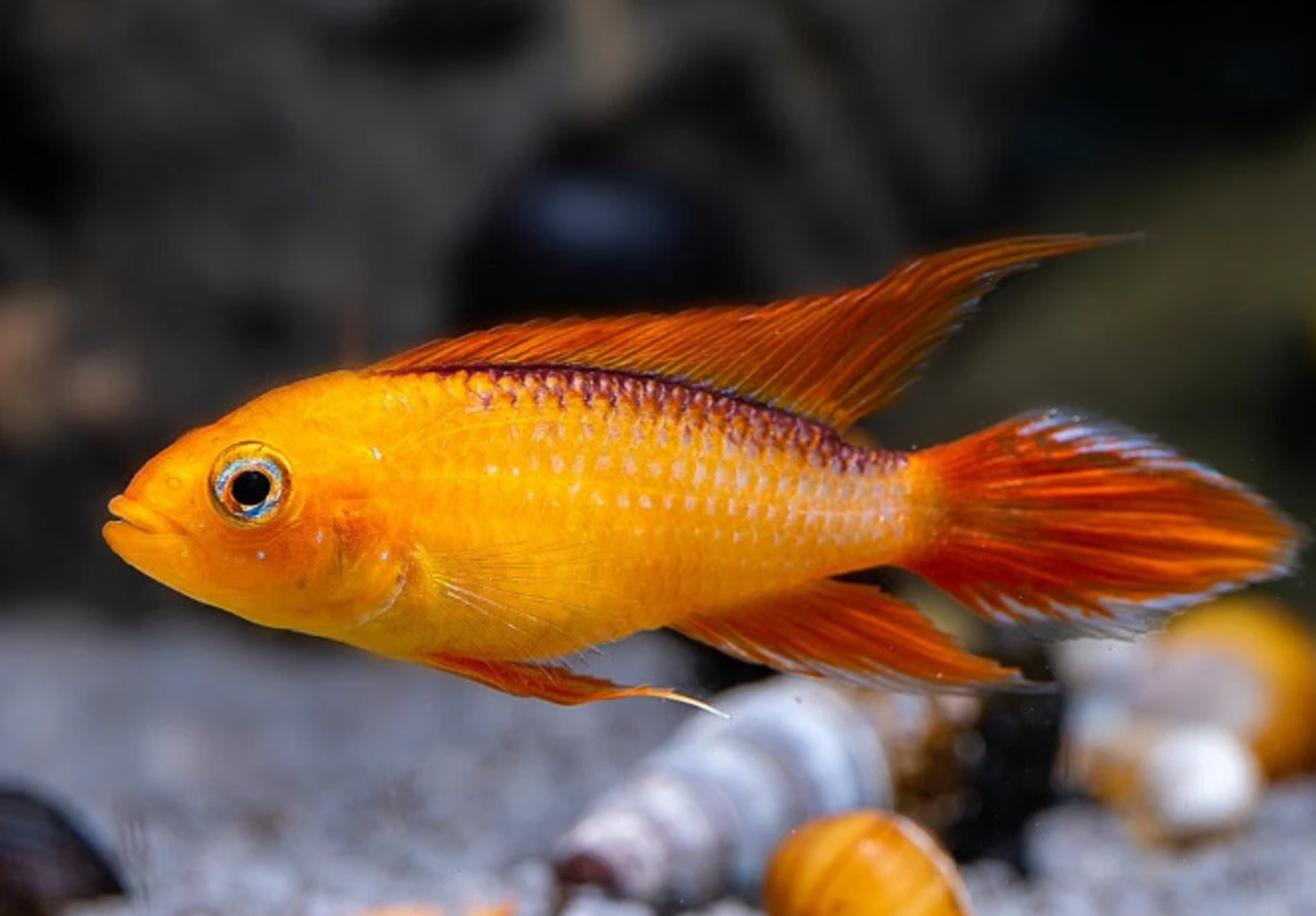

Best Tank Mates for Apistogramma: Compatible Fish and Species to Avoid
The best tank mates for Apistogramma are small, calm schooling fish that stay in the middle and upper water, such as cardinal, ember and rummynose tetras, pencilfish and small rasboras, plus a few gentle bottom fish like Corydoras and kuhli loaches that like the same soft, acidic, warm water. Skip anything big enough to eat an apisto, fin-nippers, rowdy bottom-dwellers and hard-water species. Below you'll find group sizes, tank sizes and a few stocking plans you can shop from.
How Apistos Use the Tank
Apistogramma are floor-dwelling dwarf cichlids. Males usually reach about 2.5–3.5 inches (6–9 cm), and females stay smaller. Each fish claims a patch of bottom built around a cave, and most of its aggression goes to fish that share that bottom zone. A tetra cruising at mid-water barely registers. A cory rooting past the cave entrance gets chased.
So don't pick mates just because they're labeled "peaceful community" fish. Plan around the apisto's floor territory:
- Top and middle zones: open for schooling dithers.
- Bottom zone: limited room for small, non-territorial fish, and only with enough caves and cover.
- Water: every mate has to be happy in soft, acidic, warm water.
Species differ, too. A. cacatuoides and A. agassizii are generally hardier and bolder and A. borellii tends to be gentler. Wild-caught fish of any species usually need softer water than tank-bred stock.
Water and Tank Size Your Mates Must Match
| Parameter | Apisto range | Target for a community |
|---|---|---|
| Temperature | 72–84°F (22–29°C); most do best at 76–82°F (24–28°C) | 76–80°F (24–27°C) |
| pH | 5.5–7.0 | 6.0–7.0 (lower for blackwater setups) |
| Hardness | Soft, roughly 1–8 dGH | Stay within that range |
| Nitrate | Sensitive | Under 20 ppm |
| Tank size | Pair or trio | 20 gal long (76 L) minimum |
Sources don't agree on the minimum tank. Some say 10 gallons (38 L) is fine for a single apisto, while others ask for 20–30 gallons (76–114 L). For any community setup, start at a 20-gallon long. Go to 30 gallons (114 L) or more if you want a second bottom group or another dwarf cichlid. Footprint matters more than height, because the floor space is what these fish fight over.
Temperature ranges vary as well, with one spread running 72–86°F and cory-focused data closer to 75–79°F. Aim for 76–80°F as the overlap and choose bottom fish that can handle it.
The Best Dither Fish for Apistogramma
What dither fish actually do
Dither fish are calm schooling fish whose steady swimming tells a shy cichlid the area is safe. With dithers present, apistos hide less, show more color and eat better. Dithers are not "target fish" put there to soak up aggression. They live above the apisto's zone and mostly get left alone.
Keep at least 6 of one species, and 8–10 or more works better. Three neons won't do the job, and a nervous apisto will either stay hidden or turn aggressive.
Top dither choices
- Cardinal tetras and neon tetras: classic soft-water schoolers.
- Ember tetras: tiny, so they fit well in a 20-gallon.
- Rummynose tetras: tight schooling, and they appreciate warmth.
- Lemon tetras: a little larger and still peaceful.
- Pencilfish: slow, quiet and very good at making the tank feel safe.
- Harlequin and other small rasboras: a sturdy mid-water option.
- Hatchetfish: they stay at the surface. Use a tight lid because they jump.
You can browse schooling species in FishyHub's tetra selection.
Best Bottom Tank Mates
| Species | Group size | Minimum tank | Notes |
|---|---|---|---|
| Corydoras | 6+ | 20 gal long (76 L) | Soft sand; pick species that tolerate warmth |
| Kuhli loaches | 5+ | 20 gal long (76 L) | Burrowers that need sand and cover |
| Otocinclus | 6+ | 20 gal (76 L), mature | Needs established biofilm and algae |
| Bristlenose pleco | 1 | 30 gal (114 L) | Keep just one |
Apistogramma with Corydoras
Corys are broadly compatible with apistos. Keep these points in mind:
- Use soft sand so their barbels stay intact.
- Keep 6 or more so they shoal and feel secure.
- Choose warmth-tolerant species. C. sterbai handles warmer water well. Peppered corys prefer cooler temperatures and don't suit an apisto tank kept near 80°F.
- Corys roam the whole floor, including past caves, so expect some chasing, particularly during spawns.
- Feed them separately. More on that below.
Browse suitable species in the Corydoras section.
Other Workable Companions
- Dwarf gourami or honey gourami: they stay in the upper water and don't compete for caves.
- Small, peaceful rainbowfish such as dwarf neon rainbows, but only if your water sits close to neutral.
- Livebearers (guppies, platies): sources disagree here. They prefer harder, more alkaline water, so add them only if the tank runs near pH 7 with moderate hardness. Leave them out of true blackwater. Most do poorly long-term in soft, acidic water.
- Angelfish: another point of disagreement. Angels are a real predator risk. Try it only in 55 gallons (208 L) or more, with adult apistos and young angels raised together. Never add adult angels to juvenile apistos.
Other Dwarf Cichlids With Apistos
Rams, goldeneye cichlids (Nannacara) and Laetacara can share a tank with apistos, but only in 30–40 gallons (114–151 L) or more, with separate caves and broken sightlines. Usually keep one male per species.
Rams
Some keepers say rams are ideal with apistos. Others point out that both fight over the floor. Both can be right, depending on space. Give them 30 gallons or more and plenty of caves so each fish can hold its own area.
Goldeneye cichlid (Nannacara anomala and N. aurocephala)
These are small, with males around 2 inches (5 cm), and they need soft, acidic water in 20 gallons or more. Keep one male per tank. A spawning female turns dark and aggressive, and in a small tank she can kill the male. Otherwise they get along with small characins and corys. They work well as an alternative to apistos, or as a careful companion in a larger tank.
Kribensis (Pelvicachromis pulcher)
Kribs are West African dwarf cichlids. Males reach about 4 inches (10 cm) and females about 3 inches (7.5 cm). They handle a wider pH range than apistos, up to about 8, so they suit a wider range of community tanks. They breed readily, defend their young fiercely, and can nip long fins. Because kribs and apistos are both cave spawners that want the same floor, we don't recommend combining them in anything under 40 gallons. With both kribs and apistos, water pH can also affect the ratio of males to females in the fry.
Two Apistogramma species together
This is possible only in 40 gallons or more with plenty of caves. Even then you risk fights and hybrids.
Species to Avoid
- Predators: large angelfish in small tanks, oscars and larger cichlids. Anything big enough to swallow an apisto eventually will.
- Fin-nippers: tiger barbs and serpae tetras harass slow cichlids.
- Fast, boisterous or bottom-competing fish: larger loaches and rainbow sharks contest the floor.
- Hard-water fish: African rift lake cichlids, and most livebearers over the long term.
- Extra males of the same apisto species in a small tank. One usually gets killed or spends its life hiding.
What about shrimp?
Adult cherry or Amano shrimp may survive in a heavily planted tank, but apistos will eat shrimplets. Treat shrimp as food unless you're fine with losing some.
Layout: Where Community Peace Comes From
- Give one cave per female, plus spares. Coconut shells and clay caves work well.
- Add leaf litter, driftwood and plants to break lines of sight, so fish can't see each other across the whole floor.
- Avoid bare-bottom or open layouts, which lead to more territory disputes.
Blackwater and biotope style
Botanicals like almond leaves, alder cones and guava leaves stain the water, lower pH, have a mild antimicrobial effect and add cover. Start with about 1–2 leaves per 10 gallons and don't run carbon, since it strips the tannins. Watch out for low KH: blackwater with very little buffering can crash in pH. For an Amazon biotope, pick South American mates such as tetras, pencilfish, corys and hatchetfish.
Stocking Order and Templates
Add dithers first, bottom fish next and apistos last. If the apistos go in first, they claim the whole tank before anything else settles.
| Tank | Apistos | Dithers | Bottom |
|---|---|---|---|
| 20 gal long (76 L) | 1 pair | 10 ember tetras | 6 pygmy or habrosus corys |
| 40 gal breeder (151 L) | 1 trio (1 male, 2 females) | 12 cardinals + 8 pencilfish | 8 corys |
Pair or harem? Keep a pair in a 20-gallon. In 30 gallons or more, one male with 2–3 females spreads the male's attention around.
Breeding Changes the Rules
A guarding female will chase corys, loaches and even the male. Expect a no-go zone of about 1–2 feet (30–60 cm) around the cave. Dithers pick off eggs and fry at night, and corys eat them too. If fry vanish overnight, that's usually the reason. If you want to raise them, move the fry to a separate tank. If the corys are being chased nonstop, add more caves and sightline breaks, or move the corys out for a while during brood care.
Feeding and Quarantine
Feed apistos frozen and live foods. After the cichlids have eaten, drop sinking wafers so they reach the corys and plecos, or the bottom fish will slowly starve. Doing this after lights-out also helps.
Quarantine new fish for 2–4 weeks. Apistos are sensitive to ammonia, nitrate and disease brought in by new arrivals, and wild-caught tetras are a common carrier. Keep nitrate under 20 ppm. If your apisto goes missing, turns pale or holds its fins clamped, test nitrate, look for pH swings in low-KH blackwater, and watch for bullying from tank mates.
Common Mistakes
- Putting two males in a small tank.
- Picking mates by "peaceful" labels without checking pH and hardness.
- Adding too few dithers.
- Using open, bare layouts.
- Adding the apistos first.
- Assuming the bottom fish get food just because the tank was fed.
Frequently Asked Questions
Can apistos live with shrimp?
Adult cherry or Amano shrimp sometimes survive in dense cover. Baby shrimp will almost certainly get eaten. Don't count on a colony reproducing.
How many tetras should I add?
Add at least 8–10 of one species for a good dither effect. Smaller groups make both the tetras and the apisto nervous. Add the tetras before the cichlids.
Will apistos eat neons?
Adult apistos rarely eat healthy adult neons. Tiny juveniles and fry of any species are at risk. Buy dithers at a decent size.
Are apistos OK with bettas?
It can work in 20 gallons or more, but it isn't ideal. Both fish may spar, and the betta's long fins attract attention. A calm schooling dither is the safer pick.
Can apistos live with rams?
Yes, in 30 gallons or more with separate territories, several caves and broken sightlines. In smaller tanks they tend to fight over the floor.
Can I keep two apisto species together?
Only in 40 gallons or more with lots of caves. Expect some territorial fights, and there's a risk of hybrids if the species are closely related.
Plan Your Apisto Community
Start with the water, add dithers and bottom fish, and put the apistos in last. When you're ready to choose your dwarf cichlids, browse FishyHub's angelfish, discus, rams and cichlids collection.


