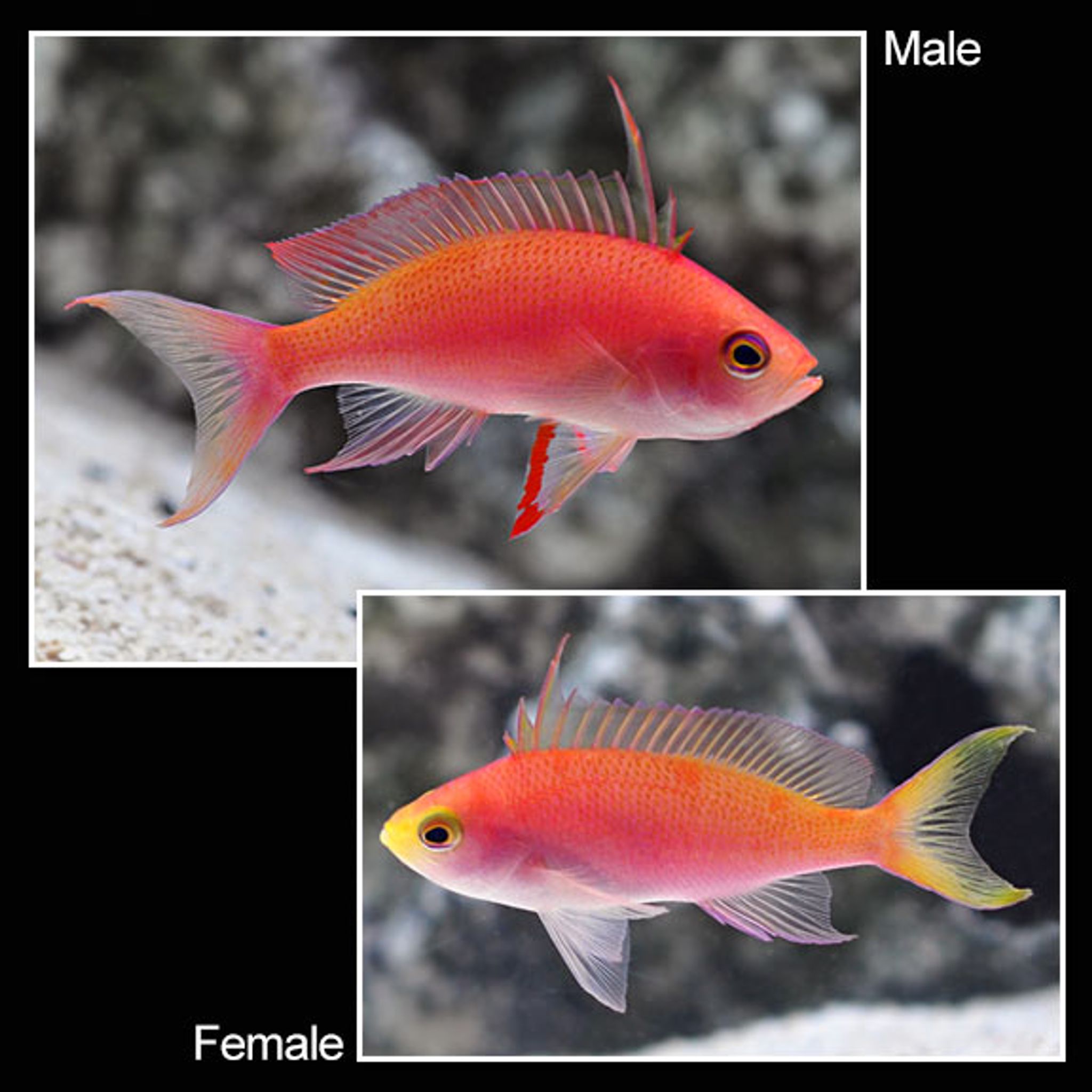
Best Tank Mates for Anthias: Peaceful, Risky and Incompatible Choices
Anthias are practically bulletproof around corals, but that doesn't mean any fish belongs in their tank. This guide sorts tank mates into peaceful, risky, and incompatible tiers, and explains the harem structure, feeding schedule, and stocking order that decide which category a given fish actually lands in.
Why Anthias Compatibility Is About More Than the Species List
Anthias (Pseudanthias spp., most commonly the lyretail anthias) are small, fast-swimming, shoaling planktivores that measure roughly 2–5 inches (5–13 cm). They spend their day picking plankton out of open water and essentially ignore corals, clams, and other sessile invertebrates — reef-safe in the truest sense.
That reef-safety is only half the compatibility story. Anthias are also protogynous hermaphrodites living in harems: one dominant male presides over several females in the wild. Remove the male and the largest, most dominant female will typically convert to male within about 2–3 weeks. This social structure — not the species chart — is what drives most conflict:
- A lone male with too few females puts constant pressure on the females he does have.
- A crowded or underfed harem redirects aggression outward, toward tank mates.
- Two males in one system, or a male with no clear harem, usually means ongoing sparring.
So before asking "will fish X work with anthias," the more useful question is whether your anthias group itself is set up to stay calm.
Tank Size and Flow: The Compatibility Prerequisite
Anthias are column swimmers, not rock-huggers, so cramped tanks and weak flow turn otherwise-fine tank mates into rivals simply by forcing everyone into the same small space.
- Group size: a shoal of 4+ is a workable minimum; 6–10+ is ideal for a stable hierarchy, since larger groups dilute aggression across more individuals.
- Tank size: 70–125+ gallons (265–475+ L) for a small harem; go larger for bigger groups or multiple anthias species.
- Flow: strong, turbulent water movement that mimics open-water current, not a gentle rock-face flow.
- Layout: generous open swimming room plus rockwork for retreat when a fish wants to disengage.
As a rough stocking rule, budget an extra 15–20 gallons of swimming space for each female added past your starting minimum group — it keeps per-fish aggression low as the harem grows.
Feeding Schedule: The Make-or-Break Husbandry Factor
Feeding is arguably the single biggest compatibility variable — bigger than any species pairing on this list. Anthias need small meals 2–3 or more times a day of mysis shrimp, brine shrimp, copepods, amphipods, and other meaty or planktonic foods.
Skip feedings or feed once a day and the effects show up fast:
- Noticeably increased aggression and territoriality toward tank mates competing for food
- Weight loss and a washed-out, faded color
- Wasting and, in prolonged cases, death
A well-fed anthias harem is genuinely peaceful. An underfed one will pick fights with fish it would otherwise ignore. Frozen mysis and enriched brine shrimp, along with a rotation of other planktonic foods available on FishyHub, make it realistic to hit that 2–3x daily target.
Peaceful Tank Mates
These species share the same non-territorial, open-water-friendly temperament anthias need and rarely compete for the same resources:
| Tank mate | Why it works |
|---|---|
| Clownfish | Holds territory near an anemone or rock, doesn't compete for mid-water plankton |
| Chromis | Similar peaceful shoaling behavior, low food competition |
| Cardinalfish | Slow, nocturnal-leaning feeders that don't clash over the water column |
| Watchman & neon gobies | Bottom-oriented, no overlap with anthias' feeding zone |
| Fairy & flasher wrasses | Comparable size and temperament, similar reef-safe profile |
| Firefish | Peaceful, holds a burrow, minimal interaction |
| Royal gramma | Shy, cave-dwelling, non-competitive |
| Tangs & calm butterflyfish (e.g., copperband) | Graze elsewhere in the tank, don't chase anthias for food |
| Calm reef-safe angelfish | Non-aggressive species coexist without issue |
You can browse many of these directly in FishyHub's marine fish selection, including clownfish and wrasse options that pair well with a healthy harem.
Risky Tank Mates
These fish can work, but the outcome depends heavily on group size, tank size, and who arrives first:
- Hawkfish — the classic gamble. A lone hawkfish added to an established, full anthias harem can get bullied; conversely, a hawkfish (even a small one) introduced before or alongside a weak or single anthias has been known to kill it. Treat hawkfish as a genuine risk category, not a safe pick.
- Six-line and other feisty wrasses — compete for the same mid-water niche and can spar with anthias over territory.
- Dottybacks — small but assertive, and territorial disputes are common.
- Other small territorial fish that overlap with anthias for space and food.
With every fish in this tier, introduction order and numbers matter more than the species label itself.
Incompatible Tank Mates
Avoid these outright:
- Large predatory or mouth-large fish — groupers, lionfish, large hawkfish, big wrasses, and large angelfish can simply eat a small anthias.
- Triggerfish and other aggressive bruisers — harass anthias and dominate feeding, starving out the more timid shoal members.
- Very slow, passive fish sharing the same food niche — anthias will out-compete and bully them, not the other way around, so gentle plankton feeders with weak feeding drive tend to lose out and fade.
A Quick Compatibility Checklist
For any candidate not covered above, run it through these questions:
- Mouth size vs. anthias size — could it physically swallow a 2–5 inch fish?
- Water-column overlap — does it also feed in open mid-water, or does it stay on rock/sand?
- Known temperament — is it documented as territorial or a bully, even toward similarly sized fish?
- Similar color/shape — male anthias can target fish that resemble their own harem members, especially under crowding or poor feeding.
If a candidate scores "yes" on the first or third question, treat it as incompatible or risky rather than assuming reef-safe automatically means community-safe.
Mixing Multiple Anthias Species
Combining species is possible in large enough systems, and can actually spread out aggression rather than concentrating it on one species. The key is matching temperament:
- Feistier species: lyretail, Bartlett's — pair these with each other.
- Calmer species: Resplendent, Randall's — pair these with each other.
- Avoid mixing a boisterous species with a shy one; the assertive group will dominate feeding and space.
Market availability and price vary noticeably by species — lyretail anthias tend to be the most common and affordable, while Resplendent, Randall's, and squarespot anthias are typically pricier and less frequently in stock, so plan a mixed-species tank around what's realistically available rather than assuming any combination is easy to source.
Introducing Anthias to an Established Tank
Order of introduction changes outcomes more than most people expect:
- Add anthias early, ideally before territorial residents are established, or add a full group simultaneously rather than trickling individuals in over weeks.
- Sequence by aggression: mellow species and individuals first, more assertive fish last.
- Consider a quarantine-then-batch-release approach: hold the shoal together in a bare quarantine tank, feeding multiple times daily on enriched frozen mysis and brine shrimp, so the group arrives at the display already conditioned, feeding well, and less vulnerable to harassment from residents.
Anthias are notoriously prone to shipping stress, and starvation in the first few weeks is a bigger real-world threat to a successful stocking plan than almost any tank-mate pairing. A shoal that's eating well and holding weight before it ever reaches the display tank is far more likely to settle into a stable hierarchy without conflict.
Common Mistakes to Avoid
- Buying a single anthias expecting long-term thriving — it can survive solo but stays shyer, hides more, and may unexpectedly turn male if females are added later.
- Underfeeding (once daily or irregular) — leads to weight loss, faded color, and redirected aggression.
- Adding anthias last into a tank already dominated by territorial fish — they get harassed and often refuse to feed.
- Mixing a highly assertive species with a docile one, or keeping a single male with too few females, which puts constant pressure on one or two females.
- Weak flow or too little open swimming room — this creates stress-driven aggression that looks like a tank-mate incompatibility but is really a setup problem.
- Assuming reef-safe means community-safe — anthias won't touch corals but can absolutely compete with, and bully, other small fish over food and space.
Frequently Asked Questions
Can you keep just one anthias?
Yes, a single anthias can live long-term, but it tends to be shyer, hides more, and won't display the natural schooling and color behavior of a group. It can also unexpectedly change sex if females are introduced later.
Will anthias eat small shrimp or snails?
No. Anthias are planktivores focused on food drifting through the water column, and they leave sessile invertebrates and most cleanup crew members alone.
Can anthias live with clownfish?
Yes, this is generally a safe and common pairing. Clownfish hold territory near an anemone or rock and don't compete directly with anthias for mid-water plankton.
Do anthias fight each other?
Males can spar over harem dominance, and females may squabble when no male is present, but serious injury is uncommon. Behavior typically settles once a stable hierarchy forms.
What fish should never go in an anthias tank?
Avoid large predatory fish — groupers, lionfish, large hawkfish, big wrasses, and large angelfish — that could eat a small anthias, along with aggressive bruiser species like triggerfish that stress the shoal and dominate feeding time.
How many anthias should I start with?
Start with at least 4, ideally 6 or more (one male to several females), in a tank of 70+ gallons (265+ L) with strong water flow.
Can different anthias species be mixed?
Yes, in large enough tanks. Match similar temperaments — two calmer species together, or two feistier species together — rather than pairing a shy species with a boisterous one.
Why is my anthias suddenly aggressive toward tank mates?
This is almost always underfeeding, overcrowding, or an imbalanced male-to-female ratio. Check feeding frequency and stocking density before assuming it's a species incompatibility.
Ready to plan your harem? Browse available anthias and other marine fish on FishyHub to build a stocking list around the peaceful pairings covered here.


