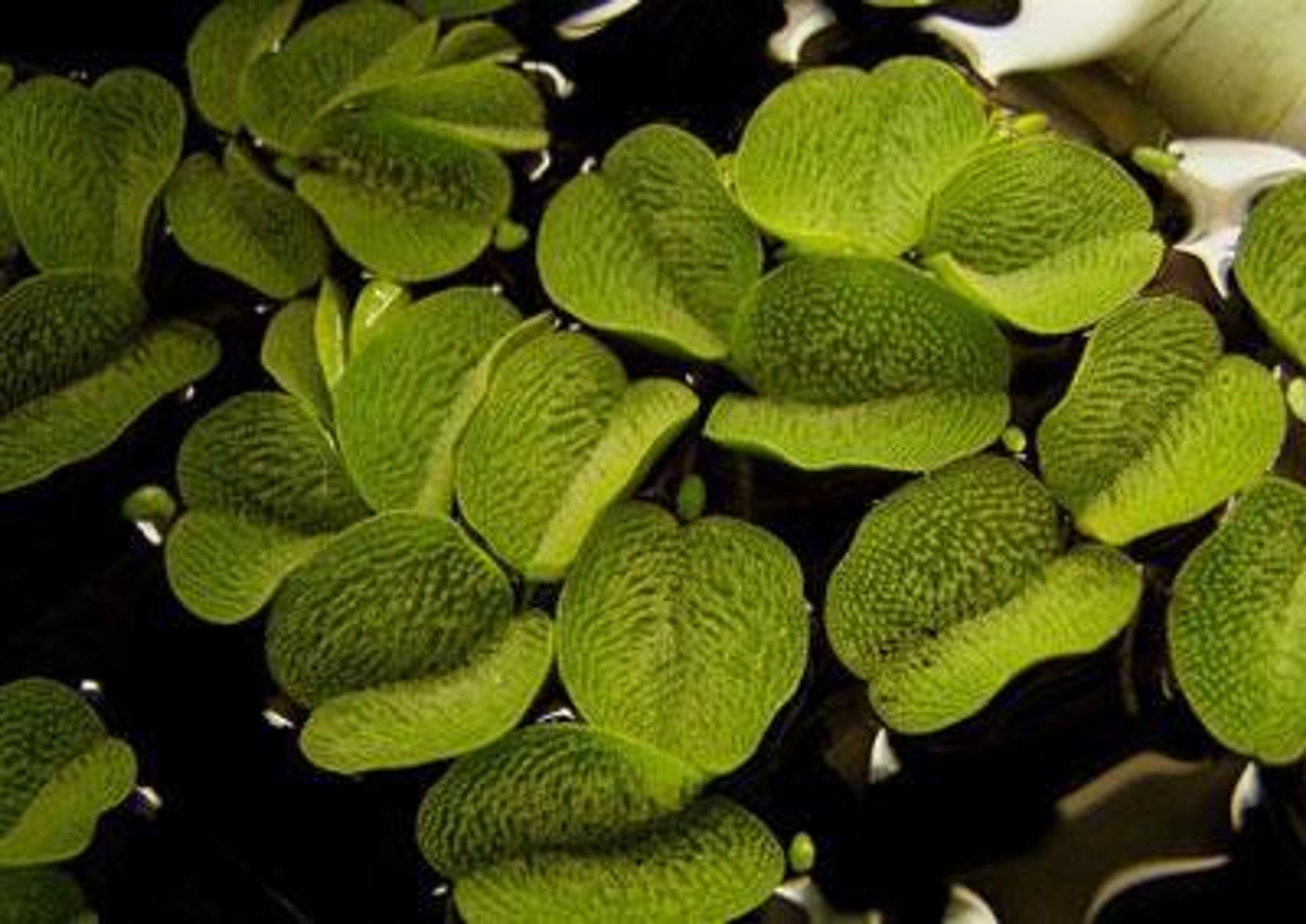
Best Tank Mates and Aquascaping Uses for Salvinia
Salvinia is a fast-growing floating fern that does far more than sit on the surface — it shades shy fish, supports bubble nests, and pulls excess nutrients out of the water column. This guide covers which tank mates thrive alongside it, how to use it as an intentional design element rather than a random mat, and the US legal caveats every buyer should check first.
What Salvinia Actually Is
Salvinia is a free-floating fern with no root system anchored in substrate. Instead of true roots, it grows feathery, hair-covered structures underneath each leaf that function like false roots — they stabilize the plant and absorb nutrients directly from the water, but they don't anchor into anything. That's why Salvinia never needs substrate or planting: you simply set it on the surface and it takes care of the rest.
Several species show up in the US aquarium trade, and they are not interchangeable:
| Species | Common name | Leaf size/shape | US legal status |
|---|---|---|---|
| Salvinia minima | Water spangles | Small, oval, ~0.5 in (1.3 cm) | Widely sold, generally unrestricted |
| Salvinia auriculata | Common salvinia | Larger, folded/hinged leaves | Sold in some states; confirm locally |
| Salvinia cucullata | — | Narrow, cupped leaves | Less common; confirm locally |
| Salvinia molesta | Giant salvinia | Large, heavily crumpled, dense hairs | Federally listed noxious weed — illegal to possess or sell in many states |
Because retailers often label everything simply "Salvinia," always confirm the species before buying. Treat any listing for "giant salvinia" as a red flag and skip it. Reputable sellers should name the exact species; if they can't, buy elsewhere.
Care Basics Before You Aquascape With It
Light: Salvinia needs strong light hitting the surface directly — 6 to 8+ hours of moderate to high intensity. Ambient light bleeding up from a substrate-focused fixture usually isn't enough; low light causes leggy, spaced-out growth and eventual die-off. Pendant or hood lighting mounted directly above the floating mat works better than angled or side-firing fixtures, since floaters block a meaningful amount of light from reaching stem and carpet plants below.
Water parameters: It does best between 68–82°F (20–28°C) and pH 6.0–7.5, in soft to moderately hard water. Once established, it tolerates a fairly wide range of conditions.
Flow: Salvinia prefers still to low-flow surface water. Strong surface agitation or direct filter output will break the mat apart and push fragments into intakes and equipment. Baffle your filter return, angle it downward, or corral the plant away from the outflow.
Nutrients: This is a heavy feeder through its false roots, pulling nitrate, ammonia, and phosphate straight from the water column. Fast, vigorous growth is often a sign the tank is heavily stocked or overfed — in a lightly stocked tank you may see slower growth simply because there's less waste to consume.
Aquascaping Uses
Salvinia is a design tool, not just a beginner floater. Here's how experienced aquascapers put it to work:
- Surface shade and cover. A partial mat reduces light intensity for shade-loving or low-light species below, including certain anubias and java fern, and gives shy fish somewhere to retreat, which also reduces jumping.
- Fry and shrimp refuge. The dense floating mass gives newborn fry and molting shrimp cover from adult fish looking for an easy meal.
- Bubble-nest support. Labyrinth fish like bettas and gouramis use floating plant mats to anchor their bubble nests, giving the nest more structural stability than open water alone.
- Breeding trigger. Many killifish and some tetras spawn more readily with floating cover overhead, and some egg-scattering species use the trailing false roots as a substitute for a spawning mop.
- Blackwater and biotope canopy. A loose mat softens harsh overhead light and adds a natural, moody canopy look to blackwater, jungle-style, or biotope displays.
- Textural contrast. The light-green, finely textured surface mat contrasts nicely against dark substrate and hardscape, and its dangling false roots look striking in paludarium and riparium planters where the plant can trail along the waterline.
Corralling Instead of Carpeting
Rather than letting Salvinia spread into a single unbroken sheet, section it off using floating plant rings or a simple driftwood-anchored barrier. This keeps part of the surface open for feeding, viewing, and gas exchange while still delivering shade and cover where you want it — turning a floater into deliberate negative space instead of an accident.
How Much Surface Coverage Is Right
This is where advice varies. Some guides recommend covering 50–70% of the surface for maximum shade and nutrient export. Others warn that full coverage blocks gas exchange and starves the tank of oxygen overnight, since plants respire and consume oxygen in the dark rather than producing it. Without surface agitation elsewhere, this reversal can leave fish gasping by morning.
A more balanced approach: cap coverage around 30–50%, and always leave open surface area, especially if you don't run a sponge filter, airstone, or hang-on-back filter that agitates the water elsewhere. If you notice fish hanging near the surface gasping at dawn, that's a sign coverage is too high and needs thinning immediately.
Salvinia in CO2-Injected Tanks
Opinions split here too. Some aquascapers avoid Salvinia in high-tech, CO2-injected setups because it efficiently pulls atmospheric CO2 and shades light from carpet plants that need it most. Others use it deliberately as a light diffuser to soften intensity over sensitive stem plants. The practical middle ground: it's fine in a CO2 tank if kept sparse and positioned away from foreground plants that need full-strength light.
Compatible Tank Mates
Salvinia pairs well with most peaceful community setups. It's non-toxic and provides real benefit to species that appreciate cover or need a bubble-nest anchor.
Good tank mates:
- Peaceful community fish such as tetras, rasboras, and livebearers like guppies and platies
- Bettas and gouramis, which benefit directly from bubble-nest support
- Freshwater shrimp and snails, which use the mat as cover and rarely damage it
- Most general community aquariums between 5 and 75 gallons
Avoid pairing with:
- Vigorous plant-eaters such as goldfish and silver dollars, which will shred or eat the mat quickly
- Some larger cichlids that uproot or nibble floating plants out of curiosity
- Tanks with strong turbulent flow, such as many rift lake cichlid setups, where the mat will break apart faster than it can regrow
How to Introduce Salvinia to Your Tank
- Quarantine and rinse first. New Salvinia frequently carries hitchhikers — duckweed fragments, snail eggs, or pest larvae. Dip and rinse it in a separate container of dechlorinated water before it ever touches your display tank.
- Float it directly. No planting, no substrate, no anchoring needed — just set it on the surface.
- Position under strong light. Place it where your fixture's light lands directly on the surface, not in a shadowed corner of the tank.
- Check flow near the drop zone. Keep it away from filter returns or powerheads until you see how the current in that area behaves.
Pruning and Propagation
Salvinia reproduces by splitting and budding new daughter plants, and under strong light it can double in as little as a few days to about a week. Left unchecked, it will carpet an entire surface and cut off light to everything below.
- Thin weekly. Skim excess off with a net or your hand on a set schedule rather than waiting until it's already overgrown.
- Discard responsibly. Put excess in the trash or a compost pile — never in a pond, canal, storm drain, or any natural waterway.
- Share or trade if legal. If a species is unrestricted in your state, trading extras with another hobbyist is a fine alternative to composting.
Salvinia vs. Duckweed vs. Water Lettuce vs. Frogbit
Choosing between floating plants depends on your goals for shade, ease of maintenance, and legal risk.
| Floater | Size | Ease of removal | Growth rate | Invasive concern |
|---|---|---|---|---|
| Salvinia | Small–medium leaves, dense mats | Easy to net in clumps | Very fast | Giant salvinia federally restricted; other species vary by state |
| Duckweed | Tiny (1–4 mm fronds) | Difficult — spreads through tiny gaps and hitchhikes on nets/plants | Extremely fast | Restricted in some states |
| Water lettuce | Large rosettes, several inches | Easy — large individual plants are simple to remove | Fast | Restricted or banned in several states |
| Frogbit | Medium, round leaves | Moderate | Moderate | Generally lower risk, but check locally |
Salvinia sits in a practical middle ground: easier to control than duckweed, less bulky than water lettuce, and it offers a denser textural mat than frogbit for shade-focused aquascaping.
Common Mistakes and Troubleshooting
- Fish gasping at the surface. Usually caused by overcrowding the surface until oxygen exchange and nighttime respiration tip against the tank. Thin the mat and add partial surface agitation.
- Browning or melting leaves. Almost always a light problem — reposition the fixture or trim back a canopy or hood lip that's shading the surface.
- Mystery duckweed appearing. Duckweed hitchhikes on Salvinia constantly. Quarantine and rinse all new floating plants in a separate container before adding them to the display tank.
- Buying a species that's illegal in your state. Invasive-species laws vary. Check your state agriculture or wildlife department's noxious/invasive plant list before purchasing or trading, and never release excess into ponds, canals, or storm drains.
- Shredded mat and clogged intakes. Strong filter outflow or powerheads tear the plant apart. Add an intake sponge or pre-filter and redirect flow away from the surface mat.
- Fish uprooting or eating it. Goldfish and some barbs will tear through a Salvinia mat. Pair the plant with species listed above instead.
Frequently Asked Questions
Is Salvinia easy for beginners?
Yes. It's low-tech, needs no substrate or CO2 injection, and tolerates a wide range of water parameters once established. The main ongoing task is regular thinning to keep it from overtaking the surface.
Will Salvinia hurt my fish?
No, it's non-toxic. Any risk is indirect — an overgrown mat can block light and oxygen exchange, and in rare cases fish can get briefly tangled in a very dense root mass.
Can I keep Salvinia with a filter or strong flow?
It's best kept in low-flow zones. Use a floating corral or ring to contain it, or baffle your filter output so it doesn't break the mat apart and clog intakes.
Does Salvinia need fertilizer?
Usually not in an established tank. It thrives on ammonia and nitrate from fish waste, and fast growth often signals a heavily stocked or overfed system rather than a nutrient deficiency.
Is Salvinia invasive or illegal to own?
Some species, notably giant salvinia (Salvinia molesta), are federally and state-regulated noxious weeds in the US. Common trade species like S. minima are generally fine to own, but check your state agriculture department's list before buying, and never release any Salvinia into the wild.
What fish and shrimp pair best with Salvinia?
Peaceful community fish, bettas, gouramis, shrimp, and snails all do well with it. Avoid large herbivorous or destructive species like goldfish and silver dollars, which will shred or eat the mat.
Can Salvinia grow emersed in a paludarium or riparium?
Yes, it can trail and adapt along a humid waterline in riparium-style setups, with its false roots dangling attractively into the water. It's primarily an aquatic floater, though, so it does best with most of the plant still in contact with the surface.
Ready to build out your floating-plant setup? Browse freshwater livestock on FishyHub to find compatible tank mates for your Salvinia-topped aquarium.


