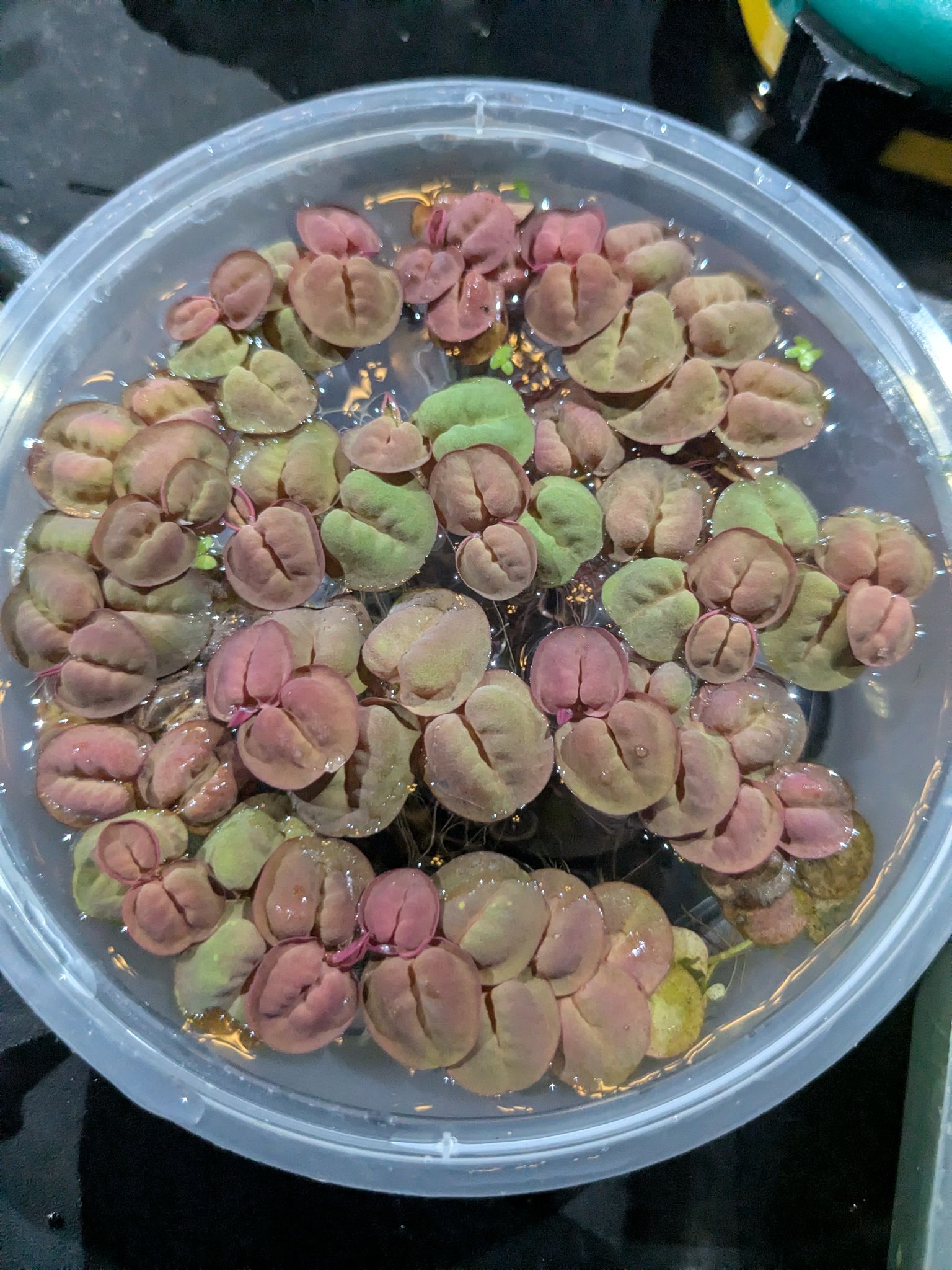
Best Tank Mates and Aquascaping Uses for Red Root Floater
Red Root Floater (Phyllanthus fluitans) is more than a color accent — it's a functional tool for shade, fry cover, and nutrient export in a freshwater tank. This guide covers which fish and invertebrates pair well with it, which species will destroy it, and how to put its dangling roots and red canopy to work in your layout.
What Red Root Floater Actually Is
Red Root Floater is a true floating plant, not a fern or moss anchored to hardscape. It forms small rosettes of round leaves that sit directly on the water's surface, with fine roots dangling down into the water column. The leaf undersides and margins take on a red hue under the right conditions, while the tops stay green to soft red depending on lighting.
Because it never submerges, everything about its care revolves around the surface: what touches the leaves from below (fish, flow, other floaters) and what hits them from above (light).
Water Parameters and Flow
Red Root Floater is forgiving within normal community-tank norms:
| Parameter | Range |
|---|---|
| Temperature | 70–82°F (21–28°C) |
| pH | 6.5–7.5 |
| General hardness (GH) | Best at 0–12 dGH; tolerates up to roughly 30 dGH |
| Water flow | Still to very gentle surface movement only |
On hardness, sources disagree on the ceiling — some cap it at 12 dGH, others say it handles water up to 30 dGH. In practice, it grows successfully in typical U.S. tap water, which usually falls in a moderate range. Color and vigor are simply best in soft-to-moderate water; harder water isn't ideal, but it isn't a dealbreaker either.
Flow tolerance gets described inconsistently, too — "minimal" in one place, "gentle" in another. The practical reconciliation: some surface movement is fine and even helps with gas exchange, but direct filter output or air-stone turbulence hitting the mat will cause melting — leaves flip over, trap water, and rot. Keep the plant away from filter outflow and strong air-driven surface agitation, not in a completely dead-still tank.
Lighting: The Detail Most Hobbyists Miss
Because Red Root Floater sits on top of the water rather than submerged in it, light has to strike the leaf tops directly from above — not filter down through the water column the way it does for rooted plants. This trips up hobbyists with full glass canopies, deep-set fixtures, or lights mounted far back from the tank's front edge, where the floater drifts out of the light cone entirely.
Guidelines:
- Minimum: 6–8 hours of light reaching the leaf surface.
- For deep red color: 8–12+ hours of moderate-to-high intensity light aimed at the top of the water.
- Duration alone won't turn it red if intensity is too low — you need both.
Check that any glass lid or condensation cover isn't dimming or blocking the light path, and that the fixture's beam actually spreads to wherever the floaters drift. A stronger LED fixture from FishyHub's Lighting selection can help if your current setup isn't intense enough to color the plant up.
Nutrients and Feeding
Red Root Floater needs no CO2 injection. It feeds heavily through its roots hanging in the water column, which makes it a strong exporter of nitrate and ammonia — a genuine benefit in stocked community tanks. For color specifically, it benefits from a liquid fertilizer, and iron/micronutrient dosing in particular is the single biggest lever for pushing leaves toward deep red rather than green.
Tank Size: Surface Area, Not Volume
Unlike most plants, Red Root Floater doesn't care about depth or gallon count — it cares about surface area (length × width). It works equally well in a 5-gallon (19 L) nano cube or a large show tank; more surface simply means more room for colonies to spread. A shallow, wide tank will support a bigger floating mat than a tall, narrow one of the same volume.
Best Tank Mates for Red Root Floater
Fish
Small, peaceful community fish that don't dig at or eat plants are ideal, especially species that appreciate diffused light or use surface cover to feel secure:
- Bettas
- Tetras (neon, ember) and rasboras
- Guppies, platies, mollies
- Danios
- Pygmy corydoras
- Otocinclus
Bettas deserve a special mention: Red Root Floater is a favorite anchor material for bubble nests, since the roots and leaf clusters give a male something to build against near the surface — a direct link between a tank mate choice and a breeding-friendly aquascape. You can browse betta stock and small community species like tetras and rasboras through FishyHub's Bettas and Small Community Fishes categories.
Invertebrates
- All dwarf shrimp: cherry, crystal, amano, ghost, bamboo
- Nerite, ramshorn, trapdoor, and Malaysian trumpet snails
- Crayfish and freshwater crabs
Dwarf shrimp in particular do well with Red Root Floater — the dangling roots act as a grazing surface loaded with biofilm and microorganisms, plus a hiding spot for molting shrimp and newborns. Unlike rooted substrate plants, floaters can't be uprooted by burrowing crayfish or crabs, which makes them a safer plant choice for those tanks. FishyHub stocks a full range of compatible dwarf shrimp under Shrimps.
Species and Setups to Avoid
Some fish and equipment combinations will shred or eat the plant outright:
- Goldfish and koi — notorious plant grazers that will strip a floating mat in days.
- Oscars and other large or boisterous cichlids — physically destructive even without intent to eat plants.
- African cichlids — often territorial and rough on tank decor generally.
- Silver dollars and other large herbivorous fish — will eat floating plants as a food source.
- Strong surface agitation setups — sump overflows, powerful hang-on-back waterfalls, and similar high-turbulence outputs will physically shred the leaves and roots regardless of what's swimming in the tank.
If you're set on a goldfish or larger cichlid tank, a tougher, faster-growing floater or a hardier stem plant is generally a better fit than Red Root Floater.
Aquascaping and Functional Uses
Red Root Floater earns its place as more than decoration:
- Shade provider — a partial surface canopy dims light for shade-loving stem plants and reduces stress for light-sensitive fish and fry that prefer diffused conditions.
- Breeding aid — cover and structure for egg-scattering fish and shrimp; newly hatched fry get somewhere to hide from adult tankmates, which measurably improves fry survival in community setups.
- Algae control — by intercepting light and competing for the same nitrate/ammonia that algae feeds on, a floating mat starves algae of resources before it gets a foothold.
- Living filtration and hideout — the dangling root network functions as a biological filter surface and a hiding structure for shrimp and fry simultaneously.
- Color contrast — red-tinged leaves against dark substrate, or mixed with green stem plants, give a "jungle" aquascape visual depth without hardscape changes.
Combining It With Other Floaters
Red Root Floater is often preferred over duckweed, water lettuce, or frogbit because it's "tidier" — it doesn't proliferate into microscopic fragments the way duckweed does, and its rosettes are large enough to net out cleanly. If you run it alongside other floaters, expect competition for light and surface space; the faster-multiplying species will eventually crowd out the slower one unless you actively thin both.
Propagation and Thinning
Red Root Floater reproduces via runners — small daughter plantlets that split off from the main rosette. Under strong light and good nutrient levels, it multiplies quickly and can become genuinely invasive within the tank if left unchecked.
A simple maintenance routine turns this from a problem into an easy task:
- Net off daughter plantlets and excess rosettes every 1–2 weeks.
- Keep total surface coverage well under 50–75% at any time.
- Share, trade, or discard the thinned-out extras rather than letting the mat compound.
Common Mistakes and Troubleshooting
| Problem | Likely cause | Fix |
|---|---|---|
| Plant stays green, never reds up | Insufficient light intensity/duration, or missing iron/micronutrients | Increase photoperiod and intensity; dose a fertilizer with iron |
| Leaves flip over, fill with water, rot | Too much surface agitation or flow | Relocate away from filter output or air-stone turbulence |
| Mass melt/die-off after purchase | Transport stress, sudden parameter shift, or contamination from the source tank | Acclimate slowly; rinse and quarantine new plants |
| Fish gasping at the surface, lower plants pale or dying | Overgrowth blocking light and reducing surface gas exchange | Thin the colony regularly; keep coverage well under 50–75% |
| Plant shredded or eaten | Incompatible tank mates | Check stocking against the avoid-list above |
| Duckweed, algae, or pond snails suddenly appearing | Hitchhikers on new plant stock | Rinse and quarantine before adding to the display tank |
Quarantining or rinsing new floating plants before they go into a display tank is worth the extra step every time — snail eggs, pest algae, and duckweed fragments hitchhike on floating plants more easily than on most other plant forms.
Frequently Asked Questions
What temperature and pH does Red Root Floater need?
It does best between 70–82°F (21–28°C) and a pH of 6.5–7.5, which overlaps with most standard community tank setups. Within that range it's forgiving and doesn't require precise dialing-in.
Does Red Root Floater need CO2 or special fertilizer?
No, it doesn't need CO2 injection. It does benefit from a liquid fertilizer, and dosing iron or a micronutrient blend specifically helps push the leaves toward deeper red coloration.
What fish will eat or destroy Red Root Floater?
Goldfish, koi, oscars, other large or aggressive cichlids, and silver dollars are the usual culprits, either eating it directly or shredding it through rough handling. Stick with small, peaceful community fish instead for a floater-friendly tank.
Can shrimp live with Red Root Floater?
Yes — all dwarf shrimp, including cherry, crystal, amano, ghost, and bamboo shrimp, are fully compatible. They benefit from the roots as a grazing surface and a hiding spot, especially for molting adults and newborns.
Why is my Red Root Floater turning green instead of red?
This almost always comes down to insufficient light intensity or duration, or a lack of iron and micronutrients in the water column. Increasing photoperiod and dosing a fertilizer with iron typically resolves it within a few weeks.
How much surface coverage is ideal?
Enough to provide shade and cover benefits without fully blocking light to plants below or interfering with surface gas exchange. As a rule of thumb, keep coverage well under 50–75% of the surface and thin regularly rather than letting it fill in completely.
Will Red Root Floater take over my tank?
Under good light and nutrient levels, it reproduces quickly via runners and will spread fast — treat this as expected behavior, not a problem. Regular thinning (netting off daughter plants every week or two) keeps it fully in check.
Can Red Root Floater be used in a betta tank or breeding setup?
Yes, it's a commonly recommended choice for bettas and other egg-scattering species. Beyond providing cover, its roots and leaf clusters are a favorite anchor site for betta bubble nests, making it a functional breeding-tank plant rather than just decoration.
Ready to build out a floater-friendly community? Browse compatible fish and shrimp in FishyHub's Freshwater Livestock selection to match your tank to the right tank mates.


