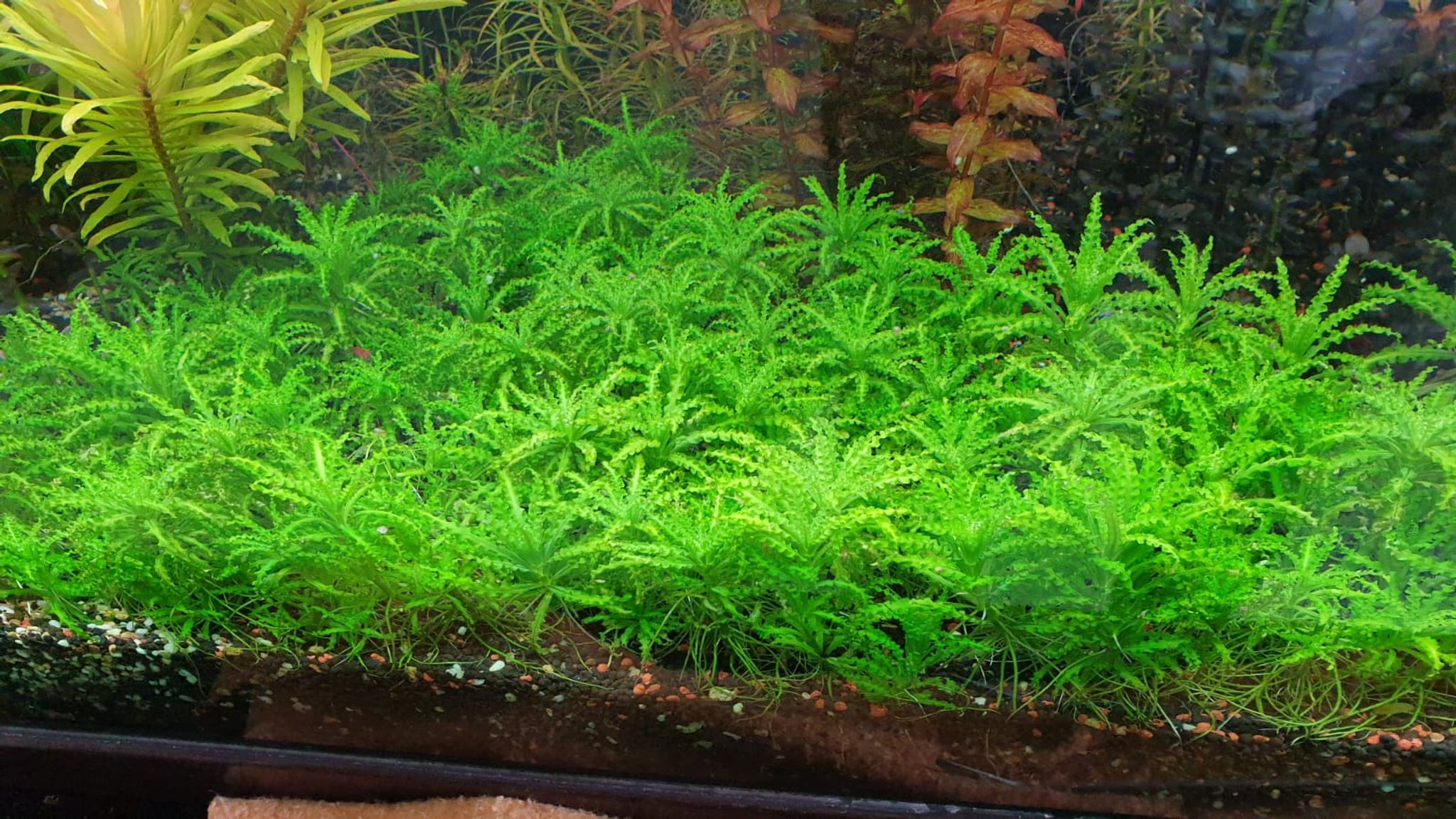

Best Tank Mates and Aquascaping Uses for Pogostemon Helferi
Pogostemon helferi, better known as Downoi, is a low, curly-leaved rosette plant that many US aquascapers reach for without knowing exactly which fish and inverts belong alongside it or where it actually looks best in a layout. This guide covers safe tank mates, realistic placement options, and the care details that keep Downoi compact instead of leggy.
What Pogostemon Helferi Actually Is
Downoi (Thai for "little star") is a stream plant native to Thailand. It forms a low rosette that reaches roughly 2-4 inches (5-10 cm) tall and spreads slowly by runners and side shoots, building a dense clump rather than a continuous mat.
That distinction matters for stocking and layout planning:
- It is not a true carpet plant like dwarf hairgrass or Monte Carlo, which spread laterally into a single unbroken lawn.
- Downoi instead produces clusters of rosettes that expand outward over months, so it reads more like a textured accent or "carpet substitute" than a solid ground cover.
- Marketing sometimes calls it a carpeting plant, but setting the right expectation upfront — cluster plant, not lawn — avoids disappointment for anyone planning an Iwagumi-style foreground.
Water Parameters and Growing Conditions
| Parameter | Recommended Range | Notes |
|---|---|---|
| Temperature | 72-78°F (22-26°C), tolerates up to 82°F (28°C) | Stays healthiest on the cooler-to-moderate side; sustained heat above ~82°F can trigger melt or stalled growth |
| pH | 6.0-7.5 | Soft, slightly acidic water is ideal |
| Hardness | 2-15 dGH | Soft to moderately hard |
| Lighting | Medium to high | Needed for the tight, curled leaf form |
| CO2 | 15-30 ppm injected preferred | Survives without it, but growth is slower and less compact |
| Substrate | Nutrient-rich aqua soil | Root tabs recommended as a moderate root feeder |
Why the Temperature Range Matters for Stocking
Downoi is a subtropical stream plant, and many popular US community fish — angelfish, discus, and other warm-water tropicals — are typically kept at 78-82°F (26-28°C). Running a tank at the warm end of that range while also expecting tight, compact Downoi growth is a common mismatch. If the plant is a priority, lean toward tank mates that are comfortable at 72-78°F rather than fish that need consistently warmer water.
Light and CO2, Without the Guesswork
Aim for a PAR reading in the 30-50 range at the substrate for compact growth; a mid-tier planted-tank LED fixture mounted at typical hood height generally lands in this window. If dosing CO2, a drop checker set to read green (not blue or yellow) indicates a safe, effective concentration. Low-tech tanks can still grow Downoi successfully with a liquid carbon supplement — just expect a looser, less curled rosette and slower fill-in.
Best Tank Mates for Pogostemon Helferi
Because Downoi roots relatively shallowly while establishing, the ideal tank mates are peaceful, non-digging, and not inclined to graze on soft new growth.
Fish That Work Well
- Small tetras — neon tetras, ember tetras, and similar nano species browse the water column without disturbing the substrate.
- Rasboras, including chili rasbora, are a natural fit for the same soft, slightly acidic water Downoi prefers.
- Dwarf gouramis add midwater color without bothering low plantings.
- Corydoras and other gentle bottom dwellers are generally safe once Downoi is rooted, since they forage rather than dig.
- Livebearers such as guppies and endlers work in moderate numbers, though heavy livebearer populations can eventually disturb loose substrate near new plantings.
Invertebrates: The Best Match of All
Dwarf shrimp are arguably the ideal companions for Downoi. Cherry shrimp, Amano shrimp, and Caridina/crystal shrimp all use the dense rosette as grazing surface for biofilm and as shelter during molting and for newly hatched young. Nerite and mystery snails are similarly compatible and won't uproot established clumps. This pairing is popular enough that many shrimp-focused nano tanks are built around Downoi specifically as functional habitat, not just decoration — a single well-established clump can shelter a surprising number of juvenile shrimp as they molt through their early instars.
Species to Avoid
- Goldfish — cold-water fish that graze on and uproot soft plants.
- Large or digging cichlids — will excavate substrate and destroy shallow-rooted clumps.
- Crayfish — notorious for shredding and uprooting low plantings.
- Any fast-moving, boisterous schooling fish in an undersized tank, where constant substrate disturbance prevents new clumps from anchoring.
Fish and Invert Compatibility at a Glance
| Group | Compatibility | Why |
|---|---|---|
| Small tetras, rasboras | Excellent | Peaceful, don't dig |
| Corydoras, bottom-dwelling loaches (calm species) | Good once rooted | Forage rather than excavate |
| Dwarf shrimp (cherry, Amano, Caridina) | Excellent | Use rosette for grazing and shelter |
| Nerite and mystery snails | Good | Glide over substrate without uprooting |
| Guppies, endlers | Good in moderation | Fine in normal numbers |
| Goldfish, large cichlids, crayfish | Avoid | Dig, graze, or shred low plants |
Aquascaping Placement and Style Pairings
Foreground to Low-Midground Accent, Not a Lawn
Plant Downoi in small clumps of a few rosettes each rather than trying to fill an entire foreground. It performs best used to:
- Soften the base of rocks and driftwood where hardscape meets substrate
- Fill gaps between larger hardscape pieces for texture
- Contrast against fine-leaved plants like dwarf hairgrass or Monte Carlo, and against broad-leaved plants like Anubias nana petite, Bucephalandra, or Java fern
Style-by-Style Guidance
- Iwagumi-adjacent layouts: use Downoi as an accent around stone bases rather than the primary carpet — a true Iwagumi carpet plant should still anchor the main foreground.
- Jungle/nature-style scapes: tuck clusters around wood and rock for a natural, streamside look.
- Shrimp and biotope tanks: Downoi mimics the low vegetation of Southeast Asian streams and doubles as functional shrimp habitat, making it a strong fit for biotope-style setups.
A Simple Decision Framework
If the tank is smaller (10-20 gallons/38-76 liters) or under medium light, treat Downoi as the main low-growing feature and let it be the star accent. In larger, higher-light tanks (20-40 gallons/76-151 liters), pair it with a true carpet plant and use Downoi as a textural break rather than the primary ground cover. Because Downoi grows slower than plants like Monte Carlo, plant faster carpet species first or trim them back near Downoi clumps so they don't shade it out and win the competition for light at substrate level.
Planting and Starting Tips
- Separate individual rosettes before planting rather than dropping in a whole pot as one mass.
- Space clumps 1-2 inches (2.5-5 cm) apart to leave room for lateral spread.
- Bury only the base and roots — the crown should sit at or just above the substrate line.
- Expect some melt in the first 1-3 weeks after planting; this is normal transplant stress, not failure.
Trimming and Maintenance
- Remove yellowing or melting leaves promptly to prevent them from fouling water quality.
- Trim leggy, stretched growth back to the crown to force denser, more compact regrowth.
- Thin overcrowded clumps periodically so light and flow reach the base of each rosette.
Common Mistakes and Troubleshooting
- Burying the crown: planting too deep smothers the growth point and causes rot. Only the roots belong in the substrate.
- Insufficient light: produces pale, leggy, uncurled growth. Raise light gradually and watch for algae as you do.
- Skipping CO2/ferts, then blaming "difficulty": Downoi can survive low-tech, but the tight, curled form most aquascapers want requires CO2 or at least liquid carbon plus root tabs.
- Uprooting by boisterous tank mates or burrowing snails: choose appropriate species (see the compatibility table above) and consider lightly weighting new plantings until roots take hold.
- Mistaking melt for death: post-purchase melt is common transplant stress. If parameters stay stable, healthy new growth from the crown typically follows within a few weeks.
- Algae on older leaves: usually a sign the light-CO2-nutrient triangle is unbalanced — strong light without matching CO2 or fertilization. Dial back light or add CO2/ferts to correct it rather than removing light entirely.
Propagation
Downoi propagates by division. Once a clump has produced several side shoots, separate them at the base with clean scissors or by gently pulling them apart, then replant each rosette individually with a bit of spacing to encourage independent spread.
For stocking a Downoi-based shrimp or nano setup, browse dwarf shrimp and calm bottom dwellers like corydoras alongside small schooling options such as tetras — all of which pair well with a Downoi-planted layout.
Frequently Asked Questions
Is Pogostemon helferi (Downoi) a true carpet plant?
No. It grows in clumping rosettes rather than spreading into a single dense mat, so it's best used as an accent or foreground cluster rather than a solid lawn like hairgrass or Monte Carlo.
What fish should I avoid with Downoi?
Avoid goldfish, large or digging cichlids, and other substrate-disrupting or plant-eating species. These fish tend to uproot shallow-rooted clumps or graze on soft new growth before it establishes.
Is Downoi shrimp-safe?
Yes — it's a favorite in shrimp tanks. Cherry, Amano, and Caridina shrimp use the dense rosette for grazing and as shelter during molting and for newly hatched young.
Does Downoi need CO2 to survive?
No, but it grows noticeably more compact and healthy with injected CO2 or liquid carbon. Without it, expect slower growth and a leggier, less curled appearance.
Why is my Downoi melting after planting?
This is normal transplant shock, not a sign of failure. Keep water parameters stable, trim off dead leaves, and healthy new growth from the crown should appear within a few weeks.
What's the ideal placement in an aquascape?
Foreground to low-midground, positioned near hardscape in small clustered clumps rather than as one continuous carpet. It works especially well softening the base of rocks and driftwood.
Can Downoi grow in low light?
It can survive, but it loses its tight, curled look and grows leggy and pale. Medium to high light gives the compact form most aquascapers are aiming for.
How do I propagate Downoi?
Divide rosettes or side shoots at the base once a clump is established, then replant each division separately with some spacing to allow independent growth.
Ready to stock a Downoi-planted tank with compatible tank mates? Explore FishyHub's full range of freshwater livestock to find peaceful fish and shrimp suited to a low-tech or planted community setup.


