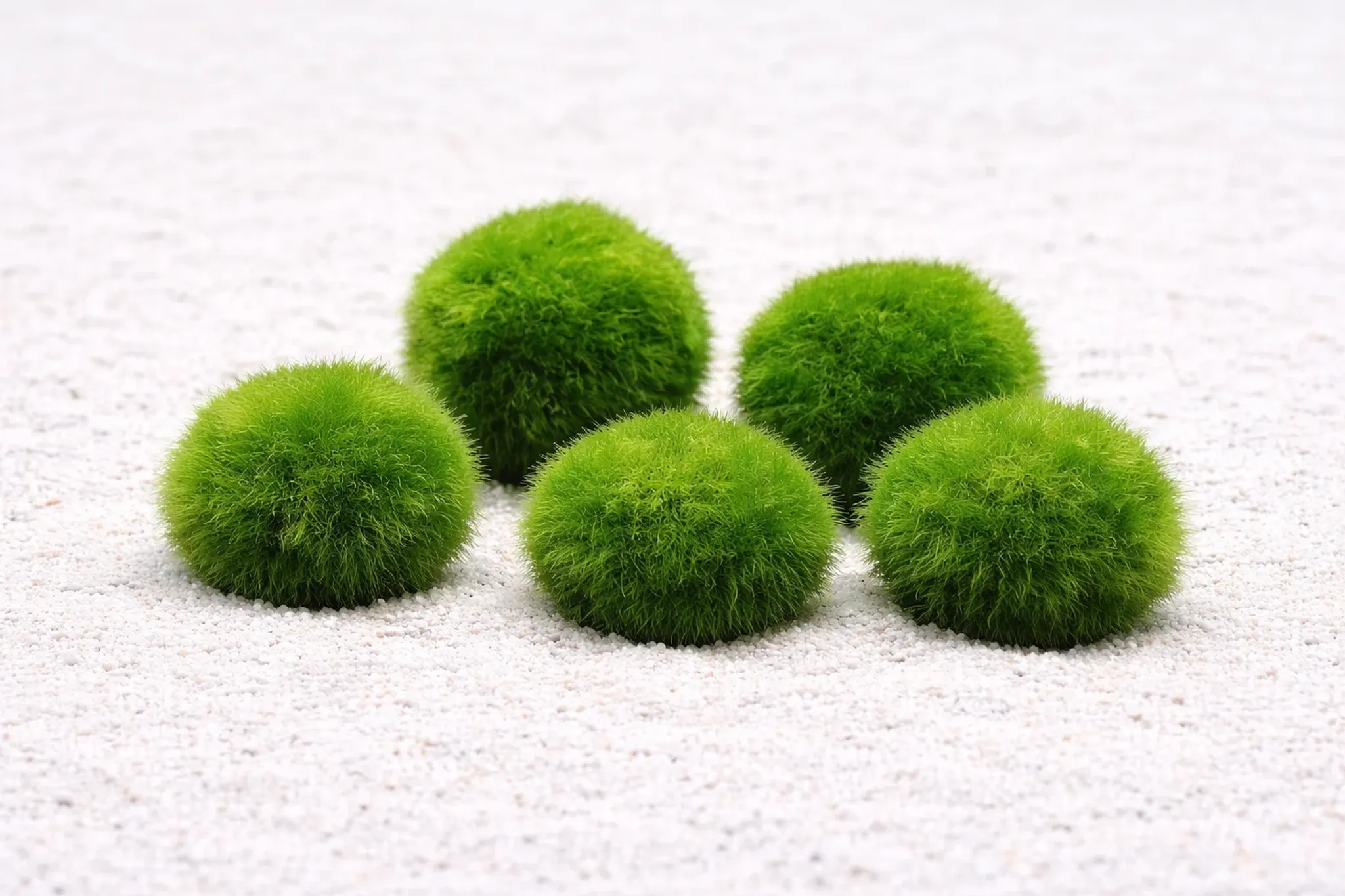

Best Tank Mates and Aquascaping Uses for Marimo Moss Ball
A marimo moss ball is one of the few aquarium additions that's genuinely hard to kill and useful for more than looks. This guide covers exactly which tank mates are safe, which ones will shred or bully it, and how to use marimo as a real aquascaping tool instead of just a novelty orb sitting in a bowl.
What a Marimo Moss Ball Actually Is
Despite the "moss" in its name, marimo (Aegagropila linnaei) is a slow-growing filamentous green algae that naturally rolls into a sphere in certain lakes. It isn't a vascular plant, but it behaves like one in a tank: no CO2 injection and no fertilizer dosing are required, though very low light will slow growth further, and an occasional dose of a low-strength liquid fertilizer doesn't hurt.
Growth is glacially slow — roughly 0.2–0.8 inches (5–20 mm) of diameter per year — so whatever size ball you buy and wherever you place it will look basically the same for years. Size the ball (or the number of balls) to your tank rather than expecting it to fill space quickly.
Ideal conditions:
| Factor | Range |
|---|---|
| Temperature | 60–75°F (16–24°C) ideal; tolerates up to ~78–80°F (26–27°C) short-term with more grooming |
| Light | Low to moderate, indirect |
| CO2/fertilizer | Not required |
| Tank size | 1-gallon bowl up to full show tanks |
Best Tank Mates for Marimo Moss Balls
Marimo pairs well with peaceful fish and invertebrates that share its mild-water preferences and won't treat it as a chew toy.
- Betta fish — one of the most popular pairings; marimo gives bettas a soft grazing/resting surface. You can browse betta fish for stock.
- Peaceful community fish — tetras, rasboras, corydoras, guppies, and mollies. Small community fish generally leave marimo alone entirely.
- Dwarf shrimp — cherry, amano, and crystal shrimp graze biofilm off the surface constantly. See available shrimp for nano and shrimp-only setups.
- Nerite and mystery snails — clean the ball's surface without damaging it.
- African dwarf frogs — peaceful and unlikely to bother it.
How Marimo Helps Tank Mates
Marimo isn't just decoration for these species — it does real work:
- Shrimp and snails graze detritus and biofilm off its surface, effectively self-cleaning.
- It absorbs a small amount of ammonia and nitrate and competes with nuisance algae for nutrients, acting as a mild natural filter (not a replacement for real filtration).
- It gives berried or molting shrimp cover, and can hide shrimp fry from adult fish and larger tank mates.
Tank Mates to Avoid
- Goldfish — messy, plant-shredding, and prone to eating chunks of it.
- Crayfish and larger crabs — will physically tear it apart.
- Cichlids and other diggers — tend to uproot and toss it around the tank.
- Puffers and some barbs — may nip or damage it out of curiosity even without eating it.
Marimo vs. True Aquarium Moss
Because marimo is often shelved next to Java moss and similar plants, it's easy to assume they're interchangeable. They aren't.
| Marimo | Java moss (true moss) | |
|---|---|---|
| Classification | Filamentous algae | Vascular moss (Bryophyta) |
| Attachment | Free-floating/rolling ball, no attachment needed | Ties or glues onto wood/rock and roots in place |
| Trimming | Never needed | Regular trimming to control shape |
| Fertilizer/CO2 | Not required | Benefits from light dosing |
| Aquascaping role | Sphere, carpet fragments, or draped accents | Carpets, walls, tied-on moss trees |
Aquascaping Uses Beyond the Round Ball
The classic sphere is only the starting point. Marimo is workable material for several aquascaping techniques:
- Draped hardscape accents — gently unroll and tease apart the fibers, then drape them over driftwood or rock for a natural, moss-covered look.
- Foreground "moss carpet" — flatten fragments and anchor them between rocks for a low, textured carpet substitute.
- Crevice fill — wedge small torn pieces into hardscape gaps for a mature, weathered appearance.
- Scattered foreground accents — several small marimo balls placed loosely to add scale and depth.
- Midground focal point — a larger ball floated or nestled mid-tank as a soft, rounded contrast to angular hardscape.
- Minimalist centerpiece — a single large marimo in an Iwagumi-adjacent nano layout, where its form does all the visual work.
Placement Using Aquascaping Fundamentals
A few core aquascaping principles apply directly to marimo placement:
- Focal point and negative space — don't center a marimo ball; place it off-center with open space around it so the eye has somewhere to land and somewhere to rest.
- Rule of thirds — position balls or clusters near one of the intersection points of a 3×3 grid over the tank rather than dead center.
- Front-to-back layering — keep marimo low in the foreground and reserve taller plants or hardscape for the background, preserving a sense of depth.
- Odd-number grouping — arrange marimo in groups of three or five rather than pairs; odd numbers read as more natural to the eye, a standard aquascaping design principle.
Propagation for Matching Clusters
To multiply your stock (and get matching balls for a grouped layout), cut a healthy marimo into two to four pieces and hand-roll each piece into a new sphere over several weeks. This is the standard, low-cost way to build a cluster for scaping rather than buying several individually.
Nature Aquarium Setup, Step by Step
If you're building a layout from scratch, the standard build order is:
- Substrate/soil goes down first, sloped for depth if desired. Browse substrate options for aquascaping-grade material.
- Hardscape (rock and wood) is placed next to establish the focal point and overall structure — rinse and cure new rocks or wood first to avoid leaching tannins or shifting pH unexpectedly.
- Planting proceeds background to foreground, tallest stems and background plants first, foreground carpet last.
- Slow fill and cycling follows, with marimo as a safe, low-risk first addition — it tolerates the parameter swings typical of a cycling tank far better than most true plants, making it a good placeholder while the biological filter establishes.
Aquascaping for Kids
Marimo is arguably the most kid-friendly aquascaping element available: no CO2 system, no trimming schedule, extremely hard to kill, and safe to briefly hold and touch. A simple starter project pairs one or two marimo balls with a snail and basic gravel or rock in a small tank — low risk, low maintenance, and genuinely engaging for a child who wants a "pet" they can help care for.
Detailing and Nano/Edge Tank Uses
Once a main layout is finished, small marimo pieces work well as finishing touches — tucked at rock bases, wood joints, or corners to soften hard edges and add a "found in nature" polish. In compact or edge-style nano tanks, marimo is particularly useful because its round form reads clearly at small scale and needs no trimming to stay tidy; group two or three small balls in odd numbers for a minimalist nano layout.
Aquarium Decoration Safety
Marimo has a built-in safety advantage over many decorations: no sharp edges, no seams, and nothing that leaches into the water. When adding any other decoration to a tank that houses marimo and its tank mates, apply the same standard:
- Rinse and quarantine new items before adding them.
- Avoid decorations with tight gaps that can trap fish, or rough seams that can injure fins or shrimp.
- Confirm any paints or dyes on decorations are aquarium-safe.
Maintenance Routine
- Rinse every 2–4 weeks — gently squeeze the ball in tank water or dechlorinated water to release trapped detritus and prevent a sour or musty smell.
- Rotate regularly — turn the ball periodically, and give it a gentle roll during water changes, so all sides get light exposure and it keeps its round shape.
- Address floating — if it won't sink, gently squeeze out trapped air or gas bubbles. Persistent floating combined with white or brown patches usually signals rot or die-off on the shaded side.
Common Mistakes
- Keeping it in high heat or strong direct light, which causes rapid browning or die-off.
- Never rinsing or squeezing it, leading to trapped detritus, odor, and a mushy exterior.
- Treating it like a true plant and dosing heavy fertilizer or CO2 it doesn't need.
- Housing it with goldfish, crayfish, or large cichlids that shred or eat it.
- Leaving it in one position too long, browning the shaded side from lack of light rotation.
- Overcrowding a small tank with too many or too-large marimo balls, cutting into swimming space and shrimp grazing area.
A Word on Genuine vs. Fake Marimo
Some pet stores sell dyed algae or fabricated "marimo-style" balls instead of genuine Aegagropila linnaei. Genuine marimo has a firm, slightly springy texture and won't bleed dye into clean water; a fake or dyed ball often feels artificially uniform and may cloud the water with color when squeezed. If a ball seems unusually cheap or perfectly uniform, test it in a cup of water before adding it to your main tank.
A Note on US Shipping Restrictions
Some US states have restricted the sale or shipping of marimo moss balls due to past incidents where zebra mussels were found attached to imported balls. Because these restrictions vary by state and change periodically, check current local and state regulations before ordering marimo for shipment, particularly if you live near the Great Lakes region.
Frequently Asked Questions
Do marimo moss balls need a filter or special equipment?
No. Marimo tolerates unfiltered bowls without issue, though filtration and periodic water changes keep both the marimo and its tank mates healthier over the long term.
Can marimo live with betta fish?
Yes — it's considered one of the best betta companions, providing gentle grazing and resting texture. It tolerates typical betta tank temperatures reasonably well, though it will need more frequent rinsing and rotation at the warmer end of that range.
Will marimo balls multiply on their own?
Not really. Growth is extremely slow, and marimo doesn't naturally split into new balls often. Most hobbyists propagate it manually by cutting a ball into pieces and hand-rolling each into a new sphere.
Why is my marimo moss ball turning brown or white?
Usually one of three causes: insufficient light rotation, sustained heat above its comfort range, or trapped detritus and rot. Rinse it, trim any damaged sections, resume regular rotation, and cool the water if it's running too warm.
Can I put marimo moss balls with shrimp?
Yes — shrimp graze biofilm directly off the surface and use marimo as cover, especially berried or molting individuals. It's considered an excellent addition to shrimp tanks.
Is marimo safe for a shrimp-only or nano tank with no fish?
Yes, and it's one of the most recommended additions for nano and shrimp-only setups, since it needs no CO2 or fertilizer while offering grazing surface area and hiding cover.
Marimo works equally well as a functional biological helper and as a genuine aquascaping element once you move past the "bowl decoration" mindset. For stocking a tank around it, start with the freshwater livestock selection on FishyHub to find peaceful, marimo-compatible fish and invertebrates suited to your tank size.


