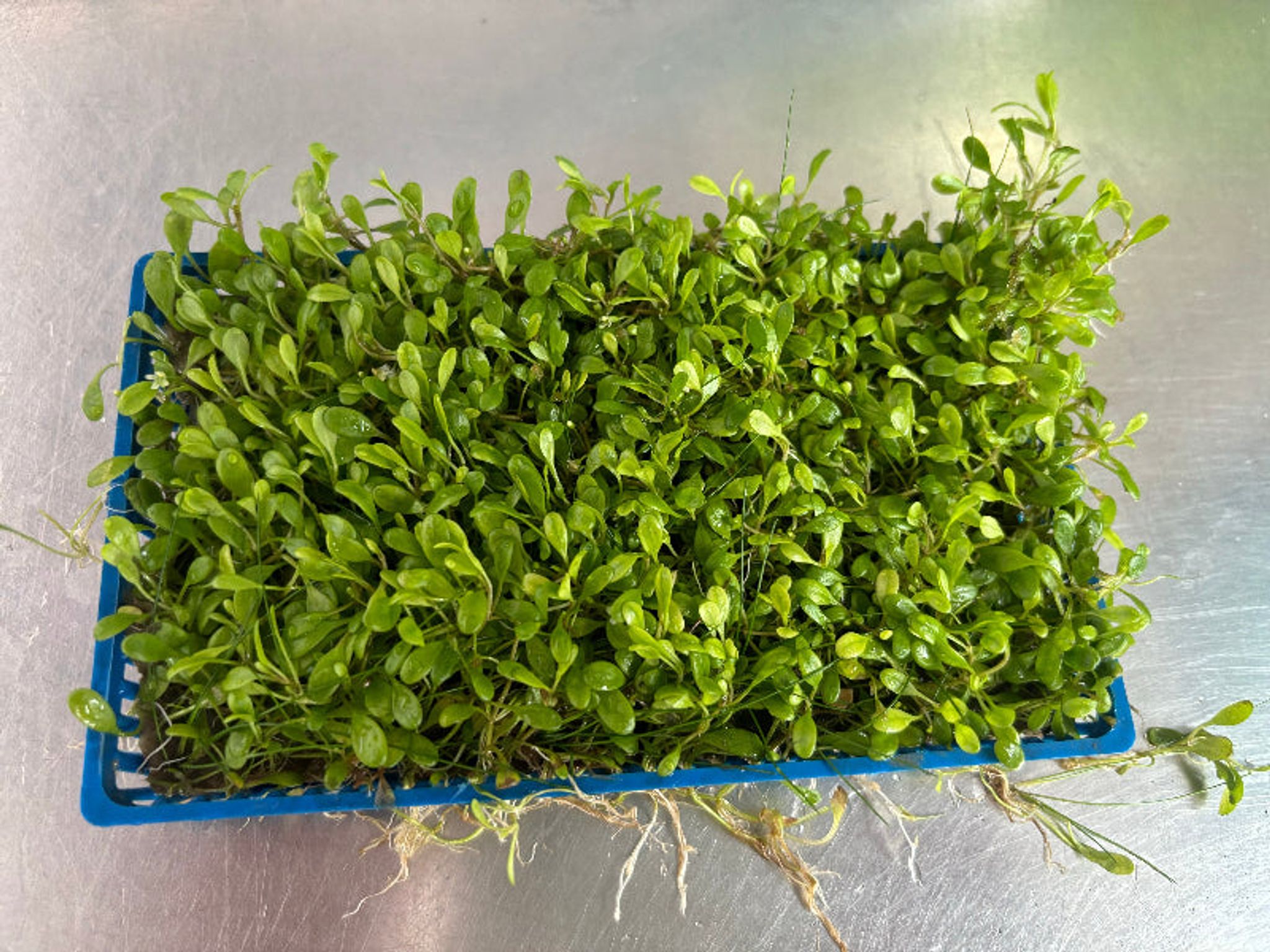

Best Tank Mates and Aquascaping Uses for Glossostigma
Once a Glossostigma elatinoides carpet is in the ground, the biggest risk to it usually isn't algae or nutrients — it's the wrong tank mate walking, digging, or grazing right through it. This guide covers which fish, shrimp, and snails work with a thin, shallow-rooted carpet, and how to actually design a layout around one.
A Quick Refresher on What Glossostigma Needs
Glossostigma elatinoides is a low, creeping stem plant that spreads by runners into a dense mat under 1 inch tall. It's easy to confuse with the similarly named Glossostigma diandrum sold under overlapping trade names, so double-check which species you're buying.
This is not a beginner carpeting plant. To form a true carpet rather than sparse, leggy growth, it generally needs:
- High light — roughly 50+ PAR at the substrate
- Pressurized CO2 injection — diffused CO2 rarely keeps pace with its growth rate
- A nutrient-rich substrate that feeds the root zone from day one
- Water temperature of 68–82°F (20–28°C), pH 6–7.5, soft to moderately hard water
- Regular macro/micro fertilizer dosing, since fast growth under strong light burns through nutrients quickly
If any of those pieces is missing, the plant tends to melt or stretch vertically instead of spreading laterally — a pattern worth remembering when you're troubleshooting later.
Tank Mate Criteria for a Carpet Tank
Before picking species by name, it helps to know what you're screening for. Good tank mates for a Glossostigma layout generally share these traits:
- Don't dig or uproot substrate — no burrowing or pit-digging behavior
- Graze algae without shredding leaves — light grazing pressure, not aggressive rasping
- Small and calm-swimming — minimal constant disturbance to the thin runners anchoring the mat
- Bottom dwellers chosen carefully or avoided — Glossostigma roots shallowly, so anything that spends time pressing into the substrate is higher risk than a mid-water swimmer
Recommended Tank Mates
| Tank mate | Why it works | Notes |
|---|---|---|
| Ember tetra, neon tetra | Small, mid-water schooler, no digging | Keep in a group for natural behavior |
| Chili rasbora, micro rasboras | Tiny footprint, barely disturbs substrate | Great scale match for nano Iwagumi tanks |
| Endler's livebearer, guppy | Peaceful mid-water swimmers in modest numbers | Avoid overstocking a small footprint |
| Cherry shrimp | Grazes algae film off carpet surface | Add after carpet is rooted |
| Amano shrimp | Effective at eating hair algae that can smother a struggling carpet | Larger than cherry shrimp; still gentle on plants |
| Nerite snail | Cleans glass and algae without heavy substrate disturbance | Favored snail for carpet tanks |
You can browse a range of compatible options, including small schooling fish, in FishyHub's small community fishes selection, and pick up cherry or Amano shrimp from the shrimp category.
Species to Avoid or Use With Caution
- Goldfish and larger cichlids — dig, uproot, and often eat soft plant matter outright; entirely unsuitable for a Glossostigma carpet
- Crayfish and larger freshwater crabs — will shred and uproot a mat with routine foraging
- Common plecos (large specimens) — disturb substrate and can rest heavily enough on a carpet to crush it
- Most loaches and burrowing catfish — generally too disruptive; kuhli loaches in small numbers are usually fine once a carpet is mature
- Corydoras — a genuinely borderline case (more below)
Where Opinions Differ (and What to Actually Do)
A few tank-mate questions get inconsistent answers across the hobby. Here's the practical read on each:
Corydoras compatibility. Some hobbyists call corys safe, gentle bottom cleaners; others warn they'll uproot fresh plantings while sifting substrate. The reasonable middle ground: corydoras are fine once a carpet has been rooting undisturbed for 6 or more weeks, but risky in a newly planted tank where runners haven't anchored yet.
Shrimp and carpet damage. Most sources treat shrimp as purely beneficial algae control. A minority note that a dense shrimp population can loosen very shallow-rooted new growth simply through constant foraging activity. Shrimp are still a net positive for a carpet tank — just add them after the initial establishment period rather than on day one.
Snail choice. Nerite snails are broadly favored for carpet tanks. Some hobbyists flag that heavier snails like apple or mystery snails can physically disturb a thin mat as they move across it. Sticking to nerites, or a controlled population of small ramshorn or pond snails, is the safer call.
When to Add Bottom-Dwelling Fauna
Across all three of the disagreements above, the same rule applies: wait for the carpet to establish before introducing anything that spends real time at substrate level. Several weeks of unimpeded root growth lets runners anchor firmly enough to tolerate light foot traffic and foraging. Adding bottom dwellers too early is one of the most common causes of a carpet that never quite fills in.
Aquascaping Styles Built Around Glossostigma
Pick a style before buying plants or hardscape — it changes how much stone you need and how much plant variety makes sense.
Iwagumi
The classic use case. Iwagumi is a minimalist Japanese rock-garden style built around odd-numbered stone groupings, with Glossostigma forming the "grass" that carpets the exposed substrate. Plant variety is deliberately kept low so the stone arrangement stays the visual focus.
Nature Aquarium / Jungle Style
Here Glossostigma plays a supporting role — a foreground transition texture that softens the base of driftwood and rock rather than being the whole show. Mixed planting depths and denser stem-plant backgrounds are typical.
Dutch Style
A poor fit. Dutch layouts are built around stem-plant "streets" and layered color/texture rather than open carpet space, so Glossostigma's strength — a flat, uninterrupted lawn — doesn't really apply here.
Layout and Design Techniques
Planting and Trimming
- Plant small portions (tissue-culture cups work well) spaced a few centimeters apart directly into nutrient substrate
- Trim weekly once established to encourage lateral spreading instead of vertical growth
- Keep flow even across the entire substrate — low-flow dead zones are a common cause of patchy melt even when light and CO2 look fine on paper
Using Forced Perspective
Because it's so fine and low, Glossostigma is a go-to tool for forced perspective: a short, dense foreground plant reads visually as "farther away," which makes a tank look larger than its actual footprint. This is part of why it's an Iwagumi staple in nano tanks.
Pairing Plants
Since Glossostigma demands strong light and CO2 anyway, aquascapers commonly build the rest of the scape from equally demanding species — Hemianthus callitrichoides, dwarf hairgrass (Eleocharis), Rotala for color and height, and Anubias or Bucephalandra mounted on hardscape for contrast. The usual build order is hardscape first (stone for Iwagumi, wood for nature style), then carpet fills the remaining open substrate.
General Layout Principles
- Foreground-midground-background hierarchy — Glossostigma belongs strictly in the front third, kept under 2 inches (5 cm) tall
- Rule-of-thirds hardscape placement — avoid centering the main stone or wood piece
- Leave open substrate "paths" — a mat that fills every inch reads as a flat green wall rather than a landscape with depth
Substrate and Tank Choices That Support the Carpet
Substrate
A nutrient-rich aquasoil is strongly preferred over inert gravel or sand, since Glossostigma needs root-zone nutrients from the moment it's planted. A depth of 2–3 inches (5–7.5 cm) is typical. Some scapers cap aquasoil with a thin inert layer for a specific look, though this is an aesthetic choice rather than a requirement. FishyHub's substrate category covers both soil-based and gravel/sand options if you're setting up from scratch.
Tank Shape and Size
Rimless, low-iron ("ultra-clear") glass tanks are the aquascaping standard because they remove visual distractions and show carpet color accurately without the greenish tint of standard glass. Nano-to-mid sizes, roughly 2.5–20 gallons (10–75 liters), suit Iwagumi-style Glossostigma layouts particularly well. The trade-off is no built-in lid — splash- or jump-prone fish aren't a good match, and evaporation needs closer attention than in a covered tank.
Photographing a Carpet Layout
A dense, well-trimmed Glossostigma lawn is one of the more rewarding things to photograph in the hobby, but getting it to read as vividly green as it looks in person takes a bit of technique:
- Clean the glass inside and out before shooting — smears show up more than expected under close focus
- Turn off room lights and close curtains to kill reflections off the glass
- Use a tripod, since low aquarium lighting often forces slower shutter speeds that amplify hand shake
- Keep ISO moderate to avoid grain that hides fine texture in the carpet
- Basic contrast and white-balance adjustment afterward helps correct for the color cast aquarium lighting introduces
Common Mistakes to Avoid
- Planting into low light or a no-CO2 setup and expecting a carpet — melting or leggy vertical growth is the predictable result, not bad luck
- Adding bottom-diggers or large fish immediately after planting, uprooting the mat before runners take hold
- Blaming fish for hair or BBA algae — algae overtaking a struggling carpet is almost always a light, CO2, or flow imbalance; algae-eating shrimp and snails help manage it but don't fix the underlying cause
- Ignoring flow distribution — patchy die-back at substrate level can happen even when light and CO2 look adequate, simply because flow isn't reaching every section evenly
- Trusting generic "planted tank safe" lists — a fish or snail that's fine with taller stem or rosette plants isn't automatically safe for a shallow-rooted carpet; check specifically for carpet compatibility
Frequently Asked Questions
Can I keep shrimp with Glossostigma?
Yes. Cherry and Amano shrimp are both good choices, with Amano shrimp especially useful for eating hair algae that can smother a struggling carpet. Add shrimp after the carpet has had time to establish rather than immediately after planting.
Will Glossostigma survive with goldfish or cichlids?
No. Goldfish and larger cichlids dig, uproot, and frequently eat the plant outright, making them incompatible with a carpet setup of any kind.
Do I need CO2 for a Glossostigma carpet?
Effectively yes. Without pressurized CO2 injection, growth tends to be sparse and leggy rather than forming the dense, low mat the plant is known for.
What fish work best in an Iwagumi tank with Glossostigma?
Small schooling fish — tetras, rasboras, and similar mid-water swimmers — are the standard choice, since they don't disturb the substrate and their scale suits the typically small tank sizes used for Iwagumi.
Are corydoras safe with a Glossostigma carpet?
Only once the carpet is well rooted, generally after 6 or more weeks of undisturbed growth. In a freshly planted tank, their substrate-sifting behavior can uproot new growth before runners anchor.
How do I stop my carpet from uprooting?
Hold off on adding diggers or burrowers until the carpet is established, keep flow even across the substrate rather than concentrated in one area, and avoid overstocking the substrate zone with bottom-dwelling fauna.
Building a carpet tank means matching every stocking decision to the plant's shallow root structure, not just its water parameters. Once you've settled on a layout style and tank mates, browse FishyHub's full range of freshwater livestock to source fish, shrimp, and snails sized right for a Glossostigma scape.


