

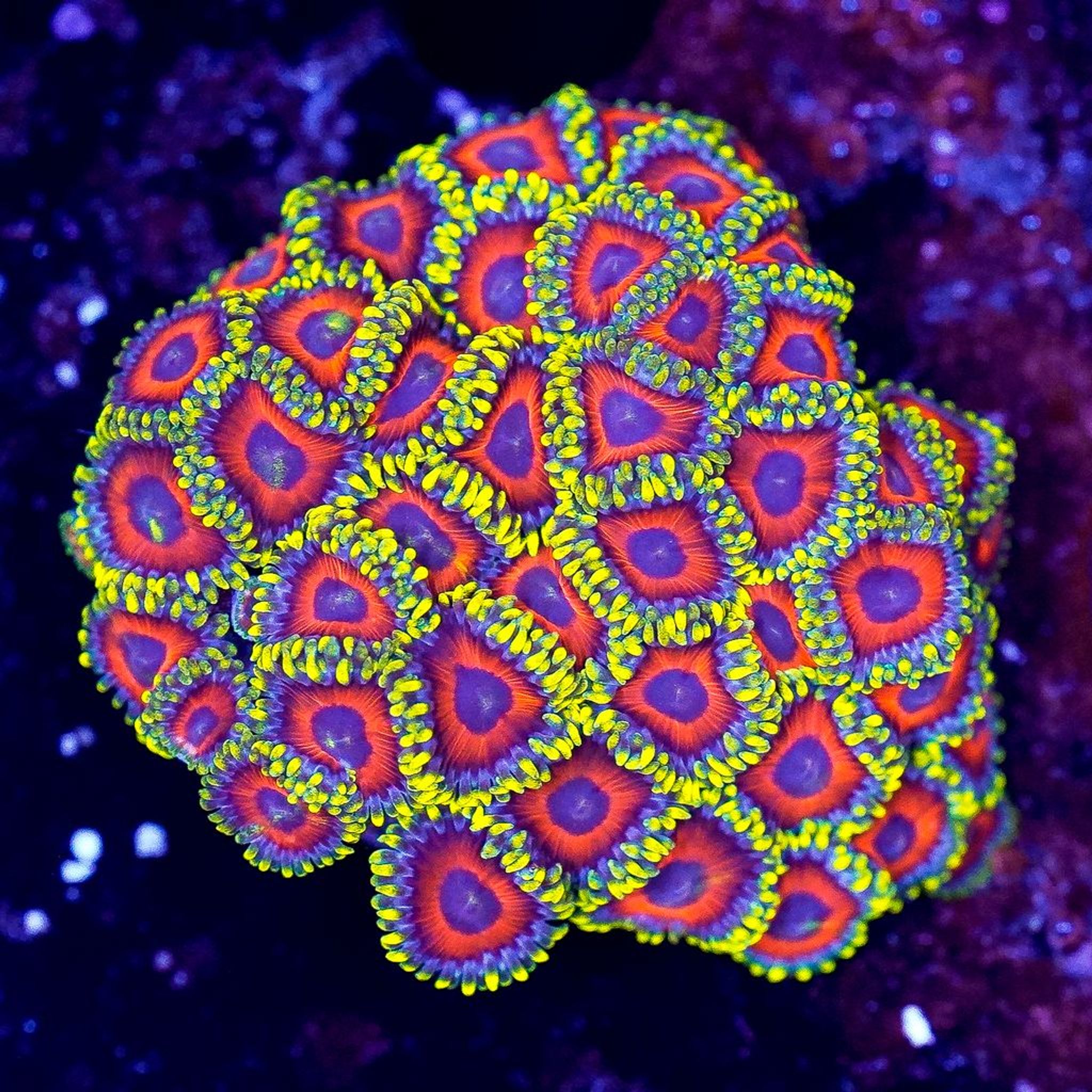

Zoanthids Care Guide: Lighting, Flow, Feeding and Placement
Zoanthids and palythoas are the coral most reefers start with, because they forgive small mistakes that would stress an SPS colony. This guide gives you real numbers for lighting, flow, feeding, and placement, plus a straight answer on the palytoxin safety question that comes up in almost every search on this topic.
Where Zoas Fit Among Coral Types
Reef corals are usually grouped into three broad categories, and knowing where zoanthids sit explains why they're so tolerant:
- Soft corals — no rigid calcium skeleton; includes zoanthids, palythoas, mushroom corals, and leather corals. Flexible tissue, wide parameter tolerance.
- LPS (large polyp stony) — build a fleshy-covered but rigid skeleton; hammer and torch corals are typical examples. Moderate care demands.
- SPS (small polyp stony) — fast-calcifying, thin-tissued corals like Acropora; the least forgiving of parameter swings.
Because zoanthids have no skeleton to calcify, they aren't dependent on tight alkalinity or calcium control the way SPS corals are. That single trait is most of the reason they're recommended as a first true coral.
Zoanthus vs. Palythoa: Telling Them Apart
"Zoas" and "palys" are sold interchangeably, but they're two distinct genera with one important practical difference: palythoa polyps tend to carry a higher concentration of palytoxin.
| Trait | Zoanthus | Palythoa |
|---|---|---|
| Polyp texture | Thin, smooth flesh | Thicker, fleshier flesh |
| Oral disc | Flat, minimal ridging | Often ridged/textured around the mouth |
| Colony pattern | Tight mats, distinct individual polyps | Can form larger, more fused mats |
| Substrate tolerance | Struggles directly on sand | More tolerant near sand |
| Relative palytoxin risk | Lower | Higher |
Since the two are easy to confuse and often unlabeled at point of sale, treat every zoa/paly frag with the same handling precautions regardless of which genus it looks like.
Coral Anatomy in Brief
Each polyp is an oral disc with a central mouth ringed by tentacles. Neighboring polyps connect through a shared mat or stolon (the coenenchyme), which is how a single frag eventually becomes a spreading colony. Inside their tissue, zoanthids host symbiotic zooxanthellae algae that photosynthesize and supply most of the coral's energy — this is why light matters more than food for survival.
Lighting: The PAR Numbers
Moderate PAR is the sweet spot for most zoa and paly varieties.
| PAR level | Result |
|---|---|
| ~30 PAR or less | Polyps stretch and reach for light; colony stays open but pale/leggy |
| 75–150 PAR | Sweet spot for most varieties; full extension, good color |
| 150+ PAR | Colonies mat out flat; risk of bleaching at the higher end |
Run an 8–12 hour photoperiod. Many varieties tolerate a wide range, but shipping-stressed frags are light-sensitive even when the species itself is broadly tolerant — so always acclimate conservatively.
Practical PAR ramp-up: place a new frag at roughly 40–50 PAR for the first week, then step up by about 15–20 PAR per week until you reach your target zone (75–150 PAR), watching for any paling or retraction after each increase before moving up again. A full ramp from shade to a bright display spot typically takes 2–4 weeks. If you don't have a PAR meter, use light height and intensity settings as a rough proxy and err on the side of a slower ramp.
Flow: Turbulent, Not Blasted
Zoanthids prefer moderate to fairly strong, turbulent or indirect flow over one direct laminar jet aimed straight at the polyps. Good flow does two jobs: it keeps detritus and film algae from settling on the mat (a leading cause of polyps staying closed), and it helps carry food particles past open tentacles.
- High-flow habitat varieties naturally form short, dense polyp mats.
- Low-flow/deeper-water varieties grow longer, sparser tentacles.
Position colonies where flow crosses and bounces off rockwork rather than in the direct path of a single pump outlet, and avoid dead spots where water barely moves.
Feeding: Optional but Worth Doing
Zoanthids don't need to be fed to survive — most of their energy comes from photosynthesis via their zooxanthellae. That said, target feeding 1–3 times a week measurably improves color, growth rate, and polyp size, and it's especially useful in newer or nutrient-poor systems where the water alone isn't supplying much.
Good food choices for their small mouths:
- Rotifers
- Cyclops
- Phytoplankton
- Fine mysis ("mysis fines")
- Coral-specific pellets or powders
How to feed: use a turkey baster or pipette to direct a small amount of food at open polyps. Briefly pausing return pumps for about 10 minutes after feeding improves capture before flow sweeps the food away. In a mature, well-stocked tank, fish waste (ammonia and nitrate from normal feeding) also indirectly feeds zoas, which is part of why zoa colonies often color up as a tank matures.
Water Parameters
Zoanthids follow standard reef parameters rather than a strict zoa-specific range, and they tolerate a bit more nutrient load than SPS corals.
| Parameter | Target range |
|---|---|
| Temperature | 75–78°F (24–25.5°C) |
| Salinity | 1.025–1.026 SG |
| Alkalinity | 8–12 dKH |
| Calcium | 400–450 ppm |
| Magnesium | 1,250–1,350 ppm |
| Nitrate | ~5–20 ppm |
| Phosphate | ~0.03–0.1 ppm |
Sources disagree slightly on the "ideal" nutrient band — some recommend keeping both nitrate and phosphate under 10 ppm combined, others put nitrate as high as 20 ppm. In practice, a realistic band of 5–20 ppm nitrate and 0.03–0.1 ppm phosphate works well, and stability matters more than hitting an exact number. Ultra-low-nutrient systems can actually cause zoa polyps to shrink or close, and can invite dinoflagellate blooms. Do weekly water changes of 10–20%.
Placement
Mount zoas and palys on solid rock, frag plugs, or exposed vertical surfaces such as rockwork ledges and overflow boxes, where they get consistent light and flow. Give each colony room to spread — they grow by budding into mats and will keep expanding outward.
- Zoanthus generally does poorly placed directly on sand.
- Palythoa tolerates sand-adjacent placement better.
- Keep zoa mats a few inches away from more aggressive stinging corals — some LPS types, Galaxea, and Euphyllia can sting and kill zoa polyps at the point of contact. Zoas are relatively passive; they're rarely the aggressor, so the buffer space protects them, not the neighbor.
Browsable options for stocking a mixed system, including soft corals and more aggressive LPS corals that need that spacing buffer, are worth reviewing together before you finalize rockwork layout.
Growth, Coloration, and Fragging
Zoanthids are among the fastest-growing, easiest-to-propagate true corals. They reproduce asexually by budding new polyps off the shared mat, and — rarely, mostly in the wild — sexually via broadcast spawning. Fragging is essentially cloning: cutting a section of mat with one or more polyps and re-attaching it elsewhere.
Growth speed varies a lot by morph. Common, inexpensive "war coral" type morphs spread quickly; rarer, more colorful varieties tend to grow slower and cost more.
Color signals to read:
- Bleaching/paling → too much light too fast, or nutrients crashed too low.
- Browning out/drab color → usually excess nutrients or insufficient light.
Gluing a Frag
- Cut a section of mat containing one or more polyps with clean, sharp tools.
- Dry-fit the piece against a plug or rock before gluing.
- Dab a small amount of cyanoacrylate gel ("coral glue") or two-part epoxy putty on the base only — never cover the polyp itself.
- Hold the piece in flowing water a few seconds until the glue sets.
- Place the plug in low-to-moderate flow for a few days while it fully attaches, then move it into its permanent spot.
Handling Safety and Palytoxin
Palytoxin is one of the most potent non-protein toxins known, and both zoanthids and palythoas can carry it — palythoa generally at higher concentration. The risk is real, but it's manageable with a few consistent habits, and severe poisoning cases are rare compared to the much more common mild skin or eye irritation from incidental contact.
Always:
- Wear nitrile gloves any time you handle, cut, or scrape a zoa/paly colony.
- Avoid touching your eyes or face while working with corals.
- Wash hands and tools thoroughly afterward.
- Work in a ventilated area when cutting or scraping colonies.
Never:
- Use hot water on frags or live rock — heat can aerosolize palytoxin.
- Boil or pressure-wash a zoa/paly colony.
- Assume closed polyps are "safe" to touch bare-handed — the toxin risk exists whether polyps are open or closed.
Exposure typically happens through a skin cut, a splash to the eyes or mouth, or inhaling aerosolized toxin from hot water or vigorous scrubbing. Symptoms range from numbness and tingling to muscle cramps, and in severe cases, respiratory distress requiring hospitalization. If you develop symptoms after handling a colony, seek medical attention immediately and mention coral/palytoxin exposure.
Daily, Weekly, and Monthly Maintenance
| Frequency | Tasks |
|---|---|
| Daily | Check temperature, top off evaporation, observe polyp extension/behavior |
| Weekly | Test nitrate, phosphate, and alkalinity; do a 10–20% water change; dose supplements as needed |
| Monthly | Clean pumps and skimmer; check calcium/magnesium; inspect rockwork for pests |
Troubleshooting Closed or Unhealthy Polyps
Work through causes roughly in this order:
- Just arrived and won't open? Most likely shipping/temperature stress. Give it one to two weeks, keep parameters stable and flow moderate, and don't discard it early.
- Small white pustules on the flesh ("zoa pox")? Usually insufficient flow letting detritus build up. Increase flow, gently clean the area, and consider a coral-safe iodine or pine-oil-based dip.
- Film or algae coating over the polyps? Usually elevated phosphate. Address nutrients, boost flow, and gently brush the affected area.
- Polyps closing inconsistently or disappearing one at a time? Check for predators — tiny, camouflaged zoa-eating nudibranchs (which lay resistant eggs, so repeated pine-oil dips are often needed) or nibbling from tangs, foxfaces, or certain hermit crabs.
- Colony bleaching/paling? Light moved up too fast, or nutrients crashed too low. Ease light intensity or duration and confirm nutrients aren't near zero.
- Colony browning out? Usually excess nutrients or too little light. Test water and adjust feeding or lighting accordingly.
- Mat shrinking or not spreading? Usually unstable parameters, or a nearby aggressive coral stinging it — check spacing.
Zoas in Nano Reef Tanks
Zoanthids and palythoas are a top pick for nano tanks (roughly under 20–30 gallons / 75–115 liters) because they're slow to overgrow a small footprint compared to SPS, tolerate the faster parameter swings common in small water volumes, and deliver strong color in a compact space. That said, a small volume still swings temperature and salinity faster than a large one, so stability discipline matters even more in a nano.
For aquascaping a nano reef, place zoa colonies on elevated rockwork or ledges to build layered color "gardens," and leave spacing between different morphs and colonies — this prevents chemical warfare between corals and gives each mat room to spread. Zoanthids, mushroom corals, and leather corals are commonly grouped together as the easiest starter soft corals for exactly these reasons: wide parameter tolerance and modest light/flow demands relative to SPS.
Buying and Acclimating New Frags
Before adding any frag to a display tank:
- Inspect polyps for full extension and even color; avoid frags showing tissue recession, bleaching, or visible pest eggs.
- Quarantine and dip new frags to intercept hitchhiker pests such as flatworms or nudibranchs before they reach your display.
- Prefer aquacultured (farm-propagated) frags over wild-collected colonies where possible — they're generally hardier, more pest-free, and more sustainable, even if wild colonies sometimes carry rarer colors.
Acclimation steps:
- Float the sealed bag for 15–20 minutes to match temperature.
- Drip-acclimate tank water into the bag over 20–40 minutes to gradually match salinity and pH.
- Dip the frag in a coral-safe pest treatment before introducing it to the display.
- Place it initially in lower flow and lower light than your display average, then step both up over the following days to weeks, following the PAR ramp described earlier.
Frequently Asked Questions
Are zoanthids/palythoas safe to keep at home?
Generally yes, with basic precautions. Wearing nitrile gloves, avoiding bare-handed contact, and never using hot water on frags reduces the real but low risk of palytoxin exposure to a manageable level for a home hobbyist.
Do zoas need to be fed?
No — they get most of their energy from photosynthesis through their zooxanthellae. Occasional target feeding, 1–3 times a week, isn't required for survival but does noticeably boost color and growth rate.
What lighting do zoanthids need?
Moderate PAR, roughly 75–150, acclimated gradually over 2–4 weeks when moving a frag to a brighter spot. Many varieties tolerate a wide range, but extremes in either direction — too dim or too intense — cause stress or bleaching.
How much flow do zoanthids need?
Moderate, turbulent flow rather than one direct blast. Avoid stagnant zones, which invite detritus and film algae, and avoid pointing a single powerhead straight at the polyps.
Why won't my zoas open?
Check causes roughly in this order: shipping stress on a new arrival, poor flow or detritus buildup, elevated phosphate with film algae, or a hidden predator like a zoa-eating nudibranch. Working through them in that sequence usually identifies the cause fastest.
Can zoanthids sting other corals?
They're relatively passive and are more often the victim than the aggressor — some LPS corals, Galaxea, and Euphyllia can sting and kill zoa polyps on contact. Leave a few inches of buffer space around zoa mats rather than treating them as a threat to neighbors.
How fast do zoanthids grow and spread?
They're among the fastest-growing, easiest-to-propagate true corals, reproducing by budding into colonies. Growth rate varies a lot by morph — common, inexpensive types spread quickly, while rarer, more colorful varieties grow noticeably slower.
Are zoanthids good for a nano tank or beginner tank?
Yes — they're one of the top beginner and nano-tank coral choices thanks to their hardiness, small footprint, and tolerance of the parameter swings that are common in smaller water volumes.
Ready to start or expand a zoa garden? Browse current coral selections on FishyHub, including soft coral and LPS options, to find frags that fit your tank's light and flow.