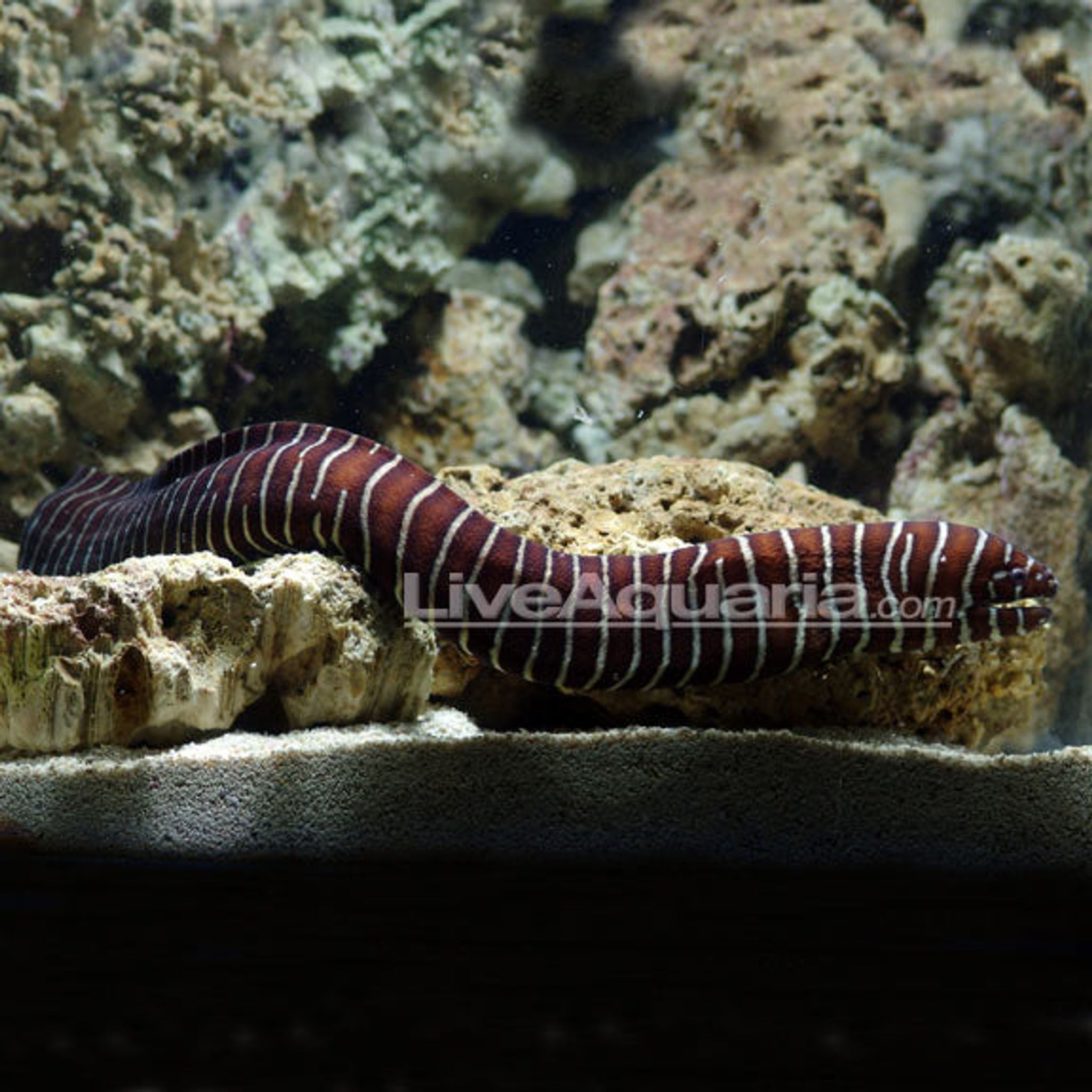
Zebra Moray Eel Care Guide: Tank Size, Diet, Compatibility and Reef Safety
The zebra moray eel is one of the few large eels that can share a tank with fish without hunting them, because it feeds almost exclusively on hard-shelled crustaceans rather than fish. That trade-off is the whole story of this species: a genuinely large, long-lived, escape-prone animal that is more forgiving toward fish and coral than most morays, but a guaranteed threat to any shrimp, crab, or hermit in the tank. This guide covers the tank size, water parameters, diet, and compatibility decisions you need to make before bringing one home.
Size and Lifespan
A zebra moray typically reaches 3–4 feet in captivity, with wild specimens occasionally reported near 5 feet. Unlike slender fish-eating morays, its body is thick and heavy for its length, which matters more for tank volume than the length number alone suggests.
Captive lifespan for morays in general commonly runs 10–20+ years with stable care. That is a multi-decade commitment tied to one tank size and one feeding routine, and it should factor into the buy decision as much as the initial cost of the animal.
Tank Size and Setup
Minimum Tank Size
Generic "moray eel" care sheets often cite minimums as low as 15–55 gallons (55–200 L), but those figures are aimed at small species like the snowflake moray. A zebra moray's bulk pushes the real minimum much higher:
| Life stage | Minimum tank size | Notes |
|---|---|---|
| Juvenile | 125 gallons (475 L) | Footprint matters more than height |
| Full-grown adult | 180+ gallons (680+ L) | Long, deep, stable rockwork required |
| Keeping two adults | Considerably larger, 250+ gallons | Multiple separate hiding areas required |
A long, wide floor plan is more useful than a tall tank, since morays move along the substrate and through rock rather than swimming in open water.
Escape-Proofing the Lid
Undersized or poorly sealed tanks are the single most common cause of eel deaths — an eel that pushes through a small gap and ends up on the floor overnight. Zebra morays are strong, determined escape artists, so the lid needs to be treated as a system, not a single part:
- Overflow boxes and corner overflows — cover the top opening with egg-crate or mesh, not just the main lid.
- Cord and plumbing pass-throughs — foam or mesh any gap where a heater cord, return line, or probe cable exits the canopy.
- Canopy seams and back-panel gaps — check where glass panels meet, and where the canopy meets the tank rim; a gap the width of your finger is enough.
- Weight the lid — a snug-fitting lid held down with clips or weight, not one that can be nudged upward from underneath.
Water Parameters
Zebra morays don't need anything exotic — the target parameters sit squarely in standard reef-adjacent marine ranges:
| Parameter | Target range |
|---|---|
| Temperature | 74–82°F (23–28°C), aim for 76–80°F (24–27°C) |
| pH | 8.0–8.4 |
| Specific gravity | 1.020–1.025 |
| Alkalinity (dKH) | 8–12 |
| Ammonia / nitrite | 0 |
Filtration and Flow
A meaty, crustacean-heavy diet produces a heavy bioload. Plan for oversized filtration and skimming relative to the tank size, plus weekly partial water changes to keep nitrate and organics in check. Water flow should be strong enough for good gas exchange and waste export but not violent — morays aren't strong open-water swimmers and rely on rockwork rather than fighting current.
Aquascape
Build deep rockwork with caves, tunnels, and crevices sized to the eel's girth, not just its length. The rock must be eel-proofed: stacked and secured on the tank bottom (not balanced on sand) so it can't collapse when the eel burrows or repositions itself, which it will do regularly.
Diet and Feeding
What Makes the Zebra Moray Different
Most morays are fish-eaters with sharp, needle-like teeth built for grabbing slippery prey. The zebra moray is a durophage — a shell-crusher. Its teeth are blunt and molar-like, built to crack the shells of crabs, shrimp, lobster, and clams rather than to catch fish. This is the mechanical reason it's a safer tankmate for fish than almost any other large moray.
Feeding Routine
- Food: fresh or frozen shrimp, crab, clam, and mussel meat.
- Method: always offer food on a feeding stick or with tongs — never by hand.
- Frequency: 2–3 times per week, to satiety, rather than daily. Sources differ on 2x vs. 3x weekly; use that range and scale down if the eel starts looking heavy.
- Why not hand-feed: morays have poor eyesight and locate food largely by scent and movement. A hand near the water reads the same as food to the eel, which is how well-meaning keepers get bitten — the eel isn't being aggressive, it's misjudging the target.
Feeding daily or offering more than the eel will finish encourages obesity and, over time, liver problems, which are a recognized issue in captive morays fed too generously.
Compatibility With Other Fish
Because the zebra moray doesn't hunt fish, it can share a tank with large, robust species that a fish-eating moray would treat as prey — think groupers, large angelfish, tangs, and larger wrasses. Sizeable, confident tankmates are less likely to be mistaken for food and are large enough to hold their own if a curious bite does happen.
Small or slow-moving fish are still at some risk, not from predation but from mistaken identity: a moray relying on smell and vibration can strike at something small moving near its hiding spot out of reflex. The safer rule is to stock only fish too large and too fast to be confused with a meal.
If you're building the tank around the eel, it also helps to sequence introductions: adding the eel while other fish are still small and settling in gives them time to establish size and territory before the eel is fully grown, or alternatively add the eel last, once tankmates are already too large to be seen as prey. Either order works better than adding a large eel to a tank of small, newly settled fish.
For stocking large, hardy marine fish that pair well with a zebra moray's tank requirements, you can browse marine fish suited to bigger systems.
Reef and Invertebrate Safety
This is where the species gets misrepresented in both directions. General moray content often lumps every moray in with reef-unsafe predators, while zebra-moray-specific sources are more forgiving because of its shellfish-only diet. The accurate picture:
- Coral: generally left alone; the zebra moray has no real interest in sessile invertebrates and won't pick at coral tissue.
- Fish: comparatively safe, as covered above.
- Crustaceans: not safe at all. Cleaner shrimp, hermit crabs, and any crab or shrimp in the tank will be eaten. Don't add a zebra moray expecting to keep a standard reef cleanup crew.
- Snails: some risk, though lower than crustaceans.
If you want a cleanup crew alongside a zebra moray, plan around non-crustacean grazers such as snails rather than shrimp or crabs, and treat the eel and any marine invertebrates you're considering as mutually exclusive purchases.
Keeping More Than One
Zebra morays are territorial. Housing two or more requires a considerably larger tank than a single adult needs, with ample separate hiding spots so each eel can retreat without contesting space. Territorial disputes are a real risk even in large setups, so multi-eel systems are best attempted by experienced keepers who can monitor behavior closely and separate animals if conflict escalates.
Handling and Bite Safety
Zebra morays are not venomous — no moray eel is, since morays lack venom glands entirely. The danger from a bite is entirely mechanical: a strong jaw, a firm grip, and a real risk of infection from bacteria naturally present in the eel's mouth. Always use tools rather than fingers when feeding or performing any tank maintenance near the eel, and treat any bite as a wound requiring cleaning and medical attention, not a poisoning event.
Quarantine Before the Display Tank
New eels should spend a minimum of 4–6 weeks in a dedicated quarantine tank before joining the display. A simple, bare-bottom or lightly furnished QT setup works best:
- Bare bottom or minimal substrate for easy monitoring and cleaning.
- PVC pipe or similar hiding tubes so the eel feels secure enough to settle and eat.
- Stable heater and the same water parameters as the display tank.
- Confirm the eel is reliably eating prepared foods (not just live offerings) before moving it.
Skipping quarantine is a common failure point: it lets parasites reach the display tank, and it means you commit to an eel before confirming it will actually eat, which is one of the more frequent problems in this group of fish.
After acclimation, give a newly added eel several days to a week to settle before attempting the first feeding. A refusal to eat in that initial window is normal stress behavior, not necessarily a sign of a sick animal — patience at this stage prevents unnecessary panic or premature returns.
How the Zebra Moray Compares to Other Eels
| Species | Typical adult size | Diet | Reef/fish compatibility | Difficulty |
|---|---|---|---|---|
| Zebra moray | 3–4 ft (up to ~5 ft) | Crustaceans, shellfish | Fish/coral-safe-ish; unsafe for crustaceans | Moderate–high (tank size) |
| Snowflake moray | 2–3 ft | Crustaceans, some fish | Similar profile, smaller footprint | Moderate (good stepping-stone species) |
| Tessellata moray | 5+ ft | Fish | Aggressive toward tankmates; true "monster" eel | High |
| Ribbon eel | 2–3.5 ft | Live/small fish (fussy eater) | Poor community fit; high early mortality | Very high (feeding) |
Moray Eels in General
Most morays outside the zebra moray are dedicated fish-eaters spanning a wide size range, from foot-long dwarf species to true giants. They share the traits described above regardless of species: powerful escape ability, heavy bioload from a meaty diet, and a strong recommendation against hand-feeding.
Tessellata Eel — A Rougher Alternative
The tessellata eel gets compared to the zebra moray because both grow large, but the resemblance stops there. It's a fish-eater, routinely reaches 5+ feet, and is noticeably more aggressive toward tankmates. It belongs in a species-only or very carefully stocked tank, not a mixed community.
Ribbon Eel — Why the Zebra Moray Is the Easier Choice
The ribbon eel is smaller and needs less floor space, but it's notoriously difficult to keep because many individuals refuse prepared foods and require live feeder fish, contributing to high early mortality in the hobby. Against that backdrop, a zebra moray's willingness to eat frozen shrimp and crab off a feeding stick makes it the more manageable large eel for most keepers.
Smaller, Hardier Alternatives
If a 180-gallon tank isn't realistic, the snowflake moray is a common stepping-stone species: a similar crustacean-leaning diet and temperament in a noticeably smaller footprint. Some keepers also look at snake eels as a calmer alternative, though most still need deep sand for diving and burrowing and can be just as capable of escaping through an unsealed lid, so treat them as a different commitment rather than a drop-in substitute.
Common Mistakes to Avoid
- Undersized or poorly sealed tanks — the leading cause of eel loss; audit every gap, not just the main lid.
- Hand-feeding — leads to accidental bites from an animal that hunts by scent, not sight.
- Overfeeding — daily feeding drives obesity and liver issues; stick to 2–3 times weekly.
- Adding crustacean cleanup crews — shrimp and crabs will be eaten regardless of intent.
- Skipping quarantine — risks introducing parasites and buying an eel before confirming it eats.
- Unstable rockwork — an eel that burrows can topple rock that isn't secured to the tank bottom.
- Mixing with small or slow fish — even a non-fish-eating moray can bite out of mistaken identity.
Frequently Asked Questions
How big does a zebra moray eel get?
Most captive zebra morays reach 3–4 feet, with wild individuals occasionally reported up to around 5 feet. Their bodies are notably thick and heavy-bodied for their length compared with slimmer moray species.
What size tank does a zebra moray eel need?
Plan for a minimum of 125 gallons (475 L) for a juvenile and 180+ gallons (680+ L) for a full-grown adult, with a secure, weighted, gap-free lid. A long, deep footprint matters more than tank height.
What do zebra moray eels eat?
They're crustacean and shellfish specialists — crab, shrimp, and clam meat — rather than fish eaters. Their blunt, molar-like teeth are built for crushing shells, not catching prey, which is the mechanical basis for their diet.
Are zebra moray eels reef safe?
They're reasonably safe with fish and coral, since they have little interest in either. They are not safe for crustaceans: cleaner shrimp, hermit crabs, and crabs will be eaten, and snails carry some risk too.
Are moray eels poisonous or venomous?
No. Morays have no venom glands at all, so a bite carries no toxin. The real risk is a mechanical injury from a strong bite and a possible bacterial infection from the eel's mouth.
Can you keep more than one zebra moray eel together?
It's possible in a very large tank with multiple separate hiding spots, but zebra morays are territorial and disputes are a genuine risk. Multi-eel setups are best attempted by experienced keepers who can monitor and separate animals if needed.
How long should a new eel be quarantined before adding it to the display tank?
Quarantine for a minimum of 4–6 weeks in a simple, bare-bottom tank with hiding tubes, and confirm the eel is reliably eating prepared foods before moving it to the display.
What are good tankmates for a zebra moray eel?
Large, robust fish such as groupers, large angelfish, tangs, and larger wrasses work well, since they're too big to be mistaken for prey. Avoid small or slow-moving fish that could be bitten out of curiosity.
Before adding a zebra moray to your stocking plan, browse FishyHub's Eels category to see current availability and compare it against the tank size and tankmates you already have.

