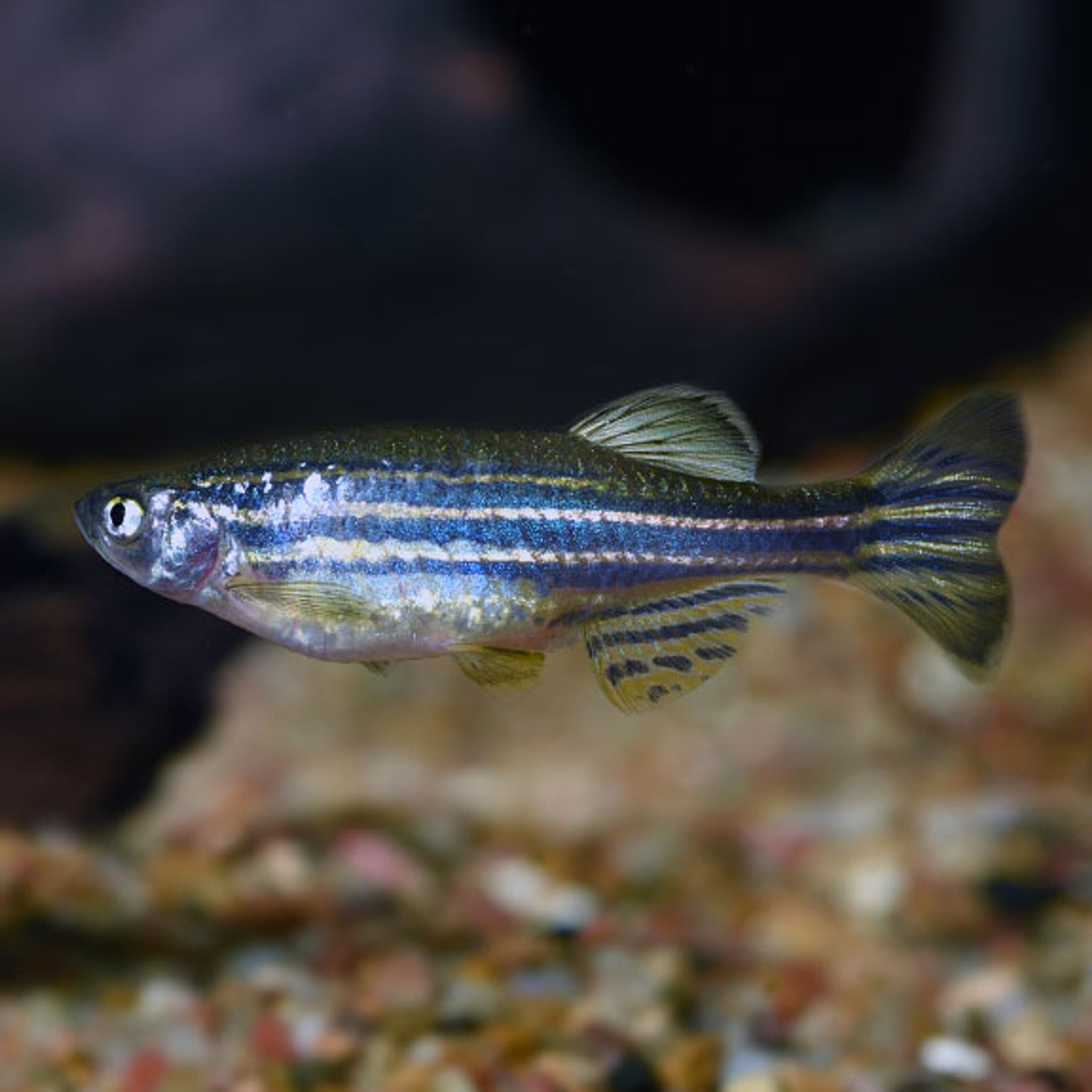

Zebra Danio Care Guide: Tank Size, Diet, Water Parameters and Temperament
Zebra danio care is simple: keep a school of at least 6 in a cycled, lidded tank (a 20-gallon long is ideal), hold the water at 68–74°F (20–23°C) with a pH of 6.5–8.0, and feed a quality flake plus frozen treats a few times a week. They are peaceful, nonstop swimmers that suit most community tanks, as long as you avoid slow, long-finned fish. Below are the full numbers, feeding plan, tankmate list, breeding steps and answers to the questions US hobbyists ask most.
Zebra Danio Quick Facts
| Trait | Detail |
|---|---|
| Scientific name | Danio rerio (also called the zebrafish) |
| Family | Cyprinidae (minnows) |
| Origin | South Asia, mainly India and nearby countries |
| Adult size | About 2 in. (5 cm), up to 2.5–3 in. (6–7.5 cm) |
| Lifespan | 2–3 years on average, up to 5 with good care |
| Minimum group | 6, with 8–10+ better |
| Tank size | 20 gal (76 L) long recommended; 10 gal (38 L) bare minimum |
| Temperature | 64–77°F (18–25°C); target 68–74°F (20–23°C) |
| pH / hardness | 6.5–8.0 (7.0–7.5 ideal) / about 5–19 dGH |
| Diet | Omnivore |
| Temperament | Peaceful but hyperactive |
Where Zebra Danios Come From (and Why They're So Tough)
In the wild, zebra danios live in slow, shallow streams, rice paddies and floodplains that swell and shrink with the monsoon. Water in those habitats changes temperature and chemistry through the seasons, so the species evolved to tolerate a wide range of conditions. That's why the zebra danio is one of the hardiest beginner fish available.
The same toughness, plus fast growth and easy breeding, made the zebrafish one of the most widely used research animals in biology labs. For a home aquarist, that history is reassuring: this is a fish that adapts, spawns readily and forgives small mistakes. It doesn't forgive neglect, though, and "hardy" is not the same as "indestructible."
Tank Size and Setup
10 gallons vs. 20 gallons long
This is the most common debate about danios. Our recommendation: a 20-gallon long (76 L) for a proper school of 6 or more. A 10-gallon (38 L) works only for a small starter group, and you'll need to keep up with frequent water changes.
The reason is behavior, not just body size. Zebra danios swim constantly in the top and middle of the tank, darting end to end. Length matters more than height, so a long, shallow tank beats a tall one holding the same volume.
Stocking rules you'll see, such as "1 fish per 2 gallons" or "10 gallons plus 2 gallons per extra fish," are rough guides only. Tank length and filtration capacity matter more than any formula.
Example stocking plans:
- 10 gal (38 L): 6 zebra danios and a few nerite snails or adult shrimp. Nothing else.
- 20 gal long (76 L): 8–10 zebra danios, 6 corydoras or kuhli loaches on the bottom, and a nerite snail or two.
Setup checklist
- Lid: mandatory. Danios jump, and a gap at the back is enough.
- Filter: choose one rated for more than your tank's volume. They like moderate current and well-oxygenated water.
- Plants and decor: plant the sides and back, and leave the front and top open for swimming.
- Substrate: sand or fine gravel. It isn't critical for this species.
- Cycling: always add danios to a fully cycled tank. Their hardiness doesn't make them a tool for cycling a new aquarium; ammonia and nitrite still harm them.
You can compare glass tanks and filters on FishyHub when planning the build, including hang-on-back filters that suit 10- and 20-gallon setups.
Water Parameters
| Parameter | Target | Tolerated / notes |
|---|---|---|
| Temperature | 68–74°F (20–23°C) | Survive roughly 60–82°F (16–28°C); avoid long spells at either end |
| pH | 7.0–7.5 | 6.5–8.0 is fine if it stays stable |
| Hardness | 5–19 dGH | Soft to hard water both work |
| Ammonia / nitrite | 0 ppm | Any reading means a problem |
| Nitrate | Under 20–40 ppm | Lower is better |
Temperature: how warm is too warm?
Sources split on the upper limit. Some cap it at 75°F (24°C); others allow 79–82°F (26–28°C). Aim for 68–74°F. Danios tolerate water above 78°F (26°C), but warm water holds less oxygen, raises their metabolism and shortens their lifespan. Keeping them for years at 80°F with warm-water tropicals is a common, quiet mistake.
- Too cold: fish turn sluggish, eat less and become more prone to disease.
- Too warm: oxygen demand rises and fish gasp at the surface.
- Cooling a tank in summer: point a fan across the water surface, increase surface agitation or, in hot rooms, use a chiller. Lower the temperature gradually rather than dumping in ice.
pH: stable beats perfect
One common range is 6.0–7.0; others give 6.5–8.0. Danios handle anything from 6.5 to 8.0 comfortably. What causes stress is a pH that swings, so don't chase a specific number with chemicals.
Do you need a heater in a US home?
Often not. In a house that stays above about 65°F (18°C) year-round, many zebra danio tanks run fine unheated. Use a heater, set low (around 68–72°F), when:
- The room drops below ~65°F in winter, which is common in basements and in northern states.
- The room swings noticeably between day and night, such as near windows or exterior walls.
- The house is kept cool while you're away or overnight.
In summer, especially in the South and Southwest, overheating is the bigger risk than cold.
Diet and Feeding
Zebra danios are omnivores. In the wild they eat mainly insects and larvae, plus some plant matter.
- Staple: a quality flake or small pellet.
- Protein boost, 2–3 times a week: frozen or live bloodworms, brine shrimp or daphnia.
- Occasional greens: blanched peas, zucchini, spinach or an algae flake.
- How much: feed 1–2 times a day, only what they finish in about 2 minutes.
Danios feed at the surface and move fast, so they can strip food before slower tankmates reach it. Drop sinking pellets or wafers for bottom dwellers at the same time, or after lights-out, so corydoras and loaches don't go hungry. Flakes, frozen and freeze-dried foods can all be found in FishyHub's food and supplements section.
Temperament and Behavior
Zebra danios are peaceful but hyperactive. They chase each other constantly, and that's normal: it's how they sort out a loose pecking order and how males court females. Step in only if one fish is being cornered, injured or kept from food.
They may nip long fins or harass slow fish, mostly when the group is too small. A school of 8–10 spreads that energy among themselves. On the plus side, danios make excellent dither fish: their confident open-water swimming signals safety and helps shy species come out.
Tankmates
| Good tankmates | Avoid |
|---|---|
| Other danios, white cloud minnows | Bettas |
| Harlequin and chili rasboras | Fancy goldfish |
| Cherry and rosy barbs | Other long-finned or slow fish |
| Corydoras, kuhli loaches, otocinclus | Large predators that can swallow a 2 in. fish |
| Bristlenose pleco | Aggressive cichlids |
| Platies, swordtails, most hardy tetras | |
| Honey gourami, nerite snails, adult shrimp |
Match temperatures too: tankmates that need 78°F or warmer push danios above their comfort zone.
Types of Danios
Many fish sold as "danios" differ in size and needs. Here's how the common ones compare.
| Type | Adult size | Minimum tank | Temperature |
|---|---|---|---|
| Zebra (standard, longfin, albino, gold) | 1.5–3 in. (4–7.5 cm) | 10–20 gal (38–76 L) | 68–74°F (20–23°C) |
| Leopard (zebra color form) | 1.5–3 in. (4–7.5 cm) | 10–20 gal (38–76 L) | 68–74°F (20–23°C) |
| Pearl danio | ~2 in. (5 cm) | 10–20 gal (38–76 L) | 73–77°F (23–25°C) |
| Glowlight danio | Small | Nano to small tanks | Cool, clean water |
| Celestial pearl danio | ~1 in. (2.5 cm) | Nano tanks | Peaceful nano fish |
| Giant danio | 4–6 in. (10–15 cm) | 30 gal (114 L); 40–55 gal better | 72–75°F (22–24°C) |
| Moustached danio | 4–5 in. (10–13 cm) | 40 gal+ (150 L+) | Well-oxygenated, flowing water |
Leopard danio
The leopard danio is not a separate species. It's a spotted, often gold-toned color form of Danio rerio, also sold in long-finned versions. Care is identical to the striped zebra.
Pearl danio
An iridescent blue-violet fish with an orange-pink line along the body. It's peaceful and hardy but prefers slightly warmer water than the zebra.
Giant danio (Devario aequipinnatus)
At 4–6 inches (10–15 cm), it needs a 30-gallon minimum, with 40–55 gallons better for a school. It's semi-aggressive toward small or long-finned fish, needs a tight lid, and lives 5–7 years.
Moustached danio (Devario dangila)
This 4–5 inch (10–13 cm) fish has barbels at the mouth and needs 40 gallons or more with flow running the length of the tank and river-stone decor. It will eat small shrimp.
Breeding glowlight danios (Celestichthys choprae)
Small, peaceful and not a true Danio. They spawn over fine-leaved plants or moss in a cool, clean tank, and their tiny fry need infusoria as a first food.
Laubuka tenella
A small, less common cyprinid often grouped with danios in the trade because it looks and behaves similarly.
Fluorescent Danios
Fluorescent danios are genetically modified zebra danios carrying fluorescent protein genes. The color is inherited from the parents, not dyed or injected. They're sold under color names such as red, green, orange, pink, blue and purple, plus longfin versions.
- Care: identical to regular zebra danios.
- Lighting: they glow brightest under blue or actinic light, but normal aquarium lighting is fine.
- Breeding: they spawn just like standard danios, but the lines are patented, so selling or trading offspring is not allowed.
- State rules: California restricted their sale for years. Check your state's current regulations before buying.
Pink zebra danios
Pink fish come from one of two sources: the fluorescent line, or older dyed or injected fish. Avoid dyed fish. The process harms them and the color fades. A pink fluorescent danio gets standard zebra care.
Sexing and Breeding Zebra Danios
Males vs. females
- Males: slimmer, torpedo-shaped, often with a gold or yellow tint between the stripes.
- Females: deeper-bodied and rounder, especially when carrying eggs.
"Pregnant" danios, egg-binding and dropsy
Zebra danios aren't pregnant. A round female is gravid, meaning full of eggs. Signs include a swollen belly and males chasing her. A female who can't release eggs may become egg-bound; adding males or giving the group a spawning setup usually helps. Don't confuse this with dropsy, where the scales stick out like a pinecone. That's a sign of illness, not eggs.
How to breed them
Zebra danios are the classic first fish to breed. They're egg scatterers that give no care to eggs or fry, and they reach maturity at about 3 months.
- Set up a separate 5–10 gallon (19–38 L) tank with shallow water and a layer of marbles, a mesh or dense fine-leaved plants or moss so eggs fall out of reach.
- Condition the adults with live or frozen foods for several days.
- Move them in the evening. Spawning usually happens the next morning.
- Remove the adults once eggs are scattered, since parents eat them.
- Wait for hatching. Eggs hatch in about 2–3 days (faster when warmer), and fry swim free a few days later.
- Feed fry infusoria or a powdered fry food, then baby brine shrimp.
Estimates of eggs per spawn range from about 100 to 800; a well-fed female typically scatters a few hundred. You may read that danios mate for life, but that claim is weak and anecdotal. In a group they spawn freely with multiple partners.
Health and Maintenance
Common problems
- Ich: white spots on body and fins. Treat promptly.
- Fin rot: ragged fins, usually from stress or poor water.
- Mycobacteriosis: seen in poorly kept stock. A thin fish with a bent spine is a warning sign. Separate it, and don't dose antibiotics blindly.
Quarantine new arrivals
Keep new danios in a separate tank for 2–4 weeks. Watch for white spots, clamped fins, weight loss or a curved spine before adding them to your display.
Routine maintenance
Change 20–30% of the water weekly or every other week, and match the new water's temperature to the tank. Test ammonia, nitrite and nitrate regularly, especially in a 10-gallon.
Common Mistakes and Troubleshooting
- Keeping only 1–3 fish. This leads to stress and fin nipping.
- Using danios to cycle a new tank.
- Housing them with bettas or fancy goldfish.
- Skipping the lid.
- Running them too warm for years alongside warm-water tropicals.
- Overfeeding at the surface while bottom fish starve.
- Buying dyed fish.
| Symptom | Likely cause | What to do |
|---|---|---|
| Hiding, clamped fins | Poor water quality or too small a group | Test water, change water, enlarge the school |
| White spots | Ich | Treat for ich |
| Thin fish, bent spine | Possible mycobacteriosis | Isolate; avoid blind antibiotic use |
| Gasping at surface | Low oxygen or overheating | Add surface agitation, lower temperature slowly |
Frequently Asked Questions
Do zebra danios need a heater?
Often not, if the room stays above about 65°F (18°C). A heater set low still helps by keeping the temperature steady through winter nights and daily swings.
How many zebra danios should I keep?
At least 6, and 8–10 or more is better. Larger groups are calmer, nip less and show more natural behavior.
Can zebra danios live with bettas or goldfish?
Not with bettas; danios nip and stress them. Goldfish share a similar temperature range, but they grow large, move slowly and produce heavy waste, so the pairing works only in theory.
Why do my zebra danios chase each other?
Chasing is normal hierarchy and spawning behavior. It's only a problem if a fish is injured, cornered or can't eat.
Do zebra danio fry survive in a community tank?
Rarely. Adults and tankmates eat eggs and fry, so use dense cover or a separate breeding tank if you want to raise them.
Are fluorescent danios harder to keep, and how long do danios live?
Fluorescent danios need exactly the same care as regular zebras. Either type lives 2–5 years, with cooler, stable water and good maintenance pushing toward the longer end.
Bring Home a School
With a long tank, a lid, cool stable water and a group of 6 or more, zebra danios are among the easiest and liveliest fish to keep. When you're ready to stock up, browse danios on FishyHub along with compatible small community fish.


