Why Is My Pogostemon Helferi Melting or Turning Brown? Causes and Fixes
New Pogostemon helferi leaves turning mushy or brown right after planting is usually a normal adjustment response, not a dying plant. This guide separates expected post-purchase melt from real ongoing problems — light, CO2, nutrients, water quality, and algae — and gives you a clear troubleshooting flow plus recovery steps.
What Is Pogostemon Helferi?
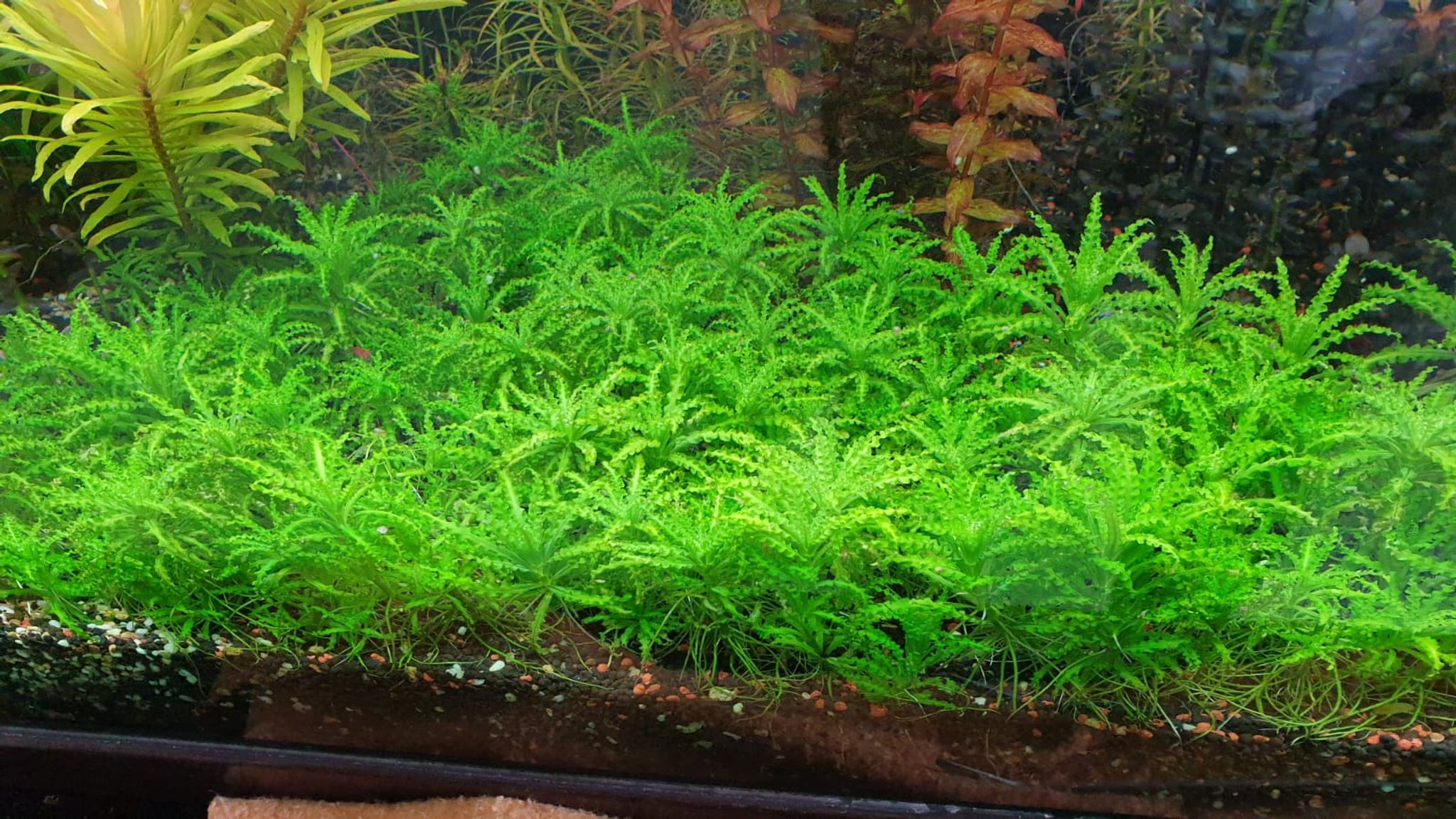
Pogostemon helferi, widely sold as Downoi (Thai for "little star"), is a compact rosette-form plant from Southeast Asia prized for its tight, curly, star-shaped leaf clusters. It works as a foreground or midground carpet-adjacent plant and is generally safe with shrimp and most community fish.
Despite its small size and cute appearance, Downoi is not a true beginner plant. It is moderately demanding: it wants stable water chemistry, decent light, and rich nutrition to hold its signature curl. Many "why is my plant dying" searches start because a low-tech, low-light tank was set up expecting an easy carpet.
At-a-Glance Care Card
| Trait | Detail |
|---|---|
| Origin | Streams and wet rock crevices, Southeast Asia |
| Placement | Foreground to midground |
| Growth rate | Slow to moderate |
| Difficulty | Moderate (not beginner-friendly) |
| Mature size | 2–4 in (5–10 cm) tall, spreads via crown offshoots |
| Tank mates | Compatible with shrimp and most peaceful community fish |
| Minimum tank size | 5 gallons (19 L) |
Baseline Water Parameters
Getting the basics right prevents most chronic browning problems. Use this as your quick-reference target range.
| Parameter | Ideal Range |
|---|---|
| Temperature | 74–86°F (23–30°C); low-to-mid 70s°F is more reliable long term |
| pH | 5.5–7.0 (slightly acidic to neutral) |
| Water hardness | Soft to moderate |
| Planting depth | 1–1.5 in (2.5–4 cm), crown left uncovered |
| Light | Medium-high, roughly 30–50+ PAR at substrate |
| CO2 | Optional but strongly beneficial |
| Minimum tank size | 5 gal (19 L) |
Melting vs. Browning: They're Not the Same Thing
Hobbyist sources often use "melting" and "browning" interchangeably, but distinguishing them speeds up diagnosis:
- Melting: rapid, wholesale leaf death shortly after planting or a major tank change. This is almost always the plant shedding its old leaf form as it adapts — an expected adjustment, not disease.
- Browning/necrosis: gradual, patchy discoloration that develops over weeks in an otherwise stable, unchanged tank. This points to nutrient deficiency, algae fouling, or a slow water-quality issue.
If your plant just came home and is melting, that's typically normal. If a plant that's been settled for months suddenly starts browning, something in the tank has changed or is deficient.
The Most Common Cause: Transplant Shock From Emersed Growth
Most Downoi sold commercially is grown emersed — out of water, in humid greenhouse trays — because it's faster and cheaper to produce that way. Emersed leaves are adapted to air: different humidity, different CO2 availability, different light quality than underwater.
When you plant it into an aquarium, those original leaves often can't survive the switch and melt back to the base while the plant grows a new, submersed leaf form from the crown. This is normal and typically resolves in 1–3 weeks as long as the crown and root system stay healthy. Don't judge the plant by its first leaves — judge it by what grows back.
Buying tip: tissue-cultured (in-vitro) Downoi is propagated directly in a sterile, submersed-compatible form and largely skips the emersed-to-submersed transition. It melts far less than bare-root or potted emersed stock, so it's worth seeking out if you want a smoother start. You can browse live plant-safe tank setups and stock on FishyHub's freshwater livestock pages when planning a planted community tank.
Other Causes of Melting or Browning
Lighting Issues
Downoi needs medium-high light to hold its tight curl. Under low light, it doesn't usually die outright — instead it stretches upward and loses its compact shape (etiolation). This stretching is a stress signal that often precedes actual melting or weak, brown-prone leaves. Sources disagree on exactly how much light is required; the safe target is medium-high (around 30–50+ PAR at the substrate), while accepting that lower light will change the plant's look and slow its recovery rather than kill it immediately.
CO2 and Nutrient Deficiency
CO2 injection isn't strictly required, but it's the single biggest lever for reducing melt frequency and encouraging tight, healthy growth. In low-tech (no-CO2) tanks, expect slower growth and a higher chance of melting, yellowing, or algae fouling — dial light back somewhat to compensate.
Nutrient symptoms are diagnostic:
- Pale or yellow new growth → iron/micronutrient deficiency.
- Browning or holes on older leaves → potassium or nitrogen deficiency.
Downoi is a moderate-to-heavy root and column feeder, so it benefits from both root tabs in a nutrient-rich substrate and regular liquid fertilization.
Water Quality Swings
Ammonia or nitrite spikes in a new, uncycled tank are a common trigger for sudden melt — always plant into a cycled or at least stable tank. Large, unstable swings in pH or hardness, or a big water change with very different parameters from the existing water, can also shock the plant into dropping leaves.
Physical Handling and Planting Depth
Rough handling during planting, or roots planted too shallow (floating free) or too deep (crown buried), can cause localized browning right at the damaged tissue. Disturbing the crown during maintenance has the same effect.
Poor Flow and Algae
The dense rosette shape traps detritus if flow is weak, especially in high-light, low-CO2 tanks where algae growth outpaces the plant. Algae film coating the leaves blocks light and causes browning and die-off underneath the mat.
Normal Age-Related Turnover
Occasional single brown leaves on an otherwise healthy plant with visible new green growth from the crown is just normal leaf turnover — not a problem to fix.
How to Plant Downoi Correctly
- Separate clumps carefully. Small portions establish faster than dividing a large mat all at once; gently pull apart runners rather than cutting through the crown.
- Plant 1–1.5 in (2.5–4 cm) deep, keeping the crown at or just above the substrate line — never buried.
- Choose a nutrient-rich substrate, or use an inert substrate supplemented with root tabs placed near (not directly on) the root mass.
- Anchor lightly if the plant tends to float; weighting with a small stone or planting slightly deeper at the very base can help until roots take hold.
Propagation and Trimming
New plantlets form from the crown and short runners as the plant matures. To divide:
- Wait until the parent clump shows multiple distinct rosettes with their own root growth.
- Gently separate at the runner connection rather than cutting through unestablished tissue.
- Replant divisions with the same depth and spacing guidance above.
Trimming older, leggy, or partially browned leaves near the crown encourages denser, fuller growth and redirects energy to new shoots.
CO2 and Fertilization Setup Basics
- Liquid carbon is the lower-commitment option — easier to dose, cheaper to start, but less effective than pressurized CO2 for driving compact growth.
- Pressurized CO2 gives the most consistent results for tight curl and faster recovery from melt, at the cost of more equipment and monitoring.
- Root tabs feed the root system directly — push them into the substrate near, not under, the crown.
- Liquid macro/micro fertilizers cover water-column feeding, important since Downoi draws nutrients through both roots and leaves.
Algae Control for Carpeting Plants
Algae competing with a struggling Downoi mat makes recovery slower and messier. Effective approaches:
- Manual removal: gently siphon or brush off algae film during water changes rather than scrubbing hard enough to damage the rosette.
- Cleanup crew: algae-eating shrimp or snails work well in a shrimp-safe planted tank; browse options among freshwater shrimp for compatible additions.
- Balance light and nutrients: reduce photoperiod slightly or boost CO2/fertilizer dosing so the plant, not the algae, wins the competition for available light and nutrients.
Troubleshooting Flow
Work through these questions in order:
- Is this a newly planted specimen (under 3 weeks)? If yes, this is likely normal transplant melt — trim dead tissue and wait.
- Is the crown/root system still firm and white/pale, not mushy? If yes, recovery is likely. If the crown itself is soft and rotting, the plant may not recover.
- Has anything changed recently (new tank, big water change, moved plant, dosing change)? If yes, that's your probable trigger — stabilize and stop changing variables.
- Is light adequate (medium-high) and is CO2/fertilizer being dosed consistently? If light is low or dosing is inconsistent, that's a likely chronic cause of browning.
- Is algae visibly coating the leaves? If yes, address flow, photoperiod, and nutrient balance.
- Are water parameters stable and within range (see the table above)? If not, test and correct ammonia, nitrite, pH, and hardness first.
Recovery Steps
- Trim all mushy or clearly decaying leaves promptly — they foul the water and can spread rot into healthy tissue.
- Leave partially green leaves with visible living tissue; only remove what's fully brown or soft.
- Leave the crown and root system undisturbed. Don't uproot or move the clump while it's recovering.
- Keep parameters stable — avoid large water changes or dosing swings during recovery.
- Be patient. Recovery is measured in weeks, not days.
Common Mistakes to Avoid
- Pulling the whole plant at the first sign of brown leaves instead of trimming and waiting.
- Repeatedly replanting or moving the clump to "fix" it, which resets transplant shock.
- Running high light without adequate CO2 or nutrients, fueling algae and stress.
- Planting too deep (burying the crown) or too shallow (roots exposed).
- Planting into an uncycled tank with unstable ammonia or nitrite.
- Ignoring dead flow zones under the rosette where detritus and algae accumulate.
- Treating normal single-leaf die-off as a systemic emergency when new growth is clearly emerging.
Frequently Asked Questions
Is it normal for new Pogostemon helferi to melt after planting?
Yes. Most Downoi sold is grown emersed and sheds its original leaves as it adjusts to underwater life. Expect roughly 1–3 weeks of dieback before new submersed growth appears, as long as the crown stays healthy.
Will Pogostemon helferi grow back after melting?
Yes, provided the roots and crown remain alive. Trim off dead leaves, keep parameters stable, and new shoots will emerge from the base over the following weeks.
Does Pogostemon helferi need CO2?
Not strictly, but injected or liquid CO2 markedly reduces melt risk and speeds up compact, curly growth. Without it, keep light more moderate to avoid pushing the plant faster than it can use available nutrients.
Why are the leaves turning brown but not falling off?
This is usually a nutrient issue — often potassium or micronutrient shortage — or an algae film rather than transplant shock. Check your dosing routine and light/CO2 balance.
Can low light kill Downoi?
Rarely outright. Low light more commonly causes stretching, loss of the tight curl, and weaker leaves that are more prone to browning and algae buildup over time.
How long until Pogostemon helferi recovers from melt?
Typically two to four weeks with stable water and adequate light, and faster with CO2 injection and consistent nutrient dosing.
Should I remove all the brown leaves or leave some?
Remove leaves that are clearly mushy or decaying, since they can foul the water and spread rot. Leave leaves that are only partially discolored but still have visibly living, firm tissue.
Is melting a sign of poor water quality?
It can be, especially in a new or uncycled tank or after a large parameter swing. In an established, stable tank, ongoing browning is more often related to light, nutrients, or algae than to water quality itself.
If your Downoi is settling in and you're building out the rest of a planted community setup, explore freshwater livestock on FishyHub for tank mates that pair well with a slow-growing carpet plant.


