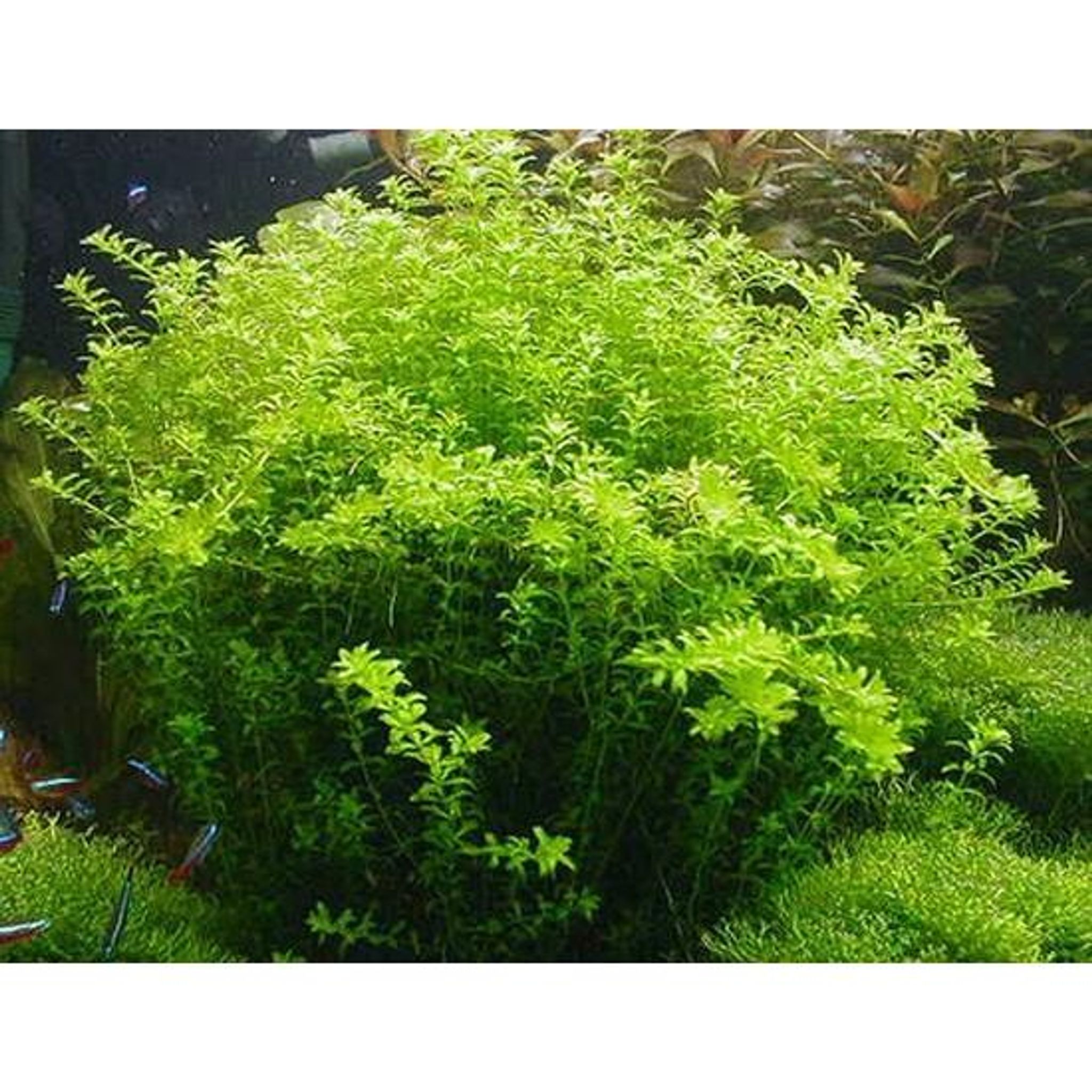

Why Is My Pearl Weed Melting or Turning Brown? Causes and Fixes
Watching a freshly planted pearl weed carpet turn translucent, brown, or mushy is alarming, but it isn't always a disaster. Some melt is a normal, temporary transition, while other cases point to a real imbalance in light, carbon, or nutrients that needs correcting. This guide walks through how to tell the difference and exactly what to fix, in order.
Which "Pearl Weed" Do You Have?
The name "pearl weed" gets used loosely for two different carpeting plants, and the correct fix depends on which one you're growing:
- Hemianthus callitrichoides "Cuba" — the true pearl weed, with tiny round leaves. It's the more demanding of the two and melts faster when conditions slip.
- Micranthemum "Monte Carlo" — often sold under the same "pearl weed" label. It has slightly larger, rounder leaves and is noticeably more forgiving of lower light and no CO2.
If your plant tolerates modest light without much drama, you likely have Monte Carlo. If it's more finicky and prone to melting at the first sign of stress, you probably have true HC. Either way, the diagnostic steps below apply — Monte Carlo just has more margin for error.
Normal Transition Melt vs. a Real Problem
There are two distinct melt situations, and mixing them up leads to a lot of unnecessary panic.
Transition Melt (First 1–3 Weeks)
Pearl weed is typically grown and shipped emersed — out of water, in humid tissue-culture cups or trays — because it grows faster and ships cleaner that way. Those emersed leaves are structured for air, not water, so once submerged many of them die back while the plant regrows leaves suited to underwater life.
What to expect:
- Some outer or older leaves turn translucent, soft, or brown within days of planting.
- Individual leaves may detach from stems, especially at the base.
- New, smaller, glossier leaves should appear within 2–3 weeks.
This is normal and does not usually need intervention beyond basic maintenance. Ripping out melting tufts during this window, or dosing extra fertilizer to "save" them, is a common mistake — the plant usually just needs time.
Established Melt (Weeks to Months Later)
If a carpet that was previously healthy starts browning, thinning, or detaching from the substrate weeks or months after it filled in, that's not transition melt — it's an environmental problem. This is the case the rest of this guide focuses on.
What Melting Actually Looks Like
Because these terms get used interchangeably, it helps to separate them by appearance:
| Symptom | Likely meaning |
|---|---|
| Leaves turn clear/glassy and mushy, disintegrate when touched | True melt — cellular breakdown, often from light/CO2 imbalance or transition |
| Leaves yellow or brown but stay firm, oldest leaves affected first | Nutrient deficiency (nitrogen, iron, or other micros) |
| Fuzzy, hairy, or slimy green-brown film coating the blades | Algae overgrowth, not melt — the plant tissue underneath may still be alive |
| Stems detach cleanly from the substrate, base looks dark or slimy | Root/base rot from a compacted or anaerobic substrate |
| Whole patches brown quickly right after setup | New tank syndrome (ammonia/nitrite from an uncycled tank) |
The Diagnostic Order: Light → CO2 → Nutrients → Substrate → Algae → Water Quality
Rather than guessing, work through causes in this order, since each one interacts with the next.
1. Light
Pearl weed carpets need consistently strong light to grow low and dense rather than tall and leggy. As a rough home-tank target:
- Roughly 2–3+ watts per gallon equivalent, or 30–50+ PAR at the substrate, depending on fixture and tank depth.
- A 6–8 hour photoperiod, run consistently at the same time each day.
Too little or inconsistent light causes stems to stretch upward, thin out, and melt starting from the base as lower leaves get shaded out. In a shallow nano tank (say 5–10 gallons), a modest fixture can deliver adequate PAR at the substrate; the same fixture on a taller tank will fall well short, since light intensity drops sharply with distance. Match fixture strength to your actual water depth, not just tank volume. Browsing options under lighting can help you compare fixtures suited to your tank's depth.
2. CO2 and Liquid Carbon
This is the single most argued-over factor for pearl weed, and for good reason — it matters more than almost anything else.
- With pressurized CO2: target roughly 20–30 ppm, checked with a drop checker that reads yellow-green (not blue, not yellow). This is what produces a genuinely dense, low, pearling carpet.
- Without pressurized CO2: a liquid carbon (glutaraldehyde-based) supplement, dosed per label directions, can support slow spread, especially for Monte Carlo. True HC without any carbon source tends to stay sparse and is more melt-prone.
- Sources disagree on whether CO2 is "required." It isn't strictly mandatory — the plant can survive and slowly spread without it — but a dense, fast-filling carpet is very difficult to achieve without CO2 or at least consistent liquid carbon paired with moderate (not maxed-out) light.
For a simple home setup without a full high-tech rig: start with liquid carbon at the labeled dose, diluted into tank water before dosing near delicate carpet leaves rather than spot-dosing directly onto them, since overdosing can bleach or burn sensitive foliage. If you later add pressurized CO2, bring it up gradually over a week or two rather than jumping straight to target ppm.
High light without matching CO2 or nutrients is the classic combination that causes both algae and melt. If you can't supply enough carbon, dial the light back rather than running it at full intensity and duration.
3. Water Column Nutrients
A filling carpet pulls a meaningful amount from the water column, not just the substrate:
- Nitrate (NO3): roughly 10–20 ppm
- Phosphate (PO4): roughly 1–2 ppm
- Potassium and micronutrients (including iron): dosed per a balanced planted-tank fertilizer routine
Deficiency symptoms typically show up in older, lower leaves first — yellowing or browning while newer growth still looks fine. If you're seeing browning without mushiness or detachment, check your dosing and light duration before assuming disease. Excess ammonia or nitrite from an uncycled tank, by contrast, browns and melts new plants very quickly and is a different problem (see New Tank Syndrome below).
4. Substrate and Root Health
Pearl weed roots shallowly, which makes it sensitive to what's happening right at the surface of the substrate:
- A substrate that has compacted over time, or gone anaerobic in spots, can starve roots and cause stem bases to blacken and detach. If you gently probe the substrate and see dark patches or smell gas bubbles releasing, that's a sign of anaerobic buildup.
- A nutrient-rich aquasoil-type substrate as a base layer gives shallow roots something to draw from without needing frequent disturbance.
- On root tabs: opinions differ here. Some hobbyists push tabs directly under an established carpet for targeted feeding; others argue that repeatedly inserting tabs disturbs pearl weed's thin root mat and does more harm than good. A more balanced approach is to get the nutrient load right in the base substrate at setup, and rely on water-column dosing for an established carpet rather than repeatedly poking tabs into a mature mat.
5. Algae Smothering
Hair algae, fuzz algae, or diatoms overgrowing the blades are frequently mistaken for "browning," but this is a light/CO2 imbalance showing up as a symptom, not a separate disease. If you gently rub a blade and find a fuzzy or slimy film that wipes away to reveal green tissue underneath, treat it as an algae problem — usually meaning your light is ahead of your carbon and nutrient supply — rather than assuming the plant itself is dying.
6. Flow and Water Quality
Stagnant water sitting under a dense carpet traps debris and detritus against the substrate, encouraging localized rot and browning even when light, CO2, and nutrients are otherwise fine. Aim for gentle but consistent circulation across the substrate surface, not just at the water's surface.
New tank syndrome deserves its own mention: planting pearl weed into a tank that hasn't finished cycling is one of the fastest ways to see rapid, tank-wide browning. Ammonia and nitrite spikes damage plant tissue directly, independent of light or CO2. If your tank is under a few weeks old and wasn't seeded with established filter media, test your water before troubleshooting anything else.
Planting Technique Matters Too
Poor initial planting sets a carpet up to fail before conditions even come into play:
- Plant in small tufts (a few stems at a time), not large clumps — clumped stems shade each other and rot in the center.
- Use tweezers to place stems shallowly, just enough to anchor the base; planting too deep buries growth points and encourages rot.
- Space tufts 0.5–1 inch (1.3–2.5 cm) apart to give runners room to spread without immediately competing.
Temperature and Acclimation
Sudden swings — cold shipping water mixed into a warm tank, or a large abrupt water change — stress emersed-grown plants and can trigger melt on their own. Acclimate new plants gradually and keep parameters stable afterward:
- Temperature: roughly 68–82°F (20–28°C)
- pH: roughly 6.5–7.5
- Water hardness: soft to moderately hard
Stability matters more than hitting an exact number within these ranges.
Maintenance: Trim and Remove Decaying Tissue
Once a carpet fills in, dense mats shade their own lower leaves, which can brown and rot at the base if never thinned. Trim regularly, and promptly remove any visibly mushy or decaying leaf litter — left in place, it fouls the water and can trigger further melt or an algae bloom in the surrounding carpet. A gentle water-conditioning routine after trims helps offset the organic load; browsing water conditioners and additives is a reasonable place to start if you're not already dosing one.
Recovery Timeline
Once the underlying cause is corrected:
- New pearly leaf growth typically resumes within 1–2 weeks.
- A full, dense carpet fill can take 4–8+ weeks or longer, depending on light, carbon, and nutrient consistency.
Patience matters here — the most common mistake is judging a fix as "not working" after only a few days and changing something else before the plant has had time to respond.
Common Mistakes to Avoid
- Panicking and uprooting melting plants during the normal 1–3 week transition window instead of waiting for regrowth.
- Dosing CO2 or fertilizer abruptly at high levels to "fix" melt fast — this usually adds stress or triggers algae instead.
- Running high light at full intensity and duration while CO2 or nutrients lag behind — the classic algae-and-melt combination.
- Leaving decaying, melted tissue in the substrate, where it fouls water and encourages more rot.
- Planting into an uncycled tank or right after a major substrate or water change.
- Skipping trims on a filled-in carpet, causing self-shading and base rot.
- Overdosing liquid carbon directly onto pearl weed leaves, which can bleach or burn delicate tissue — always dose per label and dilute in tank water if concerned.
If You're Not Running CO2
If a full high-tech setup isn't realistic for your tank, set expectations accordingly: pearl weed can survive and slowly spread under moderate light with just liquid carbon, but it will stay sparser and take longer to fill in than a carbon-injected tank. Keep light on the lower end of the range above to avoid outrunning your carbon supply, and consider Monte Carlo over true HC if you keep losing ground — it's the more tolerant of the two under low-tech conditions. If pearl weed keeps failing despite correct care, an easier low-light carpeting plant may simply be a better match for your setup than continuing to fight the same cycle.
Frequently Asked Questions
Is pearl weed melting after planting normal?
Yes. Some melt in the first 1–3 weeks after planting is expected as the plant converts from emersed to submerged growth. New leaves should appear within that window; if nothing regrows by week three or four, treat it as an environmental issue instead.
How long does pearl weed take to recover from melt?
With stable, corrected conditions, new growth typically appears within 1–2 weeks, and a full carpet can take 4–8 or more weeks to fill in completely.
Does pearl weed need CO2 to survive?
No, it can survive and even spread slowly without pressurized CO2, especially Monte Carlo. But forming a dense, healthy carpet rather than a sparse, melt-prone one generally requires CO2 or at least consistent liquid carbon paired with adequate light.
Why is my pearl weed turning brown but not falling apart?
Firm brown or yellow leaves that aren't mushy usually point to a nutrient deficiency (iron, other micros, or macronutrients) or an early algae film rather than true melt. Check your dosing routine and light duration before assuming disease.
Can too much light cause pearl weed to melt?
Indirectly, yes. Excess light without matching CO2 and nutrients drives algae growth and creates the imbalance that leads to melt, even though the light itself isn't the direct cause.
Should I remove melted pearl weed leaves?
Yes. Gently remove visibly dead, mushy, or detached tissue so it doesn't foul the water, but leave any healthy green growth undisturbed.
Is my substrate causing the browning?
It can be. Compacted, old, or nutrient-poor substrate starves shallow roots and can cause base rot. Check for dark, anaerobic-looking patches or gas bubbles when you gently probe near the roots.
What water parameters are ideal for pearl weed?
Roughly 68–82°F (20–28°C), pH 6.5–7.5, and soft to moderately hard water. Stability over time matters more than hitting an exact number within that range.
Ready to fine-tune your setup? Browse tank-appropriate lighting fixtures and nutrient-rich substrate options on FishyHub to give your pearl weed carpet the foundation it needs.


