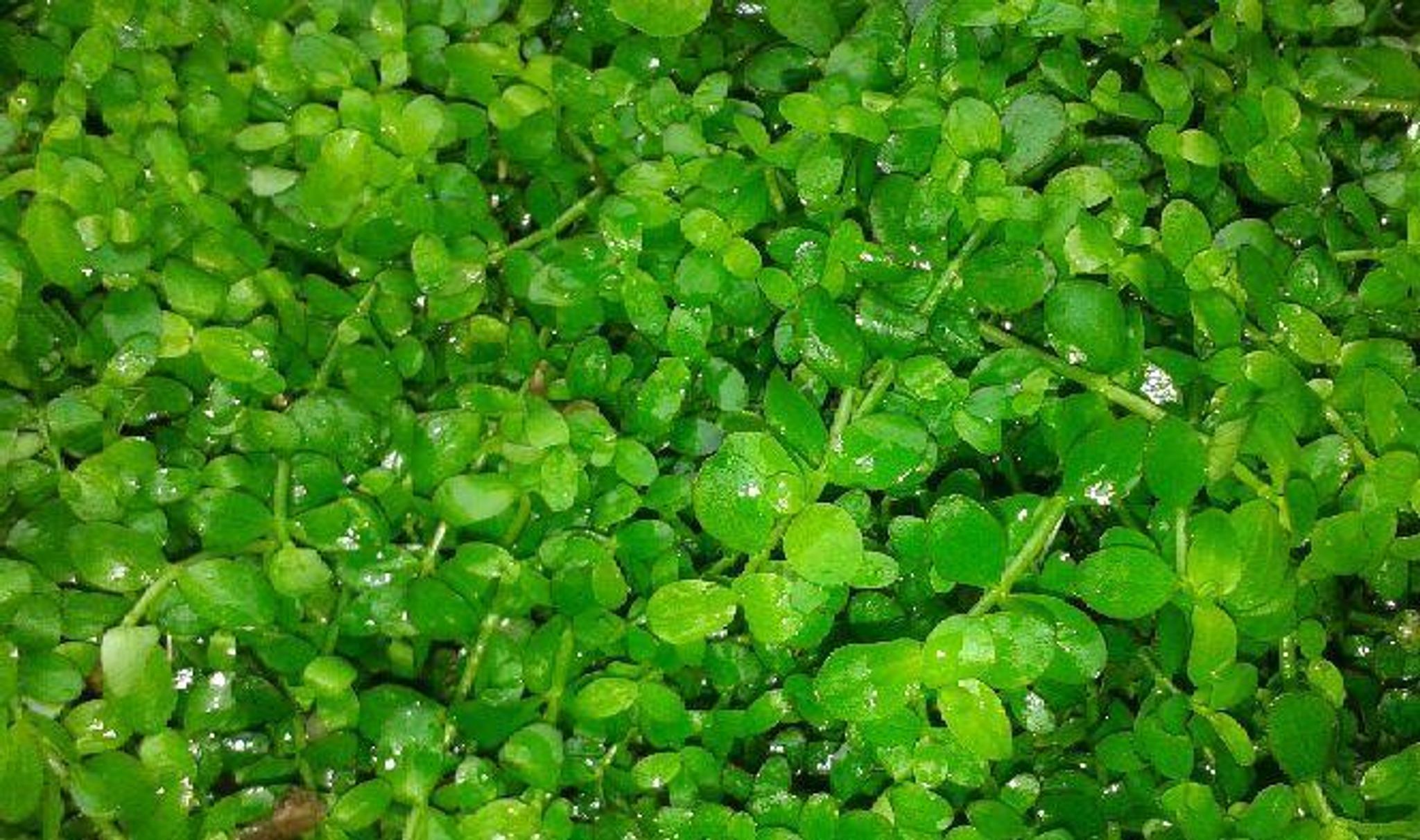

Why Is My Monte Carlo Melting or Turning Brown? Causes and Fixes
Watching a new carpet of Monte Carlo (Micranthemum tweediei) turn translucent, mushy, or brown is alarming, but it isn't always a disaster. Some melt is a normal adjustment response, while other cases point to a real light, CO2, flow, or algae problem. This guide walks through how to tell the difference and what to do about each cause.
Normal Melt vs. a Real Problem
"Melting" describes leaves that turn translucent, soft, or mushy, then brown and disintegrate. It's different from two other things people often mistake for it:
- Algae coating – a fuzzy, slimy, or filmy layer sitting on top of otherwise intact leaves.
- Slow yellowing – pale or stunted new growth that develops gradually, usually from a nutrient shortfall rather than sudden tissue breakdown.
The most common trigger for true melt is the switch from emersed to submersed growth. Monte Carlo sold as tissue-culture cups or grown in a dry-start setup develops its leaves in air. Once submerged, those emersed leaves are shed and replaced by new submersed-form growth. Expect this old growth to die back within days of planting, with fresh green shoots appearing over the following 1–3 weeks. That timeline is the key diagnostic: melt in the first one to two weeks after planting emersed-grown stock is expected. Melt that shows up later, spreads to previously healthy patches, or affects fully submersed-grown stock is a sign something in the tank needs adjusting.
Quick Visual Comparison
| Symptom | Likely Cause | What To Do |
|---|---|---|
| Old top growth turns clear/mushy in week 1–2 after planting | Normal emersed-to-submersed transition | Leave it — trim only the dead tissue, wait for new shoots |
| Brown/black slimy sheet, musty smell, peels off in one piece | Cyanobacteria (blue-green algae) | Improve flow, cut photoperiod, manual removal, check nitrate |
| Fuzzy or hairy dark tufts on leaf surface | Black beard or staghorn algae | Manual removal, stabilize CO2 before raising light |
| Pale, yellowing, or stunted new leaves (no mushiness) | Nutrient deficiency | Dose nitrogen, potassium, phosphorus, iron/micros |
| Sudden melt weeks after a stable carpet was established | Light/CO2/flow imbalance or new-tank swings | Work through the troubleshooting order below |
A Step-by-Step Troubleshooting Order
Rather than guessing at every possible cause at once, check these in sequence — each step rules out (or confirms) a category before moving to the next.
1. Check Light
Monte Carlo is a medium-to-high light plant. Under a standard LED fixture in the 6500–8000K range, aim for roughly 50–100+ PAR at the substrate, with an 8–10 hour photoperiod. Symptoms of too little light include stretching (reaching upward instead of spreading) and weak, brown-tinged tissue from insufficient energy. Too much light without CO2 and nutrients to match invites algae to outcompete the carpet, and the resulting stressed tissue can melt.
2. Check CO2 Stability
Monte Carlo carpets fastest and thickest with pressurized CO2 injection. It can survive and slowly spread under moderate light without CO2, just with lower density and a slower fill-in — that's a valid low-tech path if expectations are set accordingly. What causes more trouble than simply running no CO2 is unstable CO2: a drop checker that swings between green, blue, and yellow through the day stresses the plant more than steady, moderate CO2 levels held consistently.
3. Check Flow
Carpet plants need good water movement across the substrate. Poor flow — especially in larger or deeper tanks — creates stagnant pockets where detritus builds up and CO2/oxygen run low at the base of the carpet. That localized starvation is a common cause of the underside of a carpet browning and rotting even when the top looks fine.
4. Check Nutrients
Nitrogen, potassium, phosphorus, and iron/micronutrients all matter for Monte Carlo. A true deficiency usually shows as pale or yellowing new growth rather than sudden melt, but prolonged deficiency compounds other stress and can accelerate browning. Watch the opposite problem too: overdosing liquid CO2 or fertilizers to "fix" melt quickly adds more stress, not less.
5. Check for Algae
If the carpet is browning or blackening in patches rather than turning uniformly translucent, algae is a likely culprit — not plant death. See the algae section below.
Planted Aquarium Lighting Requirements
Matching light to a plant's demand is the foundation of most carpet troubleshooting. As a general framework:
- Low-light plants: roughly 25–50 PAR at substrate
- Medium-light plants: roughly 100–150 PAR
- High-light plants: roughly 150–250+ PAR
Monte Carlo sits in the medium-to-high range. Spectrum matters less than intensity for most fixtures — a balanced red/blue output around 6500–8000K works well — but photoperiod should stay in the 8–10 hour window. Longer photoperiods without more CO2 or nutrients mainly feed algae, not the carpet.
Choosing a Fixture for a Carpet Tank
When picking or troubleshooting an LED for a carpeting plant like Monte Carlo:
- Look at PAR at substrate depth, not wattage or lumens — those numbers vary widely between brands and don't tell you what's actually reaching the plant.
- Prefer a fixture with adjustable intensity and spectrum so you can dial output down while CO2 and fertilizing are still being tuned in.
- Check for even spread across the tank footprint rather than chasing the single brightest unit — hot spots and shadowed corners both cause uneven carpet growth.
- Match fixture strength to your actual CO2/fertilizing commitment. A high-output light paired with no CO2 system is a common recipe for algae, not a thicker carpet.
You can browse a range of options under Lighting when comparing fixtures for a planted setup.
Substrate, Planting Technique, and Water Parameters
Plant Monte Carlo in small tufts, not one large mat. A single dense clump traps detritus underneath and rots at the base; small, spaced tufts root faster and knit together as they spread. Use a nutrient-rich substrate — an aqua soil or a standard substrate capped with root tabs — and avoid letting it compact, since roots need to establish before the plant pearls or fills in densely.
Monte Carlo is fairly adaptable on water chemistry: roughly 68–82°F (20–28°C), pH 6–7.5, soft to moderately hard water. The bigger risk is sudden change — a large water change with very different parameters, or a fast temperature swing, can shock a newly planted or already-stressed carpet into melting. A new, uncycled tank compounds this: an immature nitrogen cycle causes fluctuating ammonia and nitrite regardless of how well the lighting and CO2 are dialed in, and Monte Carlo planted into that environment often melts through no fault of the light or CO2 setup at all.
Algae Management in the Planted Aquarium
Algae is a symptom of an imbalance among light, CO2, and nutrients — not simply a "dirty tank" problem. General fixes:
- Trim and manually remove affected leaves rather than dosing chemicals first.
- Reduce photoperiod before reducing light intensity if algae appears.
- Improve flow, especially near the substrate.
- Get CO2 stable before increasing light — raising light on unstable CO2 is one of the most common paths to an algae outbreak.
- Add a cleanup crew — nerite snails, amano shrimp, or otocinclus — as a supplement to correcting the imbalance, not a substitute for it.
Identifying and Treating Blue-Green Algae (Cyanobacteria)
Cyanobacteria is often mistaken for the plant "dying" because it forms a slimy, sheet-like blue-green to blackish film directly over the carpet, blocking light and smothering leaves underneath. Two identifying traits: it usually has a musty or earthy smell, and it tends to peel off in one continuous sheet rather than crumbling like true algae.
It thrives in low flow, high organic waste, a light/CO2 mismatch (often paired with low nitrate), and low oxygen overnight. To treat it:
- Increase flow and surface agitation.
- Do larger and more frequent water changes.
- Reduce excess organics — cut back feeding and remove decaying plant matter.
- Check nitrate levels; low nitrate combined with excess light or CO2 is a common trigger.
- Try a short full blackout period (multiple days with no light) for stubborn cases.
- As a last resort for severe outbreaks, a short-course erythromycin-based treatment can knock it back, but use it cautiously — it can also disrupt the biological filter.
Recovery: Getting the Carpet to Fill Back In
Once you've identified the cause, recovery follows the same general plan:
- Trim off clearly dead, mushy, or algae-covered tissue to stop it fouling the water — but leave healthy-looking crowns and runners in place.
- Stabilize CO2 and improve flow across the substrate.
- Verify photoperiod and intensity match your current CO2 and fertilizer routine (8–10 hours is the target range).
- Keep up regular water changes to avoid the organic buildup that feeds algae.
- Be patient. Regrowth from surviving nodes and runners typically resumes within 2–4 weeks once conditions are corrected.
If an earlier attempt failed completely, don't start from scratch unless you have to. Check for any surviving green runners at the substrate — even a few can be separated into fresh small tufts and replanted using the same tuft-based technique above, rather than buying an entirely new batch.
Common Mistakes That Cause or Worsen Melt
- Planting one large dense mat instead of small, spaced tufts.
- Running high light without CO2, or with CO2 that swings inconsistently.
- Leaving photoperiod and intensity high while CO2/fertilizing is still being dialed in.
- Poor substrate-level flow, especially in larger or deeper tanks.
- Mistaking algae overgrowth for plant death and uprooting healthy plant tissue along with it.
- Planting into an uncycled or brand-new tank and blaming the plant for parameter swings.
- Overdosing liquid CO2 or fertilizer trying to reverse melt quickly.
- Giving up and removing the plant too early, before surviving nodes get a chance to regrow.
Frequently Asked Questions
Is it normal for Monte Carlo to melt after I plant it?
Yes, especially for emersed-grown stock. Expect the old top growth to die back and new submersed growth to appear within 1–3 weeks of planting.
Does Monte Carlo need CO2 to survive?
No, but it grows denser and carpets much faster with pressurized CO2. Without it, keep light moderate and expect slower, thinner spread.
How much light does Monte Carlo need?
Medium to high light, ideally roughly 50–100+ PAR at the substrate from a controllable LED fixture, with an 8–10 hour photoperiod matched to your CO2 and fertilizing routine.
Why is my Monte Carlo turning brown/black instead of melting clear?
This is more often algae — commonly cyanobacteria or staghorn — coating the leaves rather than the plant itself dying. Address flow, nutrient balance, and any light/CO2 mismatch.
How long until Monte Carlo recovers or fills in after melting?
Typically 2–4 weeks once light, CO2, and flow are corrected, assuming healthy roots or runners survived.
Should I remove all the melted parts?
Trim off clearly dead or mushy tissue so it doesn't foul the water, but leave healthy-looking crowns and runners in place — they're the source of the regrowth.
Can bad water changes or temperature swings cause melt?
Yes. Sudden shifts in temperature or water changes with very different parameters can shock a newly planted or already-stressed carpet into melting.
What's the difference between nutrient deficiency and melt?
Deficiency typically shows as pale, yellowing, or stunted new leaves developing gradually. Melt is rapid — existing leaves turn translucent and mushy and detach within days.
Once your carpet is stable, you can browse substrate, root tabs, and planting supplies under Substrate on FishyHub to support the next round of growth.


