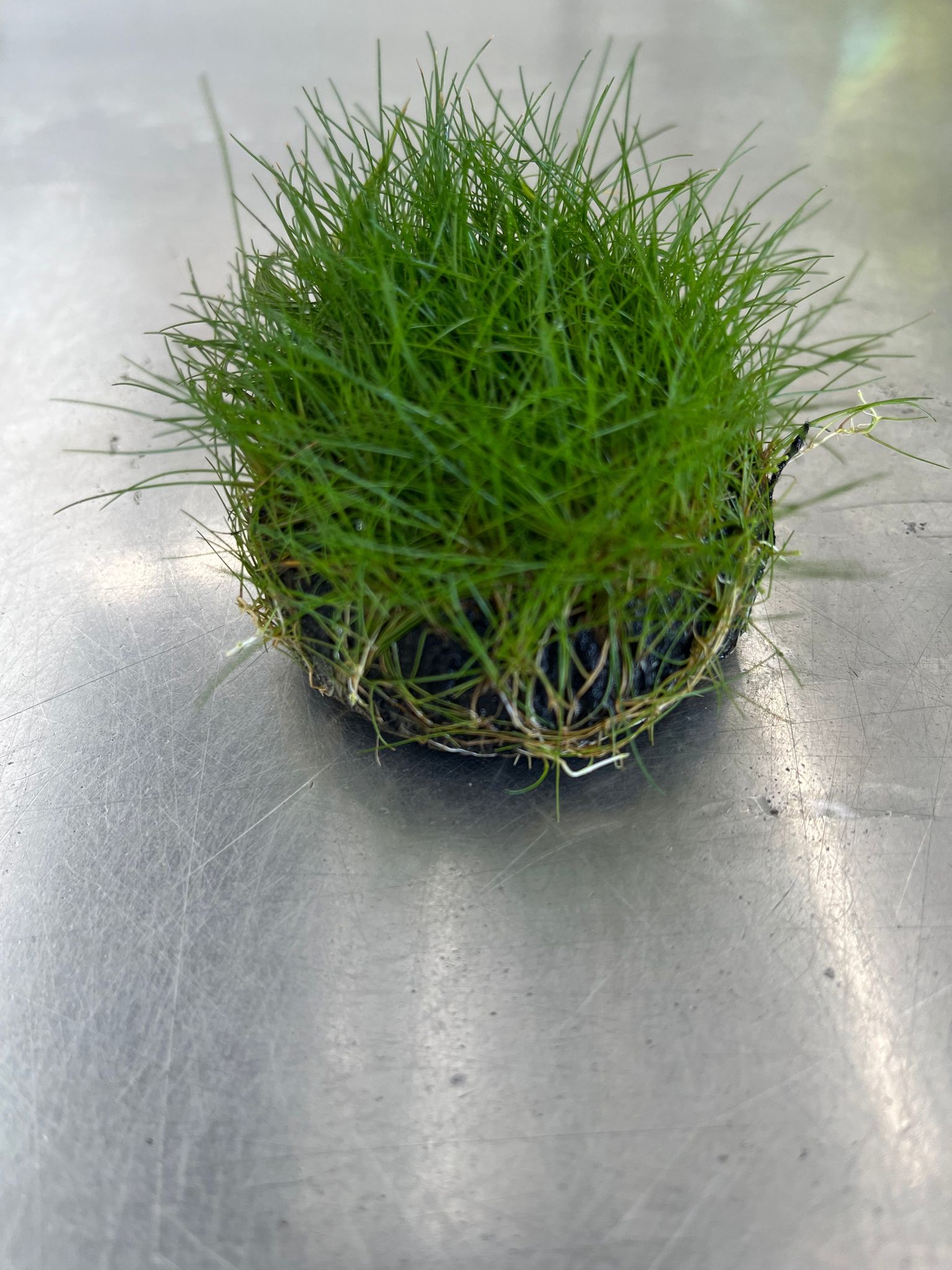

Why Is My Dwarf Hairgrass Melting or Turning Brown? Causes and Fixes
Dwarf hairgrass (Eleocharis) that goes limp, translucent, or brown a week or two after planting is usually normal transplant melt, not a dying carpet. But if an established, healthy lawn suddenly browns or thins out, that's your tank telling you something about light, CO2, nutrients, or maintenance needs to change. This guide walks through both scenarios and gives you a clear order to check things in.
Transplant Melt vs. Established Melt: Know Which One You're Seeing
These two situations look similar but call for opposite responses.
Transplant melt happens because the hairgrass you planted was grown emersed (above water, in a nursery) with a leaf structure suited to air. Once submerged, those original blades often die back within 1–3 weeks while new, water-adapted growth pushes up from the base and runners. This is a normal, expected part of establishing the plant — the worst thing you can do is panic and rip everything out before regrowth has a chance to appear.
Established melt is different: a carpet that has already been full, green, and stable for weeks or months suddenly starts browning, thinning, or collapsing. This is not a shedding process — it's a signal that something in the tank has changed or drifted out of range, and it needs troubleshooting rather than patience alone.
| Sign | Transplant melt | Established melt |
|---|---|---|
| Timing | Within 1–3 weeks of planting | Weeks/months after a carpet was already healthy |
| Pattern | Original blades die back; new shoots appear at base | Existing blades brown, thin, or collapse with no new growth |
| Cause | Normal adaptation from emersed to submersed growth | Light, CO2, nutrient, substrate, flow, or algae problem |
| Action | Wait 2–3 weeks; don't uproot | Diagnose and correct the underlying cause |
A Quick Diagnostic: Where Is the Browning Happening?
Before changing anything, look closely at which part of the plant is affected. This narrows down the cause fast.
| Location affected | Likely cause |
|---|---|
| Older, lower blades yellow or brown first | Nitrogen or potassium deficiency, or normal senescence |
| New growth emerges pale, yellow, or white | Iron or micronutrient deficiency |
| Whole blades go translucent, mushy, and collapse | True melt — light/CO2 mismatch, or rot from poor flow |
| Blades coated in a dusty brown film (new tank) | Diatom bloom, not melt |
| Blade tips only, with dark or black patches | Algae (often black beard algae) smothering the tip |
Treat these differently. Deficiency issues call for adjusted fertilizing; diatom haze on a new tank usually clears on its own within a few weeks as the tank matures; true melt means checking light and CO2 together.
Light: The Most Common Root Cause
Dwarf hairgrass is a high-light plant, and insufficient light is the single most common reason a carpet fails to form or thins out over time. As a rough legacy guideline, aim for roughly 2–3+ watts per gallon of older-style lighting — but this rule is unreliable across modern LED fixtures with very different efficiencies. A more dependable target is 30–50+ PAR (µmol/m²/s) measured at the substrate, which you can check with a PAR meter or estimate from your fixture's published output and mounting height.
Under too little light, hairgrass grows tall, thin, and leggy instead of carpeting low and dense, and the lower leaves brown from self-shading as the upper growth blocks light from reaching them. Browsing FishyHub's LED lighting options is a reasonable place to start if your current fixture is older, dim, or not rated for planted tanks.
CO2: Not Mandatory, But Needed to Carpet Well
Hairgrass can survive without supplemental CO2, but it rarely carpets well without it — especially under the higher light levels needed for a dense lawn. Light without matching CO2 is one of the classic melt triggers: you've given the plant the energy to grow fast, but not the carbon it needs to use that energy, and the result is stress and die-back rather than growth.
If you're running CO2, target roughly 20–30 ppm, confirmed with a drop checker showing a green (not blue, not yellow) color. A few practical points that get skipped in most CO2 advice:
- Sync the timer with lights. Start CO2 injection 60–90 minutes before the lights turn on, so concentration is already stable by the time photosynthesis demand ramps up, and let it run until 30–60 minutes before lights-off.
- Never raise light without raising CO2 and nutrients together. Bumping intensity to "help" a struggling carpet without also increasing CO2 is one of the most common mistakes — it accelerates melt instead of fixing it.
- Inconsistent CO2 is worse than none at all in some cases — a misaligned timer that delivers CO2 in bursts, or a tank running high light with CO2 that cuts out overnight inconsistently, stresses the plant more than steady low-tech conditions.
Nutrients: Hairgrass Feeds Through Its Roots
Dwarf hairgrass is a root feeder first, so a nutrient-rich substrate (an aquasoil) or root tabs matter more here than for many stem plants — though it also responds to water-column fertilizers containing nitrogen, potassium, iron, and micronutrients.
For a runner-based carpet, root tab placement and frequency are often glossed over:
- Space root tabs every 2–3 inches under the area the carpet is spreading into, not just where it currently sits — this feeds new runners as they extend.
- Redose every 4–6 weeks, or when new growth starts to look thin or pale despite good light and CO2.
- If dosing water-column ferts instead of or alongside root tabs, watch for the deficiency pattern in the diagnostic table above to know which nutrient to adjust.
Substrate Depth and Condition
Hairgrass needs at least 2–3 inches (5–7.5 cm) of substrate to anchor its roots properly. Planted in gravel or a very shallow layer, it uproots easily and struggles to establish even under otherwise good conditions. Old, compacted, or nutrient-exhausted substrate can also cause gradual die-back in a carpet that was previously fine, since the roots simply run out of food over time.
If you're setting up a new carpet or replacing exhausted substrate, FishyHub carries substrate options including nutrient-rich soils suited to root-feeding carpet plants.
Water Parameters and Flow
Dwarf hairgrass tolerates a fairly wide range: 68–82°F (20–28°C), pH 6.5–7.5, and soft to moderately hard water. Parameters within this range are rarely the primary cause of melt — but extremes (a heater malfunction spiking temperature, or a large water change with drastically different temperature or hardness) can trigger stress and die-back on top of an already marginal setup.
Flow matters more than most people expect for a carpet plant. Water movement across the substrate prevents detritus from settling into the blades and stops stagnant pockets from forming, both of which encourage rot and give algae a foothold. A carpet planted at the very back of the tank in a dead zone behind decor is more melt-prone than one in the main current path.
Trimming as Prevention, Not Just Rescue
Regular trimming — roughly every 1–2 weeks once the carpet is established — keeps blade height around 1.5–2 inches (4–5 cm), which encourages horizontal runner growth over vertical growth. This matters for two reasons: it prevents lower/older blades from being shaded out and dying, and cutting off algae-affected tips is often enough to control light outbreaks before they spread. Skipping this step and letting the carpet grow tall and matted is one of the more common self-inflicted causes of die-back.
How to Control Algae on a Hairgrass Carpet
Algae — especially diatoms, black beard algae, or hair algae — commonly coats or smothers hairgrass blades, and it can look like (or accompany) true melt. A few things distinguish algae control here from generic algae advice:
- Balance light, CO2, and nutrients so the plants outcompete algae, rather than just cutting light. Reducing light alone often just slows the hairgrass down without meaningfully starving the algae.
- Manually remove and spot-treat outbreaks. Trimming affected blades, combined with a diluted hydrogen peroxide spot treatment or a liquid carbon-based algaecide applied directly to problem areas, handles localized outbreaks without dosing the whole tank.
- Add a cleanup crew and keep up water changes. Nerite snails, amano shrimp, and otocinclus all graze algae off blades without disturbing the carpet's roots. Pairing a cleanup crew from FishyHub's shrimp selection with a consistent water change schedule keeps organic waste and excess nutrients from feeding the next bloom.
Remember that new-tank diatom haze is a separate, usually temporary phenomenon tied to a tank still cycling and stabilizing — it typically clears within a few weeks on its own and shouldn't be treated as the same problem as light/CO2-driven melt.
Recovery Timeline
With corrected light, CO2, nutrients, and substrate, expect new white or green shoots to appear from the base or runners within 1–3 weeks. A full, dense carpet recovery from a significant setback can take 4–8+ weeks or more, so give changes time to show results before making another adjustment — changing several variables at once makes it hard to tell what actually worked.
Frequently Asked Questions
Is it normal for dwarf hairgrass to melt after planting?
Yes. Brief die-back of the original emersed-grown blades within the first 1–3 weeks is a normal part of adapting to submersed growth. Look for new shoots emerging from the base rather than judging the plant by its original leaves.
How long does dwarf hairgrass take to recover from melt?
New growth typically appears within 1–3 weeks of correcting the cause, with a full carpet recovery taking roughly 1–2 months under stable conditions. Recovery from a severe, prolonged problem can take longer.
Does dwarf hairgrass need CO2 to survive?
No — it can survive without supplemental CO2. However, it needs CO2 to carpet well, especially under higher light, and without it you should expect leggier growth and a higher risk of melt if light is pushed too high.
Why is my dwarf hairgrass turning brown but not dying?
This is usually a nutrient deficiency showing on older leaves, or a diatom/algae film on a newer tank, rather than true melt. Adjust root tabs or water-column ferts, or address the algae, before assuming a bigger environmental problem is at play.
What lighting do I need for a dwarf hairgrass carpet?
Aim for roughly 30–50+ PAR at the substrate, which is a more reliable target than watts-per-gallon since fixtures vary widely in efficiency. Too little light produces tall, thin growth prone to browning instead of a dense, low carpet.
Can I save a melting hairgrass carpet, or should I replant?
Most melting carpets are salvageable. Trim off dead or mushy blades, correct light, CO2, nutrients, and substrate as needed, and give it several weeks to regrow rather than uprooting and starting over immediately.
Why is my hairgrass carpet uprooting or floating?
This is typically caused by too-shallow substrate, roots that haven't developed enough to anchor yet, or fish and shrimp disturbing loose stems before they take hold. Press floating stems back into place and make sure your substrate is at least 2–3 inches deep to give roots room to establish.
Does algae cause hairgrass to melt?
Not directly, but it smothers blades, blocks light from reaching them, and adds general stress to the plant, which can look like and contribute to die-back. Controlling algae early prevents it from compounding an existing light or nutrient problem.
Ready to rebuild or refresh your carpet setup? Browse FishyHub's full range of substrate to give dwarf hairgrass the root depth and nutrition it needs to thrive.


