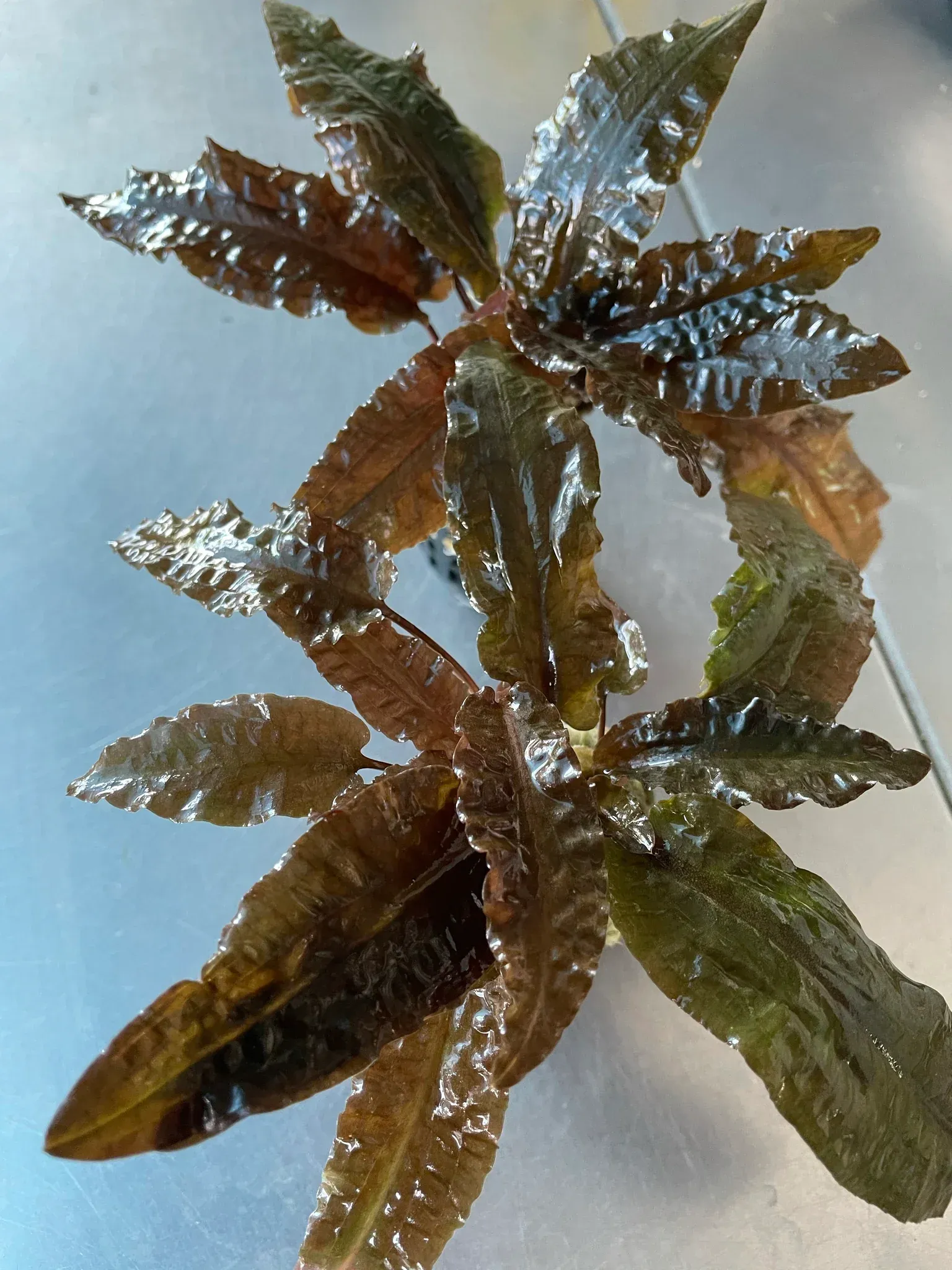
Why Is My Cryptocoryne Melting or Turning Brown? Causes and Fixes
A Cryptocoryne that turns brown, goes translucent, and collapses into mush overnight looks like your plant is dying — but in most cases it's not. This is a well-known stress response called "crypt melt," and it's usually recoverable if you leave the roots alone and stabilize the tank. Here's how to tell the difference between normal melt and a plant that's actually in trouble, plus a step-by-step recovery plan.
What Is Crypt Melt, Exactly?
Crypt melt describes the rapid softening, yellowing or browning, and eventual disintegration of Cryptocoryne leaves — sometimes within a matter of hours, more often over a day or two. Leaves can turn translucent, slimy, and stringy before falling apart entirely.
The phenomenon is old enough that hobbyists once nicknamed it "Cryptocoryne disease" or "Cryptocoryne rot," which makes it sound like an infection. It isn't. There's no pathogen involved, and it doesn't spread to other plant species in the tank. It's a stress and adjustment response, not an illness.
Why Crypt Melt Happens: The Root Causes
1. Emersed-to-Submersed Transition (the most common cause)
Most crypts sold commercially are farm-grown emersed — meaning they're raised in air, in humid greenhouse trays, not underwater. Their leaves develop a thinner cuticle and different internal structure suited to life in humid air. When you plant that same leaf fully underwater, it is structurally unequipped for submersion and predictably dies back within days to a couple of weeks.
This is the single most common reason a newly purchased crypt melts, and it has nothing to do with anything you did wrong.
2. Sudden Changes in an Established Tank
A crypt that has been growing happily for months can still melt if its environment shifts abruptly:
- Temperature swings
- pH or hardness changes
- A large water change
- A jump in CO2 injection
- Changed lighting intensity or photoperiod
- A new fertilizer or dosing routine
None of these need to be dramatic on their own — it's the suddenness that triggers the response.
3. Physical Disturbance
Uprooting, replanting, moving a crypt to a new spot in the tank, or having a digging fish or shrimp disturb the substrate around its roots can all trigger melt, even without any change in water chemistry.
4. Poor Water Quality
Ammonia or nitrite spikes, persistently high nitrate, chlorine or chloramine from an untreated top-off, or a sudden swing in organic bioload can all stress crypts into melting.
5. Nutrient Deficiency or Imbalance
Crypts are heavy root feeders. A shortage of nitrogen, potassium, or iron, or insufficient light or CO2 relative to the plant's needs, can bring on melt. Interestingly, the opposite can also trigger it — a sudden, large increase in fertilizer dosing can shock a plant just as easily as a deficiency.
6. Pests or Physical Damage
Less commonly, thrips or other pests, snail or shrimp grazing, or mechanical damage sustained during shipping can damage leaf tissue enough to trigger a melt-like collapse.
A Minor, Often-Overstated Factor: Allelopathy
Some plants and algae release chemicals into the water that can inhibit the growth of neighboring plants — a form of chemical competition called allelopathy. It's a real concept in planted-tank ecology, but it isn't a documented, specific cause of crypt melt. Treat it as background trivia, not something to troubleshoot for.
Melt Is a Survival Strategy, Not a Death Sentence
Here's the reassuring part: when a crypt melts, it's reabsorbing nutrients from its dying leaves and redirecting them into the root system to grow new leaves better adapted to your tank's current conditions. Melt is the plant resetting itself, not shutting down. As long as the rhizome and roots stay intact, this is a normal, if alarming-looking, transition.
Recovery Protocol: What to Do Right Now
- Do not uproot the plant. Leave the root and rhizome system undisturbed in the substrate. This is the single most important step.
- Trim off mushy or rotting leaf tissue close to the base. This prevents decaying matter from fouling the water and encouraging bacterial or fungal growth. Leave healthy-looking leaves alone — for compact species like Cryptocoryne parva, leaves are small enough that trimming usually isn't necessary or practical anyway.
- Stabilize everything else. Hold temperature, pH, lighting, and dosing steady. This is not the time for another water change overhaul, a new fertilizer, or a rescape.
- Keep up modest, routine water changes to manage ammonia and nitrate released by decaying tissue — but keep them small and consistent, not another drastic swing.
- Feed the roots. Since crypts are primarily root feeders, a nutrient-rich substrate or root tab fertilizer buried near the base gives the plant what it needs to rebuild.
- Be patient. Expect roughly 2 to 4 weeks for new, tank-adapted leaves to emerge from the crown. Some sources cite as little as two weeks, others up to five or six for slower species — give it a full month before you write the plant off.
Recovering vs. Actually Dying: How to Tell
| Sign | Recovering | Actually Dying |
|---|---|---|
| Rhizome/roots | Stay white or pale and firm to the touch | Turn soft, mushy, or smell foul |
| New growth | Small, pale shoots appear from the crown within a few weeks | No new growth after 4-6+ weeks |
| Anchoring | Roots hold the plant in the substrate | Whole plant lifts freely with no root mass |
| Leaf loss | Limited to older leaves; new ones eventually replace them | Ongoing collapse with nothing regrowing |
If the rhizome itself has gone soft or smells bad, that's true rot reaching the crown — at that point the plant likely won't recover. If everything below the substrate still feels firm, keep waiting.
Melt vs. Yellowing vs. Algae Decline: Three Different Problems
It's easy to lump every declining plant symptom together, but they call for different fixes:
- Melt — rapid, mushy, translucent leaf collapse tied to a transition or sudden change. Usually resolves on its own with stable conditions.
- Yellowing — a slower, chronic symptom, most often nitrogen or iron deficiency. Fix with root tabs, liquid iron, or a more complete fertilizer routine, not by waiting it out.
- Algae-covered decline — leaves get smothered by algae because light and nutrients are out of balance, letting algae outcompete the plant. Fix the light/nutrient balance first; trimming alone won't solve it.
Correctly diagnosing which of these three you're seeing saves a lot of wasted troubleshooting.
Why Plants Melt Right After Planting
If you just added a new crypt and it's melting within days, this is almost always the emersed-to-submersed adjustment described above — it's normal, not a sign you did something wrong. Give it a full 2-3 weeks minimum before assuming the plant has failed, and resist the urge to pull it up repeatedly to "check the roots." Every time you disturb the root system, you reset the recovery clock.
Emersed-Grown vs. Submersed-Grown: What to Look For When Buying
Understanding how a plant was grown helps set realistic expectations before you even plant it:
- Emersed-grown stock is raised in air/humid greenhouse conditions. It's cheaper to produce, ships hardier, and is often pest-free — but its leaves aren't built for full submersion and will predictably melt back after planting.
- Submersed-grown or tissue-culture stock has already adapted to life underwater, so it typically adjusts with less dramatic melt.
When shopping, submersed-grown or tissue-culture crypts are worth seeking out if you want to minimize melt on a new purchase. You can browse a range of stocked options in FishyHub's freshwater livestock selection when planning a planted setup.
Species Matters Too
Not all crypts melt equally. Hardier, more forgiving species like Cryptocoryne wendtii and Cryptocoryne parva tend to be less melt-prone than more demanding species such as C. nurii or C. pontederiifolia. If melt has been a recurring headache, starting with a hardier species can reduce how often you deal with it.
Prevention for New Plantings
- Choose submersed-grown or tissue-culture stock where available.
- Let a bagged or potted plant reach room temperature before planting — most aquarium plants don't need the formal drip acclimation that fish do, but this light-touch step helps pickier species.
- Plant promptly and avoid disturbing the plant once it's placed.
- Avoid planting into an uncycled or newly set up, unstable tank.
- Consider a brief dip (such as a diluted bleach or hydrogen peroxide dip, rinsed thoroughly) as an optional advanced step to remove pests or algae without adding parameter shock.
Prevention in Established Tanks
- Make water parameter changes gradually — favor small, frequent water changes over large, infrequent ones.
- Introduce new fertilizer or CO2 regimens incrementally rather than all at once.
- Watch liquid carbon/CO2 supplement dosing carefully — overdosing glutaraldehyde-based carbon products is a known trigger for melt-like leaf damage.
- Keep a consistent lighting schedule.
- Avoid moving or re-scaping crypts unnecessarily once they're settled. An undisturbed, established crypt becomes remarkably hardy over time.
Normal Leaf Turnover Isn't Melt
Even in a stable, well-run tank, older crypt leaves naturally age and get shed as new ones take over — this is ordinary leaf senescence, not pathological melt. If you're only losing the occasional oldest leaf while the plant otherwise looks healthy and keeps producing new growth, that's normal turnover, not something to fix.
Reviving a Tank After a "Plant Massacre"
If a plant-eating fish or a major dieback has wiped out a big chunk of your planted tank, resist the urge to panic-remove everything:
- Monitor closely for an ammonia spike from decaying plant matter and do extra water changes if needed.
- Feed the surviving plants immediately — root tabs or a liquid fertilizer — since starved plants need nutrients right away to rebound.
- Protect what's left from further grazing with denser planting or hardscape barriers between fish and vulnerable plants.
General Water Quality: The Foundation Under All of This
Poor water quality and algae blooms are common secondary planted-tank problems that stress crypts indirectly, even when they aren't the primary melt trigger. Keep ammonia and nitrite at zero and nitrate at a moderate level. A well-fed, healthy plant community outcompetes algae far more effectively than any single fix — which is also why stable root-feeding through the recovery period matters so much.
Crypt-Friendly Water Parameters (General Guidance)
There's no single universal number, but as a general target range for most common Cryptocoryne species in a US home aquarium:
| Parameter | General Range |
|---|---|
| Temperature | 72-82°F (22-28°C) |
| pH | 6.0-7.5 |
| Water hardness | Soft to moderately hard |
Treat these as a starting point for "stable," not a strict requirement — the priority is consistency, not hitting an exact number.
Common Mistakes That Turn Melt Into a Dead Plant
- Panicking and repeatedly uprooting the plant to inspect it — this is the single most common way to turn a recoverable melt into an actual death, since the roots need to stay undisturbed.
- Throwing the plant away at the first sign of melt without checking whether the rhizome and roots are still firm.
- Making another big change — a water change, new fertilizer, or rescape — while the plant is already mid-melt, compounding the stress.
- Leaving large amounts of decaying leaf matter in the tank, which can spike ammonia/nitrate or feed an algae bloom.
- Blaming "bad water" entirely when it's actually the normal emersed-to-submersed transition on a freshly purchased plant.
- Under-feeding the root zone — planting crypts in inert gravel with no root tabs or nutrient-rich substrate, leaving a stressed plant with nothing to rebuild leaves from.
- Placing new crypts under high light and CO2 that's mismatched to whatever conditions they were grown in before you bought them.
If you need to rebuild the root zone properly, a nutrient substrate or root tab fertilizer paired with a stable substrate setup gives a recovering crypt the fuel it needs.
Frequently Asked Questions
Is crypt melt going to kill my plant?
Usually no. As long as the roots and rhizome stay healthy and firm, expect regrowth within a few weeks. Only worry if the rhizome itself turns soft or nothing regrows after about a month.
Should I remove a melting crypt from the tank?
No — leave the roots planted and undisturbed. Only trim off leaf tissue that's clearly mushy or rotting above the substrate line.
How long does crypt melt last?
Typically 2 to 4 weeks from onset to visible new growth, depending on the species and how stable the tank is. Give it up to about a month before assuming the plant has failed.
Will crypt melt happen every time I buy a new plant?
Not necessarily. Submersed-grown or tissue-culture crypts melt less than field- or emersed-grown stock, and an established, undisturbed crypt rarely melts again once it's settled in.
Can I prevent crypt melt entirely?
Not always for a newly purchased plant transitioning between growing conditions — some melt-back is normal there. In an established tank, though, you can minimize or avoid melt by keeping parameters, lighting, and dosing stable and not disturbing planted crypts unnecessarily.
Is my crypt melting from disease or something contagious?
No. Despite the old nickname "Cryptocoryne disease," it isn't caused by a pathogen and it won't spread to other plant species in your tank. It's a stress and adjustment response, not an infection.
Why did my crypt melt after a big water change or rescape?
Sudden shifts in parameters, lighting, or physical disturbance are classic triggers for established-plant melt. Making smaller, more gradual changes going forward reduces how often this happens.
What should I feed a recovering crypt?
Root tab fertilizer or a nutrient-rich substrate, since crypts are primarily root feeders, along with stable lighting so the plant can photosynthesize while it regrows new leaves.
Crypt melt looks dramatic, but it's rarely the end of the plant — patience and a stable tank do most of the work. If you're planning a planted setup or adding tankmates that won't disturb your substrate, browse FishyHub's freshwater livestock category to find species that pair well with a recovering plant bed.


