
Why Is My Bucephalandra Melting or Turning Brown? Causes and Fixes
Watching bucephalandra leaves turn translucent, brown, or slimy is alarming, but it doesn't always mean the plant is dying. "Melt" has several distinct causes — from harmless transition stress after a new purchase to real water-quality or rhizome problems — and each one has a different fix. This guide walks through how to tell them apart and what to do about each.
What Bucephalandra Actually Needs
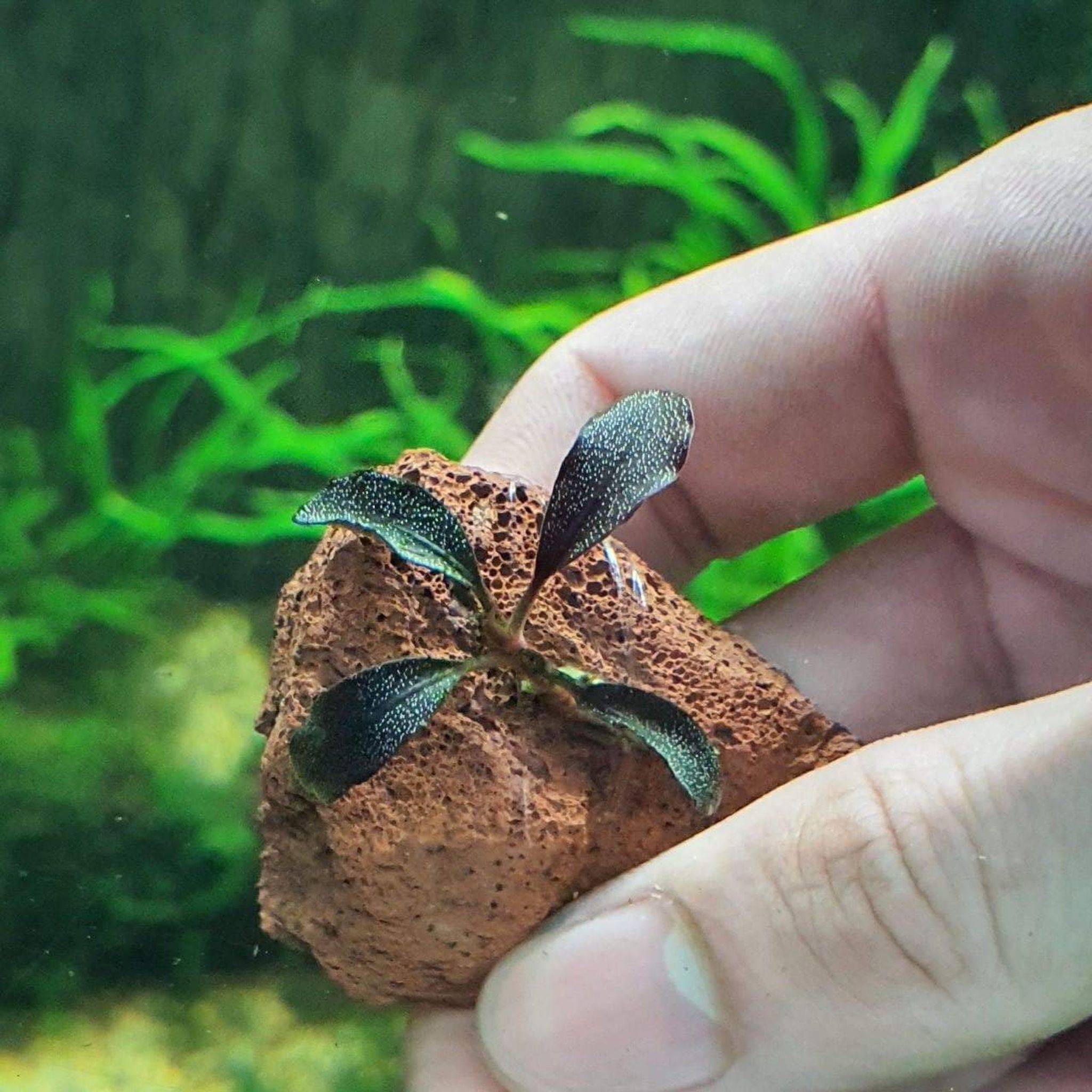
Bucephalandra ("buce") is a slow-growing, rhizomatous epiphyte native to Borneo's streams. Unlike stem plants or crypts, it doesn't grow in soil — it clings to hardscape with its roots while the rhizome itself sits exposed to water and light.
That structural quirk matters more than almost anything else in preventing melt:
- The rhizome must never be buried in substrate. It should rest on top of driftwood or rock, or be tied on with thread or fishing line, or attached with a small dab of cyanoacrylate ("super") glue.
- Only the fine roots that grow from the rhizome should reach into substrate or simply trail in the water column.
- Buce is adaptable on water chemistry, generally doing fine across roughly 68–82°F (20–28°C) and soft-to-moderately hard water with a mildly acidic to neutral pH. These are workable ranges, not rigid targets — the plant tolerates some variation as long as changes happen slowly.
Burying the rhizome is the single most common structural mistake, and it causes chronic rot even in an otherwise healthy, well-maintained tank.
What Melting Looks Like at Each Stage
"Melt" describes a progression, and knowing where a leaf sits on that progression tells you how urgent the situation is.
| Stage | Appearance | What it means |
|---|---|---|
| Translucent/glassy | Leaf looks thin, see-through, sometimes with a slight sheen | Early stress response; tissue is still alive |
| Yellow or brown edges | Discoloration starts at the margins or tip and spreads inward | Localized damage or advancing decline |
| Black or mushy patches | Leaf tissue turns dark and soft to the touch | Tissue is dead; won't recover |
| Detachment | Leaf separates from the rhizome or crumbles when touched | Fully lost; safe to remove |
A leaf can stall at any stage. One with yellow edges but a green center is still photosynthesizing and worth keeping; one that's gone black and mushy is not coming back.
New Plant vs. Established Plant: A Quick Decision Tree
Almost all buce melt falls into one of two buckets, and the fix is different for each.
Recently purchased (days to a few weeks in your tank)? This is very likely transition melt, and it's normal. Most buce sold commercially is farm-grown emersed (above water), and when it's submerged in an aquarium, the old emersed-form leaves often die back while new, thinner submerged-form leaves grow in from the rhizome. Add to that the stress of shipping — temperature swings, hours or days in a bag with rising ammonia, and physical bruising — and some leaf loss in the first one to two weeks is expected, not a red flag.
Established plant that was doing fine and is now declining? This points to a chronic issue: a change in water quality, light, CO2, flow, or an algae or physical-damage problem that needs to be diagnosed and corrected. Don't assume it will "melt through" on its own the way a new plant does.
Common Causes of Melting and Browning
Shipping and acclimation stress
New buce arrives having spent time in the dark, in fluctuating temperatures, with ammonia building up in bag water. Dumping it straight into different tank water compounds the shock. A slow drip acclimation over 30–60 minutes or more — rather than a straight drop-in — gives the plant time to adjust to your tank's temperature, pH, and hardness gradually.
New Tank Syndrome and water quality
An uncycled tank running ammonia or nitrite spikes stresses plants exactly like it stresses fish. Buce is sensitive to poor water quality generally, so if a previously stable plant suddenly starts browning, testing ammonia, nitrite, nitrate, GH/KH, and pH should be the first step — not guessing at a fix.
Sudden light changes
Buce genuinely tolerates a fairly wide light range, but it's the abruptness of a change that causes trouble, not the intensity itself. A plant used to low or moderate light that gets suddenly moved under intense lighting can bleach, brown, and develop algae cover before it dies back. Too little light for too long tends to cause slow yellowing and leggy growth instead — a milder, slower problem. Either way, introduce a new light schedule or intensity gradually, and give extra shade to plants moving into a brighter tank until they acclimate.
Abrupt CO2 or fertilizer changes
Buce doesn't require supplemental CO2 to survive, but a stable buce reacts poorly to sudden changes — switching a non-CO2 tank straight to injected CO2, or making a big jump in fertilizer dosing, can shock a plant that had otherwise settled in. If you want to add CO2 or increase dosing, ramp it up over days to weeks rather than switching all at once.
Physical damage
Bruised or torn leaf tissue — from shipping, handling during aquascaping, or grazing by fish, shrimp, or snails — turns brown and eventually melts at the damage site. Damaged tissue doesn't heal; it just dies back, so this shows up as isolated brown patches on otherwise healthy leaves rather than tank-wide decline.
Algae smothering
Because buce grows so slowly, algae has plenty of time to colonize its leaves before new growth can outpace it. Different algae types tend to point to different root causes:
- Black beard algae (BBA) often tracks with unstable CO2 or organic buildup and poor flow.
- Green spot algae is commonly tied to excess light relative to nutrients, or low phosphate.
- Diatoms frequently show up on newer setups or after a light change, often linked to silicates or an immature tank.
A slow-growing, stressed buce is more prone to algae in the first place, which then blocks light and accelerates leaf death — a feedback loop that's better broken by fixing the underlying trigger than by scrubbing leaves repeatedly.
Rhizome rot
If the rhizome itself — not just the leaves — turns soft, dark, and foul-smelling, that's bacterial or fungal rot. It's usually caused by the rhizome being buried, stagnant flow letting detritus settle around it, or an injury that became an infection point. This is more serious than leaf melt because it threatens the plant's only growth point.
Normal old-leaf shedding
Buce naturally drops its oldest leaves as new growth emerges from the rhizome tip. A few older leaves yellowing or browning while newer leaves stay green and firm is normal aging, not a systemic problem — and doesn't call for medicating or dosing changes.
Step-by-Step Rescue Protocol
- Test the water. Check ammonia, nitrite, nitrate, GH/KH, and pH, especially if a previously stable plant just started declining.
- Check the rhizome. Firm and light-colored (tan, cream, or greenish) means alive. Soft, dark, and mushy means rot — cut that section away.
- Trim dead tissue promptly. Fully brown, black, or mushy leaf material should come off right away since it fouls the water and can host bacteria. Leave any leaf that still has green tissue attached.
- Fix mounting and flow. Confirm the rhizome isn't buried, and improve circulation around it so detritus doesn't settle and encourage rot. A capable filter helps keep flow consistent across the tank — you can browse options in FishyHub's filters category.
- Adjust light and CO2 gradually, not all at once — resist the urge to crank up either "to help it grow" while it's already stressed.
- Address algae at its source rather than only removing it, matching the algae type to the likely trigger above.
- Wait and observe. Recovery is commonly a few weeks to a couple of months for new leaf spikes to appear, longer for a full patch to fill back in, since buce is naturally slow-growing.
Prevention Checklist for Future Purchases
- Use slow drip acclimation instead of a straight drop-in.
- Mount on hardscape correctly — rhizome exposed, roots only in substrate or water.
- Introduce sensitive plants to a stable, fully cycled tank rather than a brand-new setup.
- Consider a brief dip or quarantine period for new plants to reduce the odds of pests or algae hitchhiking in. A reliable water conditioner or treatment product, found in FishyHub's water condition and additives category, is worth having on hand for acclimation and general upkeep.
- Keep in mind that named cultivars and hybrids vary — some resilient "classic" buce types shrug off changes that would set back a more delicate cultivar.
Frequently Asked Questions
Is bucephalandra melt normal when I first buy it?
Yes, for new plants. Some leaf loss during the transition from emersed farm growth to submerged tank life is expected, and new leaves should appear within a few weeks as long as the rhizome stays firm.
How do I know if my buce is dead or just melting?
Check the rhizome. A firm, light-colored (tan, cream, or greenish) rhizome is alive and can regrow even after losing all its leaves. A soft, dark, mushy, foul-smelling rhizome is dead or rotting and should be cut away.
Should I remove all the melted leaves?
Cut off fully brown, black, or mushy leaf tissue promptly to keep it from fouling the water. Leave any leaf that still has some green tissue, since it's still contributing energy to the plant.
How long does it take buce to recover from melt?
Commonly a few weeks to a couple of months for new growth to appear, and considerably longer for a full mature patch to fill in, since bucephalandra is naturally very slow-growing.
Can I fix melting by adding more fertilizer or CO2?
Not directly, and it can backfire. Sudden changes to CO2 or fertilizer dosing are more likely to cause melt than cure it. Stabilize water quality and light first, then introduce nutrient or CO2 changes gradually.
Why is only part of my buce turning brown while the rest looks fine?
This is usually localized physical damage, algae growth on that specific leaf, or normal aging of the oldest leaves — not a tank-wide problem requiring a major intervention.
Does bucephalandra need CO2 and high light to survive?
No. It's a hardy, adaptable low-tech plant that survives fine without either. Moderate light and light CO2 can improve growth rate and coloration, but only when introduced gradually to an already-stable plant.
Can I save a bucephalandra that has lost all its leaves?
Yes, as long as the rhizome is still firm. Keep it attached to hardscape in stable conditions — submerged or even emersed — and wait for new leaf spikes to emerge from the rhizome, which can take roughly two to four weeks or more once conditions settle.
Ready to add buce or the gear to keep it stable? Browse tank essentials in FishyHub's filters category to get flow and water quality dialed in before introducing a new plant.


