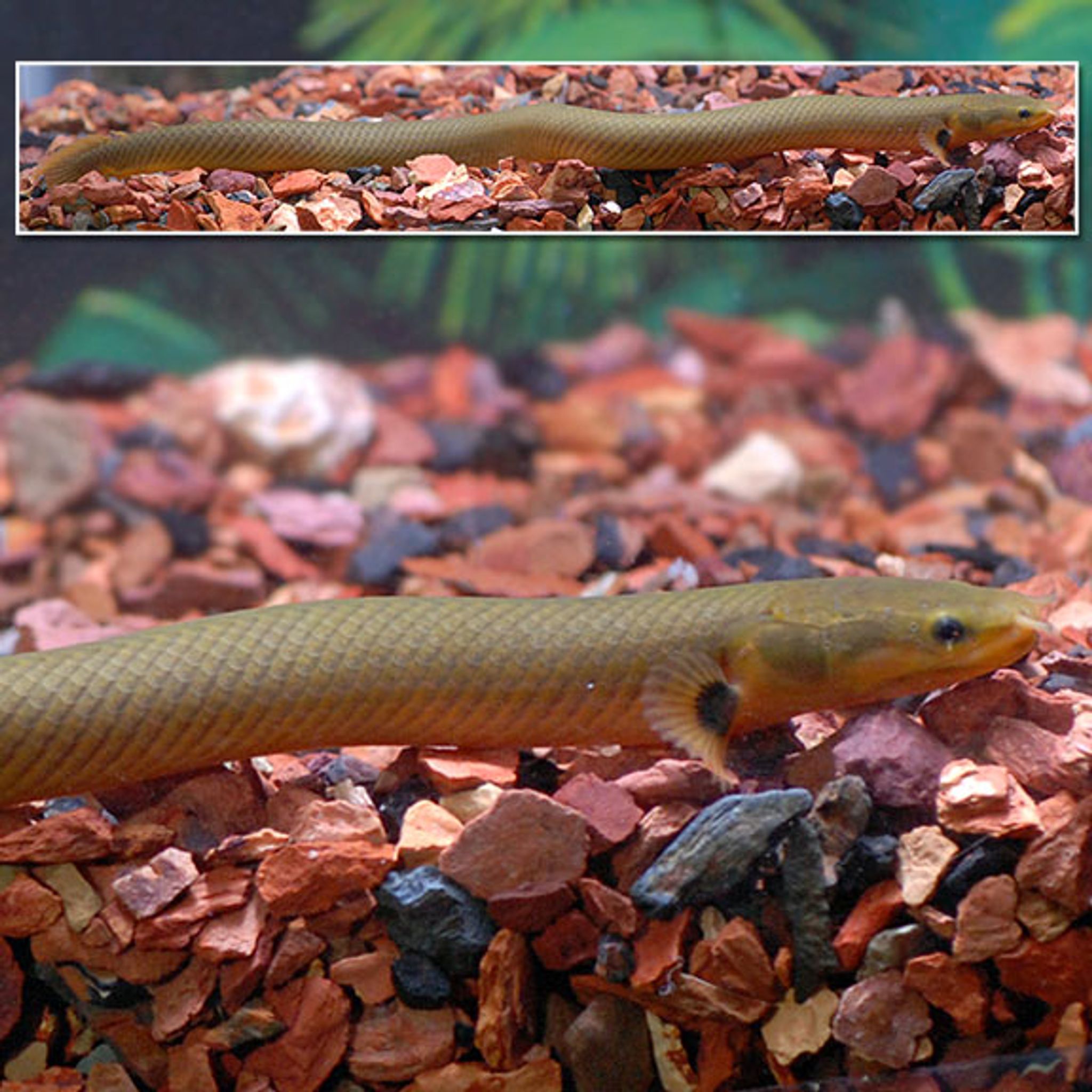

What Do Rope Fish Eat? A Practical Feeding Guide
Rope fish (also called reedfish) are obligate carnivores that hunt by smell, not sight, so getting their diet right takes a different playbook than most community fish. This guide covers exactly what to feed them at every life stage, how often, and how to work around their slow, nocturnal feeding style so they thrive across a 15- to 20-year lifespan.
What Rope Fish Eat in the Wild
In their native range, rope fish live in slow-moving, vegetated, oxygen-poor waters across West Africa. Because these habitats are often low in dissolved oxygen, rope fish have developed a lung-like modified swim bladder that lets them gulp air at the surface — a trait that shapes how you should set up their tank as much as how you feed them.
In the wild, their diet consists of:
- Small crustaceans
- Aquatic insects and insect larvae
- Worms
- Small fish, taken opportunistically rather than as a primary target
This background matters for feeding at home. Rope fish are ambush, scent-based hunters, not sight hunters. They rely on smell to find prey in murky, cluttered water, which is why they respond so strongly to strong-smelling foods like bloodworms and why they often seem "slow" to notice food that a sight-feeder would snap up instantly. A tank with cover, calm flow, and a secure lid supports this natural foraging style and reduces stress at feeding time.
Best Foods for Rope Fish
As obligate carnivores, rope fish need animal protein at every meal. The most reliable staples are:
- Frozen or live bloodworms — usually the easiest first food and a strong scent cue
- Frozen or live brine shrimp
- Mysis shrimp
- Chopped or whole prawns, sized to the fish
- Earthworms and night crawlers
- Mosquito larvae
Small pieces of chopped fish or lean meat can be offered occasionally, but mammalian meat like beef heart deserves a caveat. It's sometimes listed as a good protein source, but it's poorly suited as a staple for any fish — it's high in fat relative to what fish can efficiently digest, and it lacks the nutrient balance of aquatic prey. Treat it, at most, as an occasional extra rather than a regular menu item, and lean on aquatic-origin proteins instead.
Are Pellets and Flakes an Option?
Flakes are a poor fit. Rope fish rarely recognize them as food at all, and even when accepted, flakes offer weak nutrition for a dedicated carnivore.
Sinking carnivore pellets are a realistic option with patience. Use BB-sized pellets for juveniles and larger, dime-sized "massivore"-type pellets for adults. Because rope fish hunt by scent, a brand-new pellet often gets ignored simply because it doesn't smell like prey. To transition:
- Soak pellets in bloodworm juice or the water thawed bloodworms sat in.
- Gradually reduce the proportion of bloodworms mixed in over several feedings.
- Feed at the same time and same spot in the tank to build a routine.
- Skipping a single feeding occasionally can increase a fish's willingness to try something new — but never withhold food for an extended stretch to force the issue.
You can browse a range of sinking and freeze-dried foods suited to bottom-feeding carnivores when building out a rotation.
How Often and How Much to Feed
Feeding frequency and portion size should scale with the fish's age, metabolism, and body condition rather than a single fixed rule.
| Life stage | Size | Feeding frequency | Food size |
|---|---|---|---|
| Juvenile | ~2–6 in (5–15 cm) | Once or twice daily | Chopped bloodworms, baby brine shrimp, BB-sized pellets |
| Sub-adult | ~6–10 in (15–25 cm) | Daily | Whole bloodworm cubes, mysis shrimp, small prawns |
| Adult | 12–20 in (30–51 cm) | Every day to every other day (roughly 3–5x/week) | Whole prawns, night crawlers, dime-sized pellets |
Juveniles grow quickly and carry little fat reserve, so they benefit from more frequent, smaller meals. Adults have a slow metabolism and are prone to obesity and fatty buildup if overfed, so tapering toward every other day for older, more sedentary specimens is often the better long-term call.
Rather than following a rigid schedule, watch body condition: a healthy rope fish should show a gently rounded body along its length, without a pinched, sunken belly or visible fat deposits bulging behind the head. If you notice fat accumulating, cut back frequency or portion size before it becomes a chronic problem. For portions, offer only what's eaten within a couple of minutes — for an adult, that's often just 2–4 pieces of shrimp or a bloodworm cube-equivalent per feeding. It's better to underfeed slightly than to overfeed, given how slowly these fish burn through calories.
Feeding Technique: Working With a Scent Hunter
Rope fish are slow, deliberate feeders. They don't strike at movement the way a sight-hunting predator does — they locate food by drifting close and detecting it by smell. A few practical adjustments make a real difference:
- Use feeding tongs or a turkey baster/length of PVC tube to place food directly near the fish's snout or in its favorite hiding spot.
- In community tanks, faster tankmates will often out-compete a rope fish that's still working out where the food is. Spot-feed the rope fish separately, or briefly reduce flow so scent trails settle instead of dispersing.
- Feed at dusk or right before tank lights go off to match natural nocturnal behavior, especially for new or shy individuals. Many keepers do successfully condition rope fish to eat on a daytime schedule — either approach works long-term as long as it's consistent.
Variety Beats a Bloodworm-Only Diet
Bloodworms are an excellent starter food, but relying on them exclusively, day after day, is nutritionally unbalanced — roughly the equivalent of a person eating only one rich food source at every meal. Rotate between two or three protein sources (for example, bloodworms, mysis shrimp, and prawns or earthworms) to avoid contributing to constipation or fatty liver buildup over time. Occasionally soaking live or frozen foods in a vitamin supplement before feeding is a simple way to add nutritional insurance, particularly for fish eating a narrow rotation.
Tank Mate and Feeding Safety
Rope fish will eat any tankmate small enough to fit in their mouth — this is normal predatory behavior, not a sign of aggression or a starved fish acting out of character. Keep this in mind when stocking:
- Pair rope fish only with medium-to-large, non-aggressive fish that won't be viewed as prey and won't outcompete them for food.
- Avoid shrimp and snails as permanent tankmates unless you're intentionally offering them as food.
- A community of fast, food-competitive fish can leave a rope fish underfed even when plenty of food goes into the tank — scent-based foraging is simply slower than sight-based grabbing.
Common Feeding Problems and Troubleshooting
| Problem | Likely cause | What to do |
|---|---|---|
| "Won't eat" after being new to the tank | Stress from transport or a new environment | Usually resolves within days to two weeks; keep water quality stable and try evening feeding |
| Appears to ignore food nearby | Locates food by smell, not sight | Move food closer to the snout or a favorite hideout; give it time before assuming refusal |
| Constipation | All-bloodworm or all-meat diet | Rotate proteins; reduce meat/beef-type foods to occasional treats |
| Obesity, visible fat along the body | Overfeeding relative to slow metabolism | Cut back to every other day; reassess portion size |
| Tankmates disappearing | Normal predatory feeding behavior | Restock with appropriately sized, non-prey species |
| Losing out on food in a community tank | Faster fish out-competing by sight | Spot-feed with tongs or a tube; reduce flow at feeding time |
A rope fish that eats slowly and deliberately, picking at food in an unhurried way, is usually behaving normally rather than showing signs of illness — that hesitant style is simply how a scent hunter operates, not a red flag on its own.
Frequently Asked Questions
Can rope fish eat flakes or pellets?
Rarely as a sole diet. Flakes generally aren't recognized as food at all, while carnivore-formulated sinking pellets can work well once a fish is gradually trained onto them, usually by soaking pellets in bloodworm juice at first.
How often should I feed my rope fish?
Juveniles do best fed once or twice a day, while adults typically do well on a schedule ranging from once daily to every other day. Adjust based on body condition and activity level rather than sticking to a fixed rule.
Why won't my rope fish eat?
The most common causes are stress after a move or new tank setup, food placed too far from its snout for it to detect by scent, or an unfamiliar food it doesn't recognize as edible. Try frozen or live bloodworms placed near cover, ideally during an evening feeding.
Do rope fish eat other fish in the tank?
Yes. Any tankmate small enough to fit in its mouth is fair game as part of normal hunting instinct, not because it's hungry or aggressive specifically toward that fish. Stock accordingly with appropriately sized companions.
Can I feed rope fish live food?
Yes — live brine shrimp, earthworms, and small feeder shrimp are readily taken and can help stimulate a reluctant eater. Live feeder fish aren't necessary and carry a disease risk, so they're best avoided in favor of the safer live options above.
How much should I feed at each meal?
Offer only what's eaten within a couple of minutes — often just a few pieces of shrimp or a bloodworm-cube equivalent for an adult. Given their slow metabolism, overfeeding is a bigger long-term risk than underfeeding.
For live rope fish and other freshwater oddballs suited to a similar carnivore diet, browse bottom-dwelling species and stock up on feeding essentials in the Food & Supplements category on FishyHub.


