
What Do Platy Eat? A Practical Feeding Guide
Platies eat a mix of high-quality flake or pellet food, occasional live or frozen protein, and blanched vegetables — they are unfussy omnivores that thrive on variety rather than one single food. This guide breaks down exactly how much to feed, how often, and what to reach for on a normal week, plus what to do when a platy suddenly stops eating.
Why Platies Are Easy to Feed
Platies rank among the least fussy community fish a US hobbyist can keep. In the wild they graze almost constantly on algae, biofilm, small invertebrates, and plant matter, so their digestive systems are built to handle a broad, plant-leaning diet. That background is exactly why a varied, mostly plant-forward diet works better long-term than a protein-heavy one, and why overfeeding — not underfeeding — is the mistake that actually causes problems.
This adaptability also makes platies forgiving of a missed feeding or a slightly imperfect schedule, which is good news for anyone new to fishkeeping.
The Staple Diet: What to Feed Every Day
The foundation of a platy's diet should be a high-quality flake or micro-pellet food formulated for tropical community fish. Look for a formula that lists some vegetable matter or spirulina among the first few ingredients — this mirrors the algae grazing platies naturally do and supports color and digestion.
Shopping-list translation — when you're standing in front of a shelf of options, these are the actual categories to look for:
| Food type | Best use | How often |
|---|---|---|
| Flake or micro-pellet (community formula) | Daily staple | 2x/day |
| Freeze-dried brine shrimp or bloodworms | Protein variety, color | 1–3x/week |
| Frozen cubes (brine shrimp, daphnia, bloodworms) | Protein variety, breeding conditioning | 1–3x/week |
| Algae wafer or bottom-feeder pellet | Grazing supplement, especially low-algae tanks | 2–3x/week |
| Blanched vegetables (zucchini, cucumber, peas, spinach) | Fiber, micronutrients | 3–4x/week |
You can browse flake, pellet, and freeze-dried options in FishyHub's freeze-dried food selection or the broader food and supplements category to build out a rotation rather than relying on a single product.
The Portion Rule
The simplest way to avoid overfeeding is to use two rules together:
- Eye-size rule: offer roughly an amount of food equal to the size of one platy's eye, per fish, per feeding.
- Two-to-three-minute rule: whatever isn't eaten within 2–3 minutes was too much — reduce the next feeding.
If you're feeding a group, it's easier to judge by the clock than by counting flakes. Watch the fish, not the container.
How Often to Feed Platies
Adult platies do best on two feedings per day, spaced several hours apart (for example, morning and early evening). This is the standard most hobbyists and care sheets converge on, including for common color varieties.
Growing juveniles and fry are the exception. Because they're building tissue quickly and have tiny stomachs, fry and juveniles benefit from 3–4 smaller feedings per day rather than two larger ones. The food itself also needs to change with age:
| Life stage | Food size | Feedings/day |
|---|---|---|
| Fry (newly born) | Crushed flake, powdered fry food, baby brine shrimp, infusoria | 3–4 |
| Juvenile (growing) | Small flake or micro-pellet | 2–3 |
| Adult | Standard flake or pellet | 2 |
Standard adult flake is simply too large for a newborn platy fry to eat — this is one of the most common beginner mistakes, and it can quietly starve fry even while adults look well fed.
Build in a Fasting Day
Skipping food entirely one day per week (or at minimum once every couple of weeks) is common professional advice for livebearers like platies. A fast day gives the digestive system a break and helps prevent the bloating and constipation that come from constant feeding. It won't harm a healthy adult platy — established tanks almost always have enough algae and biofilm to graze on in the meantime.
A Simple Weekly Feeding Plan
Here's a plan a beginner can follow without overthinking it:
| Day | Morning | Evening |
|---|---|---|
| Monday | Flake/pellet | Flake/pellet |
| Tuesday | Flake/pellet | Frozen or freeze-dried brine shrimp |
| Wednesday | Flake/pellet | Blanched veggie (zucchini or cucumber) |
| Thursday | Flake/pellet | Flake/pellet |
| Friday | Flake/pellet | Daphnia or bloodworms |
| Saturday | Flake/pellet | Blanched veggie (peas or spinach) |
| Sunday | Fast day | Fast day |
Adjust the exact mix to what you have on hand — the goal is variety across the week, not a rigid formula.
Vegetables: Not Optional Filler
Vegetable matter isn't a treat for platies — it's a core part of a diet that mimics their natural grazing habits. Good regular options, always blanched (briefly softened in hot water) before offering:
- Zucchini — a nutrient-dense regular, easy to slice and clip.
- Cucumber — similar profile, softens quickly, widely available.
- Peas — shell and cook first; good fiber source, useful for digestive issues.
- Spinach — nutrient-rich but should still be rotated with other veggies.
Use a veggie clip or a weighted holder to keep pieces from drifting into the filter intake, and remove anything uneaten within 12–24 hours — leftover vegetable matter fouls the water fast.
Can Platies Eat Lettuce?
Yes, in moderation. Soft-leaf types like green leaf or butterhead work best; tougher leaves should be blanched first. Lettuce does supply real nutrients — vitamins A, C, and K, potassium, and fiber that supports digestion — but it's best treated as a supplemental, occasional veggie rather than a dietary cornerstone. Zucchini, cucumber, and peas are the more nutrient-dense regulars to build a routine around.
What Else Can Platies Eat?
Beyond dedicated fish food, a few human-food-adjacent options are safe in tiny amounts:
- Blanched zucchini, cucumber, peas, spinach, lettuce (as above)
- A very small amount of boiled egg yolk, occasionally
- A pinch of cooked, plain rice
Avoid: bread, seasoned or oily human food, and anything sugary. These offer little nutrition, break down poorly in water, and can foul a tank quickly.
Live and Frozen Protein for Variety
While not required, live or frozen protein 1–3 times per week noticeably improves color, activity, and breeding condition. Good options include:
- Brine shrimp
- Daphnia
- Bloodworms
- Microworms (especially useful for fry)
DIY Daphnia Culturing (Optional)
For hobbyists who want a sustainable live-food source, daphnia is a beginner-friendly culture to start at home:
- Set up a shallow container of dechlorinated water, roughly 68°F (20°C).
- Add duckweed or a few small plants for cover and grazing surface.
- Feed a diluted yeast-water mix sparingly — overfeeding the culture crashes it.
- Keep a light on to concentrate daphnia near the surface for easier harvesting.
- Harvest with a fine mesh net as needed, and top off water as it evaporates.
This is a nice-to-have, not a requirement — plenty of platy keepers never culture their own food and do fine with frozen or freeze-dried options.
Algae Wafers and Bottom Feeding
Platies do spend time picking at surfaces, so an occasional algae wafer or bottom-feeder pellet helps in tanks that don't have much natural algae or biofilm. It's a supplement to the staple diet, not a replacement — a couple of times a week is plenty.
Common Feeding Mistakes
Overfeeding is the single most common platy problem, and it's also the number one cause of poor water quality in a platy tank. Excess food breaks down into ammonia, and the fish themselves can develop bloating, constipation, or swim bladder issues from eating too much. The fix is straightforward: stick to the 2–3 minute rule, siphon out anything uneaten, and keep a weekly fast day.
Other mistakes to watch for:
- Flakes only, no variety — leads to dull coloration and nutritional gaps over time. Rotate in live/frozen food and veggies.
- Leaving vegetables or live food in too long — fouls the water within a day. Remove within 12–24 hours.
- Wrong food size for fry — adult flake is too large for newborns; crush it or use dedicated fry food.
- Skipping water changes — feeding and water quality are linked; regular partial water changes should pair with any feeding routine, especially in tanks under about 10 gallons (38 L).
Platies generally do best at 70–77°F (21–25°C) and a pH of about 6.8–8.5, in tanks of 10 gallons or more. Stable water quality makes every feeding decision easier, since a stressed fish in poor water often stops eating regardless of what's offered.
When a Platy Won't Eat
Platies are rarely picky, so a sudden loss of appetite is usually a signal, not a preference. Check in this order:
- Water parameters — test for ammonia and nitrite spikes first; these suppress appetite quickly.
- Stress — aggressive tankmates, overcrowding, or a recent move/transport can all cause temporary refusal to eat.
- Illness — look for other symptoms (clamped fins, unusual coloring, lethargy) alongside the lack of appetite.
Address the underlying cause rather than trying different foods — a healthy platy in clean water will eat almost anything offered.
How Long Can Platies Go Without Food?
Healthy adult platies in an established tank can typically survive up to about a week without feeding, grazing on algae and biofilm in the meantime. That said, this isn't something to rely on routinely:
- 2–3 days: fine to leave unsupervised for a short trip.
- Longer absences: use an automatic feeder or arrange for a fish-sitter rather than assuming the tank will hold.
Marigold Platies and Other Varieties
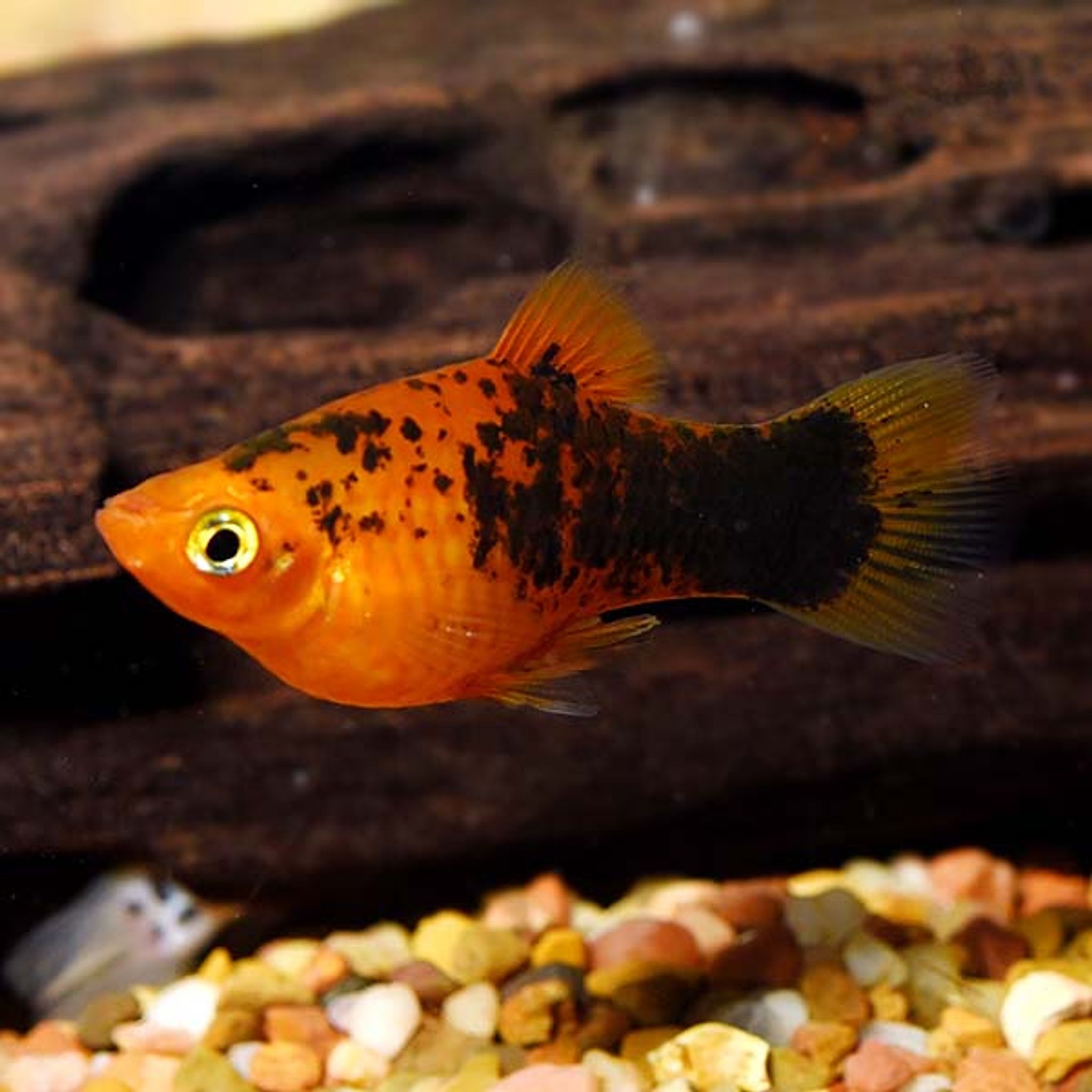
The marigold platy — a popular gold, yellow, or orange color variety — has identical feeding needs to any other platy. Color pattern (marigold, mickey mouse, tuxedo, wagtail, and others) has no bearing on diet; every variety benefits from the same staple-plus-variety approach outlined above.
A Note on Guppies and Other Livebearers
Platies are frequently kept alongside guppies, and the two share a lot of care overlap worth knowing:
- Guppies are similarly hardy, colorful, easy breeders, and good beginner community fish — the appeal parallels platies closely, and you can compare options in FishyHub's guppy selection alongside the platy selection.
- Guppy "types" are generally categorized by fin shape and color/pattern strain, and some uncommon fin and pattern strains exist — similar to how platies are grouped by pattern.
- Like platies, guppies are livebearers: males fertilize females internally via a modified anal fin called a gonopodium — worth stating plainly, since some hobby write-ups mistakenly describe external fertilization. Females can store sperm and produce multiple broods (typically 20–30 fry) from a single mating. Fry need immediate separation from adults, who will eat them, and fine foods like baby brine shrimp or crushed flake — the same fry-feeding approach used for platies.
- Livebearers including mollies (and occasionally platies and guppies) can develop a "shimmy" — a distinctive side-to-side rocking motion without forward movement, different from erratic darting. It's usually caused by temperature stress, poor water parameters, or a bacterial/parasitic issue. Raise and stabilize temperature into the mid-to-high 70s°F to low 80s°F (roughly 24–28°C), do a water change, check ammonia and nitrite, and consider a mild aquarium salt treatment or quarantine if symptoms persist.
Frequently Asked Questions
How often should I feed my platies?
Feed adults twice a day, offering only what they clear in 2–3 minutes. Fry and growing juveniles need more frequent, smaller feedings — 3–4 times a day — and adding one fasting day per week helps prevent overfeeding.
What is the best staple food for platies?
A quality flake or small pellet formulated for tropical community omnivores works best, ideally one that includes some plant or spirulina content to mirror the algae grazing platies do naturally.
Can platies eat vegetables?
Yes — blanched zucchini, cucumber, peas, spinach, and soft lettuce are all safe in moderation. Remove any uneaten vegetable matter within about a day so it doesn't foul the water.
Do platies need live or frozen food?
It's not required, but brine shrimp, daphnia, or bloodworms offered 1–3 times a week noticeably improve color, health, and breeding condition compared to a flake-only diet.
How long can platies go without food?
Healthy adults in an established tank can typically go up to about a week, grazing on algae and biofilm. Short trips of 2–3 days are fine unsupervised, but longer absences call for an automatic feeder or a fish-sitter.
Why isn't my platy eating?
Loss of appetite is usually a water quality or stress/illness issue rather than pickiness. Test ammonia and nitrite first, then check for aggressive tankmates, recent transport stress, or signs of illness.
Can I culture my own live food for platies?
Yes — daphnia is a beginner-friendly option. A shallow container of dechlorinated water around 68°F (20°C), a mild yeast-water feeding, and a light to concentrate the culture near the surface for harvesting is enough to get started.
What foods should I avoid feeding platies?
Skip bread, sugary or seasoned human food, and diets that are protein-only with no vegetable matter. Also avoid letting any food — flake, veggie, or live — sit uneaten in the tank, since it breaks down and fouls the water.
Ready to build out a feeding rotation or add a few platies to an existing community tank? Browse platies and other easy-care livebearers in FishyHub's small community fishes category.


