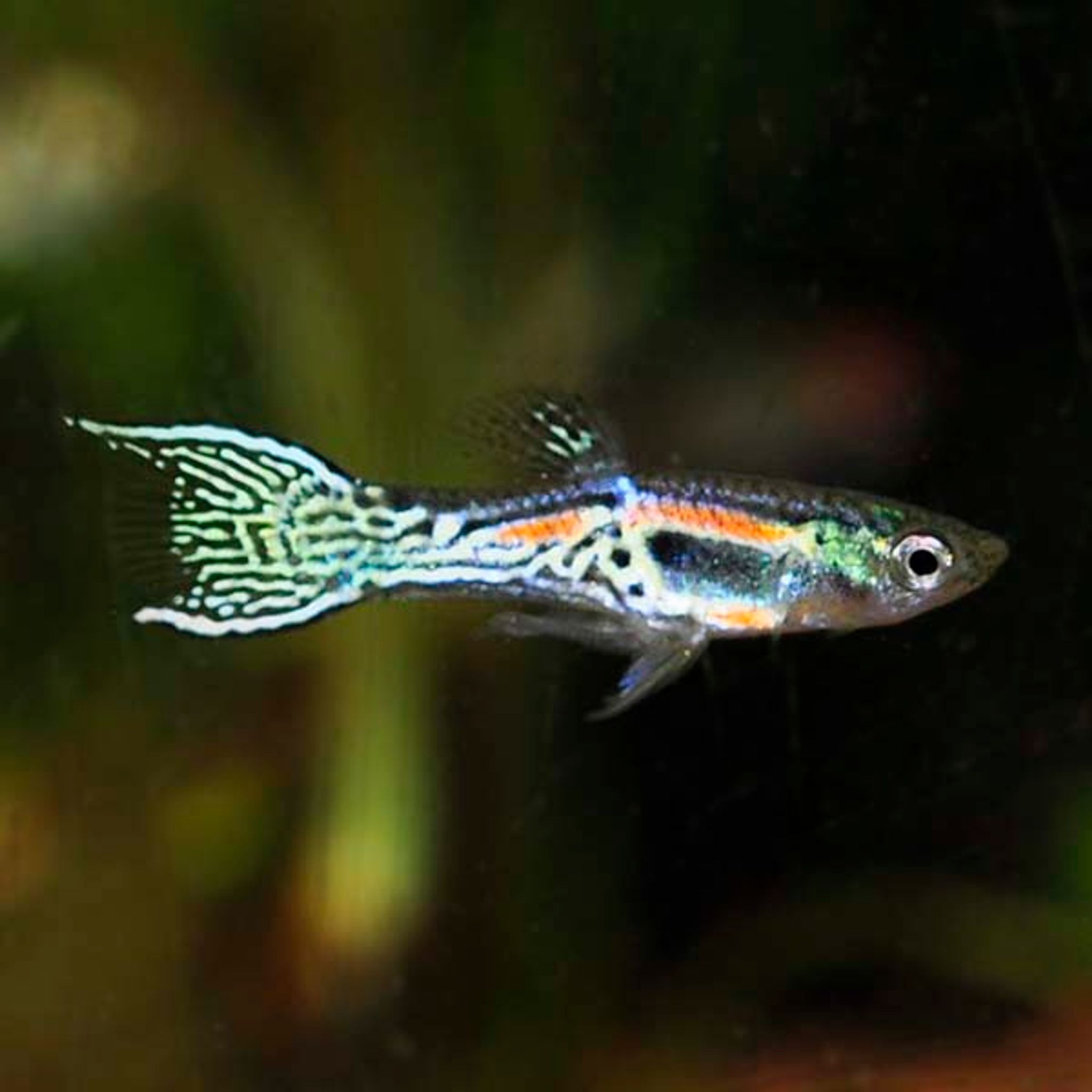

What Do Endler's Livebearer Eat? A Practical Feeding Guide
Endler's livebearers eat a mix of small formulated foods, occasional live or frozen protein, and grazed algae and biofilm, mirroring their wild diet as tiny omnivorous micro-predators. This guide lays out a copy-ready daily and weekly routine, a fry-feeding ladder, and fixes for the most common feeding mistakes in the 5–10 gallon (19–38 L) tanks most Endler's keepers use.
What Endler's Livebearers Eat in the Wild
In their native Venezuelan waters, Endler's livebearers graze almost constantly on algae and biofilm coating rocks and plants, while also picking off small insect larvae and zooplankton drifting in the water column. This dual role as grazer and micro-predator is why a single dry food, fed the same way every day, rarely produces the best color or condition. A captive diet that rotates plant matter with small protein sources comes closest to matching that natural pattern.
The Staple Diet: Daily Foods
A high-quality micro pellet or crushed flake formulated for tropical fish should make up most of an Endler's diet. Their mouths are tiny, so standard-sized flake needs to be crushed between your fingers before it goes in the tank; a purpose-made micro pellet skips that step entirely.
Protein target: look for a staple in the roughly 35–45% crude protein range. That's appropriate for a small omnivore — enough to support growth and color without the fat buildup that comes from feeding a high-protein carnivore formula meant for larger predatory fish long-term.
Reading a Fish Food Label (Basic Version)
You don't need a fisheries degree to shop smart. Focus on three numbers on the guaranteed analysis panel:
| Nutrient | What to look for | Why it matters for Endler's |
|---|---|---|
| Crude protein | ~35–45% | Supports growth and color; much higher is unnecessary for a small omnivore |
| Crude fat | Low-to-moderate, generally under 10% | Excess fat contributes to obesity and fatty deposits over time |
| Crude fiber | A few percent, higher if spirulina/algae is listed | Aids digestion; important since Endler's graze plant matter naturally |
Ingredient order matters too — a fish meal or shrimp meal listed near the top signals a protein-forward formula, while a spirulina or algae meal near the top signals a more plant-forward one. Rotating between the two types covers both sides of an Endler's omnivorous diet.
Adding Variety: Frozen, Freeze-Dried, and Vegetable Foods
Once the staple is established, build in variety a few times a week:
- Frozen or freeze-dried baby brine shrimp and daphnia — good protein sources, gentle on digestion, and widely available.
- Bloodworms — fine as an occasional treat, but not a staple; the fat and chitin content make them a poor everyday food for a fish this small.
- Blanched spirulina flake or algae wafer crumbs — covers the plant-grazing side of their diet and supports color.
A freeze-dried food rotated in two or three times a week is an easy way to add this variety without maintaining a live culture.
A Simple Weekly Rotation
| Day | Food |
|---|---|
| Mon / Wed / Fri | Staple micro pellet or crushed flake |
| Tue / Thu | Frozen or freeze-dried baby brine shrimp or daphnia |
| Sat | Blanched spirulina flake or algae wafer crumb |
| Sun | Staple, or live food if culturing one |
This isn't a rigid rule — it's a template you can copy directly and adjust based on what you're culturing or have on hand.
Do Endler's Livebearers Need Live Food?
Not strictly. A good staple pellet or flake alone is enough to keep adult Endler's healthy. Where live food earns its place is in enhanced color, vigor, and breeding conditioning — it's a boost, not a requirement. If culturing live food isn't practical for you, a rotation of dry staple plus frozen/freeze-dried variety will keep a colony thriving.
Live Foods Overview
For keepers who do want to culture something, here's how the common options compare:
| Live food | Best for | Effort to culture |
|---|---|---|
| Baby brine shrimp | Fry (after ~1–2 weeks) and adults | Moderate — needs hatching setup, done in batches every 1–2 days |
| Microworms | Newly free-swimming fry | Low — simplest culture to start and maintain |
| Daphnia | Adults and larger fry | Moderate — needs a separate container and green water or yeast feed |
| Vinegar eels | Very small fry, alternative to microworms | Low-to-moderate — slower to establish but long-lived once going |
| Infusoria | Newborn fry with the smallest mouths | Low effort, but slow to develop (several days to a week) |
Microworms and infusoria are the two most beginner-friendly options and the ones most relevant to a first breeding project.
Culturing Microworms (Step by Step)
Microworms are the easiest live food to start, which is why they're the default answer for "what do I feed the fry" once the first batch of babies shows up.
- Container: a small shallow plastic container with a loose-fitting lid (not airtight — the culture needs some air exchange).
- Medium: a mashed-potato or oatmeal paste, moistened but not soupy, spread about half an inch (1.25 cm) deep.
- Starter culture: add a small amount of live microworm starter to the medium and cover loosely.
- Wait: within a few days, worms will climb the sides of the container above the medium line.
- Harvest: wipe the inside wall with a clean finger or a small brush and rinse into the tank, or swirl a small amount of dechlorinated water inside to collect worms floating at the surface.
- Feeding rate: add small amounts often — microworms only survive 8–12 hours in tank water, so little-and-frequent beats one large dose.
Microworms are not nutritionally complete on their own. Combine them with baby brine shrimp or powdered fry food rather than relying on them exclusively — sole reliance has been linked to deformities in fry from nutrient gaps.
Culturing Infusoria for the Smallest Fry
Infusoria is sized for the very first days of a fry's life, when even microworms are too large. To culture it:
- Fill a jar with tank water and add a small amount of decaying plant matter or a pinch of hay.
- Let it sit undisturbed for several days to a week; the water will cloud slightly as microorganisms bloom.
- Add a small amount to the fry tank using a dropper or turkey baster, aiming near the fry rather than dumping it in one spot.
- A single culture is usable for a few weeks before it needs refreshing.
Use infusoria for the first several days after fry are born, then transition toward microworms and baby brine shrimp as the fry grow large enough to eat them.
The Fry Feeding Ladder
Endler's fry have tiny stomachs and need food matched to their size at every stage:
| Fry age/size | Food | Feedings per day |
|---|---|---|
| First few days (newborn) | Infusoria, green water, or a liquid/powdered fry food (5–100 micron range) | 3–5 |
| ~1–2 weeks | Baby brine shrimp and/or microworms | 3–5 |
| 3+ weeks | Crushed flake, micro pellet, baby brine shrimp | 2–3, tapering toward the adult schedule |
Feed fry 3–5 small meals a day rather than one or two large ones — their stomach capacity is tiny, and inconsistent feeding is the most common cause of uneven growth within a single batch.
How Often and How Much to Feed Adults
For adult Endler's, once or twice a day, in an amount they finish in about 2 minutes, is the standard recommendation. Twice daily suits most setups; once daily is acceptable for lightly stocked tanks or older fish that are less active.
Because most Endler's live in 5–10 gallon (19–38 L) tanks, portion sizing matters more than it would in a large community tank. A pinch that looks trivial in a 55-gallon tank can be a serious overfeed in a 5-gallon one. As a rule of thumb, aim for a light dusting across a few square inches of surface — visible food that's still floating after 2 minutes is too much. You can browse guppies and related livebearers if you're building out or restocking a small community alongside your Endler's.
Water quality connection: uneaten food is the single most common cause of ammonia spikes in small Endler's setups. Feed conservatively and siphon out any visible leftovers after a few minutes rather than trusting the fish to finish it.
Conditioning Adults for Breeding
Endler's breed continuously in mixed-sex groups, so if you keep both sexes together, you're already running a breeding colony whether you intended to or not. To condition adults ahead of an intentional breeding push:
- Increase feeding frequency slightly.
- Raise the ratio of live or frozen protein — daily baby brine shrimp or daphnia — for 1–2 weeks before you want females to be in top breeding condition.
- Well-conditioned females tend to produce larger, healthier fry batches.
Gestation runs roughly 3–4 weeks, and because breeding is continuous in mixed groups, plan your fry-food supply (infusoria, microworms, powdered fry food) as an ongoing routine rather than a one-time setup. Dense floating plants or a dedicated breeder box also help fry survive their first days, since adults and other tankmates will eat fry given the chance.
Common Feeding Mistakes and Fixes
| Mistake | Fix |
|---|---|
| Overfeeding | Feed only what's eaten in ~2 minutes; siphon out leftovers |
| Dry food only, no variety, long-term | Rotate in frozen or live foods weekly for color and nutrition |
| Relying solely on microworms for fry | Mix in baby brine shrimp, infusoria, or powdered fry food |
| Fry starving in a community tank | Use a breeder box or heavily planted grow-out area, and target fry food directly there |
| Uneven fry growth | Switch to 3–5 small feedings a day instead of 1–2 large ones |
| Assuming bloating/shimmy is hunger | Check water parameters and stress factors first; nutrition is only one possible cause |
A brief note on shimmy: this stress symptom (a side-to-side swaying without forward movement) shows up across livebearer species, including guppies. Poor nutrition and unstable water parameters can both contribute. A varied diet and consistent water quality reduce the risk, but shimmy is primarily a water-quality and stress issue rather than a core Endler's feeding problem.
A Note on "True" Endler's vs. Hybrids
Fish sold as "Endler's livebearers" in stores are sometimes true Poecilia wingei and sometimes Endler's/guppy hybrids. It's a common point of confusion, but it doesn't meaningfully change feeding — both eat the same staple diet, protein range, and variety described above.
If You Liked Endler's: Similar Small Livebearers
If you enjoy Endler's, a few less-common Limia species — the Lake Miragoane limia, humpbacked limia, Limia perugiae, and Limia islai — share a similar profile: small, colorful, omnivorous livebearers with comparable feeding needs. A micro pellet or crushed flake staple plus occasional live or frozen food works just as well for these as it does for Endler's.
Frequently Asked Questions
Can Endler's livebearers eat regular tropical fish flake?
Yes, as long as it's crushed into small pieces to suit their tiny mouths. It works well as a staple alongside rotated variety.
Do Endler's fry need special food or can they eat adult food?
Fry need much smaller particle sizes at first — infusoria or a powdered fry food — before they're large enough to graduate to crushed flake or baby brine shrimp.
How often should I feed adult Endler's livebearers?
Once or twice a day, in an amount they can finish within about 2 minutes. Twice daily works well for most tanks; once daily suits lightly stocked or older fish.
What's the easiest live food to start culturing for fry?
Microworms, thanks to a simple setup and low maintenance. They're best combined with other foods like baby brine shrimp or infusoria rather than used alone.
Can Endler's livebearers eat algae, or do they need dedicated food?
They graze algae and biofilm naturally, which supplements their diet, but they still need a complete formulated food for full nutrition.
Why is my Endler's not eating?
Check water quality, recent water changes, temperature swings, stress, or illness before assuming it's a diet problem — appetite loss is more often linked to those factors than to the food itself.
Do I need to feed differently to get Endler's to breed?
A week or two of more frequent, higher-protein or live-food feeding conditions adults for breeding and can improve fry batch size, though Endler's often breed readily even without special conditioning.
How much should I feed fry each day?
Multiple small feedings — 3 to 5 a day — rather than one or two larger ones, matched to their tiny stomach capacity.
Ready to build out your setup? Browse small community fishes on FishyHub to find tankmates and stock that pair well with a well-fed Endler's colony.


