
What Do Celestial Pearl Danio Eat? A Practical Feeding Guide
Celestial pearl danios (CPDs) need food that is genuinely tiny, offered in small amounts, and varied between a micro pellet staple and live or frozen foods. Because their mouths are barely a couple of millimeters wide, the biggest feeding mistake is simply offering food that's the right diet but the wrong size. This guide breaks down exactly what to feed, how often, and how to raise fry that survive past their first week.
Why "just feed it like a danio" doesn't work
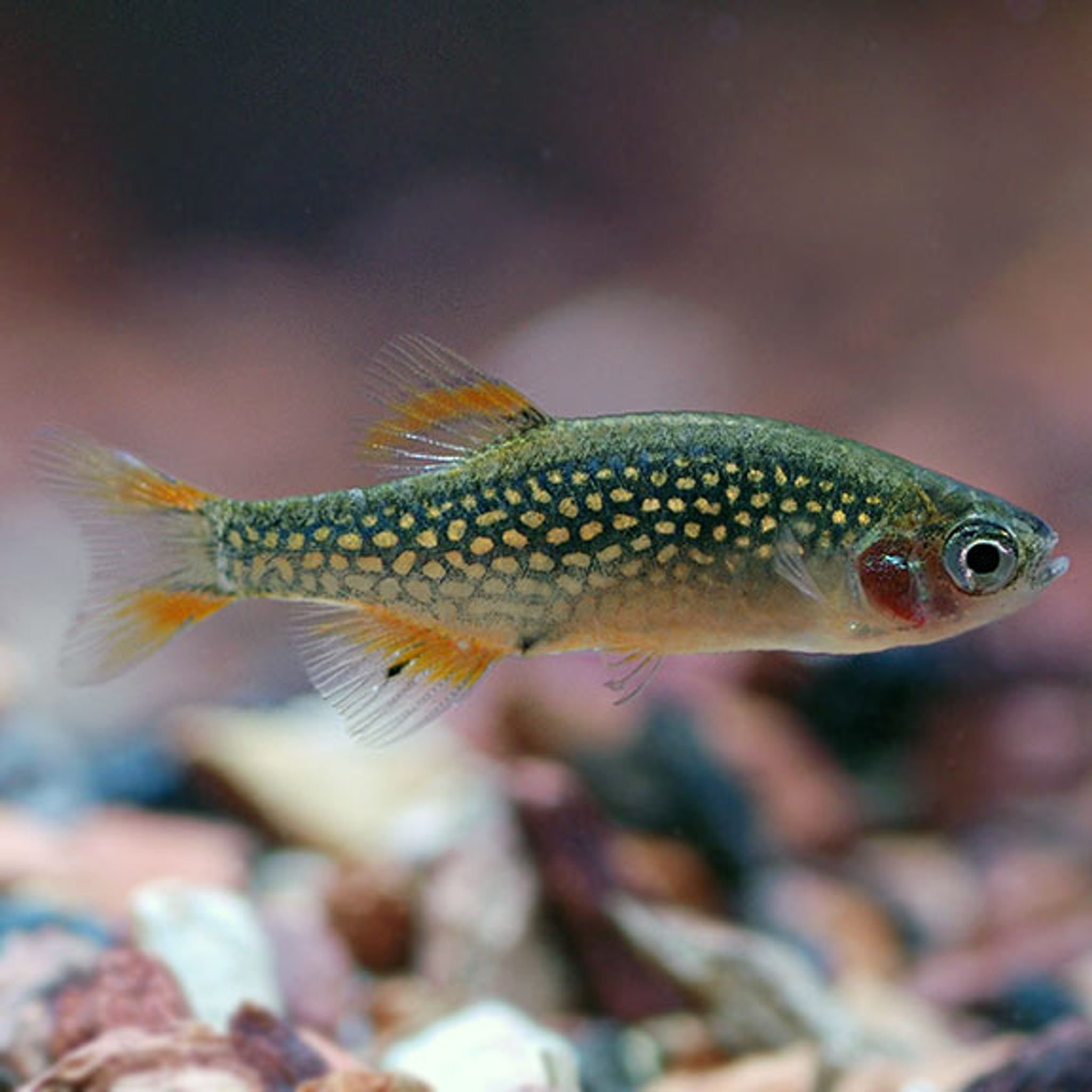
Despite the common name, celestial pearl danios (Danio margaritatus) aren't ordinary danios in feeding terms. They're small, specialized micro-predator cyprinids from shallow, weedy ponds in Myanmar, where they graze almost constantly on zooplankton, tiny insects, and algae or biofilm clinging to plants. That natural diet makes them closer to omnivorous-leaning-carnivorous grazers than the flake-eating generalists most people picture when they hear "danio."
The practical result: standard tropical flakes or granules sized for community tanks are frequently too large. A CPD will mouth a piece, fail to get it down, and spit it back out — looking like it's refusing food when it's actually just physically unable to eat it. Adult CPDs top out around 0.75–1 inch (2 cm) in body length, and their mouths are proportioned even smaller than that measurement suggests.
The core staple diet
Build feeding around a high-quality micro pellet or finely crushed flake formulated for small fish or fry. Look for sub-millimeter "nano" pellet sizing — it's an easy, non-live way to guarantee every piece is swallowable.
Feeding routine basics:
- Feed once or twice a day
- Offer only what's fully eaten in 1–2 minutes — CPDs are slow, cautious feeders with small stomachs, so a tight window (rather than the 2–3 minutes sometimes recommended for other small fish) prevents leftover food from fouling the tank
- Crush any flake between your fingers before it hits the water if a micro pellet isn't available
- Target-feed near plant cover, since CPDs are shy and often won't compete for food in open water
Do fish actually need a lot of protein?
Protein needs vary by fish type — general aquarium guidance points to roughly 45% protein for carnivore-leaning fish and 15–30% for herbivores. There's no single confirmed number specific to CPDs, but given their zooplankton-heavy natural diet, a protein-forward diet (roughly comparable to other small insectivorous nano fish) rather than an extreme carnivore ratio is the sensible target. The bigger factor than hitting an exact percentage is variety — no single food, however well-formulated, supplies everything a fish needs long-term. Rotating food types is what actually prevents deficiency, dulled coloration, and poor breeding condition.
Rotating in live and frozen foods
Live and frozen foods aren't optional extras — they're what keeps coloration vivid and breeding condition strong. Rotate several times a week alongside the staple:
| Food | Form | Notes |
|---|---|---|
| Baby brine shrimp (BBS) | Live or frozen | Excellent all-around conditioning food; ideal size for adults and older fry |
| Daphnia / moina | Live or frozen | High protein and fat; strong color and breeding trigger |
| Microworms | Live | Easy to culture; good for fry and adults |
| Cyclops | Live or frozen | Naturally tiny; closely matches wild zooplankton diet |
| Bloodworms | Frozen (preferred) or very small live | Chop or select only the smallest — regular-size bloodworms are often too big for adults and always too big for fry |
| Spirulina/algae-based food | Crushed dry or wafer | Occasional plant matter rounds out an otherwise protein-heavy diet |
Frozen over live for bloodworms: sourcing frozen bloodworms is the safer default, since live bloodworms and blackworms carry more disease risk. Live blackworm or bloodworm culturing is possible, but it's a messy, advanced project most hobbyists skip in favor of easier live foods like daphnia or BBS.
A quarantine caution: any live food sourced from an outdoor culture or a bait shop should be rinsed and inspected before it goes in the tank, to avoid introducing parasites or predatory insect larvae (dragonfly nymphs, for example) into a small CPD setup.
Feeding for breeding condition
Conditioning feeds directly connect to spawning output: fish fed a steady rotation of daphnia and BBS alongside their staple tend to spawn more frequently and produce more viable eggs than fish kept on a single dry food. If breeding is the goal, treat live foods as a deliberate spawning trigger a few times a week rather than an occasional bonus.
Feeding in planted nano tanks
CPDs are almost always kept in the 5–20 gallon (19–76 L) range, usually heavily planted. That setup cuts both ways for feeding:
- Biofilm and infusoria growing on plant surfaces supplement formal feedings — a mature, planted nano tank gives CPDs something to graze between meals, much like their wild habitat
- It also means overfeeding is riskier — small water volumes foul fast, and uneaten live or frozen food drives ammonia spikes and algae blooms much sooner than in a larger tank
- Because CPDs hide near plants and won't push past faster tankmates, spread food across the tank or feed at a time when quicker fish aren't dominating the surface
You can browse community-friendly small fish suited to gentle, slow-feeding tankmates if you're stocking a CPD tank from scratch.
Feeding celestial pearl danio fry
Fry feeding is where most home breeding attempts fail — not from bad water, but from the wrong particle size. Newly hatched fry need food under 50 microns, far smaller than anything an adult eats.
Fry feeding timeline:
- First 1–2 weeks: infusoria, green water, or vinegar eels — particles small enough for a fry's undeveloped mouth
- After fry are visibly larger: graduate to newly hatched baby brine shrimp, widely considered the single best food for rapid, healthy fry growth
- Never offer adult-sized flake, pellet, or bloodworms to fry — they simply can't eat it, and this is the single most common reason home-bred CPD fry batches don't survive
How to hatch baby brine shrimp at home
- Add brine shrimp cysts (eggs) to aerated saltwater — roughly 1 tablespoon of non-iodized salt per liter as a starting ratio, adjusted to your specific hatchery instructions
- Keep the hatching container at 74–82°F (23–28°C) with steady aeration
- Incubate for 18–36 hours until cysts hatch
- Turn off aeration and shine a light on one side of the container — live shrimp swim toward the light, separating them from floating eggshells
- Harvest the shrimp with a fine mesh, rinse briefly under freshwater, then feed
How to culture daphnia for a steady live-food supply
Daphnia (water fleas) are worth culturing long-term: they run roughly 45–70% protein and 11–27% fat depending on age and diet, making them one of the strongest conditioning foods available.
- Container size: as small as 1–5 gallons (4–19 L) is enough to sustain a hobby-scale culture
- Water: aged, algae-rich "green water" gives daphnia both food and habitat
- Feeding the culture: yeast, green water, or liquid algae in small, regular doses
- Temperature: roughly 70–80°F (21–27°C)
- Maintenance: siphon regularly to remove waste and dead yeast — this is the step most cultures fail on
- Species selection: smaller daphnia species reproduce faster and are easier to sustain than larger ones, which is why most hobbyists favor them
- Indoor vs. outdoor: indoor culturing is more stable than outdoor, since it avoids temperature swings and contamination from wild insects or predators
A neglected culture that isn't siphoned regularly will crash — cloudy water and an ammonia-like smell are the warning signs that waste has built up faster than it's being removed. At that point it's usually faster to restart the culture than to rescue it.
Fresh and freeze-dried options for rounding out a rotation are worth browsing in Food & Supplements, including freeze-dried foods that store well between live-food batches.
Common feeding mistakes
- Feeding standard community-size flake or pellet — too large for CPD mouths, leading to spitting or fish that appear to starve despite food being present
- Overfeeding live or frozen food in a small planted tank, fouling water quickly
- Ignoring shy feeding behavior — food dropped in one spot lets faster tankmates eat first while CPDs hide
- Skipping fry-specific foods and expecting fry to eat adult food — a leading cause of fry die-off
- Relying on one food type long-term — leads to protein deficiency, dull coloration, and poor breeding condition
- Letting a live culture crash from missed water changes, then facing a cloudy, foul-smelling container with no warning
If you're setting up a dedicated CPD tank, a look at the broader freshwater livestock selection can help you plan tankmates that won't outcompete a shy, slow-feeding species like this one.
Frequently Asked Questions
What is the best staple food for celestial pearl danios?
A quality micro pellet or finely crushed flake formulated for small fish is the best staple, supplemented with live or frozen foods several times a week for variety and conditioning.
Can celestial pearl danios eat bloodworms?
Only very small, chopped, or frozen bloodworms are appropriate for adults — whole bloodworms are often too large, and fry cannot eat bloodworms at all regardless of size.
How often should I feed celestial pearl danios?
Feed once or twice daily, offering only small amounts that are fully consumed within 1–2 minutes, since CPDs are slow, cautious feeders with small stomachs.
What do celestial pearl danio fry eat?
Fry need infusoria, green water, or vinegar eels for the first 1–2 weeks, then graduate to newly hatched baby brine shrimp once they're large enough to handle it.
Do celestial pearl danios need live food?
Live food isn't strictly required, but rotating in live or frozen options like baby brine shrimp, daphnia, and microworms noticeably improves color, health, and breeding readiness.
How do I hatch baby brine shrimp at home?
Incubate brine shrimp cysts in aerated saltwater at roughly 74–82°F (23–28°C) for 18–36 hours, then use a light source to draw the live shrimp away from the floating eggshells before harvesting.
Can celestial pearl danios eat vegetables or plant-based food?
Yes, in moderation — crushed spirulina or algae-based foods make a useful occasional supplement even though CPDs lean carnivorous overall.
Why won't my celestial pearl danios eat the food I'm giving them?
The most common causes are a particle-size mismatch (food too large for their mouths) or competition from faster tankmates. Switch to a smaller, crushed food and target-feed near plant cover where CPDs feel safe.
Ready to stock or restock a nano planted tank? Browse danios and related small fish on FishyHub to find compatible additions for your setup.


