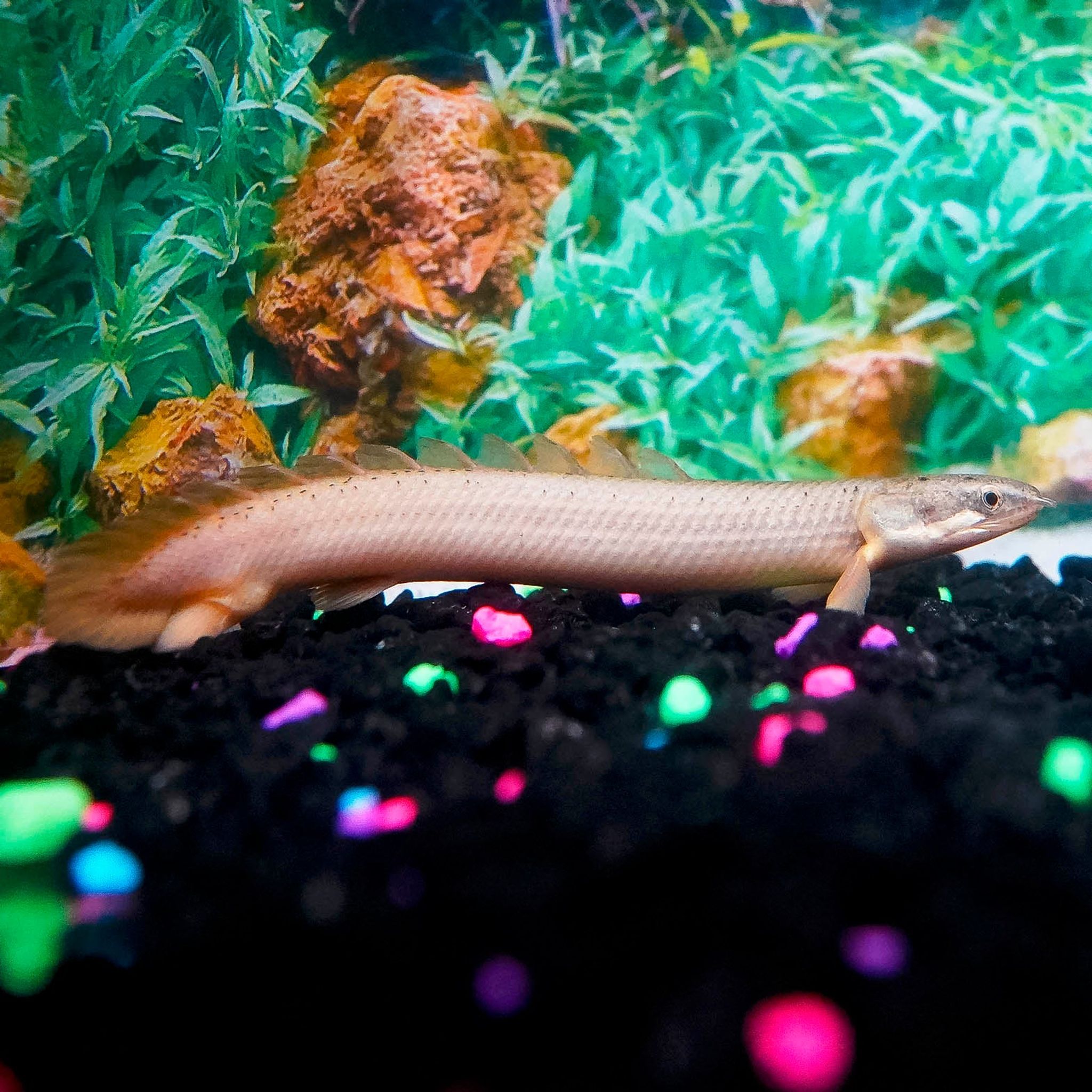
What Do Bichir Eat? A Practical Feeding Guide
Bichirs are strict carnivores that hunt by smell and vibration after dark, which trips up a lot of new owners who feed like they would a community tank. This guide covers what to feed, how much, how often, and how to fix the most common feeding mistakes with these nocturnal "dragon fish."
Which Bichirs This Guide Covers
"Bichir" covers several species in the genus Polypterus commonly kept in home aquariums, including P. senegalus, P. endlicheri, P. ornatipinnis, and P. delhezi. Adult sizes vary widely, from roughly 12 inches (30 cm) for senegalus up to 24+ inches (60+ cm) for some endlicheri and ornatipinnis. Despite the size range, all of them share the same core feeding biology: nocturnal ambush predators that locate prey with smell and electroreception rather than sight, so the feeding approach in this guide applies across the genus — only portion size and prey size scale up with the fish.
What Bichirs Eat in the Wild
In their natural habitat, bichirs are opportunistic predators that eat small fish, aquatic insects and insect larvae, crustaceans, and worms. This wild diet is almost entirely meaty and protein-rich, which is the model to follow in captivity — bichirs are not built to thrive on a plant-based or flake-based diet.
A Practical Captive Diet
A well-rounded bichir diet should rotate through several protein sources rather than relying on one staple food:
- Earthworms and nightcrawlers — an excellent whole-food staple, chopped for juveniles or offered whole to adults.
- Bloodworms (frozen or live) — good for juveniles and as a regular rotation item for adults.
- Frozen mysis or brine shrimp — useful for smaller bichirs and fry.
- Krill — a solid protein source, best offered a few times a week rather than daily.
- Raw shrimp or white fish (such as tilapia), cut into appropriately sized pieces — a good occasional "kitchen" option.
- Beef heart or other lean meat — acceptable only as an occasional treat, since it's fatty and not nutritionally complete as a staple.
- High-quality sinking carnivore pellets (cichlid, predator, or catfish sinking pellets) — convenient and nutritionally balanced, and a reasonable part of the rotation.
How Much Weight Should Pellets Carry?
Opinions differ here. Some hobbyists treat sinking pellets as an acceptable primary food when live or frozen options aren't available, while others argue pellets should never be more than a minor supplement. A sensible middle ground: use pellets as a convenient base two to three times a week, but let whole meaty foods — worms, bloodworms, shrimp, krill — make up the majority of meals for enrichment and complete nutrition. A fish fed only pellets long-term often develops poor body condition or eventually refuses food altogether.
The Live Feeder Fish Question
Live feeder fish (goldfish, minnows) are a popular option but come with real risks. They can introduce parasites or disease, and feeder goldfish in particular are nutritionally poor — they carry thiaminase, an enzyme that breaks down thiamine (vitamin B1), and tend to be fatty. Repeatedly using goldfish or thiaminase-containing feeders as a staple can contribute to nutritional deficiencies over time, not just disease risk. If you do use live feeders, quarantine them first and treat them as an occasional treat rather than a staple; pre-frozen alternatives are a lower-risk substitute for the same enrichment value.
Feeding Frequency and Portions
No single source gives one universally "correct" number, but general carnivorous-fish practice provides a workable default schedule to adjust based on body condition:
| Life stage | Size | Suggested frequency | Portion guide |
|---|---|---|---|
| Juvenile | Under 6 in (15 cm) | Daily or near-daily | Small pinch of chopped worms, small bloodworms, or mysis |
| Sub-adult | 6–12 in (15–30 cm) | Every 1–2 days | Larger pieces of worm, shrimp, or pellets sized to the mouth |
| Adult | 12 in+ (30 cm+) | 3–4 times a week | Whole earthworms, larger shrimp pieces, or appropriately sized pellets |
A good portion at any life stage is an amount the fish clears within a few minutes. Bichirs have slow metabolisms and become obese easily, so it's better to err toward smaller, more frequent meals than large, infrequent ones — and to skip a feeding if the fish still looks well-fed from the last one.
Juvenile Growth and Diet Transitions
Fry and very young juveniles typically start on live baby brine shrimp or finely chopped bloodworms, since their mouths can't yet handle larger prey. As they grow, gradually move up to small whole bloodworms, mysis, and small pieces of worm, then to whole earthworms, larger shrimp, and pellets sized for a bigger mouth. Introducing pellets early alongside live or frozen food — or moving a pellet with feeding tongs to mimic movement — makes it far easier to train a bichir onto pellets later, rather than trying to switch an established adult all at once.
Night Feeding: Why and How
Bichirs are nocturnal and locate food primarily by smell and their ampullary (electroreceptive) organs, not sight. In bright light, or when competing with fast diurnal tankmates, they're often reluctant to come out and feed at all — which leads many new owners to wrongly assume their fish is sick or not eating.
Practical ways to feed on a bichir's schedule in a home tank:
- Feed right as room or tank lights go off, or set aquarium lighting to a timer so "lights-out" happens at a consistent time each evening.
- Offer food shortly after the room itself goes dark, if the aquarium light is already off earlier in the evening.
- Use a feeding stick or long tongs to place food directly near where the bichir is resting, since it's a slow, bottom-oriented forager and won't chase food across the tank.
- In a community tank, target-feeding with tongs or a turkey baster lets you deliver food right in front of the bichir without triggering a feeding frenzy from faster tankmates.
Tank Mates and Feeding Competition
Because bichirs are slow, ambush-style feeders, fast or aggressive tankmates can out-compete them for food before it ever reaches the substrate — a bichir can look "always hungry" or steadily lose weight even though it's technically being fed. Avoid pairing bichirs with:
- Fast, food-aggressive fish that swarm the surface or mid-water and intercept meaty foods before they sink.
- Fin-nipping species, which can stress a bichir and further suppress feeding.
- Any fish small enough to fit in the bichir's mouth — bichirs will eat tankmates that size, so stock accordingly.
Tank Setup That Supports Natural Feeding
A larger-footprint tank with a soft or sand substrate lets a bichir forage the way it would in the wild, nosing along the bottom to find food by smell. Cramped quarters increase stress and competition at feeding time, especially with other bottom-dwelling tankmates. Good mechanical filtration is also essential: a carnivorous diet carries a heavy bioload, and uneaten meaty food fouls water quickly, so leftovers should be siphoned out within a couple of hours rather than left to break down. For hobbyists setting up or upgrading a bichir tank, FishyHub's bichir livestock selection and filters category are both worth browsing.
Common Mistakes and Troubleshooting
- Feeding only pellets or flakes long-term — leads to poor body condition or a fish that eventually refuses food.
- Feeding during the day and expecting normal activity — a bichir may simply ignore food until lights are dimmed or off.
- Ignoring tankmate competition — food gets stolen before it sinks, and the bichir looks underfed despite regular feeding.
- Overfeeding fatty foods like beef heart or feeder fish too often — causes obesity and liver stress in a fish with a naturally slow metabolism.
- Leaving uneaten meaty food to rot — spikes ammonia in a tank that already carries a heavy bioload from a carnivorous diet.
- A new bichir refusing food after introduction — usually a normal stress response, not illness. Try live or frozen bloodworms or earthworms at night, or hand-feed with tongs, before assuming something is wrong.
- Mistaking daytime stillness for illness — a bichir sitting motionless during the day is typically just waiting for dark, not sick.
Watching for Nutritional Deficiency
Keep an eye out for a body that looks unusually thin despite regular feeding, or a spinal curvature — both can signal an unbalanced diet, often from relying too heavily on one food type (pellets alone, or fatty feeders). Rotating protein sources and cutting back on fatty treats is the main corrective step. A varied freeze-dried food or frozen supplement rotation from the Food & Supplements category can help fill out a diet that's become too one-note.
Frequently Asked Questions
Can bichirs eat goldfish or other feeder fish safely?
Occasionally, yes, but it's risky as a long-term staple. Feeder goldfish and minnows can carry parasites and are nutritionally poor due to thiaminase and high fat content, so they're better used as an occasional treat from a trusted, quarantined source than a regular food.
Will bichirs eat pellets?
Yes, many bichirs can be trained onto sinking carnivore pellets, especially by moving the pellet with tweezers or tongs to mimic live prey movement. They shouldn't be relied on as the sole food source, though — whole meaty foods should still make up most of the diet.
How often should I feed my bichir?
Juveniles generally do well with daily or near-daily small feedings to support fast growth, while adults typically need feeding only three to five times a week. Adjust based on body condition rather than following a fixed number rigidly.
Why isn't my bichir eating?
The most common causes are its nocturnal habits, stress after being introduced or moved, or bright lights and dominant tankmates suppressing feeding activity. Try offering live or frozen worms right at lights-out before assuming illness.
Can bichirs eat other fish in the tank?
Yes — bichirs will eat any tankmate small enough to fit in their mouth, regardless of species. Stock tankmates that are clearly too large to be swallowed and that won't outcompete the bichir for food.
Do bichirs need live food?
Not strictly, but a diet that includes some live or frozen whole foods generally produces better health, body condition, and natural foraging behavior than a pellet-only diet. Pellets work well as a convenient supplement rather than the entire diet.
How much should I feed at each meal?
Offer an amount the bichir clears within a few minutes, then stop. Because bichirs have slow metabolisms and can become obese easily, it's better to underfeed slightly and feed more often than to offer large infrequent meals.
What kitchen foods are safe to feed a bichir?
Small, unseasoned pieces of raw shrimp or lean white fish like tilapia make a fine occasional addition to the rotation. Avoid seasoned or fatty foods, and keep fatty options like beef heart to rare treats rather than regular meals.
Whether you're setting up a new bichir tank or fine-tuning feeding for an existing one, browsing FishyHub's bichir livestock and Food & Supplements categories is a good next step for stocking a varied, protein-rich rotation.


