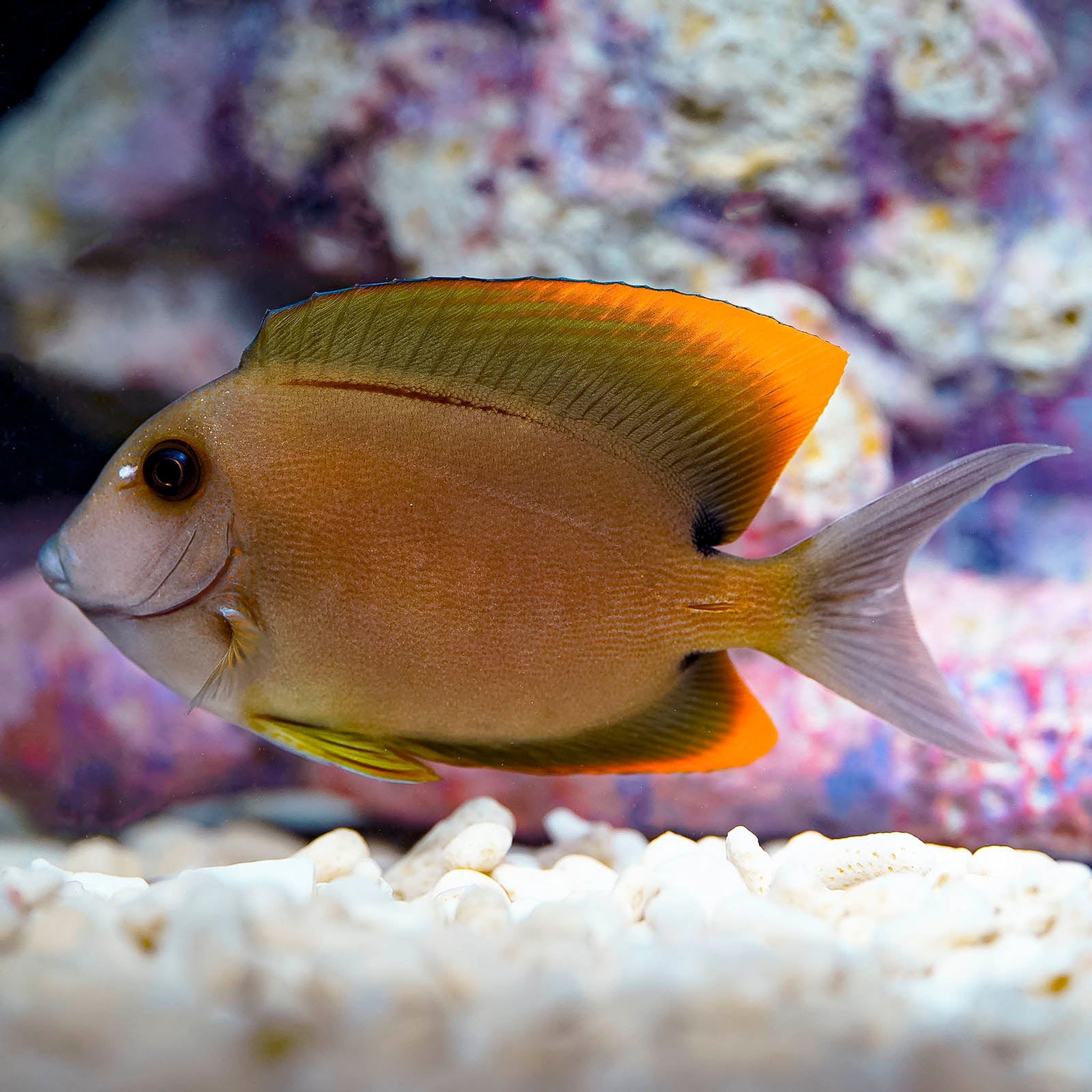
Tomini Tang Care Guide: Tank Size, Diet, Compatibility and Reef Safety
The Tomini tang (Ctenochaetus tominiensis) is often pitched as the "starter tang" for reef keepers, and for good reason: it stays compact, grazes constantly, and rarely bothers corals. This guide covers the real minimum tank size, water parameters, feeding routine, and tankmate rules you need before buying one — plus the acclimation and quarantine steps that determine whether it survives its first month.
Species Snapshot
The Tomini tang, also sold as the Tomini surgeonfish, bristletooth tomini tang, or occasionally "flame fin tang," is a member of the Ctenochaetus genus — the "bristletooth" or "comb-tooth" tangs, named for the fine, flexible teeth they use to comb algae film off rock. It's native to Indo-Pacific and Western Central Pacific reefs and lagoons, including waters around Indonesia, the Philippines, Papua New Guinea, and the northern Great Barrier Reef.
Appearance: Juveniles and adults show a brown to blue-gray body with a white underbelly that darkens as they mature. The tail glows electric blue, and the dorsal and anal fins carry a yellow tip — a helpful ID feature against similar-looking tangs.
Size and lifespan: Adults reach about 6 inches (15 cm), with some individuals pushing toward 6-8 inches — still one of the smaller tang species available in the trade. With stable water quality and a proper diet, a Tomini tang commonly lives 5+ years in captivity, and well-kept specimens can reach a decade or more.
Care level: Moderate, not beginner. The size is forgiving, but tangs as a family are disease-prone and unforgiving of poor water quality or an inadequate diet — this is a fish for someone with at least some saltwater experience already under their belt.
Minimum Tank Size (and Why Footprint Matters More Than Gallons)
Most care sources cluster around the same number: 70 gallons is the practical floor for one adult Tomini tang, with 120+ gallons considered ideal for long-term health. The gap between "floor" and "ideal" isn't marketing — tangs are active, continuous swimmers, and a cramped tank shows up later as stress, aggression, and stalled growth.
What matters more than raw volume is footprint — the length and width of the tank, not its depth. A 4-foot tank and a 6-foot tank can hold similar gallons once you factor in height, but the 6-foot tank gives the fish an actual lap to swim and lets reef lighting penetrate further across the algae-grazing surfaces it depends on. When comparing tanks of similar volume, pick the longer, wider, lower option over a tall, narrow one.
Choosing the Right Saltwater Tank
Before buying based on gallons alone, weigh:
- Footprint first: a long, wide, low tank beats a tall one of equal volume for swimming room and light penetration.
- Floor and stand load: a filled 120-gallon tank easily weighs over 1,200 lbs — confirm the stand and floor can handle it.
- Sump/overflow compatibility: if you plan to run a sump, buy a tank drilled for it (or one compatible with an external overflow box) rather than retrofitting later.
- Viewing angle: a lower, wider tank also tends to show off live rock and coral placement better than a tall column.
You can browse setup-ready options in Tanks & Stands when sizing your system.
Water Parameters at a Glance
Sources scatter these numbers across many pages — here they are in one table, using the safest overlap of the ranges commonly cited.
| Parameter | Target Range | Notes |
|---|---|---|
| Temperature | 76-78°F (24-26°C) | Don't let it drop below 72°F or exceed 80°F |
| pH | 8.1-8.4 | Stable is more important than perfect |
| Specific gravity | 1.023-1.025 | Full acceptable range 1.020-1.026 |
| dKH (alkalinity) | 8-12 dKH | Keep consistent between water changes |
| Ammonia / Nitrite | 0 ppm | Zero tolerance — tangs are early casualties of new-tank syndrome |
| Nitrate | Low (ideally under 10-20 ppm) | Chronic elevation stresses tangs over time |
| Water flow | Moderate to strong | Mimics natural reef current |
| Lighting | 6,500-10,000K, 8-10 hrs/day | Mainly to grow algae/biofilm for grazing |
Specific Gravity and Salinity Maintenance
Measure salinity with a refractometer for accuracy, or a hydrometer as a budget option, and hold steady at 1.023-1.025. Two habits prevent the most common salinity mistakes:
- Always top off evaporation with plain freshwater, never saltwater — salt doesn't evaporate, so topping off with saltwater causes gradual salinity creep upward.
- Match specific gravity before mixing in new water. Any freshly mixed saltwater should read the same specific gravity as the display tank before it's added during a water change.
A float valve on a top-off or saltwater mixing reservoir automates shutoff so the container doesn't overflow — a small setup detail that pays off for anyone maintaining stable salinity long-term.
RO/DI Water: Why It's the Standard
Reverse osmosis/deionization (RO/DI) water is the standard base for mixing saltwater because it strips out chlorine, heavy metals, silicates, and phosphates — all of which fuel nuisance algae and can stress sensitive livestock. Starting every batch of saltwater from RO/DI removes a variable that otherwise makes water-quality troubleshooting much harder.
Routine Water Changes
Dilute nitrate and phosphate and replenish trace elements with routine partial water changes — commonly about 10% weekly or 20% biweekly. Always pre-mix new saltwater a day ahead, then heat and aerate it to match the display tank's temperature and salinity before adding it.
Diet: What Actually Feeds a Tomini Tang
The Tomini tang is best described as an herbivore-leaning grazer rather than a strict herbivore or a true omnivore. In the wild it spends most of the day picking algae film, biofilm, and detritus off rock with its comb-like teeth. In captivity, that means:
- Live rock is not optional. It's both the grazing substrate and the main ongoing food source in a mature tank. A tank without established algae/biofilm on live rock will slowly starve a Tomini tang even if it's accepting flake food at feeding time.
- Nori/seaweed sheets clipped to the rockwork at least 3x per week (daily access is even better) should form the backbone of supplemental feeding.
- Meaty foods — mysis, brine shrimp, prepared pellets or flakes — are fine as a minor supplement, not a staple. Feeding mostly meaty food is a common mistake that's linked to obesity and to head and lateral line erosion (HLLE) over time.
- Feed small portions 2-3 times a day, favoring frequent grazing opportunities over one or two large meals.
Recognizing Early HLLE and Diet Problems
Ctenochaetus tangs are more prone to HLLE than many other tang genera because their whole feeding biology depends on constant grazing. Watch for small pits or erosion around the head and along the lateral line — early signs are often mistaken for cosmetic wear. HLLE is linked to poor diet (too much meaty food, not enough grazing/vegetable matter), inconsistent water quality, and in some cases activated carbon issues. The fix starts with restoring a genuine grazing routine and confirming water parameters are stable, not just adding a supplement.
Temperament and Tankmates
Toward non-tang species, the Tomini tang is generally calm and peaceful. Toward other tangs — especially similarly shaped ones — it can be territorial until a pecking order settles. The safest approach is to add it as one of the last fish into an already-established community.
Good tankmates include:
- Clownfish
- Angelfish and hawkfish
- Gobies
- Dottybacks
- Wrasses
- Pufferfish
- Eels
Avoid pairing a Tomini tang with other Zebrasoma or Ctenochaetus tangs in anything under roughly 180 gallons — the shape and grazing-territory overlap trigger conflict. You can browse compatible options like wrasses and clownfish when planning a community around one.
One Tomini Tang, or More?
Retail-oriented advice sometimes suggests keeping several Tomini tangs together to "spread out" aggression, and there are reports of groups of 6-10 working in very large systems by diffusing territorial pressure across many individuals. That's an advanced approach, not a typical home-tank plan. For a standard display, default to one Tomini tang per tank unless you're running 250+ gallons and can add a group simultaneously as juveniles.
Reef Safety
The Tomini tang is considered reef safe and is a common choice for mixed reef displays. Occasionally an individual will nip at soft coral polyps or clam mantles, so it's worth watching any new coral introductions closely for the first few weeks — but this isn't typical behavior for the species. If you're stocking a reef tank, keep an eye on soft corals in particular during the adjustment period.
Tomini Tang vs. Other Tangs
For readers weighing tang species, size is the biggest differentiator:
| Species | Adult Size | Typical Minimum Tank |
|---|---|---|
| Tomini tang | ~6 in (up to 6-8 in) | 70 gal (120+ ideal) |
| Zebrasoma tangs (yellow, sailfin, purple) | 8-10+ in | 180-300+ gal at full size |
| Black tang (color-morph relative) | Comparable to Zebrasoma species | Similarly large housing |
This is exactly why the Tomini tang gets recommended as an entry point into tang-keeping — it delivers the "tang look and behavior" without requiring the 180-300+ gallon systems that Zebrasoma species eventually demand.
Buying, Acclimation, and Quarantine
Wild-Caught vs. Aquacultured
Most Tomini tangs sold in the trade are wild-caught, since captive-bred availability is limited for this species. Where captive-bred individuals are available, they generally ship with less stress, arrive disease-free more often, and switch to prepared foods faster. Wild-caught fish are more widely available and typically less expensive, but need more careful acclimation and a longer quarantine window, plus patience while they transition onto prepared foods.
Acclimation: Resolving the Drip vs. Quick-Float Debate
Sources disagree here, and it's worth settling: some recommend a long drip acclimation running 45-90 minutes, while others warn that extending the process too long lets CO2 and ammonia chemistry inside the bag shift the water's pH in a way that increases ammonia toxicity risk — the opposite of what a cautious acclimation is meant to prevent.
The middle path works best:
- Float the sealed bag for 15-20 minutes to match temperature.
- Gradually add small amounts of tank water into the bag over 20-30 minutes to equalize salinity and pH.
- Net the fish into the display or quarantine tank — never pour bag water into the tank.
This gets the fish out of aging bag water in a reasonable timeframe while still equalizing parameters gently.
Quarantine Before the Display Tank
Run every new Tomini tang through a dedicated quarantine tank for 2-4 weeks before it goes into the display. Use nets and hoses dedicated to the QT tank only, to avoid cross-contaminating your main system. Watch for clear eyes, steady breathing, and normal feeding behavior as signs the fish is ready to move. Skipping this step is one of the most common causes of ich and velvet outbreaks traced back to a single new tang.
Common Mistakes to Avoid
- Buying for juvenile size and outgrowing a 40-55 gallon "starter" tank — plan for the 70-120 gallon range from the outset.
- Skipping live rock or adding the fish before algae/biofilm has established — slow starvation even while it accepts flake food.
- Feeding mostly meaty foods or infrequent large meals instead of frequent grazing — linked to HLLE and poor long-term condition.
- Adding it to an uncycled tank — ammonia/nitrite spikes hit tangs especially hard.
- Introducing tangs in the wrong order without a plan — add more docile, smaller fish first and this species closer to last.
- Skipping quarantine — the single most common root cause of preventable ich and velvet outbreaks.
- Topping off with saltwater instead of freshwater — causes gradual salinity creep upward.
- Over-drip-acclimating for hours — can raise ammonia toxicity risk in the bag rather than reduce stress.
Simple Husbandry Checklist
| Task | Frequency |
|---|---|
| Offer nori/seaweed sheet | 3x/week minimum, ideally daily |
| Small feedings (pellets/mysis as supplement) | 2-3x/day |
| Check specific gravity | Weekly |
| Top off evaporation with freshwater | As needed (daily in most tanks) |
| Partial water change (~10%) | Weekly |
| Or partial water change (~20%) | Biweekly |
| Observe fins/head/lateral line for HLLE signs | Weekly |
Common Health Issues
Tangs as a family are more disease-prone than typical reef fish, and the Tomini tang is no exception. Watch for:
- Marine ich (Cryptocaryon) — white spots, scratching against rock
- Marine velvet — faster-moving, often more severe than ich
- HLLE — head and lateral line erosion tied to diet and water quality
- Fin rot and general bacterial/parasitic infections when stressed or malnourished
If you spot white spots or scratching, move the fish to a quarantine or hospital tank for treatment rather than dosing the display — treatments for ich are often incompatible with corals and invertebrates. Reliable medication and treatment products can support recovery once the fish is isolated.
Breeding
The Tomini tang is a pelagic group spawner that scatters eggs into open water — a reproductive strategy that essentially cannot be replicated in a home aquarium. There's also no reliable external method for sexing individuals, so breeding isn't a realistic goal for hobbyist keepers.
Frequently Asked Questions
Is the Tomini tang reef safe?
Yes, for the vast majority of keepers it's considered reef safe. Watch new coral additions, particularly soft corals and clam mantles, during the first few weeks just in case an individual nips at them.
What is the minimum tank size for a Tomini tang?
70 gallons is the widely cited floor for one adult. 120+ gallons is recommended for long-term health, better swimming room, and lower aggression risk.
Can I keep two Tomini tangs together?
Only in a large, well-aquascaped tank, added at the same time as juveniles — generally 250+ gallons. In typical home tank sizes, pairing two usually triggers ongoing aggression.
What do Tomini tangs eat?
Mainly algae and biofilm grazed off live rock, supplemented with nori or seaweed sheets several times a week. Occasional meaty foods like mysis or brine shrimp are fine as a minor supplement, not a staple.
How long do Tomini tangs live?
Generally 5+ years in captivity with good care, and sometimes a decade or more when water quality and diet stay consistent.
Are Tomini tangs good for beginners?
Their manageable size makes them more beginner-friendly than most tangs, but tang-typical disease sensitivity and specific diet needs mean some prior marine experience helps before taking one on.
What's the difference between wild-caught and aquacultured Tomini tangs?
Captive-bred individuals tend to acclimate faster, eat prepared foods sooner, and arrive with lower shipping stress, but availability is limited. Wild-caught fish — the norm for this species — are more widely available and less expensive but need more careful acclimation and a longer quarantine period.
Why does my Tomini tang have white spots or keep scratching on rocks?
This is most often marine ich. Move the fish to a dedicated quarantine or hospital tank for treatment rather than treating the display, and review whether it went through a proper quarantine period before it was originally added.
Ready to add a Tomini tang to your reef system? Browse available stock and other compact tang species in Tangs & Surgeons on FishyHub.

