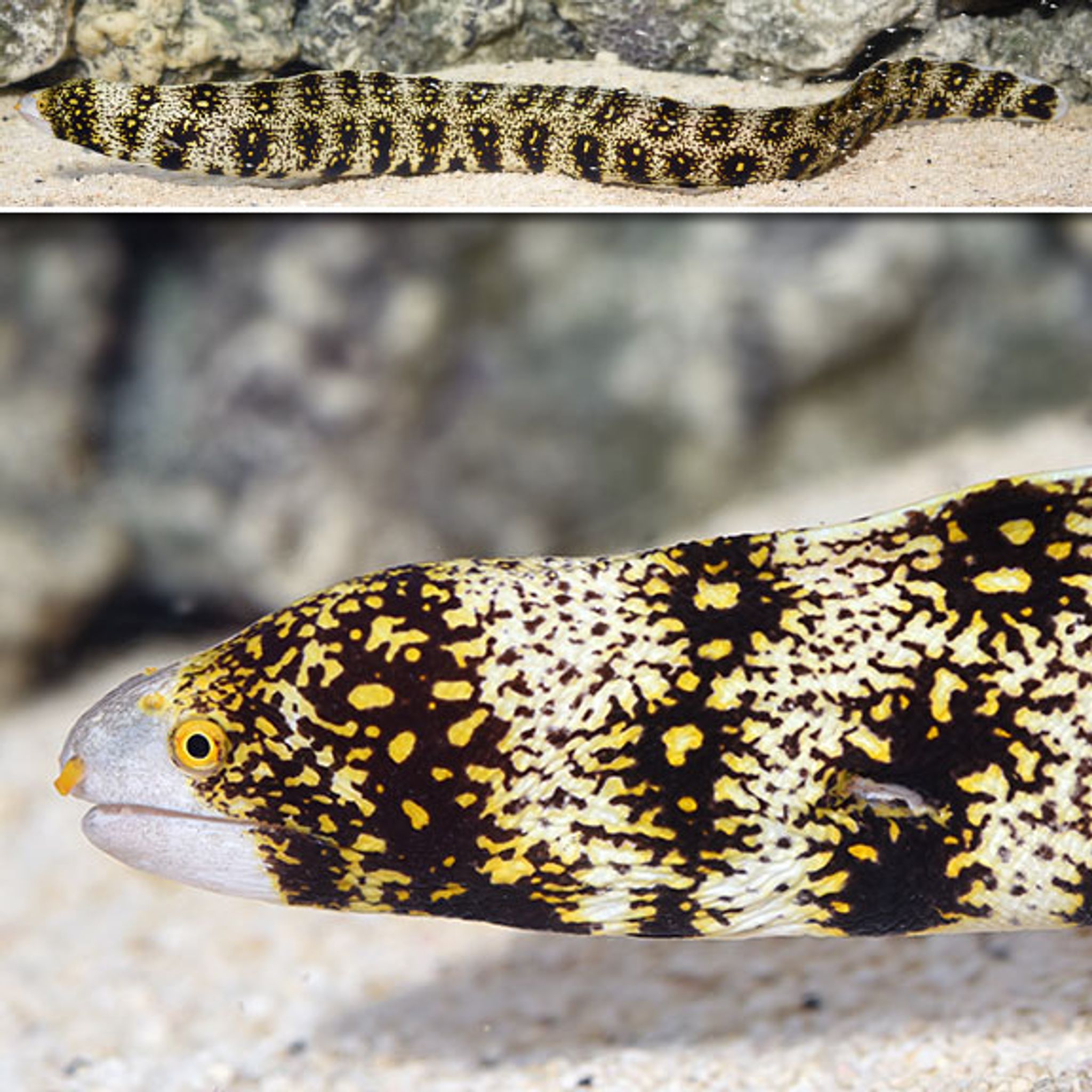
Snowflake Eel Care Guide: Tank Size, Diet, Compatibility and Reef Safety
The snowflake eel is one of the hardiest, most manageable eels in the marine hobby, but the 6-10 inch juvenile sold in stores grows into a 2-3 foot adult that needs real floor space and a genuinely escape-proof lid. This guide covers honest tank sizing, a practical feeding plan, compatibility rules that don't depend on memorizing a fish list, and the reef-safety nuance that trips up most new keepers.
Species Snapshot
The snowflake eel (Echidna nebulosa) belongs to the moray family, Muraenidae. It's sometimes mislabeled the "starry moray" in the trade, but it's the same fish — a mottled black-and-white (occasionally yellow-tinged) moray with a blunt, rounded snout built for crushing shelled prey rather than slashing fish.
Compared to other marine eels commonly sold to hobbyists, the snowflake sits toward the easy end of the spectrum:
| Eel | Difficulty | Adult size | Diet | Notes |
|---|---|---|---|---|
| Snowflake eel | Beginner-intermediate | 24-36 in | Crustaceans, mollusks, meaty seafood | Hardy, adapts to prepared foods easily |
| Zebra moray | Intermediate | 4-5 ft | Crustaceans (specialist) | Larger, more particular about food |
| Ribbon eel | Advanced, poor survival record | 3-4 ft | Live/fresh fish, picky | Frequently starves in captivity; not beginner-friendly |
If you're eel-shopping and want the most forgiving option, the snowflake is usually it — but "easy for an eel" still means a large, dedicated system.
How Big Do Snowflake Eels Get?
Expect a typical captive adult of 24 to 36 inches, with wild specimens occasionally reported past 39 inches. Stores usually sell juveniles at 4-12 inches, and growth is fastest in the first two years — roughly 4-6 inches per year — before slowing as the eel approaches full size around 4 to 5 years old.
This growth curve is the root of most sizing mistakes: a keeper buys a 6 inch juvenile for a 20-gallon tank, and eighteen months later has a 2-foot animal that has outgrown everything.
Tank Size: Plan for the Adult, Not the Juvenile
Recommendations across the hobby range from 20-30 gallons (juvenile-only, temporary) up to 100+ gallons for a full-grown adult. Both numbers are technically true — they're just describing different life stages. The honest framework:
| Life stage | Tank size | Notes |
|---|---|---|
| Juvenile (4-12 in), short-term only | 30-40 gal | Only if you're committed to upgrading within a year or two |
| Realistic adult minimum | 55-75 gal | The floor for one full-grown snowflake eel long-term |
| Ideal | 100+ gal | Comfortable margin, easier water stability, room for tankmates |
| Each additional eel or large tankmate | +10-20 gal | Scale up rather than crowd |
Footprint beats height. A long, wide tank gives a snowflake eel more usable floor space and room for multiple hides than a tall tank with the same volume — prioritize length and width when comparing models. Because re-homing a stressed adult eel is difficult and risky for the animal, the better long-term choice is usually to start juveniles directly in an adult-size tank rather than a "starter" size you'll outgrow. You can browse full-grown and juvenile specimens together with other options in the marine fish category to compare what's currently available before committing to a tank size.
A Quick Cost Reality Check
Budgeting for a snowflake eel means budgeting for the whole system, not just the animal: the eel itself is a modest cost, but a 75-100 gallon tank, stand, strong filtration, and a properly secured lid represent the bulk of the investment. Treat the eel's purchase price as the smallest line item in the setup.
Water Parameters and Filtration
Snowflake eels do best in standard, stable marine parameters:
- Temperature: 72-78°F (22-26°C)
- Specific gravity: 1.020-1.025
- pH: 8.1-8.4 (a stable marine system should never drift down toward 7.0, despite occasional wider ranges quoted elsewhere)
- Ammonia/nitrite: 0 ppm
- Nitrate: under 20 ppm
- Flow: moderate; lighting: subdued
Because eels are messy, heavy eaters, strong biological filtration paired with weekly 20-25% water changes is the realistic baseline, not an occasional top-up. Eels are also sensitive to rapid parameter swings, so drip acclimate new arrivals slowly and make water changes and top-offs gradual rather than sudden — a fast salinity or temperature shift during a water change is a more common stressor than most keepers expect.
Aquascape and the Lid: Non-Negotiable
Snowflake eels need multiple interconnecting caves and crevices built from live rock, plus a sand or mixed substrate for burrowing. Without enough separate hiding spots, the eel will stress and may stay hidden constantly even at feeding time.
The single most cited cause of preventable death in this species is escape and desiccation through a gap in the tank lid. Snowflake eels are strong, flexible, and persistent — they will find and exploit any gap over roughly 1/2 inch. A standard hobby lid or a loosely fitted glass canopy usually isn't enough on its own. Practical fixes keepers commonly use:
- A weighted, gap-free lid or full aquarium cover, not just a hinged hood
- Egg-crate (plastic light diffuser grid) cut to fit and clipped or weighted down over any cutouts for filters, cords, or overflow boxes
- Clips or clamps sealing every seam, especially where cords or plumbing pass through
- Checking corners and back panels, where gaps are easiest to miss
Treat lid security as part of the initial setup cost, not an afterthought.
What Snowflake Eels Eat
Snowflake eels are strict carnivores and will not touch flake or pellet food. A solid rotation includes:
- Shell-on shrimp
- Squid
- Octopus
- Clams and mussels (left shell-on occasionally for enrichment)
- Crab meat
- Scallops
- Occasional silversides or other fish chunks
Avoid live feeder fish — they carry a real parasite risk and add nothing nutritionally that fresh cut seafood doesn't already provide. Never season or cook the food.
Feeding Method and Frequency
Because eels have poor eyesight and hunt largely by smell, and their bite reflex is fast and strong, feed with long tongs or a skewer rather than by hand, and offer food at a consistent spot near the den entrance rather than chasing the eel around the tank.
Frequency runs 2 to 4 times per week — juveniles closer to 3x/week, adults closer to 2-3x/week as their metabolism slows. Rather than following a rigid schedule, judge by body condition: the eel should look full and rounded, never concave (underfed) or visibly bloated (overfed).
Behavior: What's Normal
Snowflake eels are nocturnal and reclusive. Expect the eel to spend most daylight hours hidden in a cave, becoming active mostly at night or around feeding time. Mouth-gaping while resting is normal breathing — not a sign of aggression or distress. After introduction, give the eel 3-5 days of undisturbed settling time before attempting a first feeding; rushing this stage is a common reason new eels refuse food.
Compatibility and Reef Safety
Rather than memorizing a fish-by-fish list, use a simple rule: anything the eel can swallow whole is at risk; anything similarly sized or larger, and robust, is generally safe.
Good tankmates include tangs, larger angelfish, wrasses, triggerfish, puffers, hawkfish, and lionfish in a fish-only-with-live-rock (FOWLR) setup.
Unsafe with:
- Small fish that fit in the eel's mouth
- Nearly all ornamental shrimp, hermit crabs, and small crustaceans
Multiple snowflake eels can sometimes share a tank if they're similar in size, the tank is very large, and each has its own separate hide — but territorial aggression is a real risk, so treat this as an advanced setup rather than a default plan.
The "Reef Safe" Nuance
Snowflake eels are marketed as reef-safe, and that's true in a narrow sense: they will not eat coral tissue, anemones, or other sessile invertebrates. But they are efficient predators of crustaceans — cleaner shrimp, ornamental shrimp such as those in the marine shrimp category, and hermit crabs read as food, not neighbors. The accurate description is reef-safe with caveats: safe for your coral, not safe for your invertebrates or small fish.
Common Mistakes to Avoid
- Undersized starter tank the eel quickly outgrows, forcing a stressful re-home later.
- Loose or unweighted lid — the leading cause of preventable death via escape and desiccation.
- Keeping ornamental shrimp or small fish expecting full reef safety, then losing them to predation.
- Hand-feeding, which risks accidental bites; use tongs or a skewer instead.
- Overfeeding or feeding live feeder fish, risking obesity or parasite introduction.
- Panicking over a new eel refusing food — this is usually stress from being rushed after arrival, not illness. Give it a quiet 3-5 day settling period and offer food at night near the den.
- Assuming a constantly hidden eel is sick — nocturnal hiding is normal. A genuine health concern looks more like prolonged food refusal combined with visible lesions or discoloration.
- Housing two eels in too small a space, which invites territorial fights.
Quarantine and Acclimation
Drip acclimate every new eel rather than a quick float-and-dump, since sudden salinity or temperature changes are poorly tolerated. Quarantine before adding the eel to a display tank, and expect a genuinely shy adjustment period even after quarantine — reduced activity and hiding in the first week or two is normal, not a red flag on its own.
Lifespan
With good husbandry, snowflake eels commonly live 10-15 years in captivity, with a documented range of roughly 4-15+ years depending on setup quality. Poor conditions — cramped tanks, unstable water, chronic stress — can shorten that to 2-4 years, while wild individuals may live 15-20 years. Tank size and water stability are the two biggest levers a keeper actually controls.
If You're Drawn to Predatory Fish: A Note on Sharks
Snowflake eels appeal to hobbyists who want a large, predatory, personality-driven animal — and sharks occupy similar territory, but at a much steeper commitment level. A few points of comparison:
- Bamboo sharks reach a manageable-for-sharks 3-4 feet and eat a similar meaty-seafood diet, but cost considerably more than an eel and need a very large, sandy-bottomed footprint tank.
- Coral catshark and marbled catshark (epaulette-type species) are among the smaller shark options but still require hundreds of gallons, grow slowly, and are best treated as an entry point only for very experienced, well-funded reef keepers.
- Blacktip reef sharks are not suitable for home aquariums at all — they grow to several feet and need systems on the scale of a public aquarium.
The takeaway: most true and reef sharks are advanced, large-system livestock that go well beyond what a snowflake eel requires. If the appeal is a big, characterful predator without shark-scale space and cost, the eel remains the more practical choice.
Frequently Asked Questions
Is a snowflake eel reef safe?
Yes toward corals and other sessile invertebrates — it won't eat coral tissue or anemones. It is not safe for crustaceans like cleaner shrimp and hermit crabs, or for any fish small enough to swallow, so treat it as reef-safe but not invert-safe.
How big of a tank does a snowflake eel need?
A 30-40 gallon tank can house a juvenile only if you're committed to upgrading soon. The realistic long-term minimum for one adult is 55-75 gallons, with 100+ gallons considered ideal for stability and comfort.
What do snowflake eels eat?
Shell-on shrimp, squid, octopus, clams, mussels, crab meat, and scallops, fed with long tongs or a skewer near the den rather than by hand. Feed 2-4 times per week depending on life stage, and judge portions by body condition rather than a fixed schedule.
How big do snowflake eels get and how fast do they grow?
Most captive adults reach 24-36 inches, with growth fastest in the first one to two years at roughly 4-6 inches annually. Full adult size is typically reached around 4-5 years of age.
Can snowflake eels live with other fish, and are they aggressive?
They coexist well with similarly sized or larger, robust fish like tangs, wrasses, and triggerfish. They aren't aggressive in a territorial sense, but they are natural hunters that will eat small fish and crustaceans given the chance.
How long do snowflake eels live?
Commonly 10-15 years with good husbandry, within a broader range of about 4-15+ years depending on tank size and water stability. Poor setups can shorten lifespan considerably, while wild eels may live 15-20 years.
How do I stop my snowflake eel from escaping?
Use a weighted, gap-free lid and check every seam, cutout, and cord opening — gaps over about 1/2 inch are enough for an eel to squeeze through. Many keepers add cut egg-crate panels or clips over vulnerable spots, since a standard hinged hood often isn't secure enough on its own.
Can you keep two snowflake eels together?
It's possible in a very large tank with similarly sized eels and multiple separate hides, but territorial aggression remains a real risk. This is an advanced setup rather than a default recommendation.
If you're ready to plan a system around this species, start by browsing available specimens in the eels category on FishyHub and size your tank and lid setup around the adult, not the juvenile you bring home.

