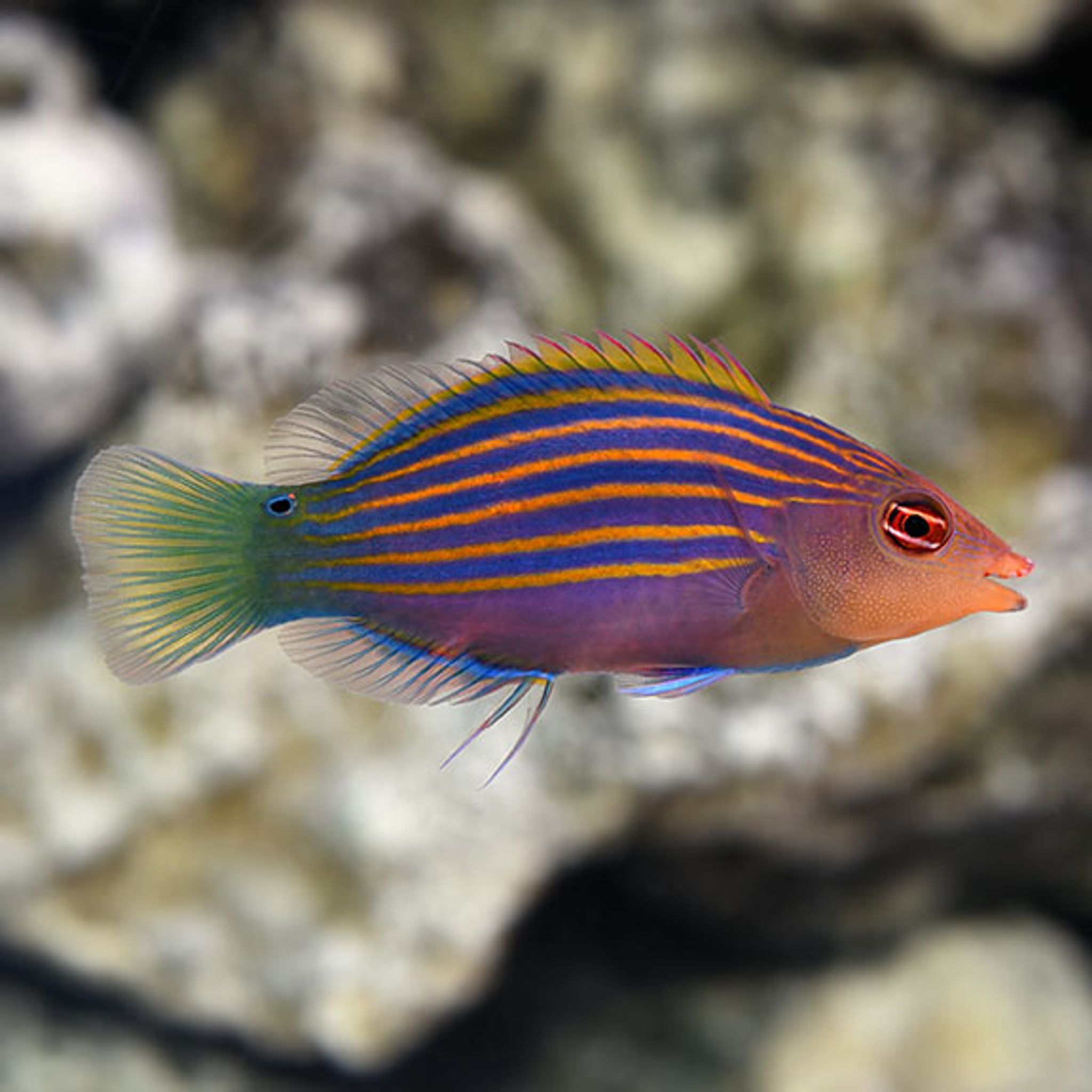
Six-Line Wrasse Care Guide: Tank Size, Diet, Compatibility and Reef Safety
The six-line wrasse (Pseudocheilinus hexataenia) is a small, hardy reef fish prized for eating pest snails and flatworms, but its territorial streak trips up more reef keepers than its care requirements do. This guide covers exact tank size, water parameters, diet, and the compatibility rules that decide whether it settles in peacefully or terrorizes the rest of your stock list.
Species Overview
The six-line wrasse belongs to the family Labridae and takes its common name (also seen as sixstripe wrasse) from the six horizontal orange-to-red stripes running down a blue-to-pink body, with a small black eye-spot near the base of the dorsal fin. It's native to Indo-Pacific reefs, ranging from the Red Sea and South Africa east to the Tuamotus, Fiji, and southern Japan. Most retail stock is wild-caught, with a large share collected around Fiji.
It's one of the smallest wrasses commonly kept in home aquariums, topping out around 3–4 inches (7.5–10 cm). In captivity it typically lives 4–6 years, and up to about 10 years with excellent nutrition and stable water quality.
One overlooked biological detail: like most wrasses, it's a protogynous hermaphrodite — it starts life female and can change to male later. That reproductive strategy, combined with the fact that virtually all trade specimens are wild-caught, is a big part of why captive breeding has never been achieved commercially for this species. Sexual maturity is reached around age 2, but no aquarist has replicated the conditions needed to spawn and raise them at home.
Tank Size and Setup
A single six-line wrasse can technically survive in a 30-gallon (114 L) tank, and that's the number most sources quote as the minimum. Treat it as an absolute floor for the fish alone. Once you factor in realistic reef stocking — other fish, corals, and rockwork the wrasse will patrol — 40–50 gallons (150–190 L) is a more practical starting point. If you plan to keep more than one wrasse species in the same display, size up to 100+ gallons (380+ L) so territories don't overlap.
Never house two six-line wrasses together. They read same-species (and similarly shaped small) wrasses as rivals and will fight, often until one is killed or so stressed it stops eating.
Aquascape Essentials
- Soft sand bed: fine to medium sand is not optional decor — six-line wrasses bury themselves in it at night and when startled. Skipping sand leads to chronic stress, excessive hiding, and appetite loss.
- Live rock with crevices and rubble: gives it places to forage for natural pods and retreat when it feels threatened.
- A tight-fitting lid: mandatory. This species is a notorious jumper, especially when newly introduced or startled, and will find any gap around cords, overflow boxes, or a loose canopy.
Water Parameters
| Parameter | Target range | Wider tolerance |
|---|---|---|
| Temperature | 75–80°F (24–27°C) | 72–82°F (22–28°C) |
| pH | 8.1–8.4 | 8.0–8.4 |
| Specific gravity | 1.023–1.025 | — |
| dKH | 8–12 | — |
| Lighting | Moderate to high | Fish itself isn't light-sensitive; match lighting to corals/inverts in the tank |
Treat the wider range as a hardiness buffer for a well-established tank, not something to aim for day to day. The species is generally hardy and disease-resistant, but it's still susceptible to standard marine ich, marine velvet, and bacterial or fungal issues, particularly during acclimation stress. Quarantine every new fish for 2–4 weeks before adding it to the display.
Diet and Feeding
Six-line wrasses are strict carnivores. In the wild they hunt copepods, amphipods, isopods, small bristleworms, flatworms, small snails (including pest pyramidellid snails), and zooplankton picked out of live rock crevices.
In the aquarium, offer:
- Mysis shrimp (staple)
- Enriched brine shrimp
- Chopped krill, clam, or shrimp
- Marine carnivore pellets and frozen carnivore blends once the fish is acclimated
Feed 2–3 small meals a day, only as much as it can finish in about two minutes. This species has a fast metabolism and does poorly on a single large daily feeding — underfeeding is a common cause of gradual weight loss. Mature live rock with an established pod population is a real asset here, giving the fish something to graze between scheduled feedings.
Is a Six-Line Wrasse Reef Safe?
This is the question most worth getting right, and it has two different answers depending on what you mean by "safe."
Coral-safe: yes. Six-line wrasses do not nip coral tissue and are considered fully reef safe with corals and sponges.
Invertebrate-safe: no. This is where a lot of generic advice falls short. The same hunting instinct that makes it useful against pests also puts ornamental micro-invertebrates at risk. It will actively eat:
- Pyramidellid snails and other pest snails
- Flatworms
- Small bristleworms
- Also at risk: ornamental snails, small shrimp, and other small desirable invertebrates it can catch
In other words, "reef safe" does not mean "invertebrate safe" for this fish. That distinction matters for any reef fish you're considering, not just wrasses — always check coral compatibility and invertebrate compatibility separately before adding a new species to a mixed reef tank.
The upside: if you're dealing with a pyramidellid snail or flatworm outbreak, a six-line wrasse is a legitimate, purposeful addition for pest control, not just a pretty stripe pattern. Just don't expect it to coexist with a delicate ornamental snail or shrimp-based cleanup crew.
Temperament and Tankmate Compatibility
Six-line wrasses are semi-aggressive and territorial for their size, and this is the single biggest reason new owners run into trouble. The fix is sequencing, not avoidance.
Add it last, or near-last, to an already-stocked, established tank. If it goes in early, it claims the rock work as its own territory and then bullies anything introduced afterward — including fish that would otherwise be perfectly compatible.
Fish it's likely to harass if added after it's settled in include:
- Mandarin dragonets
- Pipefish
- Small or newly introduced gobies and blennies
- Other dwarf/small wrasses
Good Tankmates
- Clownfish
- Larger wrasses (dragon, banana/canary wrasse)
- Tangs and surgeonfish
- Angelfish and butterflyfish
- Dottybacks
- Larger gobies
Avoid Pairing With
- A second six-line wrasse, or other small wrasse species with similar body shape and coloring
- Pipefish and seahorses
- Small ornamental shrimp
- Ornamental snails
Common Mistakes and How to Fix Them
| Mistake | Why it's a problem | Fix |
|---|---|---|
| Adding it first or early | It claims territory, then bullies later arrivals | Add it last, once other fish are settled |
| Keeping two six-lines together | Same-species/similar-looking wrasses fight | One Pseudocheilinus-type wrasse per tank |
| No lid, or gaps around overflows/cords | Classic jumping death, especially in the first weeks | Seal every gap, not just the main lid |
| Assuming "reef safe" covers invertebrates | Loses ornamental snails, shrimp, or feather dusters | Skip delicate invert cleanup crews it can reach |
| One large feeding per day | Fast metabolism leads to weight loss | 2–3 small feedings daily |
| Skipping quarantine on wild-caught stock | Introduces parasites/disease to the display | Standard 2–4 week QT with observation |
| No sand layer in a rock/frag-heavy reef | Chronic stress, excessive hiding, refusing food | Always include a soft sand bed for burying |
A Practical Introduction Routine
Because nearly all six-line wrasse stock is wild-caught and this species handles the first few days of introduction poorly if rushed, a slower approach pays off:
- Drip acclimate slowly rather than a quick bag-and-dump.
- Turn tank lights off (or keep them dim) for the release, and for the first evening.
- Offer a small feeding of mysis or brine shrimp immediately after release to start positive feeding associations.
- Minimize disturbance — avoid moving rockwork, netting other fish, or heavy maintenance — for the first several days.
- Watch for burrowing into sand at night; this is normal settling behavior, not illness.
Six-Line Wrasse Cost
Expect to pay roughly $20–$40 for a six-line wrasse at US retailers, making it one of the more budget-friendly wrasses available. That's a useful benchmark against pricier relatives discussed below — some of which run several times that price for a juvenile.
Related and Alternative Wrasses Worth Knowing
If you're weighing a six-line wrasse against other small reef wrasses, the wider Pseudocheilinus-adjacent field offers some useful contrasts.
Possum Wrasse (Wetmorella nigropinnata)
Even smaller than a six-line at around 2.5 inches, and genuinely peaceful rather than merely tolerant. It's shy and secretive, needs fine sand for burying, and is a solid pick for reef keepers who want the small-wrasse look without the attitude.
Pink-Streaked Wrasse (Pseudocheilinops ataenia)
Sometimes called the bug-eyed wrasse, this close six-line relative is one of the smallest reef wrasses at roughly 2.5 inches. It's similarly secretive and peaceful, making it a good nano-tank alternative when a six-line's territorial behavior is too much for a small system.
Active/Open-Water Wrasses: Halichoeres and Thalassoma
These genera are more active swimmers with a torpedo-shaped body, and need a longer tank with real open swimming room rather than a rock-dense reef layout. Thalassoma species stay mostly upper- and mid-water; Halichoeres species stay closer to substrate and rock and also bury in sand. Both groups tend to become more aggressive as adults and are generally unsafe with crustaceans and feather dusters — a sharper contrast to the six-line's smaller footprint and lower bioload.
Coris Wrasse (Cost and Sizing Note)
Larger-bodied Coris species, such as red coris, are sold at noticeably higher price points — often $100–$160 or more — and juveniles that look small in a store tank can outgrow anything short of a large display, with adults reaching well over a foot. Worth factoring in if you're comparing wrasse options on long-term size and budget rather than just sticker price.
Yellowtail Tamarin Wrasse (Anampses meleagrides)
A dark body with white spotting and a yellow tail, and a wide Indo-Pacific range. It's a more delicate feeder that typically needs an established live rock pod population and may need enticing with live foods initially — a useful contrast to how readily a six-line wrasse adapts to prepared foods.
Candy Hogfish (Bodianus bimaculatus)
A small hogfish relative around 4 inches, with a yellow body and pink stripes. Generally peaceful, it's another compact, reef-safe wrasse-family fish worth considering alongside the six-line for a mixed reef.
Christmas Wrasse (Halichoeres claudia)
Peaceful and easy to keep, and valued for eating flatworms and pyramidellid snails much like the six-line — but with a calmer temperament overall. A good pest-control comparison point if aggression is your main concern.
Captive Breeding Progress
The industry trend is moving toward more captive-bred wrasses overall — cleaner wrasses and red coris wrasses have both been successfully captive-bred in recent years, a notable first for coris in particular. Pseudocheilinus species, including the six-line, haven't caught up yet: essentially all six-line wrasse stock sold today is still wild-caught.
Frequently Asked Questions
Is a six-line wrasse reef safe?
Yes for corals — it will not nip coral tissue or sponges. It is not safe for small ornamental snails, shrimp, or other desirable micro-invertebrates, though it's genuinely useful against pest flatworms, bristleworms, and pyramidellid snails.
What is the minimum tank size for a six-line wrasse?
30 gallons (114 L) is the absolute floor for one fish on its own. In practice, 40–50 gallons (150–190 L) or more is a better minimum once other reef stock and tankmates are added.
Can I keep two six-line wrasses together?
No. Same-species pairs, and even other small, similarly shaped wrasses, read each other as rivals and will fight. Keep only one Pseudocheilinus-type wrasse per tank.
What do six-line wrasses eat?
A meaty carnivore diet: mysis and enriched brine shrimp, chopped krill or seafood, and marine carnivore pellets or frozen blends, supplemented by natural copepods and amphipods from live rock. Feed 2–3 small meals daily.
Will a six-line wrasse jump out of my tank?
Yes — it's a well-known jumper, particularly in the first weeks after introduction or when startled. A tight-fitting lid with no gaps around cords or overflow boxes is essential.
How long do six-line wrasses live?
Typically 4–6 years in captivity, with some reaching close to 10 years under excellent care and nutrition.
Are six-line wrasses aggressive?
Yes, they're semi-aggressive and territorial for their size, especially toward small or timid fish added after they've settled in. Adding it last to an already-stocked tank avoids most conflicts.
Can six-line wrasses be bred in captivity?
Essentially no. Nearly all specimens in the trade are wild-caught, and commercial captive breeding hasn't been achieved for this species, unlike some other wrasses such as the cleaner wrasse or red coris wrasse.
If a six-line wrasse fits your stocking plan, browse current availability along with other compatible options in FishyHub's wrasse category to compare size, coloration, and pricing before you buy.

