Royal Gramma Care Guide: Tank Size, Diet, Compatibility and Reef Safety
The Royal Gramma (Gramma loreto) is one of the most recommended first marine fish for a reason: it's hardy, colorful, and genuinely reef safe. This guide covers exactly what it needs — tank size, water chemistry, feeding, and the tankmate rules that keep it from getting hurt or turning territorial.
Identification and Natural History
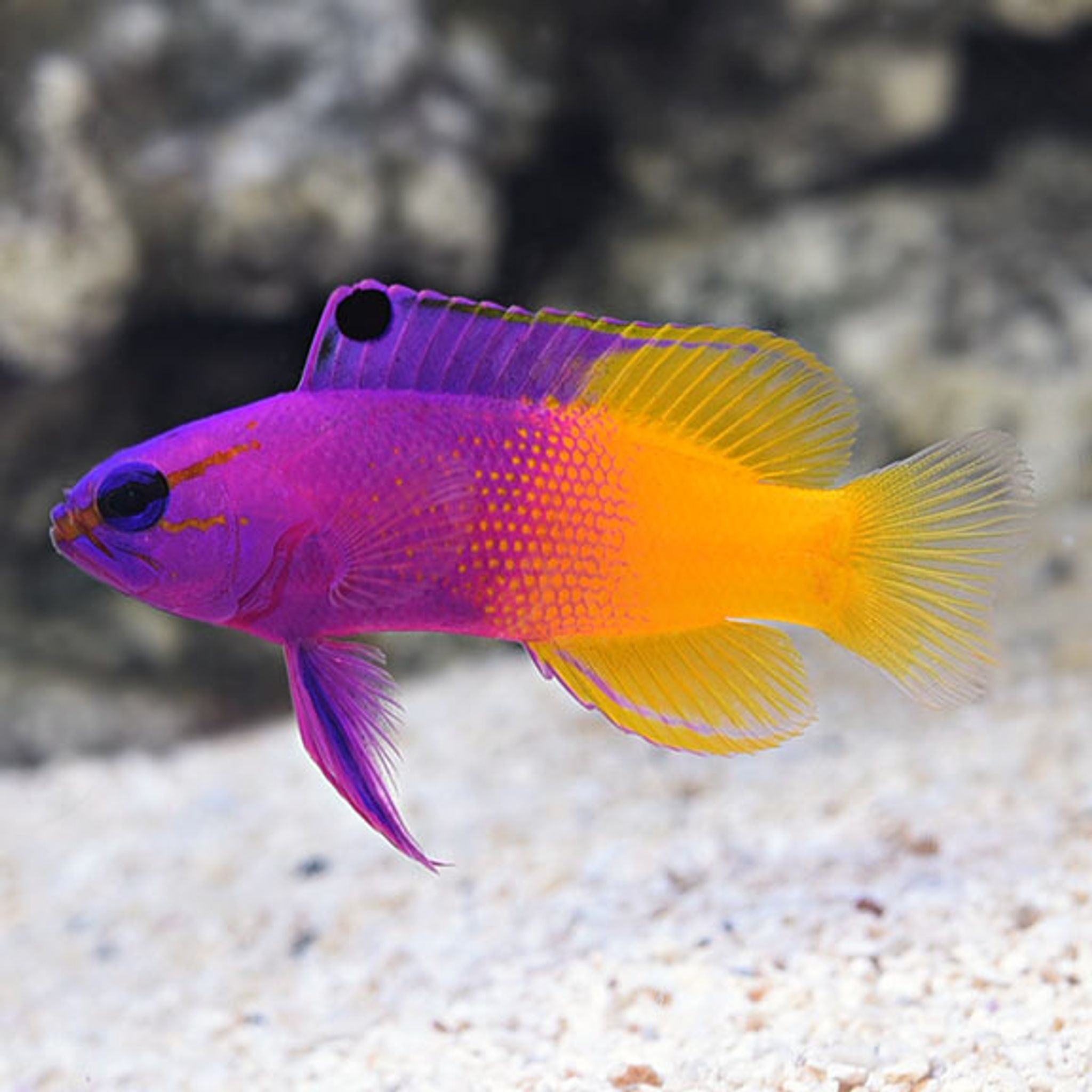
Also sold as the Fairy Basslet or Royal Gramma Basslet, this fish is native to Caribbean reefs, where it lives in caves, crevices, and beneath overhangs at moderate depth. Its coloring is unmistakable: a vivid violet-purple front half fades into golden-yellow toward the tail, with a thin black stripe running through the eye. The exact location of the color break varies by individual — some show a clean diagonal line, others a soft blend.
Adults typically reach about 3 inches, occasionally up to 4 inches in well-fed, long-term specimens. With good water quality and diet, Royal Grammas commonly live 5–6 years, and well-kept individuals have been reported to reach close to a decade.
Tank Size Requirements
| Setup | Minimum tank size | Notes |
|---|---|---|
| Single Royal Gramma | 30 gallons (114 L) | Comfortable minimum with adequate rockwork |
| Mated pair or two | 50–60 gallons (190–227 L) | Success depends heavily on aquascape, not just volume |
| Small group (3+) | Add ~20–25 gallons (75–95 L) per additional fish | Only in large, complex-rockwork systems |
For a second gramma or a pair, recommendations across sources range from 50 to 75 gallons. The honest answer is that cave count and sightline breaks matter as much as raw gallons. A 50-gallon tank absolutely packed with rockwork, overhangs, and visual barriers can support a pair; a sparser 75-gallon tank with one big rock pile might not. Think in terms of separate territories, not just water volume.
Water Parameters
Royal Grammas do best in standard reef-quality water:
- Temperature: 72–80°F (22–27°C), aiming for a mid-range of 75–78°F (24–26°C)
- pH: 8.1–8.4
- Specific gravity: 1.020–1.025, ideally 1.023–1.025
- Alkalinity: 8–12 dKH
- Ammonia/nitrite: 0 ppm
- Nitrate: kept low
These are the same parameters most reef corals and invertebrates need, which is part of why the species fits so easily into an established reef tank.
Aquascaping for Grammas: Caves Are Not Optional
Because the Royal Gramma is a cave-dweller by nature, its aquascape requirements deserve their own section rather than a passing mention. In the wild it holds a small territory around a crevice or overhang, darting out to grab food and retreating the instant it feels exposed. A tank without enough structure will produce a fish that hides constantly, loses color, and may refuse to eat.
Build the aquascape before adding the fish:
- Provide abundant live rock arranged with multiple caves, overhangs, and crevices — not just one large rock formation.
- Aim for several distinct hiding spots, especially if you plan to keep more than one gramma or basslet.
- Avoid open, sandy-bottomed layouts with minimal vertical structure.
- Include some shaded zones under rockwork even in a brightly lit reef tank — this species tolerates moderate to bright lighting but naturally prefers the dimmer pockets a cave provides.
- Let the tank cycle fully with the rockwork in place, then introduce the fish once the aquascape is finished.
A related, often-missed detail: the fish's habit of resting or swimming upside-down or sideways, oriented to the cave ceiling or wall, is completely normal cave-orientation behavior — not a sign of swim bladder trouble or illness.
Diet and Feeding
Royal Grammas are primarily carnivorous. The backbone of the diet should be frozen mysis shrimp and frozen brine shrimp, ideally vitamin-enriched, along with other meaty frozen foods. A quality marine flake or pellet food can round out the diet as a convenient supplement, but shouldn't replace the frozen meaty staples — some sources present this fish as needing flake/pellet as a base, but treating it as strictly carnivorous with occasional dry food gives more consistent color and condition.
Feeding guidelines:
- Feed small amounts 2–3 times daily rather than one large feeding.
- In an established reef tank, the fish will also pick at copepods and other micro-fauna living in the rock, supplementing its diet naturally.
- Underfeeding meaty foods and relying mostly on flake is a common mistake that leads to duller color over time.
Reef Safety
The Royal Gramma is reef safe. It does not eat coral tissue and generally ignores ornamental invertebrates like shrimp, crabs, and snails, making it a low-risk addition to a mixed reef tank.
Compatibility
Good tankmates
Royal Grammas are peaceful toward fish that don't resemble them in shape or color. Good options include:
- Clownfish
- Chromis
- Gobies
- Blennies
- Hawkfish
- Angelfish
- Tangs
- Rabbitfish
- Filefish
- Jawfish
- Squirrelfish
Fish to avoid or keep with caution
Avoid pairing a Royal Gramma with other Royal Grammas or similarly shaped, similarly colored fish — this includes royal dottybacks and other basslet species — unless the tank is large and complex enough to support multiple territories. Also avoid large predatory or aggressive species such as lionfish, eels, groupers, and other snapper-type predators that may eat or bully it.
Why Grammas Fight Each Other
This is the single most-repeated warning about the species, so it's worth explaining the "why." On a wild reef, Royal Grammas hold small individual territories along a wall of rock, each centered on its own cave. In a home aquarium, limited hiding spots plus a same-shaped rival trigger the same territorial response: chasing, fin-nipping, and chronic stress for the loser.
The fix isn't just a bigger tank — it's tank size combined with multiple simultaneous hiding spots, plus introducing potential pairs or groups at the same time rather than adding a second gramma to an already-established resident. A lone gramma that has claimed a tank as its territory will almost always defend it against a newcomer of similar appearance.
Keeping Multiple Grammas
Keeping more than one is possible, but only with adequate space and simultaneous introduction, or a true male/female pair. Adding a second gramma to a tank where one has lived alone for a while typically triggers fighting. Groups succeed more often in large systems with complex rockwork offering several distinct visual territories.
Related Basslets and Look-Alikes
Royal Grammas belong to a broader family of small, cave-dwelling reef fish that share vivid color and general reef safety, but differ in temperament, shyness, and group tolerance. Buyers researching a Royal Gramma often come across these related species while browsing marine fish for sale — here's how they compare.
| Species | Size | Difficulty | Shyness | Group-keeping | Relative price |
|---|---|---|---|---|---|
| Royal Gramma | ~3 in (up to 4 in) | Easy | Moderate | Difficult; needs space + simultaneous intro | Budget-friendly |
| Chalk bass | ~2.5 in | Easy | Low | Good — often kept in shoals of 3+ | Budget-friendly |
| Golden/Cuban basslet | ~2–3 in | Moderate | Moderate | Difficult; territorial with true grammas | Higher |
| Swissguard basslet | ~2.5 in | Moderate–hard | Very high | Poor; solitary and reclusive | Moderate–high |
| Candy basslet | ~1.5 in | Hard | Very high | Poor; needs mature, undisturbed tank | High |
| Hamlets | 4–5 in | Moderate | Low | Fish-only preferred; will eat small shrimp | Moderate |
Golden/Cuban Basslet
A related Caribbean basslet with a gold body and often a small eyespot near the tail. It shares cave-dwelling habits and reef safety with the Royal Gramma but is usually pricier and less common in the trade. Because of its similar shape, it can be territorial toward true Royal Grammas if housed together without enough space.
Chalk Bass
At roughly 2.5 inches, the chalk bass (Serranus tortugarum) is a small Caribbean sea bass with a blue-gray body and pale vertical bars. Unlike Royal Grammas, chalk bass tolerate group living well and are often kept in small shoals of three or more in a single tank. They're peaceful, reef safe, and make a common "also consider" pairing alongside a Royal Gramma in a community reef.
Swissguard Basslet
The swissguard basslet (Liopropoma rubre) is a red-and-yellow striped, deep-crevice dweller that's even more reclusive than the Royal Gramma. It's best suited to experienced keepers who can provide extensive rockwork, since it can go unseen in a tank for long stretches at a time.
Candy Basslet
The candy basslet (Liopropoma carmabi) is a deepwater, high-cost species popular in high-end reef circles. It needs a mature tank with dense rockwork and minimal disturbance, and it is not a beginner-appropriate fish — a useful contrast that highlights just how easy the Royal Gramma is by comparison.
Hamlets
Hamlets (Hypoplectrus spp.) are larger Caribbean relatives, reaching 4–5 inches, in the same broader sea bass family. They're more predatory than a Royal Gramma and will eat small ornamental shrimp or very small fish, so they suit bigger fish-only or lightly stocked reef setups rather than a delicate invertebrate-heavy tank.
The Broader Basslet and Dottyback Family
Royal Grammas, dottybacks, and true basslets span several families (Grammatidae, Pseudochromidae, and a subfamily of Serranidae) that all share small size, cave-dwelling habits, vivid coloration, and general reef safety. Most are territorial toward other members of the same family, so mixing multiple basslet- or dottyback-type species requires a large tank with rich aquascaping and several separate territories.
Acclimation and Introduction
- Finish the aquascape — caves, overhangs, rockwork — before adding the fish.
- Use a slow drip acclimation to adjust the fish to your tank's parameters gradually.
- Expect the fish to be shy for the first several days to weeks; this is normal, not a sign of poor health.
- If the fish disappears shortly after introduction, it's usually hiding and adjusting rather than deceased — give it several days to a week before assuming loss, while also ruling out chasing from another tankmate.
- Because Royal Grammas can jump, especially when startled or newly introduced, a lid or screen top is strongly recommended on open tanks.
Common Mistakes to Avoid
- Buying two grammas for a tank under 40 gallons expecting them to pair up naturally — this usually ends with one fish harassed relentlessly or hiding permanently.
- Not providing enough caves or overhangs, leading to constant hiding, stress-related color loss, or a fish that won't eat.
- Adding the fish before the rockwork and caves are established, leaving it exposed and stressed.
- Mistaking the normal upside-down resting posture for illness or a swim bladder problem.
- Housing with pseudochromis, dottybacks, or other similarly shaped/colored fish without enough space, causing chronic chasing.
- Relying mainly on flake food instead of meaty frozen foods, resulting in poor color and condition over time.
- Assuming a fish that vanishes after introduction has died, rather than waiting it out while checking for bullying.
- Leaving the tank uncovered, risking a jumping incident when the fish is startled.
Quarantine Considerations
Because Royal Grammas are shy, a bare quarantine tank can cause more stress than the treatment itself. Set up the QT with a few sections of PVC pipe or simple rock substitutes to mimic caves, so the fish has somewhere to retreat and doesn't stress-starve during the observation or treatment period. Keep the QT tank dimly lit and minimize disturbance around it.
Sourcing and Availability
Royal Grammas in the US aquarium trade are most commonly wild-caught Caribbean imports, though captive-bred stock does appear from time to time and is worth seeking out when available. Prices vary by source and season, but this species is generally considered one of the more affordable marine fish, making it accessible for a first saltwater tank. You can browse current Royal Gramma and other basslets on FishyHub, along with dottybacks if you're comparing the two families before buying.
Frequently Asked Questions
Are Royal Grammas reef safe?
Yes. Royal Grammas don't eat coral tissue and generally leave ornamental invertebrates like shrimp, crabs, and snails alone, making them a safe choice for a mixed reef tank.
How many Royal Grammas can I keep together?
One is the safest option in tanks under about 50 gallons. A pair or small group needs 50–75+ gallons with abundant, separate hiding spots, and success is much more likely when they're introduced to the tank simultaneously rather than added one at a time.
Why is my Royal Gramma hiding all the time?
This is normal for a cave-dwelling species, especially soon after introduction. Check that there's enough rockwork with real caves and overhangs, and make sure no tankmate is bullying or chasing it.
Why does my Royal Gramma swim upside down?
This is natural orientation behavior tied to its wild habit of resting against cave ceilings and walls. It is not a health issue and doesn't indicate a swim bladder problem.
What do Royal Grammas eat?
Meaty frozen foods — mysis shrimp and brine shrimp — should form the staple diet, supplemented with a quality marine flake or pellet. Feed small amounts two to three times a day.
Can Royal Grammas live with clownfish, tangs, or gobies?
Yes. Royal Grammas are generally peaceful toward unrelated, differently shaped species like clownfish, tangs, gobies, and blennies. Problems mainly arise with same-family or similarly shaped and colored fish.
How long do Royal Grammas live?
Typically 5–6 years in captivity, with well-cared-for individuals in excellent water quality sometimes reaching close to a decade.
What's the difference between a Royal Gramma and a royal dottyback?
They look similar in size and coloring, which is exactly what causes confusion at the point of purchase, but they belong to different families with different temperaments — dottybacks tend to be noticeably more aggressive. That visual similarity is also the reason the two shouldn't be housed together in a smaller tank.
Ready to start planning your reef stocking list? Browse the current selection of marine fish on FishyHub to compare Royal Grammas alongside compatible tankmates for your tank size.

