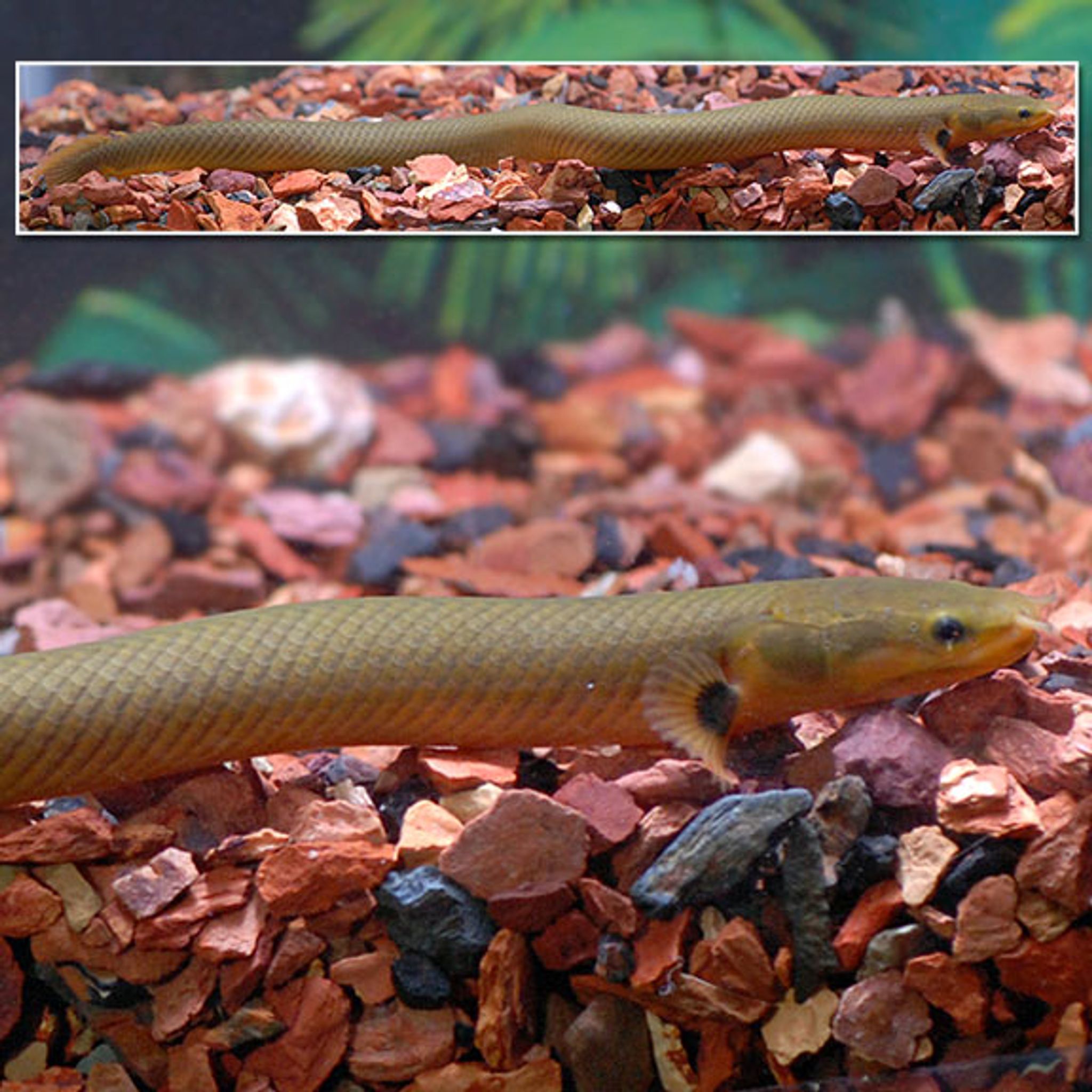

Rope Fish Care Guide: Tank Size, Diet, Water Parameters and Temperament
The rope fish (Erpetoichthys calabaricus) looks like a snake but lives like a long-term aquarium commitment, growing well past a foot and living for over a decade. This guide covers the real tank size a full-grown adult needs, what it eats, safe water parameters, and the two things that trip up most new keepers: escape-proof lids and picking tankmates it won't eat.
What Exactly Is a Rope Fish?
Despite the eel-like body, a rope fish is a true bony fish in the order Polypteriformes, closely related to bichirs. It is not an eel, not a snake, and not an amphibian — just a fish with an elongated, cylindrical body shape that evolved independently in several unrelated groups. It's native to slow-moving rivers, swamps, and floodplains across West and Central Africa, where oxygen levels in the water can drop very low.
Common names include reedfish and rope fish, used interchangeably in the hobby.
Size and Lifespan
- Adult size: typically 12–18 inches, with well-fed specimens in spacious tanks approaching 24 inches. Growth is slow, spread out over several years, which is exactly why undersized "starter tanks" become a problem later.
- Lifespan: commonly cited as 10–20 years. The honest range to plan around is up to 15–20 years with stable water quality and adequate space; real-world averages skew lower when fish are kept in cramped or poorly maintained tanks.
Tank Size and Setup
Because a rope fish is a bottom-oriented, elongated swimmer rather than a vertical one, floor space matters more than tank height.
| Setup | Recommended tank size |
|---|---|
| One juvenile (temporary, growing out) | 40+ gallons (151+ L) |
| One adult, long-term minimum | 50–55 gallons (189–208 L) |
| One full-grown adult, comfortable | 75–100 gallons (284–379 L) |
| Each additional rope fish | add roughly 10–15 gallons (38–57 L) |
Choose a long, low-footprint tank over a tall one. A 4-foot-long tank gives a nearly 2-foot fish room to turn and patrol, while a tall, narrow tank of the same volume does not.
Filtration and Lid Requirements
Rope fish are messy, heavy-bioload carnivores, so strong biological filtration is non-negotiable — undersized filters lead to ammonia spikes fast. Pair a capable filter with weekly 20–30% water changes rather than trying to compensate with media alone.
Just as important: a tight-fitting, gap-free lid. This species is one of the most notorious escape artists in the hobby, capable of squeezing through surprisingly small gaps and surviving briefly out of water thanks to its air-breathing ability. Check every potential exit point, not just the main hinge:
- Gaps where filter intake/outtake tubing or heater cords pass through the lid
- The seam between a glass lid and the tank rim on rimless or trim-less tanks
- Any corner gap on hood-style canopies that flexes with age
A heavy glass lid weighted at the corners, or a canopy with foam or silicone gap-fillers around every cutout, solves this for most tank styles. Leave a small air gap between the water surface and the lid rather than sealing it airtight — the fish needs to reach atmospheric air.
Substrate and Décor
Use soft sand or fine, rounded gravel. Rope fish have sensitive skin and barbel-like sensory tissue around the mouth, and sharp or coarse substrate causes abrasions that can turn into infections. Add plenty of driftwood, smooth rock caves, and dense planting for daytime hiding spots, plus low-to-moderate lighting that suits a nocturnal fish.
Water Parameters
| Parameter | Target range |
|---|---|
| Temperature | 72–82°F (22–28°C) |
| pH | 6.0–7.8, with 6.5–7.5 the safest middle ground |
| General hardness | Moderate — roughly 4–22 dGH; treat as "soft to medium," not an exact number |
| Ammonia / nitrite | 0 ppm |
| Nitrate | Under 20 ppm |
| Water changes | 20–30% weekly |
Sources disagree on exact hardness and pH figures partly because of inconsistent unit reporting. The practical takeaway: aim for the overlapping middle range and prioritize stability over precision — a rope fish tolerates a slightly-off number far better than a swinging one.
Rope fish can also tolerate mildly brackish conditions (specific gravity up to roughly 1.005–1.010, staying under 1.020), reflecting their native swamp habitat. Standard freshwater is still the recommended, default setup for home aquariums.
Acclimation Matters More Than It Looks
This species is generally hardy once settled, but sensitive to abrupt parameter swings during acclimation and water changes. Drip-acclimate new arrivals slowly over an hour or more rather than float-and-dump. This is especially important for wild-caught imports, which are common for this species and typically carry higher parasite and disease risk than tank-raised stock — a longer quarantine period, ideally several weeks in a bare-bottom tank, is worth the patience.
Diet and Feeding
Rope fish are strict carnivores with poor eyesight that hunt primarily by smell, mostly after dark. A varied, meaty diet should include:
- Bloodworms
- Brine shrimp and mysis shrimp
- Chopped earthworms
- Small pieces of shrimp, prawn, or fish
- Occasional chopped whole fish (avoid live feeder fish where possible — they carry disease risk)
Feeding schedule: default to once daily in the evening, after lights-out, dropping food near where the fish is hiding. Feeding a slightly larger portion every other day is an acceptable variant. Whichever schedule you pick, avoid overfeeding — leftover meaty food fouls water quickly given how much waste this species already produces.
Temperament and Tankmates
Rope fish are nocturnal and secretive, spending most daylight hours hidden among plants, driftwood, or rock caves. They are peaceful toward fish of similar or larger size but genuinely predatory toward anything small enough to swallow — this is opportunistic feeding, not aggression. Multiple rope fish generally coexist peacefully with each other.
A practical rule of thumb: avoid any tankmate under roughly 2–3 inches, since anything smaller risks becoming a meal rather than a companion.
Good tankmates:
- Angelfish
- Gouramis
- Larger tetras and rainbowfish
- Loaches
- Plecos and corydoras
- Bala sharks, rainbow sharks
- Other bichirs
Avoid:
- Small, nippy, or tiny fish — they'll be eaten or will harass the slow-moving rope fish
- Genuinely aggressive fish such as African cichlids or oscars, which can injure it
- Shrimp and small invertebrates — expect them treated as food, not tankmates
Anyone stocking a rope fish tank around similarly laid-back species can browse compatible options in FishyHub's bichir category or larger freshwater fish under Monster Fishes.
Air-Breathing: Normal Behavior, Not an Emergency
Rope fish have a modified swim bladder that works like a primitive lung, letting them gulp air at the water's surface — an adaptation for the low-oxygen swamp waters they evolved in. This is normal and expected, similar in concept (though not organ) to how bettas and gouramis use a labyrinth organ, or how lungfish breathe air.
For context: fish don't actually "drown" from water entering lungs the way mammals do — they suffocate from too little dissolved oxygen in the water they're breathing through their gills. A rope fish surfacing occasionally for air is unrelated to that risk; it's simply using a backup oxygen source.
When to worry: occasional surface visits are normal. A red flag is a noticeable increase in frequency combined with lethargy, clamped fins, or loss of appetite — that combination points to poor water quality, not the air-breathing behavior itself. Keep gentle surface agitation running and never seal the tank lid airtight, since the fish needs that air gap.
Freshwater "Eel-Like" Fish: How Rope Fish Compares
Rope fish are one of several snake-shaped fish commonly sold under "eel" names, even though most aren't true eels. True eels (order Anguilliformes) migrate to the ocean to spawn — none of the fish below do that.
| Fish | True eel? | Approx. adult size | Tank size | Notes |
|---|---|---|---|---|
| Rope fish | No (bichir relative) | 12–18 in, up to ~24 in | 50–100+ gal | Carnivore, air-breather, escape risk |
| Fire eel | No (spiny eel) | Up to 3 ft | 80+ gal | Burrowing sand-dweller, solitary — avoid keeping two together |
| Peacock eel | No (spiny eel) | Smaller, more compact | Smaller than fire eel | More beginner-friendly spiny eel, similar nocturnal carnivore habits |
| Tire track eel / pink paddletail eel | No (spiny eels) | Large | Large | Less common, burrowing, nocturnal, carnivorous |
| Dragon goby | No (goby) | Moderate | Brackish-leaning setup | Omnivore/detritus grazer — very different diet from rope fish |
| Rubber eel | No (actually an amphibian, a caecilian) | Varies | — | Not even a fish, despite the name |
| Electric eel | No (knifefish relative) | Very large | Very large, specialist setup | Generates electric shocks; not a casual community fish |
The fire eel is worth considering for someone who wants a bigger "eel-look" centerpiece fish and has room for an 80+ gallon tank, since it shares a similar temperature and pH range with the rope fish but grows even larger and prefers to burrow in sand. The peacock eel is the more compact, beginner-friendly option in the same family if a smaller footprint is the priority.
Breeding
Breeding rope fish in a home aquarium is essentially never accomplished by hobbyists. Most specimens in the trade are wild-caught, and captive breeding typically requires hormone induction or very specific environmental triggers that aren't practical to replicate at home. Treat this as a species you keep, not one you plan to breed.
Common Mistakes to Avoid
- Buying a juvenile for a small tank without planning for a 15+ inch adult — leads to stunted growth or a stressful rehoming later.
- Loose-fitting lids — the single most common cause of a rope fish turning up dead on the floor. Check cord cutouts and corner seams, not just the main lid.
- Assuming peaceful coexistence with small fish or shrimp — anything bite-sized eventually gets eaten.
- Overfeeding meaty foods — fouls water fast given the heavy bioload; pair feeding with strong filtration and consistent water changes.
- Misreading normal night-time air-gulping as an emergency, while ignoring genuinely increased gasping paired with lethargy or clamped fins, which does signal a real water-quality problem.
- Using rough or sharp décor that scrapes the skin, opening the door to fungal or bacterial infections — stick with smooth driftwood, smooth rock, and sand-based substrate.
- Skipping drip acclimation — abrupt parameter changes during introduction are a common stress trigger for an otherwise hardy fish.
Frequently Asked Questions
How big of a tank does a rope fish actually need?
Fifty gallons is the realistic minimum for one adult, but 75–100 gallons is more comfortable for a full-grown specimen approaching 2 feet. Prioritize a long, low-footprint tank over a tall one, since floor space matters more than depth for this species.
Can rope fish live with other fish, or will they eat everything?
They're peaceful toward fish of similar or larger size, but will eat anything small enough to fit in their mouth — a rough cutoff is anything under 2–3 inches. Choose tankmates like angelfish, gouramis, larger tetras, loaches, or plecos rather than small or nippy species.
Why does my rope fish keep going to the surface for air?
It has a lung-like organ that lets it breathe atmospheric air, an adaptation from its native low-oxygen swamp habitat, so occasional surfacing is completely normal. Watch for a noticeable increase in frequency combined with lethargy or clamped fins, since that combination points to poor water quality rather than normal behavior.
Can rope fish escape their tank?
Yes — they're one of the most notorious escape artists in the aquarium hobby and can push through surprisingly small lid gaps. A heavy, gap-free lid covering every cutout, including cord and tubing openings, is essential at all times.
What do rope fish eat?
They're strict carnivores that eat meaty frozen or live foods like bloodworms, brine or mysis shrimp, chopped earthworms, and small pieces of shrimp or fish. Because they hunt mainly by smell at night, feeding after lights-out gets the best results.
How long do rope fish live?
Commonly 10–20 years with stable water quality and adequate space, though real-world averages tend to be lower when fish are kept in cramped or poorly maintained setups. A larger, stable tank is the biggest factor in reaching the upper end of that range.
Can I breed rope fish at home?
It's extremely rare in captivity and generally not realistic for typical hobbyists, since most successful breeding has relied on hormone induction or very specific triggers. Nearly all rope fish sold in the trade are wild-caught rather than captive-bred.
Is a rope fish the same as an eel?
No — a rope fish is a true bony fish in the bichir family, unrelated to true eels (order Anguilliformes) despite the shared snake-like body shape and overlapping common names. True eels also migrate to the ocean to spawn, which rope fish never do.
Ready to plan a setup around one? Browse tank-appropriate equipment and filtration in FishyHub's Filters category, or check current freshwater stock under Freshwater Livestock before choosing a tank size.


