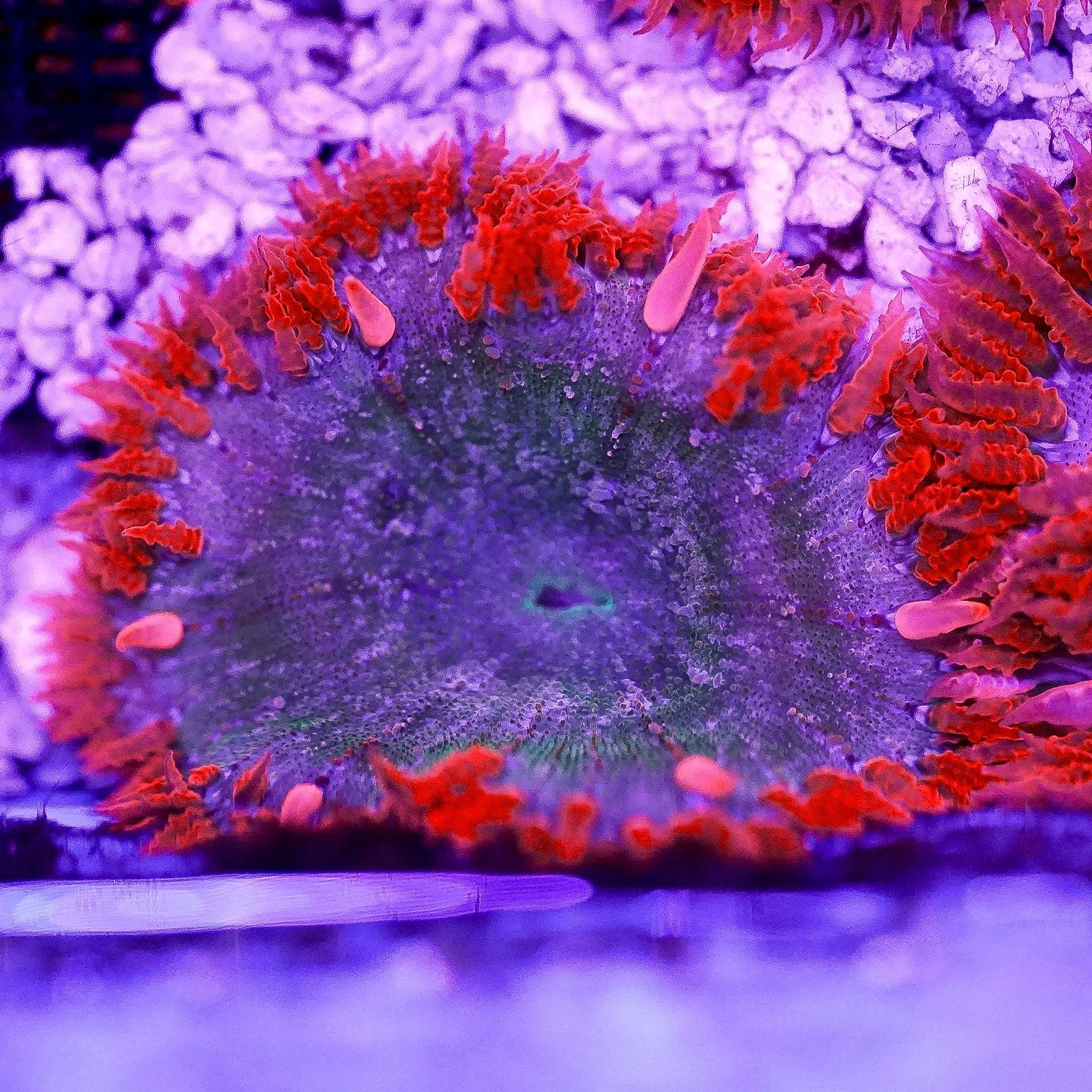

Rock Flower Anemone Care Guide: Tank Requirements, Feeding and Compatibility
Rock flower anemones (RFAs) are one of the few true anemones that reward beginners instead of punishing them. This guide covers the exact tank parameters, feeding routine, placement, and tankmate choices that keep them colorful and stationary for years, plus the mistakes that most often kill them.
What Is a Rock Flower Anemone?
Rock flower anemones belong to the genus Phymanthus, with roughly 10-11 recognized species. Unlike most anemones sold for reef tanks, which hail from the Indo-Pacific, RFAs are native to the tropical Caribbean and the coastal waters of South Florida.
Their signature feature is a flat oral disk ringed by up to about 200 short, often knobby or fuzzy tentacles that fan out like flower petals — hence the name. Color variation is extreme: turquoise, neon green, red-orange, pink, and gold specimens are common, and it's normal for a single animal to show several of these colors at once.
Size is modest and predictable:
- Sold small, typically 1-2 inches (2.5-5 cm) across the disk
- Most specimens max out around 2-4 inches in captivity
- Occasionally reaches 6-8 inches under excellent long-term care
Because they attach to one spot and rarely move, RFAs suit everything from a small nano cube to a large display reef, which is part of why they're often recommended as a first anemone.
Tank Requirements
Stability matters more than hitting an exact number. RFAs tolerate more parameter drift than most true anemones, but sudden swings — a skipped water change, a heater failure, a big dosing correction — still cause stress and bleaching. Aim for the ranges below and keep them consistent week to week.
| Parameter | Target Range |
|---|---|
| Temperature | 75-80°F (24-27°C) |
| Specific gravity (salinity) | 1.024-1.026 |
| pH | 8.1-8.4 |
| Alkalinity | 8-12 dKH |
| Calcium | 400-450 ppm |
| Magnesium | 1250-1350 ppm |
Lighting
RFAs host photosynthetic zooxanthellae and do best under moderate to moderately-high reef lighting, roughly PAR 80-150. Both LED and T5 fixtures work fine. New arrivals should never go straight under full-intensity light — acclimate them by starting on a lower setting or a shaded shelf, then ramping intensity up gradually over 1-2 weeks. Skipping this step is one of the more common causes of bleaching in newly purchased anemones.
Flow
Gentle to moderate, indirect current is ideal. Too much flow makes an RFA deflate and detach, tumbling around the tank and stinging whatever it touches. Too little flow lets detritus settle on the disk. For the first day or two after placing a new anemone, turn flow down or off entirely near it so the pedal disk (foot) has a chance to grip the rock or sand.
Placement
RFAs need a crevice in the rockwork or a stable anchor point in the sand bed. Once they attach, they typically stay in that exact spot indefinitely — this is one of their biggest advantages over wandering species like carpet anemones. Leave a buffer of a few inches from neighboring corals and other anemones; RFA tentacles carry a sting that can damage nearby sessile animals, and the reverse is true as well.
Nutrient Export and Water Quality
RFAs generally tolerate a reasonably wide range of nitrate and phosphate compared to SPS corals, but very high nutrients dull coloration over time by affecting the health of their zooxanthellae, while a tank stripped bare by an oversized skimmer or aggressive GFO use can also mute color and slow growth. Run a protein skimmer and modest nutrient export as you would for any reef system, and use feeding (below) to compensate if colors start looking washed out.
Feeding a Rock Flower Anemone
RFAs get a meaningful share of their energy from photosynthesis, but they grow faster and hold richer color with regular target feeding of meaty foods:
- Mysis shrimp
- Brine shrimp
- Chopped shrimp or scallop
- Chopped cyclops or baby brine shrimp for juvenile/small specimens
Deliver food directly to the central mouth using a turkey baster, pipette, or feeding tongs rather than broadcasting it into the water column, where it's more likely to feed everything else in the tank instead.
Feeding frequency recommendations vary across sources, from once a week up to three times a week. Twice a week is a solid default for most home tanks. Bump feeding up toward three times a week for smaller or juvenile specimens, or when you want faster growth and more vivid color; once a week is the minimum floor to keep an adult specimen healthy long term. Missing an occasional feeding won't be fatal since photosynthesis covers the gap, but skipping target feeding altogether tends to produce a pale, slow-growing anemone.
Choosing and Acclimating a Healthy Specimen
Look for these signs before buying:
- Fully extended, plump tentacles — not shriveled or limp
- A firm, closed mouth — a gaping or protruding mouth signals stress or decline
- An intact pedal foot that isn't mushy or dissolving
- Vivid, even coloration across the disk
Avoid anything deflated, mushy, or with visible tears in the tissue.
Once home, use slow drip acclimation rather than a quick dunk-and-drop. Critically, do not treat an RFA the way you'd treat a coral frag: standard coral-dip solutions are risky for rock flower anemones and can cause injury or death. Skip the dip and rely on drip acclimation plus gradual light ramping instead.
Quarantine and Acclimation Checklist
- Float the bag to match temperature (15-20 minutes).
- Begin a slow drip acclimation, adding small amounts of tank water over 30-60+ minutes.
- Skip any coral-dip step — RFAs don't tolerate it well.
- Place in a shaded or lower-light spot; do not expose to full-intensity lighting on day one.
- Reduce flow near the placement spot for the first 24-48 hours to let the foot attach.
- Ramp lighting intensity up gradually over 1-2 weeks.
- Begin target feeding once the anemone shows normal extension, typically within a few days.
Stocking Density and Spacing
There's no strict formula, but a practical rule of thumb is to allow enough footprint that a fully expanded RFA — up to several inches across at maximum size — doesn't touch its neighbors. In a nano tank, that generally means one RFA per 10-15 gallons of rock footprint as a starting guideline, spacing multiple specimens several inches apart on the rockwork. Because they don't move once settled, you can plan spacing at placement time rather than worrying about them wandering into trouble later.
Compatibility: What Can Live With a Rock Flower Anemone?
This is where advice online gets inconsistent. Many sources call RFAs safe with "most fish," while others specifically flag risks. The more accurate framing: RFAs are not aggressive, but they aren't invulnerable either, and a few tankmates are worth flagging rather than declaring the species universally fish-safe.
- Clownfish — RFAs are not a natural host species for clownfish. Some clownfish will still try to host in them, and in the process can pick at and damage tissue that never evolved to tolerate that behavior. Watch closely if you keep both, or avoid the pairing.
- Sand-sifting sea stars — can disturb a sand-anchored RFA while foraging.
- Anemone-eating or predatory fish — certain butterflyfish, some large wrasses, and triggerfish may pick at or eat anemones outright.
- Peaceful reef fish, shrimp, and most inverts — generally compatible, provided they aren't the species above.
If you're stocking a reef around an RFA, browse marine invertebrates and check individual species notes for anemone compatibility before adding anything predatory.
Anemone Look-Alikes: Don't Confuse These at the Store
Not everything labeled "anemone" in the trade is actually a true anemone, and confusing species can lead to bad tankmate decisions.
| Animal | True Anemone? | Key Traits |
|---|---|---|
| Rock flower anemone (Phymanthus) | Yes | Sedentary, moderate light/flow, safe-ish with most fish except clownfish |
| Black widow anemone (a bubble-tip, Entacmaea quadricolor color morph) | Yes | Pink/red tentacles, dark blue-black oral disk; wanders, hosts clownfish, needs brighter light |
| Orange ball "anemone" (Pseudocorynactis) | No — corallimorph | Voracious predator; extremely sticky tentacles can catch small fish and shrimp |
| Tube anemone (cerianthids, e.g. Pachycerianthus) | No — separate group | Lives in a self-secreted felt tube; very long sting reach; needs isolation from corals and small fish |
Black Widow Anemone
The black widow is a striking color morph of the bubble-tip anemone, a completely different genus from RFAs. It's a true host anemone for clownfish, but it behaves very differently — it wanders around the tank looking for a preferred light and flow spot, and it needs brighter lighting than an RFA. Don't expect RFA-style stability if you bring one home.
Orange Ball Anemone
Despite the common name, the orange ball is a corallimorph (a mushroom-coral relative), not a true anemone. It's an opportunistic predator with unusually sticky tentacles capable of catching and consuming small fish and shrimp. Treat it as a cautionary example of why species ID matters before assuming any anemone-like animal is RFA-level docile.
Tube Anemone
Cerianthids are another anemone relative but not true anemones. They live inside a self-built felt-like tube buried in soft substrate and have a surprisingly long sting reach for their size. Never house one near corals, clownfish, or other small fish, and note that some temperate species need cooler water and lower light — the opposite of an RFA's tropical, moderate-light needs.
Other Beginner-Friendly Anemones Worth Knowing
RFAs aren't the only approachable option. A few relatives worth knowing about when comparing anemones for a first reef tank:
- Condy anemones — hardy and affordable, often recommended alongside RFAs for beginners, though they can wander more.
- Caribbean anemones that host commensal shrimp — interesting for keepers wanting a symbiotic pairing without a full clownfish-hosting setup.
Just remember that "anemone" on a label doesn't guarantee true-anemone behavior — always confirm the species before buying, especially if small fish or shrimp share the tank.
Reproduction and Lifespan
With stable parameters, rock flower anemones commonly live many years — up to a decade or more in a well-maintained tank. They reproduce sexually through broadcast spawning, which requires separate male and female individuals releasing gametes into the water. Asexual reproduction via pedal laceration (a form of fragging) is rare in the wild and is considered an advanced, high-mortality procedure in captivity — better left to experienced keepers than attempted casually.
Setting Up the Right Tank
RFAs are genuinely flexible on tank size. A stable 10-gallon nano upward can house one comfortably, and because they stay put, larger reef systems work equally well for a small group.
For a first anemone tank, a compact all-in-one nano saltwater kit (commonly in the 13-gallon class) is a practical on-ramp — these bundle lighting, filtration, and flow control suited to one or two RFAs without requiring a full custom build. Keepers who outgrow a small starter kit often move to a larger all-in-one system (32-gallon-class "cube" style tanks are a common upgrade path), adding a stronger return pump, supplemental LED lighting, a protein skimmer, and finer flow control valves to dial in the moderate, stable flow RFAs prefer in a still-compact footprint.
One style to skip for RFAs specifically: cold-water or Mediterranean nano biotope tanks. These niche setups run at much lower, unheated temperatures suited to temperate species, which is the opposite of the tropical 75-80°F range RFAs need. They're worth knowing about as a contrast, not as an RFA housing option.
Browse current anemones and pair your setup with appropriate LED lighting sized to your tank's PAR needs before adding one.
Common Mistakes and Troubleshooting
| Mistake | Result | Fix |
|---|---|---|
| Placing in high flow | Deflates, detaches, tumbles and stings other corals | Relocate to a lower-flow zone; reduce pump output temporarily |
| Skipping target feeding | Pale color, slow growth | Add regular meaty feedings, 1-3x/week |
| Full-intensity light on day one | Bleaching | Ramp lighting gradually over 1-2 weeks |
| Coral-dipping like a stony frag | Injury or death | Use drip acclimation; skip standard dip |
| Housing with clownfish expecting hosting | Clownfish pick at and damage tissue | Monitor closely or avoid pairing |
| Placing too close to neighbors | Sting damage to both animals | Leave several inches of buffer |
| Ignoring a gaping mouth or dissolving foot | Mistaken for "settling in" while anemone declines | Check parameters and flow immediately, don't wait it out |
| Misidentifying a corallimorph or cerianthid as an RFA | Predatory look-alike eats small fish/shrimp | Confirm species before buying |
Frequently Asked Questions
Do rock flower anemones need a host fish like clownfish?
No. RFAs are not a natural host species for clownfish, and some clownfish will irritate or damage them rather than form a beneficial relationship. They do fine without any host fish at all.
Can rock flower anemones move around the tank?
Rarely. Once an RFA attaches its pedal foot in a crevice or sand pocket, it typically stays put indefinitely, unlike carpet or bubble-tip anemones, which wander in search of preferred light and flow.
How often should I feed a rock flower anemone?
About 1-3 times a week with small meaty foods like mysis or chopped shrimp, delivered directly to the mouth. They also get energy from photosynthesis, so an occasional missed feeding isn't fatal, but regular feeding improves color and growth.
What size tank do I need?
Any stable reef tank from roughly a 10-gallon nano upward works well, since RFAs stay small and stationary rather than needing room to roam.
Are rock flower anemones reef safe? Can they sting corals?
They can sting neighboring corals and other anemones on contact, so give them a few inches of clearance from other sessile animals when placing them in the rockwork.
How long do rock flower anemones live?
Many years — commonly cited as up to a decade or longer — provided parameters stay stable and feeding is consistent.
Can I frag or propagate a rock flower anemone?
Technically yes, via pedal laceration, but it's difficult and carries high mortality risk. Most reproduction seen in home tanks comes from spawning between separate male and female individuals rather than deliberate fragging.
Why is my rock flower anemone's mouth gaping open?
A gaping or protruding mouth is usually a stress signal tied to poor water quality, starvation, or recent shipping stress. Check your parameters, evaluate flow and lighting, and consider offering a feeding once the anemone is settled.
Ready to add one to your reef? Browse available anemones on FishyHub and pair your pick with compatible tankmates from the marine invertebrates category.


