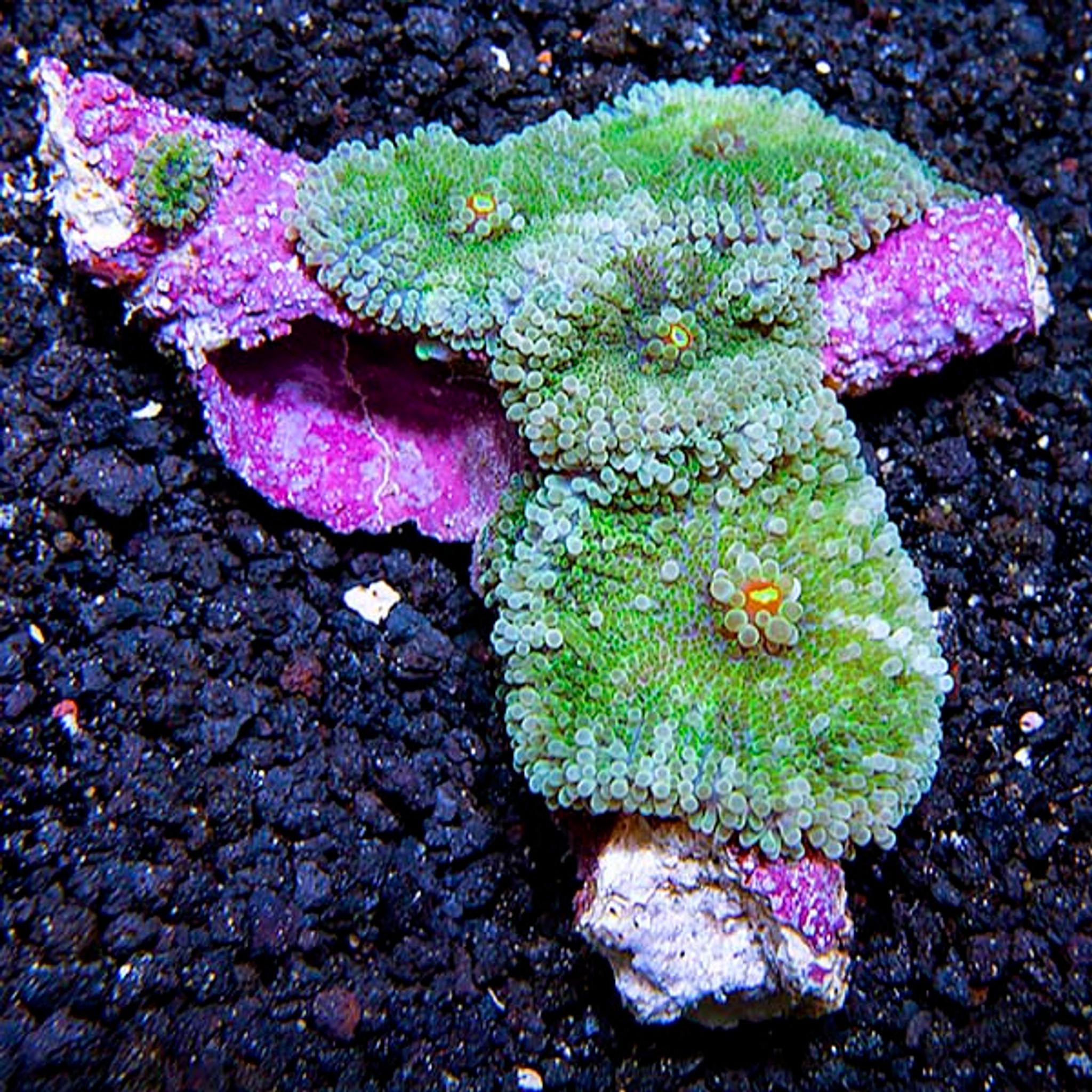

Ricordea Care Guide: Lighting, Flow, Feeding and Placement
Ricordea mushrooms are prized for packing several bright colors onto one polyp, but new keepers often stall out on how much light and flow they actually need. This guide covers the numeric ranges for lighting, flow, feeding, placement, and water parameters so you can set a ricordea up for steady growth instead of guessing.
Florida vs. Yuma: Which Ricordea Should You Start With?
Two species dominate the hobby, and picking the right one shapes how forgiving your setup needs to be.
- Ricordea florida — native to the Atlantic and Caribbean, this is the hardier of the two. It hybridizes and color-morphs widely, tolerates a broader swing in light and flow, and is generally considered the more beginner-proof option.
- Ricordea yuma — from the Indo-Pacific, yuma polyps can show three to four colors on a single animal (think blue, green, orange, purple, and pink combinations). That color payoff comes with a trade-off: yuma is more sensitive to lighting and flow extremes and rewards careful, gradual adjustments rather than "set and forget" placement.
If this is your first ricordea, florida gives you more margin for error. If you already have a stable, mature system and want maximum color variety, yuma is worth the extra attention.
Lighting: Start Low, Raise Slowly
The single most common beginner mistake with ricordea is lighting it like an SPS coral. Ricordea gets most of its energy from the zooxanthellae (symbiotic algae) living in its tissue, and it does not need intense light to thrive.
- Target range: roughly 50–100 PAR as a safe starting point, with well-acclimated colonies tolerating up to about 150 PAR.
- Spectrum: full-spectrum LED with a touch of actinic blue brings out fluorescent colors without overdriving the polyp.
- No PAR meter? Use rock position as a proxy — place new arrivals on a lower shelf, in partial shade, or under an overhang, then move them up only after they've settled in for a few weeks.
Sources disagree here: most call for low-to-moderate light, while a minority describe ricordea tolerating "moderate to high" or even strong light. Treat the higher end as something a long-acclimated colony can eventually handle, not a starting point. Bleaching and color washout from light introduced too fast is a far more common real-world problem than a ricordea getting too little light. If you're shopping for a fixture, a dimmable LED lamp lets you ramp intensity gradually over 2–4 weeks rather than jumping straight to a fixed output — you can browse options in FishyHub's LED lighting selection.
Flow: Gentle and Indirect
Ricordea has no skeleton — it's a soft-bodied polyp that relies entirely on tissue and a muscular foot to hold its shape. Strong, direct flow tears tissue, keeps the polyp closed or deflated, or can blow it clean off the rock.
- Target: low-to-moderate, indirect or randomized flow — avoid pointing a powerhead or return nozzle straight at it.
- Wild-population caveat: one commonly cited observation notes that Florida ricordea in the wild can live in shallow zones with swift current. That's a fact about wild habitat, not a tank recommendation — captive specimens consistently do better with gentler flow, since aquarium flow tends to be more turbulent and concentrated than open-water current.
- Sign of too much flow: a polyp that stays balled up, deflated, or won't fully extend its tentacles even days after placement.
Feeding: Optional, But It Pays Off in Color and Growth
Ricordea doesn't require target feeding to survive, but supplemental feeding measurably improves growth rate and color saturation, especially in leaner systems.
- Frequency: 1–3 times per week is the practical range; feed toward the higher end if you're pushing growth or color, and back off if nutrients are already running high.
- Foods: mysis shrimp, brine shrimp, zooplankton, and coral-specific pellet or powder foods work well. Cut larger pieces down to about 1/4–1/2 inch so the mouth can close around them.
- Method: use a turkey baster or pipette to target-feed directly onto or right next to the mouth, minimizing food drifting onto neighboring corals or into the substrate.
- Bonus: ricordea also absorbs dissolved organics and nitrate straight from the water column, so it tolerates — and can even benefit from — a slightly higher-nutrient system than SPS-dominated tanks. In an ultra-low-nutrient reef, a ricordea that's fading or shrinking is often just underfed; a coral-specific gel or powder food can help. Check FishyHub's coral and marine food selection for feeding supplies.
Placement: Space It Out and Let It Settle
Ricordea does best in lower-to-mid rockwork, on a flat rock, or directly on the sand bed — anywhere it sits in a shaded or moderate-light zone away from direct flow.
- Clearance: leave at least 2–4 inches between a ricordea and its nearest coral neighbor. Its sweeper-like stinging cells extend well past the visible base of the polyp, and it can just as easily be stung by a more aggressive neighboring coral.
- It may walk on its own. Ricordea can relocate itself via pedal laceration if it's unhappy with a spot. If it moves a few inches overnight, that's normal behavior, not a crisis — just check that its new spot still has appropriate light and flow.
- Securing a loose specimen: rather than gluing the animal's tissue directly (which can damage it), wedge the base rock into a crevice or use a small amount of putty/glue on the rock itself, not the polyp, until it attaches naturally.
Substrate vs. Rockwork
Florida ricordea often does well loose on sand or a flat rock in a shaded pocket, since that mirrors its natural rubble-and-sand habitat. Yuma colonies are more commonly rock-mounted higher in the aquascape for visibility, but given yuma's greater sensitivity, keep it in a shadier position on that rock rather than the most brightly lit face.
Water Parameters
Stability matters more than hitting an exact number, but these are the consensus reef ranges that support healthy ricordea:
| Parameter | Target Range |
|---|---|
| Temperature | 72–78°F (22–26°C), some sources extend to 82–83°F (28°C) |
| pH | 8.0–8.4 |
| Specific gravity | 1.023–1.025 |
| Alkalinity | 8–12 dKH |
| Calcium | 380–450 ppm |
| Magnesium | 1200–1350 ppm |
| Nitrate | ~1–10 ppm (tolerates higher than SPS) |
| Phosphate | ~0–0.1 ppm |
Quarantine and Acclimation
New ricordea should go through a drip acclimation for salinity before entering the display, and it's worth dipping and quarantining the specimen first — mushroom-eating nudibranchs and flatworms are a real hitchhiker risk that's easy to miss on a folded-up polyp. After acclimation, don't expect immediate extension:
- First few days to a week: it's normal for a newly introduced ricordea to stay closed while it adjusts. Avoid moving or poking it during this window.
- Light ramp: if you're moving it into a brighter system than it shipped from, plan a 2–4 week ramp — start on a lower shelf and raise it gradually rather than placing it at target light on day one.
Propagation
Ricordea reproduces naturally in two ways: longitudinal fission, where a polyp splits into two, and pedal laceration, where it leaves behind a bit of foot tissue that grows into a new polyp. Both happen on their own in a healthy, well-fed colony.
To frag manually:
- Cut through the center of the mouth with a sharp blade or razor, dividing the polyp into two pieces with foot tissue attached.
- Dip both halves in iodine.
- Leave them unglued on a low-flow frag rack — ricordea heals quickly and will attach to the rack on its own within days to a couple of weeks.
If a mat of ricordea starts spreading toward a neighboring coral, split off the leading edge before it makes contact rather than waiting for a sting to force the issue.
Compatibility
Ricordea is reef-safe with fish and gets along fine near clownfish, tangs, other mushrooms, zoanthids, and properly spaced LPS or SPS corals. The one real risk hobbyists underestimate is coral-to-coral aggression: ricordea uses sweeper tentacles and mesenterial filaments to sting anything that touches it, and it's equally vulnerable to being stung back. Keep that buffer zone in mind any time you're stocking around it — browse LPS corals if you want to plan compatible tankmates with enough spacing.
Common Mistakes and Troubleshooting
| Symptom | Likely Cause | Fix |
|---|---|---|
| Pale or bleached color | Light too intense or added too fast | Move to lower light, extend acclimation over weeks |
| Shrinking or staying closed | Flow too strong, light too intense, or a parameter swing | Reduce flow/light; check salinity and temperature stability |
| Won't open after introduction | Normal acclimation stress | Wait 3–7 days without moving it |
| Jelly-like film, tissue melting | Physical damage or major stress (brown jelly disease) | Isolate, remove affected tissue, iodine-dip, quarantine |
| Getting stung or stinging neighbors | Insufficient spacing | Leave 2–4 inches of clearance from other corals |
| Fading in an otherwise healthy tank | Nutrient-poor water | Add target feeding 1–3x weekly |
Why Ricordea Is a Top Beginner Coral
Ricordea sits in the same easy-care tier as zoanthids, other mushroom corallimorphs like discosoma, and soft corals such as green star polyps. What they share: wide tolerance for parameter swings, no demand for intense lighting or flow, fast recovery from keeper mistakes, and forgiving nutrient tolerance. Ricordea stands out within that group for its color payoff — it's a natural step up from plain mushrooms or zoanthids for someone who wants brighter, more varied color without taking on an SPS-level lighting and flow commitment. You can compare it against other easy soft corals in FishyHub's mushroom coral category or the broader soft coral selection.
Frequently Asked Questions
Do ricordea mushrooms need special lighting?
No. Low-to-moderate output from a standard reef LED or T5 fixture is enough. Avoid pointing high-intensity SPS-tier light directly at a ricordea, since that's the most common cause of bleaching.
Do I need to feed ricordea mushrooms?
Feeding isn't required for survival, but it noticeably improves growth and color. Target-feeding 1–3 times per week with mysis, brine shrimp, or a coral-specific food is plenty for most tanks.
Why did my ricordea shrink or close up?
Usually it's flow or light that's too strong, a recent parameter swing (salinity or temperature), physical irritation from a neighboring coral or a pest, or simply normal acclimation stress after being moved.
Can ricordea sting other corals?
Yes. It uses sweeper tentacles and mesenterial filaments that extend well past its visible base, so keep several inches of clearance between it and other corals, especially soft corals and LPS.
What's the difference between Ricordea florida and Ricordea yuma?
Florida is hardier and more forgiving of lighting and flow mistakes, making it the safer beginner pick. Yuma tends to show more colors per polyp and brighter combinations, but it's less tolerant of light and flow extremes.
How do I frag or propagate ricordea?
You can let it split naturally through fission or pedal laceration, or cut through the center of the mouth with a sharp blade, iodine-dip both halves, and leave them unglued on a low-flow frag rack until they attach on their own.
What water parameters does ricordea need?
Standard reef parameters work well: temperature in the mid-to-high 70s°F, pH 8.0–8.4, specific gravity 1.023–1.025, and alkalinity 8–12 dKH, with more tolerance for elevated nitrate and phosphate than SPS corals need.
Ricordea's combination of low light and flow demands, forgiving nutrient tolerance, and standout color makes it one of the better second corals to add once you've got the basics down. Browse current specimens in FishyHub's mushroom coral category to find a color pattern that fits your tank.


