
Queen Angelfish Care Guide: Tank Size, Diet, Compatibility and Reef Safety
The queen angelfish (Holacanthus ciliaris) is one of the largest and most striking marine angelfish in the hobby, but it needs a serious system to match its size and appetite. This guide covers the real minimum tank sizes, water parameters, feeding requirements, and the one question most buyers get wrong: whether it can go in a reef tank.
Species Snapshot
Queen angelfish are native to the Western Atlantic, Caribbean, and Gulf of Mexico, where they patrol coral and rocky reefs as adults reaching up to 18 inches (46 cm) total length and about 3.5 pounds. That makes them among the largest commonly kept marine angelfish, alongside species like the French angelfish.
They are long-lived fish, commonly reaching 15–20+ years with stable water quality and a varied diet — a genuine multi-decade commitment, not a short-term livestock purchase.
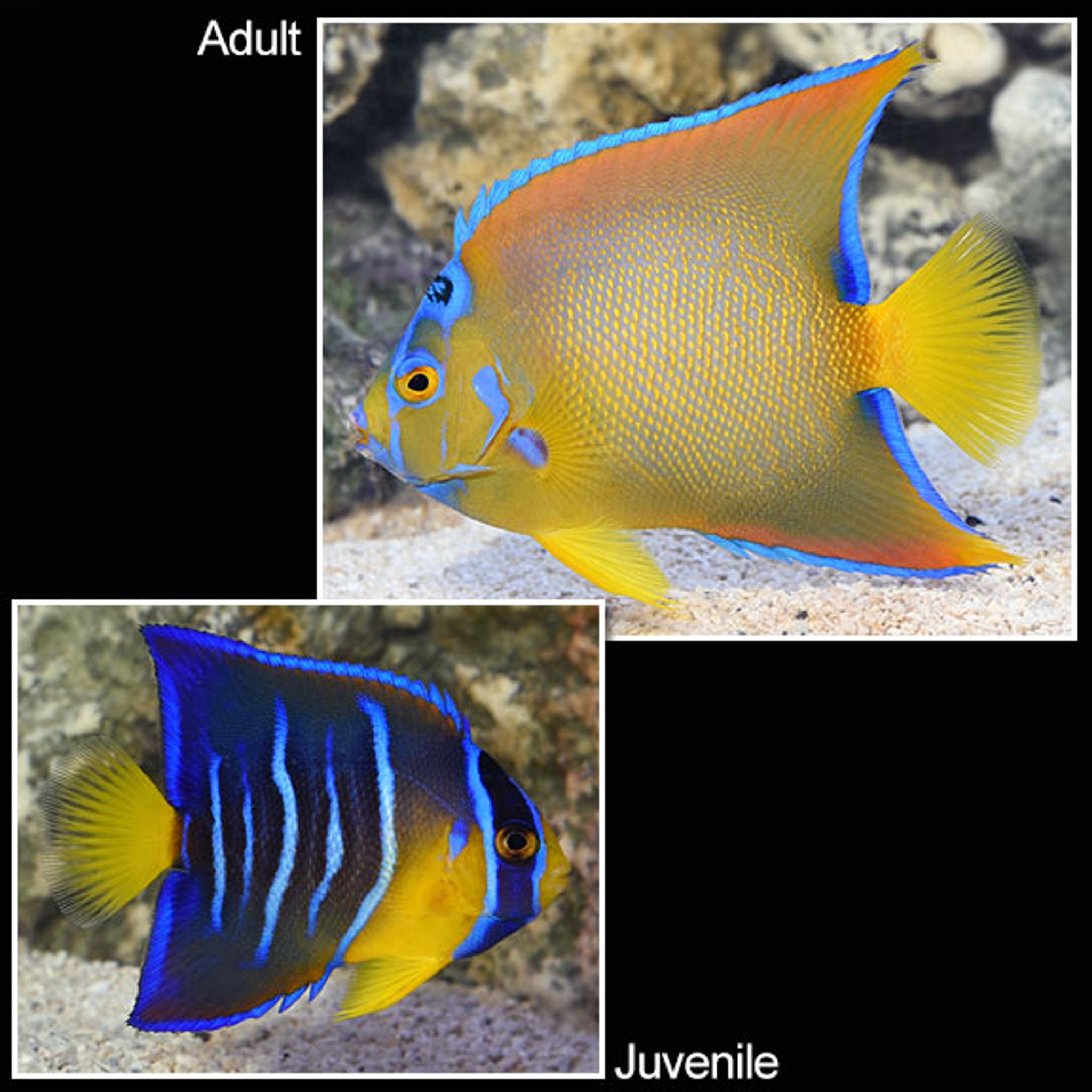
Juvenile vs. Adult Coloration
Many buyers pick up a juvenile without realizing how much it will change:
- Juveniles: dark blue body with vertical white and yellow bars, plus concentric circle patterns near the tail.
- Adults: transform gradually into a yellow-blue body pattern with a distinctive dark "crown" spot on the forehead.
This color change is a normal part of maturation, not a sign of illness or stress — it happens gradually as the fish grows, not overnight.
Tank Size Requirements
This is where sources disagree most, so here is a practical breakdown rather than a single vague number.
| Life stage | Minimum tank size | Notes |
|---|---|---|
| Juvenile grow-out | 180 gallons (680 L) | Absolute starting point only; plan to upgrade |
| Sub-adult/adult (long-term) | 250 gallons (950 L) | Practical consensus minimum for one fish |
| Preferred long-term | 300–400+ gallons (1,135–1,510+ L) | Better swimming room, more stable water quality |
Some sources cite 200 gallons as workable for a single specimen, but 250 gallons is the more realistic minimum once the fish is fully grown — queen angelfish are strong, active swimmers that need open water, not just rockwork to hide in. Buying a cute 3-inch juvenile for a 75-gallon tank without a clear upgrade plan is one of the most common mistakes in this hobby, and it routinely ends in stunted growth, stress, or the fish being rehomed. A reasonable transition plan is to start juveniles under about 4 inches in a 180-gallon system, then move to a 250-gallon or larger tank well before the fish reaches 8–10 inches, since growth accelerates once the fish settles in and feeds well.
Water Parameters
Queen angelfish are not fussy about a wide range, but they punish instability:
| Parameter | Target range |
|---|---|
| Temperature | 72–78°F (22–26°C) |
| Specific gravity/salinity | 1.020–1.025 |
| pH | 8.1–8.4 |
| dKH | 8–12 |
| Ammonia/nitrite | 0 ppm |
| Nitrate | Under 20 ppm |
Juveniles can tolerate transient temperatures up to around 82°F (28°C), but 72–78°F should be the steady-state target for the display tank. Consistency matters more than chasing the exact midpoint of any range.
Aquascape and Filtration
Queen angelfish need extensive live rock with large caves and overhangs for security, but also generous open swimming space — they are not fish that sit tucked in a crevice all day. Filtration needs to be oversized relative to the tank's rated capacity, since a single adult queen angel produces meaningfully more bioload than a mixed reef community stocked at the same gallon count. A mature, well-cycled tank of at least six months is strongly recommended before introduction; a robust protein skimmer and strong biological filtration are standard for a fish of this size and appetite.
Diet
In the wild, queen angelfish feed primarily on sponges and algae, and that natural diet drives everything about feeding them in captivity. A captive diet should include:
- Prepared angelfish foods that specifically contain sponge material (not just generic marine flake or pellet)
- Mysis shrimp, krill, clam, and squid
- Chopped seafood
- Marine algae, nori, and spirulina
- Blanched vegetables
Feed 2–3 small meals per day rather than one large feeding — this mimics natural grazing behavior and reduces waste spikes. A gel food formulated for large marine angelfish is a convenient way to combine sponge, algae, and protein in one preparation.
HLLE: The Diet-Linked Ailment to Watch For
Head and lateral line erosion (HLLE) is a well-known problem in large angelfish, and it's directly tied to diet quality and water stability rather than being a random disease. Feeding only flake or pellet food without sponge-based angelfish formulas is a common contributing factor. Sponge-inclusive foods and consistently stable parameters are the two biggest preventive measures.
Is a Queen Angelfish Reef Safe?
No. Queen angelfish are not reef safe and should be kept in fish-only or FOWLR (fish-only-with-live-rock) systems only. Even a well-fed queen angel will eventually sample:
- LPS and soft corals
- Zoanthids
- Clam mantles
- Anemones
- Tube worms and other sessile invertebrates
A common buyer assumption is that "hardy" or "adaptable" means "reef compatible" — it doesn't. Among Caribbean angelfish, the pygmy and dwarf angel group is the only truly reef-safe category; larger species like the queen, French, gray, and blue angelfish all belong in fish-only or FOWLR setups, not mixed reef displays. Anyone assembling a reef aquarium should browse marine invertebrates with this restriction in mind before adding a large angel to the stock list.
Temperament and Compatibility
Queen angelfish are semi-aggressive to aggressive and become increasingly territorial and dominant as they mature, though juveniles are noticeably calmer than adults. Key compatibility rules:
- Keep only one large angelfish per system — they attack their own kind and lookalike species on sight.
- Good tankmates include other large, robust fish: tangs, large wrasses, groupers, snappers, triggerfish, and rabbitfish.
- Avoid small, passive, or slow-swimming fish, and avoid other angelfish species entirely.
- Add the queen angel last, after territories among other tankmates are established — or early only in a brand-new, very large setup where no territory has formed yet.
Adding a second large angelfish of any species to an established tank is a near-guaranteed fight. Timing also matters in the other direction: dropping a queen angel into a tank where another fish has already claimed the entire aquascape as its territory can trigger the same aggression problem in reverse.
How Queen Angelfish Compare to Other Large Angels
Choosing between large angelfish species is difficult because most care sheets cover them one at a time. Here's a direct comparison:
| Species | Max size | Tank minimum | Reef safe? | Difficulty | Temperament |
|---|---|---|---|---|---|
| Queen angelfish | ~18 in | 250 gal | No | Moderate-difficult (husbandry) | Semi-aggressive to aggressive |
| French angelfish | ~15 in | 250 gal | No (adults) | Moderate | Semi-aggressive |
| Regal angelfish | ~9 in | 125–180 gal | Somewhat tolerant, still risky | Difficult (acclimation) | Shy, reclusive |
| Lamarck's angelfish | ~9 in | 125+ gal | Yes, rarely nips | Moderate | Peaceful |
| Goldflake angelfish | ~10 in | 200+ gal | No | Expert (wild) / Moderate (captive-bred) | Generally peaceful |
Regal Angelfish
Smaller and Indo-Pacific/Red Sea native, regal angelfish need only 125–180 gallons but are shy, slow to acclimate, and can be difficult feeders early on. They're considered one of the more reef-tolerant large angels, though they may still nip LPS, soft corals, and clam mantles — "tolerant" is not the same as "safe."
Goldflake Angelfish
A Western Pacific deep-reef species from areas like Fiji, Samoa, and the Cook Islands. Wild-caught individuals are expert-only fish that start out shy and can be slow to settle; captive-bred goldflake angels are considerably more accessible to intermediate keepers. Generally peaceful for a large angel, but still needs to be the only large angelfish in anything under about 200 gallons.
Lamarck's Angelfish
The genuine exception on this list: Lamarck's angelfish rarely nips corals or clam mantles, making it a realistic reef-safe alternative for keepers who want a large angel's look without giving up a reef display. It swims mid-water rather than hugging rock, stays peaceful, needs only 125+ gallons, and tops out around 9 inches — a moderate care level overall.
French Angelfish
Pomacanthus paru shares the queen angelfish's Western Atlantic/Caribbean range and similar 250-gallon minimum and water parameters. It's semi-aggressive toward other angelfish, not reef safe as an adult (juveniles are more tolerant), and forms monogamous pairs in the wild. One notable difference: French angelfish typically live 10–12 years, meaningfully shorter than the queen angelfish's 15–20+ year lifespan.
Caribbean Biotope Context
Queen and blue angelfish are flagship species for a Caribbean-style FOWLR biotope tank, often paired with other regional fish. If reef compatibility is the priority instead, remember that pygmy and dwarf angels are the only Caribbean angel group considered truly reef-safe — the larger species (queen, French, gray, blue) all need fish-only or FOWLR housing.
Stocking Order: A General Rule of Thumb
Beyond just queen angelfish, this sequencing rule applies broadly to large angel keeping: shy or reef-cautious species like the regal angelfish should go in early to establish their own territory before more assertive tankmates arrive, while dominant, assertive species like the queen angelfish should go in last or near-last, after other fish have already settled their territories. Adding an assertive angel too early lets it claim the entire tank as its domain before anything else has a chance.
Sourcing and Quarantine
Queen angelfish are not commonly captive-bred, unlike some Pacific angelfish species, so most available specimens are wild-collected from Caribbean reef systems — worth keeping in mind from a sustainability standpoint when comparing species. Large marine angelfish are also known to be prone to ich and marine velvet during and after transit, so a 4–6 week quarantine period is standard practice before introducing any large angel to a display tank, with close observation for early signs of parasitic disease.
Common Mistakes to Avoid
- Buying a juvenile for a small tank with no upgrade plan for the 18-inch adult it becomes.
- Feeding only flake or pellet food instead of sponge-based angelfish preparations, inviting HLLE.
- Adding a second large angelfish species to the same system.
- Getting the introduction order wrong — too early before territories form, or too late into an already-dominant tank.
- Assuming a hardy, adaptable fish is automatically reef-safe.
- Skipping quarantine on a species known to be susceptible to ich and marine velvet.
- Underestimating filtration and skimming needs relative to the tank's overall bioload.
Frequently Asked Questions
What size tank does a queen angelfish need?
A minimum of 250 gallons for a full-grown adult, with 300–400+ gallons preferred for long-term health and swimming room. Juveniles can start in a 180-gallon system, but that's a temporary starting point that requires upgrading as the fish grows.
Are queen angelfish reef safe?
No. They eat soft corals, LPS, clam mantles, and other sessile invertebrates, so they belong in fish-only or FOWLR systems rather than mixed reef displays.
What do queen angelfish eat?
An omnivorous diet built around sponge-containing angelfish preparations, plus mysis shrimp, krill, clam, squid, marine algae, nori, and spirulina. Feed 2–3 modest meals daily rather than one large feeding.
Can you keep two angelfish together?
Generally no — keep only one large angelfish species per tank in most home setups. They are territorial toward their own kind and toward similar-looking angelfish species.
How long do queen angelfish live?
15–20+ years or more with stable water quality and a varied, sponge-inclusive diet, making them one of the longer-lived marine aquarium fish.
Why did my queen angelfish's color change?
That's the normal juvenile-to-adult transformation, shifting gradually from dark blue with white and yellow bars to the yellow-blue adult pattern with a crown-shaped spot on the forehead. It's not a sign of stress or illness.
Is a queen angelfish a good beginner fish?
Not recommended. Success depends far more on tank size, water stability, and dietary variety than on general hardiness, making it a better fit for keepers with prior marine experience.
What's a reef-safe alternative to the queen angelfish?
Lamarck's angelfish is one of the few large angels considered genuinely reef-compatible, rarely nipping corals or clams. The regal angelfish is comparatively more reef-tolerant than a queen angel but still carries some risk to sessile invertebrates.
Ready to plan a Caribbean-style FOWLR build or compare large angelfish options side by side? Browse the full range of marine fish on FishyHub to see current availability.


