
Platy Care Guide: Tank Size, Diet, Water Parameters and Temperament
Platies do best in a cycled tank of at least 10 gallons (38 L), with water at 72–76°F (22–24°C), a pH of 7.0–8.2, and two small meals a day of a plant-heavy diet. They are peaceful, colorful and hardy, and they suit the hard, alkaline tap water found in much of the US. Buy a male and a female and you will get fry, so this guide covers breeding as well.
Platy Quick Stats
| Trait | Recommendation |
|---|---|
| Species | Southern platy (Xiphophorus maculatus), variatus platy (X. variatus), and hybrids |
| Adult size | 2–2.5 in (5–6.5 cm); females up to ~3 in (7.5 cm), males ~1.5–2 in (4–5 cm) |
| Lifespan | Usually about 3 years (range 2–5) |
| Minimum tank | 10 gal (38 L) for 3–5 fish; 20 gal (76 L) if you are raising fry |
| Temperature | 72–76°F (22–24°C) ideal; 70–78°F (21–26°C) acceptable |
| pH | 7.0–8.2 (tolerates 6.8–8.5) |
| Hardness | GH 10–25 dGH (~180–450 ppm); KH 4 dKH (~70 ppm) or higher |
| Diet | Omnivore, leans toward plant matter |
| Temperament | Peaceful, active, mid-to-top swimmer |
| Group | 3–6 or more; about 1 male to 3 females |
Where Platies Come From
There are two platy species in the hobby: the southern platy (X. maculatus) and the variatus platy (X. variatus). Most fish sold in stores are hybrids of the two, and some have swordtail genes as well. In the wild they live in Mexico, Guatemala and Belize, in slow, weedy water with plenty of dissolved minerals. That background is why they like hard, alkaline water.
Wild platies are fairly drab. The bright colors in stores all come from selective breeding. Hybrids vary in hardiness because different lines were bred for looks rather than toughness. When you choose fish, look for active swimmers with full bodies, open fins, clear eyes and no white spots or frayed edges. Pass on any tank that has dead or gasping fish in it.
Types of Platy
Platy varieties are sorted by three traits:
- Color: red, blue, yellow, orange, black and more.
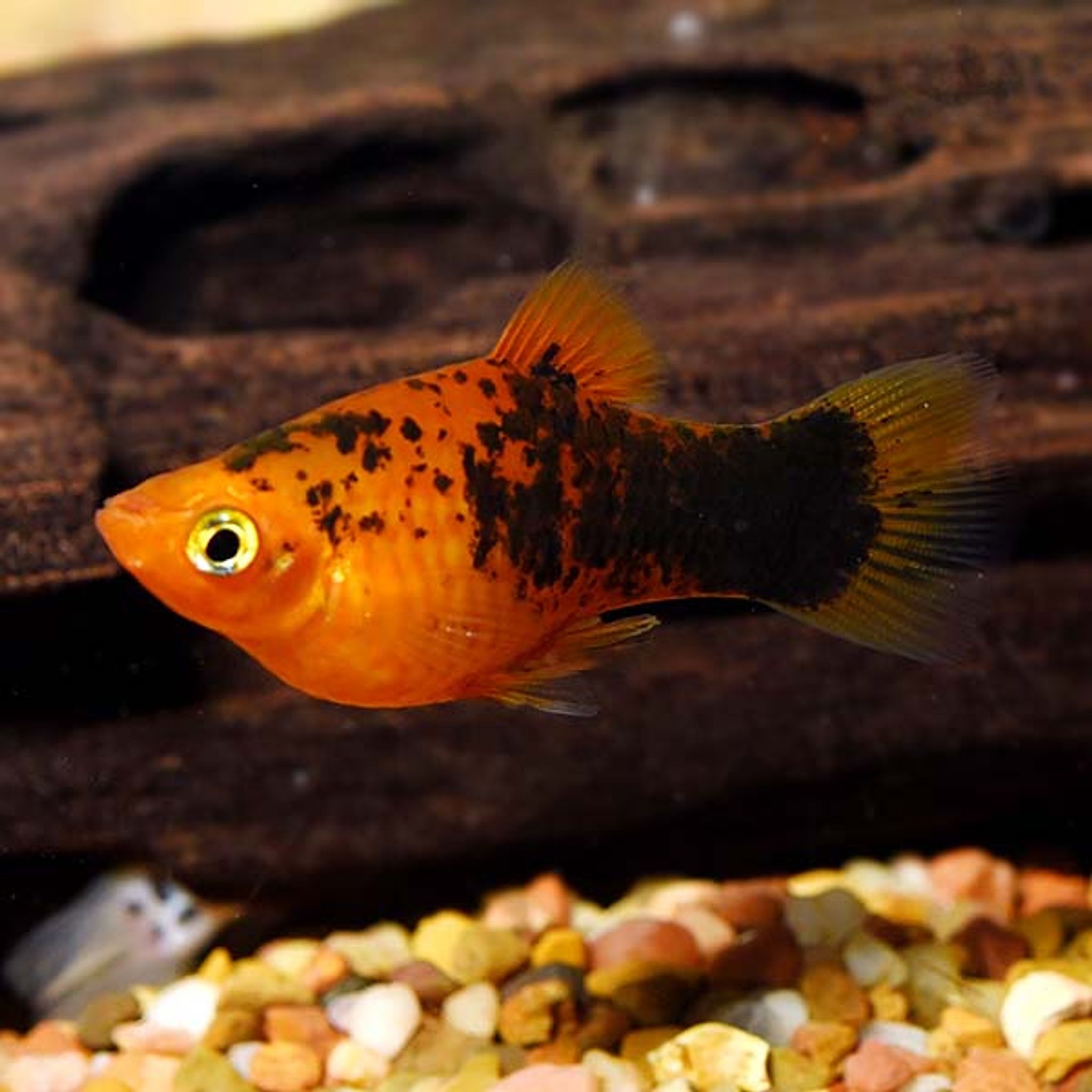
- Pattern: wagtail (any body color with black fins), Mickey Mouse (a tail-base spot shaped like mouse ears), tuxedo (a dark rear half), calico (red, white and black mottling), salt and pepper, and dalmatian.
- Fins: standard, hi-fin (a tall dorsal fin) and pintail (a pointed extension on the tail).
Names combine these traits. A sunset wagtail is yellow-orange with black fins, a red wagtail is red with black fins, and a red-white calico has red and white mottling with black flecks.
Tank Size and Setup
Sources disagree on whether the minimum is 10 or 15 gallons. A 10-gallon (38 L) tank works for 3–5 adults. If you plan to keep fry, which most platy owners end up doing, start with a 20-gallon (76 L) tank. A long footprint gives more swimming room than a tall one. Use a lid, because active livebearers sometimes jump.
Equipment Checklist
- Filter: A sponge filter, or a hang-on filter with a sponge over the intake, keeps fry from being pulled in. You can browse aquarium filters on FishyHub.
- Heater: An adjustable heater sized for your tank.
- Lighting: A standard LED is enough.
- Substrate: Sand or fine gravel.
- Plants: Stem plants, mosses and floating plants provide grazing surfaces and cover for fry.
Cycle the tank before you add fish. Ammonia and nitrite should read 0, and nitrate should be present, before any platies go in.
Do Platies Need a Heater?
Most US homes need one, especially in winter. What platies need most is stability. A tank that drops overnight when the thermostat is turned down stresses them more than one that is a degree or two cool all the time. Only variatus platies kept in a consistently warm room can safely go without a heater.
Adjust for the season. In winter, set the heater to hold 72–74°F (22–23°C) so it is covering the cold nights. In summer, if the air conditioning keeps the room in the low 70s, the heater may barely switch on, which is fine. If the room goes without cooling during a heat wave, watch for water climbing above 80°F (27°C).
Water Parameters
Temperature recommendations range from 65–82°F across sources, and one source recommends 68–75°F. A target of 72–76°F (22–24°C) is safe for both species. Variatus platies handle the high 60s°F (about 20°C). Avoid keeping any platy above 80°F (27°C) for long.
| Parameter | Target |
|---|---|
| Temperature | 72–76°F (22–24°C) |
| pH | 7.0–8.2 |
| GH | 10–25 dGH (~180–450 ppm) |
| KH | 4 dKH (~70 ppm) or more |
| Ammonia / nitrite | 0 ppm |
| Nitrate | Under 20–40 ppm |
| Water changes | 25–30% weekly |
US Tap Water Notes
Look up your utility's annual water quality report. It usually lists hardness in ppm or mg/L (these are the same unit), and 1 dGH is about 17.9 ppm. Much of the country supplies moderately hard to very hard water, which suits platies well.
Many US utilities disinfect with chloramine rather than chlorine, so use a dechlorinator that says it neutralizes chloramine. If your water is soft, or you use RO or softened water, raise hardness with a GH/KH buffer or a bag of crushed coral in the filter. Platies kept in soft, acidic water often start shimmying (wobbling in place) and clamp their fins.
Diet and Feeding
Platies are omnivores that lean toward plant food. A good menu looks like this:
- Staple: a spirulina or vegetable-based flake or micro-pellet.
- Protein several times a week: frozen brine shrimp, daphnia or bloodworms.
- Vegetables: blanched zucchini, peas (skins removed) or spinach.
- Grazing: they pick at soft algae on glass, rocks and plants.
Sources recommend anything from one feeding a day to three. Two small meals a day is a good middle ground for adults. Offer only what they finish in about 2 minutes. Juveniles need 3–4 smaller meals a day. Platies beg constantly, and overfeeding is one of the most common ways to foul a small tank. You can browse flakes, pellets and freeze-dried foods in Food & Supplements.
Temperament and Tankmates
Platies are peaceful and active. They spend most of their time in the middle and upper parts of the tank and shoal loosely. Males chase females constantly and may spar with each other, but they rarely do real damage in a properly stocked tank.
Group Size and Sex Ratio
Keep at least 3–6. Recommended ratios range from 1:2 to 1:3 males to females, and 1:3 spreads the chasing more evenly. An all-male group is a good choice if you don't want fry.
To sex them, look at the anal fin. Males have a gonopodium, a rod-shaped anal fin. Females have a fan-shaped anal fin and a rounder, larger body.
Compatible and Incompatible Tankmates
| Good matches | Avoid |
|---|---|
| Other livebearers (guppies, mollies, swordtails) | Most cichlids |
| Small tetras and rasboras | Tiger barbs and other fin-nippers, especially with hi-fin platies |
| Danios | Large predatory fish |
| Corydoras and bristlenose plecos | Bettas: depends on the individual |
| Dwarf gourami | |
| Snails and adult shrimp |
Keep in mind that platies will cross with swordtails, and southern platies will cross with variatus. If you want pure lines, keep only one of them.
Breeding Platies
Platies are livebearers. They don't lay eggs, and their fry are born free-swimming. Females store sperm, so one female can drop several broods without a male in the tank. Gestation takes about 24–30 days, and anywhere from 21 to 37 days depending on temperature. Broods usually number 20–50 fry, with occasional broods up to about 80. Young, small females drop fewer. Adults eat fry, so cover is what decides how many survive.
Breeding for Beginners
Platies are a good first breeding project. They are prolific, and the fry are big enough to eat crushed flake on day one. Plan for the surplus before it arrives. Set up a grow-out tank, or ask a local store whether it takes trade-ins.
Setting Up a Breeding Tank and Choosing a Trio
- Tank: 10–20 gal (38–76 L) with a sponge filter.
- Temperature: 76–78°F (24–26°C).
- Cover: Dense plants and floaters.
- Bottom: Bare, or a thin layer of sand, which makes cleaning easier.
- Trio: One male and two females, all healthy, full-bodied and with clean fins. Stick to one variety so the colors breed true.
Signs a Platy Is Pregnant
A pregnant female gets a boxy, squared-off belly and a darkening gravid spot near the vent. Shortly before giving birth she may hide and eat less. Move her to a planted tank instead of a cramped breeder box, which can stress her. If her swelling lasts well past a month, or her scales start to stick out, suspect bloat or dropsy rather than pregnancy.
Raising Fry
- Feed powdered flake, baby brine shrimp or microworms 3–5 times a day.
- Do small, frequent water changes, because fry are sensitive to waste buildup.
- You can tell the sexes apart at about 6–8 weeks. Separate them early to avoid inbreeding and unplanned broods.
- Fry reach adult size in about 3–4 months.
Health and Troubleshooting
Common Diseases
Watch for ich (white spots), fin rot, velvet (a gold dust coating), columnaris (cottony patches), internal parasites (thinning despite eating well) and swim bladder problems. Quarantine new fish for 2–4 weeks before adding them to your main tank, and acclimate slowly. Many new-fish losses come from skipping these two steps.
Why Platies Keep Dying
The usual causes are:
- An uncycled tank with ammonia or nitrite present.
- Soft or acidic water, or pH swings.
- No quarantine, so disease reaches the whole tank.
- Overfeeding, which leads to waste spikes.
- Too many males, which leaves females stressed and hiding.
If fry keep disappearing, the tank needs more plants or floaters.
Surviving Power Outages and Filter Failures
Platies can get through a few hours without a running filter. For outages that last longer, such as during storms or winter freezes:
- Run a battery-powered air pump.
- Stop feeding until the power is back.
- Wrap the tank in blankets or foam board to hold the heat.
- Test for ammonia after the power returns, because the filter bacteria may have died back.
Lifespan and Fun Facts
Most platies live around 3 years, and some reach 5. Scientists have used Xiphophorus fish to study cancer genetics for decades. Remember the sperm storage, too: a new female may give birth weeks after you bring her home, even if she's the only platy in your tank.
Never release platies or fry into local waterways. Releasing aquarium fish is illegal in many places and harms native wildlife, and feral platy populations are already established in some US states.
Frequently Asked Questions
How many platies can I keep in a 10-gallon tank?
Three to five adults is a sensible limit. Keep mostly females with a single male, or keep all males if you don't want fry. If you end up raising babies, you will need a 20-gallon tank or a separate grow-out tank.
Can platies live with guppies, mollies or bettas?
Guppies, mollies and swordtails are good tankmates, since they want similar water. Bettas depend on the individual: some ignore platies, while others chase or nip. Keep a backup tank ready if you try the pairing.
How can I tell if my platy is pregnant, and how long does it take?
Look for a boxy belly and a dark gravid spot near the vent. Gestation takes about four weeks. Because females store sperm, she can drop another brood about a month later without any male in the tank.
Can platies live outdoors in a pond?
Yes, in summer, once the water stays above about 65°F (18°C) day and night. Bring them back inside before fall temperatures drop. Make sure the pond can't overflow into local waterways.
Why is my platy hiding or sitting on the bottom?
Test ammonia, nitrite, nitrate and pH first. Then check whether males are harassing her, whether she is about to give birth, and whether she shows signs of illness such as clamped fins, white spots or labored breathing.
Will platies eat my shrimp or plants?
Adult shrimp are safe, but platies will eat shrimplets. They graze on algae growing on plants but generally don't eat healthy plants. If you have fry you don't want, give them to a store or another hobbyist, or raise them. Never release them.
Find Your Next Platies
Platies are one of the easiest colorful fish to keep well. Give them hard water, a steady temperature, a plant-heavy diet and a sensible sex ratio, and they will thrive. When your tank is cycled and ready, browse platies on FishyHub to pick your first group.


